
The cost of getting a single customer to visit your digital shop has reached an all-time high in 2026. If you're tired of seeing your margins eaten by expensive ads and technical glitches, you aren't alone. Most UK small businesses are currently weighing up the benefits of selling on a marketplace vs own website to find a more sustainable path to profit. It's a tough choice between the instant visibility of an established platform and the total control of your own domain. You want lower acquisition costs and a logistics setup that doesn't keep you up at night.
We understand that every penny counts whilst you're trying to scale your enterprise. This guide will show you how to choose the right model for your specific growth stage. You'll discover whether a marketplace or an independent store is the right move for your business growth and how to balance reach with brand control. We'll compare fees, technical demands, and customer access to help you build a strategy that actually delivers results. From simplified logistics to better visibility, here is everything you need to know about the 2026 retail landscape.
Key Takeaways
- Leverage instant access to active shoppers and built-in transactional security to bypass the high initial costs of customer acquisition.
- Identify the specific benefits of selling on a marketplace vs own website to determine if your budget is better spent on stock or web development.
- Evaluate the hidden costs of independence, including the technical maintenance and marketing spend required to drive traffic to a standalone site.
- Learn how to maintain creative control and own your customer data whilst still reaching a national audience.
- Discover how platforms like Anglia Market empower British independent vendors by providing a community-focused space for sustainable growth.
The Digital Storefront Dilemma: Marketplace vs Own Website
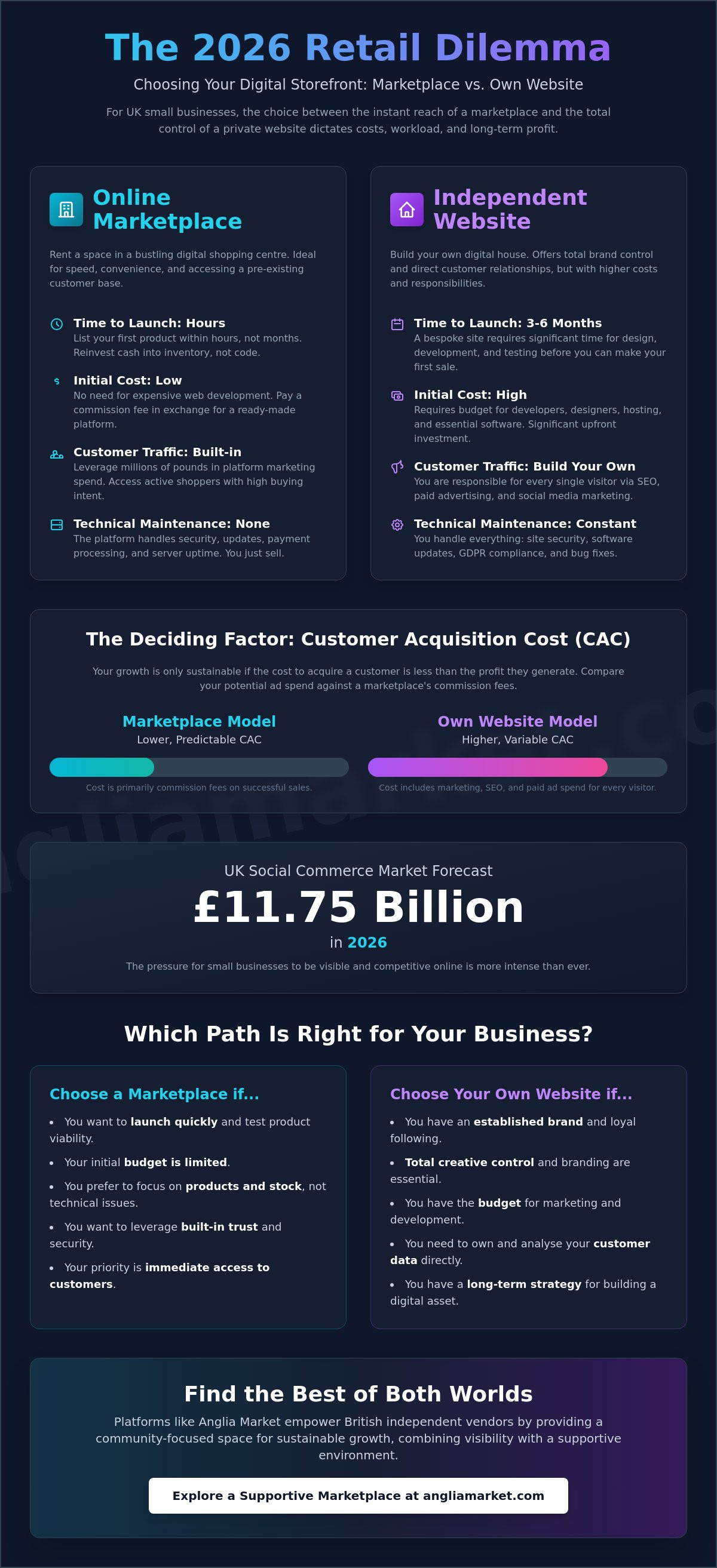
Choosing where to list your products is the most significant commercial decision you'll make this year. For UK SMEs, the current market is more competitive than ever. With UK social commerce sales forecast to reach £11.75 billion in 2026, the pressure to be visible is intense. You have to decide if you want to build your own digital house or rent a space in a busy shopping centre. This choice dictates your daily workload and your long-term profit margins. It's a balance between total independence and instant accessibility.
One of the primary benefits of selling on a marketplace vs own website is the immediate reduction in operational complexity. On a marketplace, the infrastructure is already built. On your own site, you're the architect, the builder, and the security guard. This directly impacts your marketing budget. When you own the site, you pay for every single visitor through SEO or paid ads. On a marketplace, shoppers are already there, browsing for deals. You trade a commission fee for the luxury of a pre-existing audience.
Customer Acquisition Cost (CAC) is the metric that should drive your decision. If your CAC on a standalone site is higher than the commission fees on a platform, your growth isn't sustainable. Many businesses find that the benefits of selling on a marketplace vs own website include a lower barrier to entry and faster cash flow. You can start selling in days rather than months. This allows you to focus on sourcing quality stock rather than fixing broken code or managing server uptimes.
What is an Online Marketplace?
An Online marketplace functions as a digital department store. It's a multi-vendor platform where the provider handles the technical heavy lifting, payment processing, and site maintenance. British consumers love the "one-stop-shop" experience because they can buy everything from electronics to home and garden supplies in one transaction. Platforms like Anglia Market act as a central hub, connecting local independent vendors with a national audience. It's an efficient way to sell online without needing a degree in web development.
What is an Independent E-commerce Website?
Owning an independent website means you control the entire domain. You use platforms like Shopify or Wix to create a bespoke storefront. This gives you full creative freedom. You decide the layout, the colours, and the checkout flow. However, this independence comes with heavy responsibilities. You're responsible for site security, software updates, and strict GDPR compliance. While there's a shift towards brand-first shopping experiences, you must have the technical skill or the budget to keep the lights on. It's a high-maintenance path that requires constant attention to keep traffic flowing.
The Immediate Benefits of Selling on a Marketplace
Launching a digital storefront usually involves a long, expensive road of development and design. When you weigh up the benefits of selling on a marketplace vs own website, the most obvious advantage is speed. A bespoke website can take three to six months to build and test. In contrast, you can list your first product on a marketplace within hours. This low initial capital expenditure allows you to reinvest your cash into inventory rather than code.
Security is another critical factor for British shoppers. Customers often hesitate to enter credit card details on an unknown website. Marketplaces provide built-in trust and transactional security that encourages first-time buyers to complete their purchase. This established reputation acts as a safety net for your brand. Experts discussing the future of online marketplaces suggest that this intermediary trust is what keeps consumers returning to these platforms year after year.
The Power of Built-in Traffic
Marketplaces invest millions of pounds into SEO and pay-per-click advertising to ensure they dominate search results. When you join a platform, you're essentially piggybacking on their marketing budget. You don't need to be an expert in keyword research to get noticed. The "Search Intent" on these platforms is incredibly high; users aren't just browsing for information, they are ready to buy. This is particularly beneficial for niche categories. Sellers of pet supplies or furniture benefit from category-wide traffic that they would struggle to generate on a standalone site. It's about being where the crowd already is.
Reduced Operational Friction
Running a website requires constant technical maintenance. You have to manage payment gateways, ensure mobile optimisation, and handle server security. On a marketplace, the platform handles all the heavy lifting. Listings are pre-formatted, ensuring your products look professional on any device. This structured data makes it easier for search engines to index your items. The process of becoming a vendor is designed to be as frictionless as possible. You can focus on fulfilment and customer service whilst the platform manages the technical infrastructure. If you're ready to scale without the headache of web design, you might want to look at how other vendors are finding success.
Own Website: Brand Control vs The Hidden Costs of Independence
Building your own site gives you total control over the user experience. You pick every colour and button. You decide exactly how your story is told. But this freedom comes with a price tag that many SMEs overlook during the initial planning phase. When you weigh up the benefits of selling on a marketplace vs own website, you have to consider the marketing isolation of a standalone site. You aren't just building a shop; you're building an island. Without a massive bridge of paid traffic, no one will ever find it.
Owning your customer data is the biggest win for an independent site. You can build an email list and market directly to your fans without a middleman. This is a vital factor in your ecommerce platform choice. However, the overheads add up fast. You'll need to pay for SSL certificates to keep transactions safe, high-performance hosting, and monthly app subscriptions. These "hidden" costs can easily exceed several hundred pounds a month before you've even sold a single item.
The Reality of Customer Acquisition
A new domain starts with zero authority in the eyes of search engines. You don't have the years of backlink building that established platforms possess. To get any visitors, you'll likely need to spend heavily on Google Ads or social media marketing. In 2026, the cost per click is higher than ever. Contrast this with the immediate visibility of a marketplace storefront. On a marketplace, you benefit from the platform's established domain authority from day one. You don't have to pay for every single pair of eyes on your products because the traffic is already there, browsing the categories.
Technical Maintenance and Security
Cyber-attacks are a constant threat to independent UK SMEs. Protecting your site requires firewalls, regular security audits, and strict data protection protocols. If a plugin breaks or a theme update crashes your checkout, you're the one who has to fix it. This technical debt takes time away from your core business. A marketplace is "hands-off" regarding these technicalities. The platform manages the security patches, updates, and payment gateway compliance. This allows you to focus on your products whilst the platform handles the digital heavy lifting. It's a trade-off between the total freedom of an independent site and the operational peace of mind found on a marketplace.
Decision Framework: Which Path Should Your Business Take?
Don't treat this as a binary choice. Many successful UK SMEs run a multi-channel strategy that evolves as they grow. It's about matching your platform to your current operational maturity. If you're a startup with limited capital, your priorities differ from an established brand with a £90,000 turnover approaching the UK VAT threshold. You need to decide whether your resources are better spent on stock or on a web designer. For most merchants, the answer is stock.
You also need to assess your technical appetite. If you're a merchant first and a coder second, the benefits of selling on a marketplace vs own website include avoiding the constant stress of site maintenance and security updates. Understanding the benefits of selling on a marketplace vs own website helps you allocate resources where they'll actually drive growth. Time-to-market is equally vital. If you have seasonal goods, waiting six months for a bespoke site build means missing your window. Marketplaces allow you to test product-market fit instantly.
Product type also plays a role. Does your item benefit from being amongst a wider range of goods? A shopper looking for home and garden supplies might discover your niche handmade pots purely by proximity. This "discovery" traffic is hard to replicate on a standalone site without a massive advertising spend.
When to Start with a Marketplace
Starting on a marketplace is the ideal move for SMEs looking to test the waters without heavy upfront investment. It's the best route if you want to focus entirely on product quality and customer service rather than digital marketing. You gain immediate access to a UK-wide audience without needing to understand complex SEO strategies. This path is perfect for:
- Testing new product lines with minimal financial risk.
- Businesses with limited technical staff or coding knowledge.
- Sellers who need reliable, pre-built payment and checkout infrastructure.
If you want to get your products in front of buyers today, you can apply to sell online with a platform that handles the technical heavy lifting for you.
When to Transition to Your Own Site
Moving to a standalone site is a logical step once you've built a loyal customer base. If your repeat purchase rates are high, you have a community that will seek you out directly. This transition is necessary when your brand requires a highly bespoke visual identity that a template cannot provide. It also makes sense for high-volume sellers who want to reduce commission percentages on their most popular items. However, even at this stage, most brands keep their marketplace presence to maintain a "discovery" funnel and reach new customers whilst their own site handles loyal fans.
Ready to see how other independent UK brands are growing? Explore our vendor community to find inspiration for your own business strategy.
Anglia Market: Supporting UK SMEs with the Best of Both Worlds
Choosing a platform that understands the specific needs of the British high street is essential for long-term success. Anglia Market is built specifically to empower independent UK businesses, providing a curated space where local quality meets national demand. When you evaluate the benefits of selling on a marketplace vs own website, the ability to join a community of like-minded vendors stands out. We handle the heavy lifting of digital visibility and technical security so you can focus on what you do best: sourcing and selling great products.
Our platform offers a low-risk entry point for merchants across diverse categories. Whether you specialise in home and garden essentials or the latest electronics, you get instant access to a pre-built audience. You don't have to worry about the marketing isolation of a new domain or the high costs of driving traffic through expensive ad campaigns. We provide the infrastructure, and you provide the inventory. This partnership allows you to enjoy the benefits of selling on a marketplace vs own website by keeping your overheads low whilst your reach remains high.
A Marketplace with a Personal Touch
Unlike global conglomerates that treat every seller as a number, we focus on the growth of small and medium-sized enterprises. We believe in regional independent commerce as a core part of the UK economy. Our customer testimonials prove that building trust through a reliable platform leads to appreciative, loyal shoppers. Being part of a curated UK-based community means your products aren't lost in a sea of low-quality imports. You're positioned alongside other professional British vendors, which elevates your brand authority from the moment you list your first item.
Ready to Scale Your Sales?
It's time to stop worrying about plugin updates and server uptimes. Our platform is designed to be a fast-paced, modular environment that moves users quickly from browsing to purchasing. We also offer a loyalty program that benefits both buyers and sellers by encouraging repeat business and rewarding customer engagement. This built-in incentive helps you grow your sales volume without the need for complex, bespoke marketing funnels on a standalone site.
If you're ready to simplify your logistics and focus on sustainable growth, we're here to facilitate your journey. You can apply to sell online today and join a platform that puts British independent businesses first. Don't let technical complexity hold your enterprise back. Join a community that values quality, reliability, and the success of UK SMEs.
Take the Next Step for Your SME
Choosing between a marketplace and a standalone site isn't a permanent decision; it's a strategic evolution for your brand. You've seen how marketplaces provide instant visibility and built-in trust whilst independent sites offer total data ownership. The real secret to sustainable growth in 2026 is matching your platform choice to your current budget and technical ability. Understanding the benefits of selling on a marketplace vs own website allows you to avoid the high costs of marketing isolation whilst you scale your operations.
We focus on empowering local vendors through a reliable, curated platform that puts British commerce first. You don't need technical expertise to launch your storefront and start reaching a national audience. Hundreds of British SMEs already trust us to handle the digital heavy lifting and payment security. This allows you to reinvest your time into what matters most: your inventory and your customers. Our UK-based support team is here to help you build a profitable presence without the technical headache.
Start selling on Anglia Market today and reach thousands of UK shoppers
Your growth journey starts with a single listing. Focus on your products and let us handle the rest.
Frequently Asked Questions
Is it better to sell on a global marketplace or my own website?
It depends on your current scale and marketing budget. Major international platforms provide a massive audience of active buyers but take a significant cut of every sale. Your own website offers total brand control and ownership of customer data, but you're responsible for every visitor that lands on your page. Most SMEs find that starting on a marketplace is the fastest way to generate cash flow whilst testing product demand.
How much does it cost to sell on a marketplace vs a standalone site?
Marketplace costs typically include a monthly subscription fee alongside referral fees ranging from 8% to 15% of the total sale. Standalone sites start with base monthly fees but require additional spend on SSL certificates, payment processing, and marketing. When comparing the benefits of selling on a marketplace vs own website, remember that marketplace fees often cover the traffic costs that you'd otherwise pay for in expensive digital ads.
Can I sell on a marketplace and have my own website at the same time?
Yes, you can operate on both channels simultaneously to maximise your reach. This hybrid model is a common strategy for UK SMEs in 2026. You use the marketplace to find new customers and use your own website to offer loyalty rewards or bespoke products to repeat buyers. It's an effective way to balance high-volume discovery with high-margin direct sales whilst diversifying your business risks across multiple platforms.
What are the main disadvantages of selling on a marketplace?
The main disadvantages include less control over the customer experience and the pressure of marketplace commission fees. You also don't own the customer relationship in the same way you do on a private domain. If a platform changes its algorithm or fee structure, your business is directly affected. This is why many vendors choose platforms that prioritise independent sellers and offer more transparent, community-focused terms that support sustainable growth.
Do I need a business licence to sell on a UK marketplace?
You don't need a specific "marketplace licence," but you must comply with standard UK business regulations. You need to register with HMRC as a sole trader or limited company once you start trading. Keep a close eye on your turnover; the VAT registration threshold for the 2025-2026 tax year is £90,000. If your taxable turnover for the last 12 months exceeds this, you must register for VAT with the government to remain compliant.
How do I drive traffic to my own e-commerce website?
Driving traffic to a standalone site requires a mix of SEO, paid search, and social media engagement. You'll need to invest in search engine marketing or social media campaigns to get your brand in front of new shoppers. Unlike a marketplace where users are already searching for products, an independent site starts with zero visitors. It takes consistent effort and a dedicated marketing budget to build a steady flow of customers to your domain.
Which platform is best for small businesses in the UK?
The best platform is often one that focuses on your specific region or niche. For British SMEs, platforms like Anglia Market are designed to support local independent commerce without the overwhelming competition of global conglomerates. These platforms provide a curated environment that appeals to shoppers looking for quality and reliability. Choosing a supportive marketplace can be the most sustainable way to grow your business whilst keeping your initial operational costs manageable.
What happens if a marketplace closes my account?
If a marketplace closes your account, you lose your primary sales channel and customer access instantly. This is the biggest risk of relying on a single third-party platform for all your revenue. To protect your business, always maintain backup records of your inventory and consider building a presence on multiple platforms. Diversifying your sales channels ensures that one account issue doesn't result in a total loss of income or the collapse of your enterprise.

Here to help — ask anything
If you have any questions regarding this disclaimer or any of our policies, please contact Anglia Market through the contact page on our website, by email using the address provided on the site, or by phone at 0333 772 2593