
What if your international orders could reach Europe just as easily as they reach Edinburgh? Dealing with international shipping from the UK post-Brexit has become a major hurdle for many independent sellers, especially with the 2026 removal of the €150 duty-free threshold. You're likely tired of parcels getting stuck at customs. You've probably heard from frustrated customers hit with surprise fees. It's a common struggle for small businesses trying to grow their reach.
This guide is your practical roadmap to mastering the newest regulations and keeping your global customers happy. You'll find a clear checklist of required documents like EORI numbers. We explain the new €3 flat duty on small parcels starting in July 2026. We provide tips for pricing your products correctly for international buyers. We'll help you use the Customs Declaration Service (CDS) with confidence. It's time to ship globally without the fear of returns or hidden costs. Get your goods moving again with ease.
Key Takeaways
- Understand the UK’s "Third Country" status and why shipping to Europe now mirrors global trade standards for independent sellers.
- Identify the exact documentation required for 2026, including your GB EORI number and specific commodity codes to prevent border delays.
- Simplify dealing with international shipping from uk post-brexit by choosing between IOSS, DAP, and DDP to manage VAT and customer costs effectively.
- Adopt digital-first operational habits like "Paperless Trade" to ensure your shipping data matches physical labels for faster clearance.
- Discover how a specialized online marketplace platform can provide the visibility and tools needed to scale your business globally.
The UK International Shipping Landscape in 2026
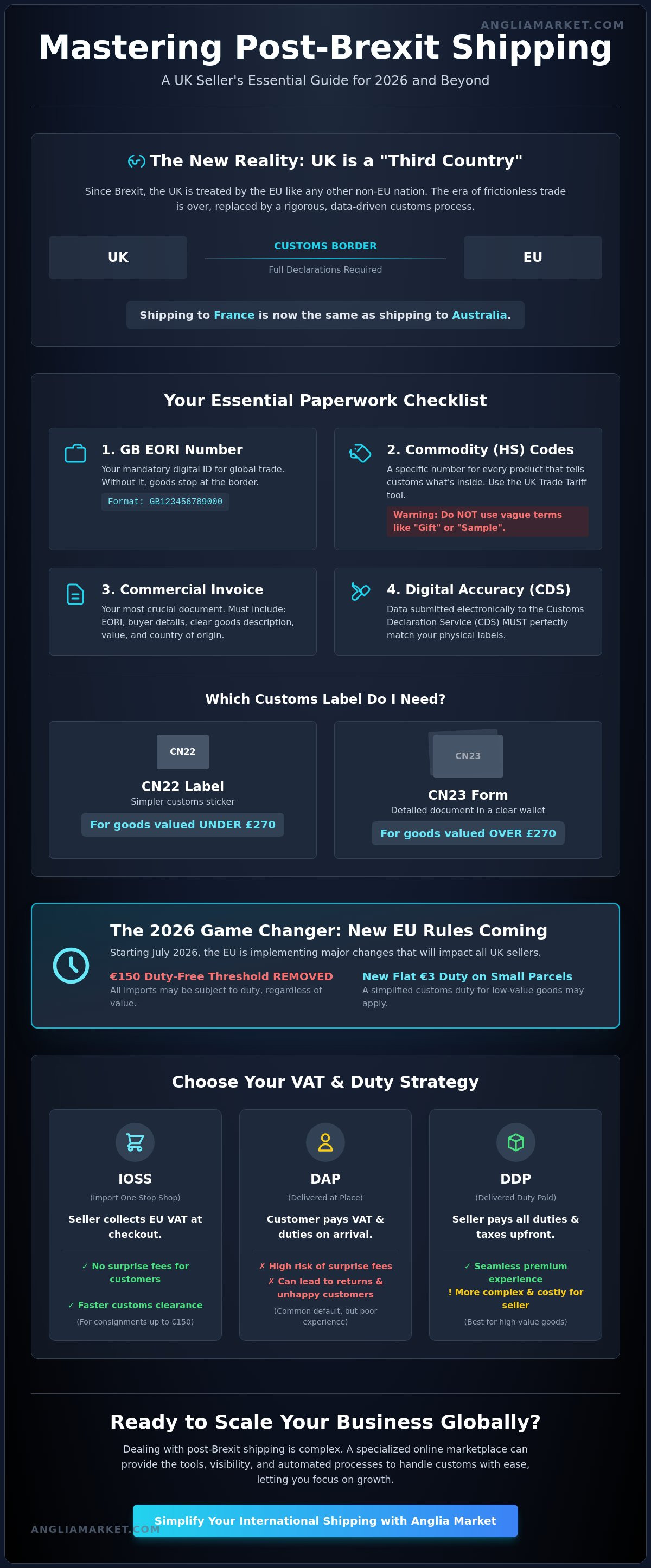
Dealing with international shipping from uk post-brexit means accepting a new legal reality. The UK is now a "Third Country" in the eyes of the European Union. This isn't just a political label. It changes everything about how your parcels move across borders. Legally, shipping a package to France is now exactly like shipping one to Australia. Both require full customs declarations, precise commodity codes, and rigorous data checks. The days of frictionless trade are gone, replaced by a digital-first system where accuracy is your best tool for speed.
The Economic effects of Brexit have fundamentally reshaped how small businesses operate. Digital systems like the Customs Declaration Service (CDS) are now the mandatory standard for all exports. Every piece of digital data must be perfect. If your electronic description doesn't match the physical item in the box, the parcel stops at the border. This focus on data accuracy is part of the EU's Import Control System 2 (ICS2). It's designed to streamline security, but it places the burden of proof on you, the seller. Mastering this process is how UK independent vendors stay relevant in a global market.
The Shift from Domestic to International Mindset
Small businesses once viewed the EU as an extension of the UK domestic market. That era has ended. Today, "international" starts at the English Channel. Adapting to this shift is vital for any brand wanting to grow in 2026. Dealing with international shipping from uk post-brexit requires moving away from casual posting toward professional logistics. You must treat every European order with the same care as a shipment to the USA. Online marketplaces play a critical role here. They provide the necessary structure to handle complex tax and customs requirements, allowing you to focus on your products instead of paperwork.
Benefits of Expanding Beyond UK Borders
You might wonder if the extra paperwork is worth the effort. The answer is scale. The EU offers a market of 450 million potential customers. This is a massive opportunity that dwarfs the UK domestic market alone. Expanding abroad also protects your revenue. If the local economy faces a downturn, your international sales provide a vital safety net. You don't have to tackle this alone. By choosing to sell online through an established platform like Anglia Market, independent vendors can reach this vast audience efficiently. It turns a complex logistics challenge into a powerful growth engine for your business.
The Essential Paperwork: EORI, HS Codes, and Customs
Successful trade depends on the quality of your data. Dealing with international shipping from uk post-brexit is primarily a paperwork challenge. Get the forms right, and your parcels move quickly. Get them wrong, and they sit in a warehouse. You must be precise with every field on your customs declarations to avoid fines and unhappy customers.
Securing Your EORI Number
An Economic Operators Registration and Identification (EORI) number is your digital identity for global trade. It's mandatory. Without it, your goods won't clear customs. You need a GB EORI to export from the UK. Most businesses can Get a UK EORI number through the HMRC portal in minutes. Your number usually starts with "GB" followed by a 12-digit string. Once you have it, verify it immediately. A simple typo can lead to weeks of border delays.
Mastering Commodity Codes
Every product has a specific number called a Commodity or HS Code. This tells customs exactly what is in the box. Use the UK Trade Tariff tool to find the 8-digit code for exports and the 10-digit code for imports. Don't take shortcuts. Labeling items as "Gifts" or "Samples" to avoid fees is a fast track to rejection. Customs officers in 2026 use automated scanning systems that flag these vague descriptions immediately. If you use an incorrect HS code, your customer might be hit with an inflated tax bill or unexpected customs duties that ruin their shopping experience.
Your commercial invoice is your most important asset for dealing with international shipping from uk post-brexit. It must include your EORI number, the buyer's full details, a clear description of goods, the value, and the country of origin. If you sell on an online marketplace, look for tools that generate these documents automatically to save time.
Choosing the right customs label depends on the value of your shipment. Use a CN22 label for parcels valued under £270. These are typically simpler stickers. For anything valued over £270, you must use a CN23 form. This is a more detailed document that usually sits in a clear plastic wallet on the outside of the box.
Digital accuracy is key for 2026. Ensure the data on these physical labels matches your electronic Customs Declaration Service (CDS) entry perfectly. All UK export declarations must now go through the CDS system. Inconsistent data is the number one cause of parcels being held at customs. Keep your digital and physical records identical to ensure a smooth journey for every package.
Navigating VAT and Customs Duties Post-Brexit
Dealing with international shipping from uk post-brexit requires a clear strategy for taxes. If you don't manage VAT correctly, your customers pay the price. In 2026, the rules for the European Union have tightened. The previous €150 duty-free threshold is gone. Now, every item crossing the border attracts some level of duty. Understanding how to collect and pay these fees is the difference between a successful sale and a rejected parcel.
You must decide how to handle the financial side of the border crossing. Many sellers find that transparency at the checkout is the most important factor for customer retention. If a buyer is hit with an unexpected bill at their front door, they're unlikely to shop with you again. It's better to build these costs into your pricing model from the start.
The IOSS Revolution for Small Sellers
The Import One-Stop Shop (IOSS) is a vital tool for orders under €150. It lets you collect the destination country's VAT at the point of sale. This means your EU customers see the total price upfront. Starting in July 2026, a new €3 flat duty applies to these small parcels per unique commodity code. Using IOSS removes the "handling fees" often charged by couriers at the doorstep. It keeps your checkout transparent and builds trust with global buyers. It's a practical way to keep your small business competitive against local EU vendors.
Choosing Your Incoterms: DAP vs. DDP
Your choice of Incoterms defines who is responsible for costs. Many independent vendors start with Delivered at Place (DAP). Under DAP, you pay for shipping, but the buyer pays VAT and duties when the parcel arrives. This keeps your initial costs low. However, it often leads to "surprise" fees for the customer. Delivered Duty Paid (DDP) is the premium alternative. Here, you handle everything. The buyer pays once, and the parcel arrives without further intervention. While DDP involves more admin, it drastically reduces return rates.
For high-value items over €150, the process becomes more complex. These shipments are subject to full customs duties and import VAT. You must ensure your pricing accounts for these costs. Consult the UK government's guide to exporting to verify the specific rates for your product category. Accuracy here is vital. Incorrectly priced goods can lead to parcels being abandoned at the border because the customer refuses to pay high import fees. Dealing with international shipping from uk post-brexit is about removing these points of friction. Clear communication about who pays what will protect your margins and your reputation.
Operational Best Practices for International Delivery
Dealing with international shipping from uk post-brexit is as much about physical preparation as it is about digital accuracy. Your parcel will likely change hands multiple times across different sorting centers before reaching its final destination. Providing accurate contact details like the recipient's email and phone number is now a mandatory requirement for most couriers. Customs officials use this data to contact the buyer for duty payments or address clarifications. Without these details, your package might be returned at your expense before the customer even knows it arrived.
Packaging for the Global Journey
International parcels face significantly more stress than domestic ones. Use double-walled cardboard boxes to ensure your goods survive multiple sorting hub transfers. Every time a package is scanned and moved, it risks damage. Optimize your packaging dimensions to save money. Shipping air is expensive, and volumetric weight can quickly inflate your costs. Keep boxes as small as possible while still protecting the contents. Secure your customs pouch in a clear, waterproof document wallet. Place it on the largest flat side of the box, ensuring it doesn't wrap around edges or cover any seams. This makes it easy for customs officers to scan the documents without damaging the packaging.
Digital Data and Customs Clearance
Electronic Customs Data is now the primary tool for border agencies. Most modern couriers use "Paperless Trade" where your declaration is sent digitally before the package even leaves the UK. The information in your shipping software must match your physical label perfectly. Common data errors include truncated addresses, missing commodity codes, or vague descriptions. These mistakes are the leading cause of "Return to Sender" scenarios. When you sell online through a professional platform, ensure your order data flows directly to your courier to eliminate manual entry errors. This digital sync is your best defense against border delays.
A clear international returns policy is vital for building trust. Dealing with international shipping from uk post-brexit means accepting that returns are more expensive and complex than they used to be. State clearly on your website who is responsible for return shipping costs and any non-refundable duties. Providing a transparent process reduces customer anxiety and helps you manage your margins. Practical operational habits like these turn a complex logistics hurdle into a standard part of your business routine. Start refining your shipping process today to keep your global customers coming back.
Scaling Your UK Business with Anglia Market
Dealing with international shipping from uk post-brexit is less daunting when you have the right platform. Most logistics advice is written for corporate giants with dedicated shipping departments. Small businesses need a different approach. They need a community-driven space that simplifies the technical hurdles. Anglia Market provides that space. It's built for independent vendors who want to reach global customers without getting lost in the paperwork. We help you turn the complexities of 2026 trade into a standard part of your growth strategy.
Leveraging Marketplace Visibility
Your seller profile is your gateway to a global audience. Setting up international shipping zones is straightforward. You can define exactly where you're willing to ship and set clear rates for each region. UK quality remains a powerful brand in 2026. Buyers across the EU and beyond value the craftsmanship and reliability of British products. You can prove this quality through customer testimonials. Real feedback from happy international shoppers builds the trust needed to convert new visitors into loyal customers. It's about showing that your business handles global orders with professional care.
Environmental impact is also a growing factor for modern shoppers. Research shows that shipping from a UK distribution center generates seven times less CO2 than transporting goods from the US. This localized distribution is a major selling point you can highlight on your storefront. Dealing with international shipping from uk post-brexit isn't just a logistics challenge; it's an opportunity to market your business as an efficient, ethical choice for European buyers.
Support and Resources for Vendors
Technical hurdles shouldn't stop your expansion. Our support home is available for your technical queries. Whether you're adjusting your storefront settings or managing a surge in international interest, help is just a click away. You don't have to tackle the complexities of global trade alone. Joining our community means you're part of a network of UK sellers navigating the same path. We provide the tools to participate in site-wide promotions that boost your visibility during peak shopping periods. These events are designed to help you reach new markets quickly and clear inventory with ease.
The next steps are simple. Refine your product descriptions, update your shipping zones, and ensure your EORI details are ready. The global market is waiting for what you have to offer. Don't let the border be a barrier to your success. Start your international journey today and see how far your business can go with the right support behind you.
Take Your UK Business to the World
Mastering the border in 2026 requires a focus on digital accuracy and transparent pricing. You've seen how precise EORI numbers and commodity codes keep your parcels moving through the Customs Declaration Service. By choosing the right tax models like IOSS or DDP, you protect your customers from unexpected costs and build long-term trust. Dealing with international shipping from uk post-brexit is no longer an insurmountable barrier. It's a professional standard that allows your independent business to compete on a global stage.
You don't have to navigate these regulations alone. Our online marketplace platform already supports over 1,000 UK SMEs with a secure transactional platform and a dedicated vendor support portal. We provide the visibility you need to reach millions of potential buyers while keeping your operations straightforward and efficient. Start selling internationally with Anglia Market today. The global market is waiting for your unique products. Take the first step toward your international success story now.
Frequently Asked Questions
Do I need a different EORI number for every EU country I ship to?
You don't need a separate EORI number for every individual EU nation. A single EU EORI number is valid across all member states for import procedures. However, you must also maintain your GB EORI number for exporting goods from the UK. If you are only shipping to customers who act as the importer, your GB EORI is often sufficient for the UK export side of the journey.
What happens if I don’t include a Commercial Invoice?
Your parcel will be stopped at the border and either returned to you or destroyed by customs authorities. The commercial invoice is a mandatory legal document that provides the basis for duty and tax calculations. Without it, officials cannot verify the contents or value of the shipment. This leads to indefinite delays and additional storage fees that you or your customer may have to pay.
Is it better to use a courier like DHL or the postal service like Royal Mail?
The choice depends on your specific business needs regarding speed and budget. Couriers like DHL or FedEx typically offer faster transit times and more robust digital data integration for DDP shipments. Royal Mail is often more cost-effective for smaller, lighter items but may involve different handling processes at the destination. Always check if your chosen provider supports the electronic data requirements necessary for dealing with international shipping from uk post-brexit.
How do I calculate the correct VAT rate for different EU countries?
You must check the standard VAT rate for the specific EU country where your buyer is located. Rates vary across the bloc, with most countries charging between 17% and 27%. If you use the IOSS system for orders under €150, you collect this VAT at the point of sale. For high-value items, the rate is applied when the goods enter the destination country based on their total value.
What is a Commodity Code and where can I find mine?
A commodity code is a standardized number used to classify your products for customs purposes. It determines the rate of duty and any restrictions that apply to your goods. You can find the correct 8-digit or 10-digit code using the UK Trade Tariff tool on the GOV.UK website. Using the correct code is essential for accurate tax calculations and preventing border rejections during the clearance process.
Can I still send "gifts" to the EU without customs forms?
No, you cannot send gifts to the EU without full customs documentation in 2026. Every parcel crossing the border requires a declaration regardless of whether it's a sale or a gift. While some low-value personal gifts might have different tax treatments, the physical requirement for a CN22 or CN23 label remains. Labeling commercial sales as "gifts" is a serious violation that results in fines and seized shipments.
How has the Windsor Framework affected shipping to Northern Ireland in 2026?
The Windsor Framework has simplified trade by establishing a "green lane" for goods staying within Northern Ireland. This means that UK internal trade faces significantly less paperwork than goods destined for the Republic of Ireland. Businesses must be part of the UK Internal Market Scheme to benefit from these reduced checks. Goods at risk of entering the EU must still use the "red lane" with full customs procedures.
What are the most common reasons for parcels being held at customs?
Inaccurate digital data and missing commercial invoices are the most frequent causes of delays. If your electronic description doesn't match the physical contents, customs officials will hold the parcel for inspection. Unpaid VAT or duties also cause significant bottlenecks when customers refuse to pay unexpected fees. Dealing with international shipping from uk post-brexit requires double-checking every field in your Customs Declaration Service entry to ensure total accuracy.

Here to help — ask anything
If you have any questions regarding this disclaimer or any of our policies, please contact Anglia Market through the contact page on our website, by email using the address provided on the site, or by phone at 0333 772 2593