

Last Tuesday, a small shop owner in Manchester spent forty minutes scrolling through a competitor's Instagram feed, feeling like her own £5,000 monthly turnover was a failure compared to their glossy "six-figure launch" posts. This habit is more than just a distraction. It's a drain on the energy you need to run your shop. Learning how to avoid comparing your business to others is the only way to stop this "compare and despair" cycle from stalling your actual progress.
You probably agree that it's exhausting to feel like you're falling behind people who only show their best moments. It's hard to focus on your own targets when you're busy measuring someone else's yardstick. We promise to show you how to silence that competitive noise and get back to what matters: your own internal growth. This guide covers practical ways to measure success using your own data, helping you build a profitable UK business on your own terms. We'll explore how to set internal benchmarks that reduce stress and keep your eyes firmly on your own goals.
Key Takeaways
- Understand why measuring your internal daily struggles against a competitor’s polished "highlight reel" creates a damaging cycle for UK SME owners.
- Discover how to differentiate between "Perceived Success" and actual business health by focusing on net profit rather than vanity metrics.
- Learn how to avoid comparing your business to others by using internal benchmarking and monthly self-audits to track your own unique progress.
- Take practical steps to filter competitive noise by conducting a digital audit and limiting competitor reviews to once a month.
- Build your brand on Anglia Market using real customer data to drive growth on your own terms as a quality UK seller.
The Comparison Trap: Why SME Owners Struggle with Business Envy
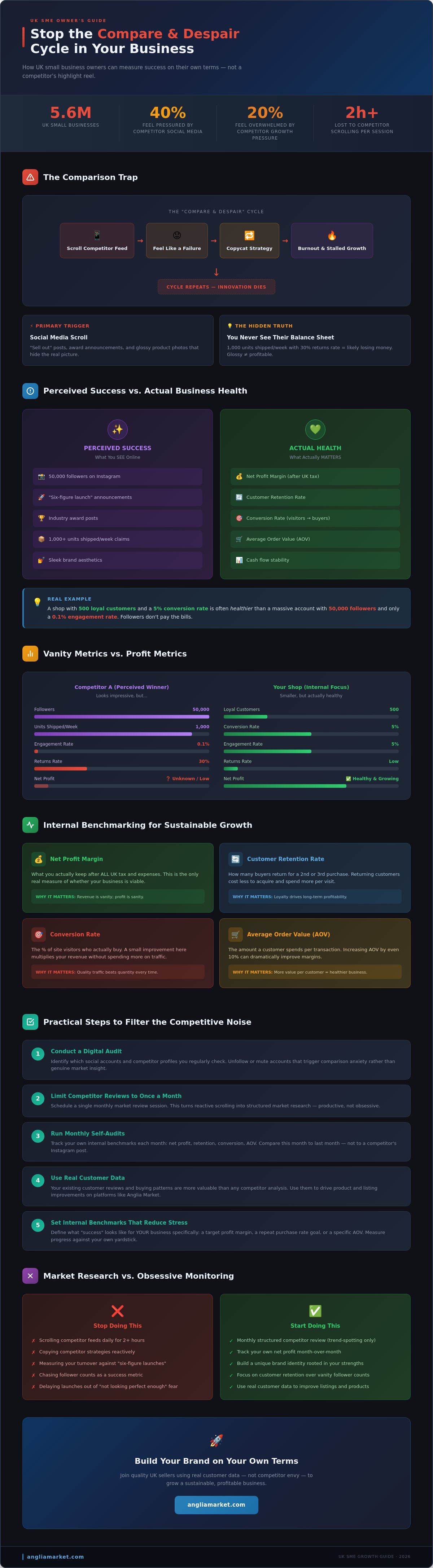
Business comparison is the psychological trap of measuring your internal mess against a competitor's polished external image. It's a natural human drive explained by Social comparison theory, where we evaluate our own worth based on how we stack up against others. In the 2026 digital-first economy, this habit has become a major hurdle for the UK's 5.6 million small businesses. When you're constantly looking sideways, you stop looking forward. This leads to "copycat" strategies that kill innovation and leave your brand feeling like a second-rate version of someone else's.
UK independent sellers face unique pressures in a crowded online marketplace. Knowing how to avoid comparing your business to others is essential for survival. Instead of building a unique brand identity, many owners fall into the trap of reactive decision-making based on what they think their rivals are doing. This creates a cycle of "compare and despair" that benefits no one.
To better understand this concept, watch this helpful video:
Identifying Your Comparison Triggers
The "social media scroll" is the primary source of business anxiety for most entrepreneurs. You see a competitor's "sell out" post or an industry award announcement and feel like you're falling behind. These posts rarely show the high return rates or the high overheads behind the scenes. There's a thin line between healthy market research and obsessive monitoring. Research helps you spot trends. Obsession just fuels resentment and stalls your progress. You must learn to spot when a quick check on a rival turns into a two-hour session of self-doubt.
The Cost of "Compare and Despair" on Your Productivity
Every hour you spend dissecting a rival's feed is a "time leak" for your own operations. This is time you could spend optimising your furniture or home and garden listings to improve your own conversion rates. Comparison paralysis is a real productivity killer. It prevents UK SMEs from launching new product lines or starting marketing campaigns because they fear they won't look as "perfect" as the competition. This cycle is a direct path to entrepreneur burnout. In 2023, industry surveys suggested that nearly 20% of UK small business owners felt overwhelmed by the pressure to match competitor growth. Focusing on your own metrics is the only way to stay productive and profitable.
Decoding Perceived Success vs. Actual Business Health
Perceived success is often just a polished digital facade. You see a competitor's sleek Instagram feed, but you don't see their high overheads or mounting debt. Learning how to avoid comparing your business to others starts with understanding that a public image isn't the same as financial health. A 2023 survey of UK small business owners found that 40% felt pressured by competitors' social media presence. However, many of those same competitors struggle with basic cash flow behind the scenes.
You never see a rival's balance sheet. You don't see their logistical nightmares or the late nights spent fixing shipping errors. They might be shipping 1,000 units a week, but if their returns rate is 30%, they're likely losing money. Staying in your lane preserves your mental energy. It allows you to focus on operational excellence rather than external noise. Focus on these internal health metrics instead:
- Net Profit Margin: What you actually keep after all UK tax and expenses.
- Customer Retention Rate: How many buyers return for a second or third purchase.
- Conversion Rate: The percentage of site visitors who actually buy.
- Average Order Value (AOV): The amount a customer spends per transaction.
The Social Media Illusion: Vanity Metrics vs. Profit
A competitor with 50,000 followers might look like they're winning. In reality, followers don't pay the bills. In the UK retail market, "boosted" posts can inflate engagement without driving a single sale. A small shop with 500 loyal customers and a 5% conversion rate is often healthier than a massive account with 0.1% engagement. Stop chasing likes. Track your own data. If you want to grow sustainably, sell online through platforms that prioritise actual transactions over vanity metrics.
Why Every Business Journey Follows a Unique Timeline
The "overnight success" is usually a decade in the making. Some UK SMEs are bootstrapped, growing slowly on their own terms. Others are VC-backed, burning through £100,000 a month to gain market share. You can't compare your "Chapter 1" to their "Chapter 20". It's better to differentiate your business by focusing on your unique value proposition. Every business moves at its own pace based on its funding and goals. Remembering this is essential for how to avoid comparing your business to others while you build your own foundation.
Shifting the Lens: Internal Benchmarking for Sustainable Growth
Internal benchmarking involves comparing your current performance against your own historical data. It's the most effective strategy for how to avoid comparing your business to others. While a competitor might see a 15% spike in traffic due to a temporary viral trend, your focus should remain on your own trajectory. A monthly self-audit allows you to track progress without the distraction of external noise. It's about your journey, not their highlights reel.
Set "Personal Best" goals every 30 days to maintain focus. These targets shouldn't depend on what a rival shop in London or Manchester is doing. Instead, look at your own dashboard. If you handled 85 orders last May, aim for 95 this May. Success comes from building momentum through small, consistent wins. Positive customer testimonials prove your business is meeting real needs, which is a better indicator of health than a competitor's social media follower count. Use a simple framework for your monthly audit:
- Review Revenue: Compare this month's total to the same period last year.
- Analyze Efficiency: Check if your processing time for orders has decreased.
- Customer Feedback: Count how many 5-star reviews you received this week.
- Traffic Quality: Look at your conversion rate rather than just total hits.
Measuring Your Current Results Against Past Performance
Stop checking competitor social media feeds every morning. Focus on Year-on-Year (YoY) growth instead. This metric accounts for seasonal shifts in the UK market, such as the December holiday rush or the August bank holiday slowdown. For instance, a seller might track a 12% increase in electronics sales compared to the same month in 2023. Seeing a 10% rise in pet supplies volume confirms your specific strategy is working. Achieving a "better than last month" result is the only metric that guarantees long-term survival for a growing SME. This approach is central to how to avoid comparing your business to others while staying profitable.
Setting Meaningful KPIs Beyond Competitor Activity
Focus on metrics you can control directly. Average Order Value (AOV) and Customer Lifetime Value (CLV) tell you more about your business health than a rival's flash sale. Review your internal data to see which promotions actually drove profit rather than just temporary revenue. A successful loyalty program can increase repeat purchase rates by 22%, providing a stable foundation that isn't shaken by market fluctuations. Use these internal figures to build a sustainable growth plan that's unique to your brand's specific audience and goals.
Practical Steps to Filter the Competitive Noise
Constant comparison drains your energy and distracts you from your core goals. It's time to take control of your focus. Follow these five steps to clear the air and learn how to avoid comparing your business to others effectively.
- Step 1: Conduct a Digital Audit. Go through your social feeds. Mute or unfollow any accounts that trigger feelings of inadequacy. This isn't about ignoring the market; it's about protecting your headspace.
- Step 2: Schedule Competitor Check-ins. Stop the daily scroll. Set a calendar reminder for the first Monday of every month to review market trends. A 2023 survey of UK small business owners found that reducing these check-ins can reclaim up to 15 hours of productive time each month.
- Step 3: Reinvest Saved Time. Use those reclaimed hours for product development or improving customer service. A 5% increase in customer retention can boost profits by 25% to 95% according to industry data.
- Step 4: Build a Supportive Network. Surround yourself with other vendors who value collaboration. Sharing experiences with peers helps you realise that every business faces similar hurdles behind the scenes.
- Step 5: Document Your Journey. Keep a "Win Log." Record your milestones, from your first sale to your 100th positive review. Looking back at where you were 12 months ago proves how far you've actually come.
Curating Your Digital Environment and Professional Network
Professional distancing from direct rivals is essential for clarity. Don't get bogged down in vanity metrics like follower counts. Instead, join communities where the focus is on practical skills, such as learning how to sell online with better efficiency. Seek mentors who value sustainable, steady growth. Rapid, unstable scaling often leads to burnout; 20% consistent annual growth is often healthier than a 200% spike that you can't support.
Focusing on Your Unique Value Proposition (UVP)
Your business has strengths that others can't easily copy. Maybe you offer ethical sourcing from UK suppliers or bespoke packaging that makes every delivery feel like a gift. Double down on your niche. Trying to match a competitor's massive, broad inventory usually leads to thin margins and high stress. Focus on being the best in your specific corner of the market.
To stay grounded, write a single North Star sentence for your UVP: "We provide high-quality, sustainably sourced home goods for eco-conscious UK families through personal, expert service." Read this whenever you feel the urge to compare yourself to a big-box retailer.
Ready to focus on your own growth and reach more customers? Start selling on Anglia Market today and join our community of independent sellers.
Building Your Brand on Anglia Market: Success on Your Own Terms
Anglia Market provides a level playing field for the 5.5 million small and medium-sized enterprises currently operating in the UK. On this platform, independent vendors don't have to compete with the massive marketing budgets of multinational corporations. Success here is built on quality and service rather than who can shout the loudest. By focusing on your own digital storefront, you create a sustainable path to growth that doesn't rely on matching every move your competitors make.
Authenticity is your greatest asset in a crowded marketplace. Customers frequently choose independent UK sellers because they value unique stories over generic corporate clones. Being a small business isn't a weakness; it's a strategic strength. It allows for a level of agility and personal connection that larger entities cannot replicate. When you communicate directly with your buyers, you build a brand loyalty that price wars can't touch.
Leveraging Marketplace Tools for Independent Growth
Data is the best remedy for business anxiety. Your vendor dashboard provides the specific analytics you need to understand your own customers. If you are selling items in kitchen and dining, look at your own conversion rates and search terms. Understanding how to avoid comparing your business to others becomes much easier when you focus on your own performance metrics instead of guessing at someone else's.
- Optimise your presence: Use your seller profile to highlight your brand's origin and values.
- Track trends: Monitor which sporting goods or seasonal items are performing best in your specific shop.
- Strategic promotions: Use the sale section based on your own inventory cycles and cash flow needs, not as a panicked reaction to a rival's discount.
How Supporting Local UK Sellers Strengthens Your Position
A "Community over Competition" mindset changes how you view the marketplace. A healthy ecosystem of UK vendors attracts more shoppers to the platform, which benefits everyone. According to 2023 retail data, British consumers are increasingly looking to support local, independent businesses to keep the economy resilient. When the marketplace thrives, your visibility increases naturally.
Collaboration often yields better results than isolation. Consider reaching out to non-competing vendors to share insights or cross-promote. Learning how to avoid comparing your business to others involves realising that someone else's success doesn't diminish your own. Your business journey is a marathon, not a sprint against the person in the next lane. Stay focused on your lane, maintain your pace, and celebrate the milestones that matter to your unique brand.
Take Control of Your Business Growth Today
Learning how to avoid comparing your business to others is a vital step for the 5.5 million SMEs currently operating across the UK. Instead of chasing a competitor's social media highlights, you should focus on your own internal data. Tracking your month-on-month revenue or specific customer retention rates provides a much more accurate picture of business health than a rival's follower count. When you filter out the noise and prioritize your unique brand identity, you build a sustainable foundation for long term success. Success isn't about being better than everyone else; it's about being better than you were yesterday.
Anglia Market acts as a helpful facilitator by providing a secure shopping and trusted vendor platform designed specifically for fast-growing UK small and medium businesses. This gives you direct access to a diverse UK customer base while allowing you to maintain your own brand voice and values. You don't need to mirror the competition to win. Focus on your products and your customers, and let your results speak for themselves. You've got the tools to scale on your own terms.
Start selling with Anglia Market and grow your business your way today
Frequently Asked Questions
Is it ever okay to look at what my competitors are doing?
Yes, monitoring competitors is a practical part of market research to identify service gaps in the UK retail sector. Use this data to refine your own unique selling proposition instead of using it as a benchmark for your personal worth. A 2023 report by the British Chambers of Commerce highlights that businesses focusing on their own innovation are more resilient than those that only react to rivals.
How do I handle the feeling that I am failing when a competitor announces a big win?
Focus on your own internal milestones and remember that public announcements are curated marketing tools. These highlights don't show a company's overheads, debt levels, or internal struggles. A win for another brand doesn't result in a loss for yours. Statistics show that 60% of UK small businesses survive past their first three years by sticking to their own long term financial plans.
What are the best metrics to track if I want to stop comparing myself to others?
Track internal data like your conversion rate and customer lifetime value to understand how to avoid comparing your business to others effectively. These figures show you exactly how your specific UK audience interacts with your brand. Monitoring your month on month net profit growth provides a much clearer picture of health than a rival's public vanity metrics or social media likes.
How can I stay motivated when my business growth feels slower than the industry average?
Prioritize sustainable, organic growth over rapid expansion to maintain your service quality and cash flow. Industry averages often include outliers like venture capital backed firms that don't reflect the reality of independent UK vendors. Focus on your 12 month retention rate. If your existing customers return to buy again, your business model is healthy regardless of wider market speed.
Does social media following actually correlate with business revenue?
No, a large social media following doesn't guarantee high revenue or profit for your business. Many UK retailers with under 2,000 followers generate more consistent profit than brands with 50,000 followers because their audience is highly targeted. Focus on your email click through rate and actual sales data. These are the numbers that pay your bills and fund your future growth.
What should I do if a competitor starts copying my products or branding?
Consult a legal professional regarding UK intellectual property rights if a competitor copies your unique designs. You can often protect your brand through trademarking with the Intellectual Property Office. Beyond legal action, you should continue to innovate and improve your customer experience. Competitors can copy a product, but they can't replicate your specific customer service or the trust you've built with your buyers.
How can I use Anglia Market tools to focus on my own business growth?
Use the Anglia Market vendor dashboard to monitor your sales trends and manage your promotions directly. Our platform is designed to support independent UK sellers by providing clear data on which of your products perform best. By focusing on your own top categories and promotional success, you can optimize your inventory based on real customer demand rather than what other shops are doing.

Here to help — ask anything
For questions about this disclaimer or the site, contact us via the website’s Contact page.


