

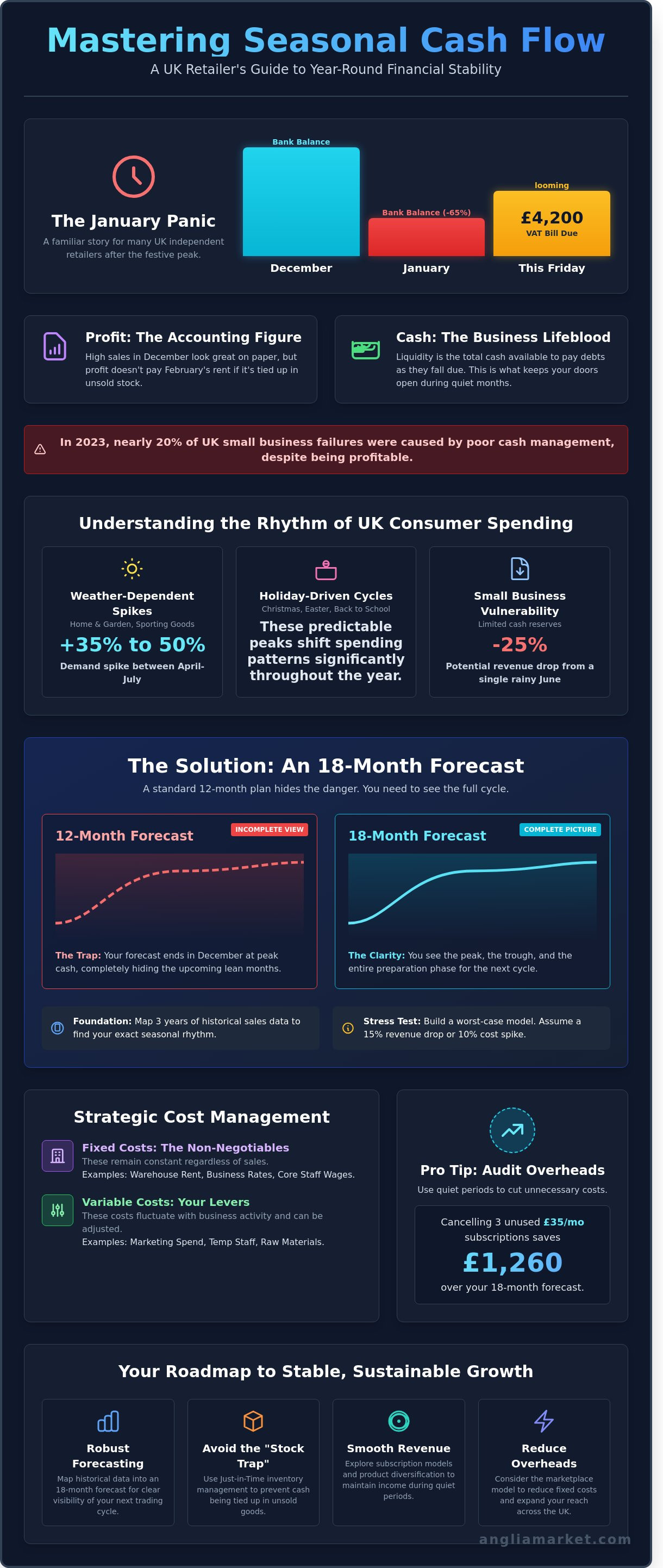
On January 15th, a UK gift shop owner looks at a bank balance that's 65% lower than it was in December, yet the £4,200 quarterly VAT bill is still due by Friday. It's a familiar panic for many independent retailers across the country. Mastering how to manage cash flow in a seasonal business is the only way to ensure your shop stays open when the high street goes quiet. You shouldn't have to spend your evenings worrying about rent or watching stock from last summer gather dust on the shelves for another 8 months.
It's stressful to watch your cash reserves dip while fixed costs remain high, but your business doesn't have to be a financial roller coaster. You can achieve a predictable bank balance year round by using practical forecasting and revenue-smoothing strategies. This guide provides a clear roadmap for navigating peaks and troughs through 12 month projections and smart inventory management. We'll show you how to cut costs effectively and build a plan that turns your quietest months into a period of stable, sustainable growth.
Key Takeaways
- Map your historical data into a robust 18-month forecast to gain clear visibility into your next trading cycle.
- Learn how to manage cash flow in a seasonal business by avoiding the "Stock Trap" and using Just-in-Time inventory management.
- Explore revenue-smoothing techniques like subscription models and product diversification to maintain steady income during quiet periods.
- Discover how the marketplace model reduces fixed overheads and expands your reach to find new demand across the UK.
What is Seasonal Cash Flow and Why Does it Matter?
Seasonal cash flow is the timing difference between money entering your bank account and money leaving it. To understand What is Seasonal Cash Flow, you need to look at your actual bank balance, not just your sales figures. For many UK retailers, income arrives in a massive rush during peak months, but fixed costs like rent and insurance stay the same every month. This creates a "Peak-Trough" cycle that can trap even the most successful entrepreneurs if they aren't prepared for the lean times.
To better understand this concept, watch this helpful video:
Profit vs. Cash: The Crucial Distinction
Profit is an accounting figure. Cash is what pays the electricity bill. It's a common trap: you record high sales in December, but that money doesn't help you pay rent in February if it's tied up in unsold stock or customer debt. Liquidity is the lifeblood of your company; it's the total cash you have available to pay your debts as they fall due. In 2023, data showed that nearly 20% of UK small business failures were caused by poor cash management despite the companies being technically profitable. Learning how to manage cash flow in a seasonal business is about surviving the quiet months, not just celebrating the busy ones.
Common Seasonal Triggers in the UK Market
UK consumer spending follows a specific rhythm. Weather-dependent sectors like home and garden or sporting goods often see a 35% to 50% spike in demand between April and July. Outdoor furniture sales usually peak around the early May bank holiday. Holiday-driven cycles also play a massive role. The "Back to School" rush in late August and the Christmas period are obvious, but Easter and the six-week summer holiday also shift spending patterns significantly.
Smaller firms in Britain are particularly vulnerable to these shifts because they often lack the massive cash reserves of larger corporations. When a rainy June hits the home and garden sector, a small business might see revenue drop by 25% compared to the previous year. Understanding how to manage cash flow in a seasonal business means predicting these troughs before they happen. You must identify the unique rhythm of your specific industry to ensure you have enough liquidity to survive until the next peak.
How to Create a Robust 18-Month Cash Flow Forecast
A standard 12-month forecast often fails seasonal UK SMEs. If your peak ends in December, a one-year plan stops exactly when your cash reserves are highest, hiding the "dry spell" that follows in February. To truly understand how to manage cash flow in a seasonal business, you must look 18 months ahead. This allows you to see the end of one cycle and the total preparation phase for the next. Start by mapping three years of historical sales data. Identify the exact week demand climbs and the date it drops. This historical baseline is your foundation, but it isn't foolproof.
You must account for economic shifts and unpredictable "Black Swan" events. For instance, the UK saw inflation hit 11.1% in October 2022, which radically altered consumer spending power. When you Create a Robust 18-Month Cash Flow Forecast, always build a worst-case scenario model. Assume a 15% drop in projected revenue or a 10% spike in utility costs. If your business survives the model where your worst month is 20% worse than expected, your strategy is solid.
Mapping Your Fixed and Variable Costs
Divide your outgoings into "Non-Negotiables" and "Levers." Fixed costs like warehouse rent, business rates, and core staff wages stay constant regardless of sales. Variable costs are your levers. These include marketing spend, temporary agency staff, and raw materials. During your peak season, these will surge. However, smart managers use quiet periods to audit overheads. Cancelling just three unused £35 per month software subscriptions saves £1,260 over your 18-month forecast. Every pound saved in a lean month like January is worth two in July. It's about keeping the "burn rate" low when the till isn't ringing.
Factoring in UK Tax and Compliance Deadlines
The "Tax Trap" ruins many seasonal traders. It's easy to feel wealthy in December and forget that a large VAT bill is due in January. You must ring-fence Corporation Tax and VAT immediately. The gold standard for UK SMEs is setting aside 20% to 30% of all peak revenue into a separate, high-yield savings account. This ensures you can cover PAYE and National Insurance contributions even during months with zero sales. If you find your current model is too volatile, you might want to sell online through established marketplaces to diversify your income streams. Planning for these liabilities 18 months in advance prevents the panic of an unexpected HMRC demand. This proactive approach is the most effective way to learn how to manage cash flow in a seasonal business without relying on expensive short-term loans.
Strategic Inventory and Supplier Management
The "Stock Trap" is a common pitfall for UK retailers. It happens when your liquid capital is frozen in cardboard boxes on a warehouse floor. Every pound tied up in unsold inventory is a pound unavailable for rent, payroll, or marketing. Efficient inventory control is a primary pillar of how to manage cash flow in a seasonal business. Adopting "Just-in-Time" (JIT) ordering can reduce holding costs by 15% to 20% by ensuring products arrive exactly as demand peaks. SMEs should use inventory management software to track "days sales of inventory" (DSI). If a product's DSI exceeds 45 days during your peak period, it is likely a slow-mover that needs addressing before the off-season arrives.
Negotiating Favourable Terms with Suppliers
Your suppliers are partners in your commercial success. Don't hesitate to ask for extended payment terms, such as 60 or 90 days, specifically for your quietest months. This strategy keeps cash in your bank account longer when revenue is thin. Be wary of the "Early Settlement" trap. While a 3% discount for paying within 7 days sounds attractive, it's often a mistake if your cash reserves are low. Keeping that cash for 30 extra days usually provides a better safety net than the small saving. Build "Preferred Partner" status by sharing your sales forecasts early. Suppliers often offer more flexibility to businesses that provide clear data. For more structured advice, explore these tips on managing seasonal business cashflow from official UK resources.
Liquidation Strategies for Seasonal Stock
Holding stock for 12 months can cost a business 25% of the item's value in storage and depreciation. It's better to sell at cost than to let items gather dust. Run a clearance sale immediately after your peak season to clear the decks. Bundling is another effective tactic; pair a slow-moving item with a high-demand bestseller to move volume quickly. Use targeted promotions and flash sales during your deepest troughs to inject quick cash. Even a 2% or 3% margin is better than a total loss on obsolete stock. This proactive approach is essential for anyone learning how to manage cash flow in a seasonal business while maintaining a healthy balance sheet.
Proactive Strategies to Smooth Income Year-Round
Managing a seasonal business doesn't mean you have to accept six months of zero revenue. Learning how to manage cash flow in a seasonal business involves creating a predictable income stream through diversification and smart customer retention. You need to fill the gaps between peak periods with intentional sales tactics. By implementing strategies that pull revenue forward or create recurring payments, you reduce the pressure on your peak months.
- Subscription models: Introduce monthly service plans or product boxes to generate reliable recurring revenue.
- Geographic targeting: Use digital ads to find buyers in different regions where the climate or holidays differ from the UK.
- Pre-orders: Offer financial incentives for customers to pay upfront for future stock arrivals.
Finding Counter-Seasonal Product Ranges
Don't let your warehouse sit empty during the quiet months. If you specialise in garden furniture for the spring, pivot your focus to indoor furniture and home decor for the autumn and winter. Data from 2023 indicates that businesses with at least two distinct seasonal peaks are 30% less likely to require emergency credit lines. Use marketplace search data to identify which niches are trending. Testing a small batch of 20 to 50 items on a platform like Anglia Market allows you to gauge demand before committing to a large shipment.
Building Customer Loyalty to Drive Off-Season Sales
Your existing database is your most valuable asset during a slump. Implementing a loyalty program encourages year-round engagement by rewarding shoppers for their repeat business. Send personalised email campaigns that offer "Early Bird" discounts for the upcoming peak season. For instance, a 12% discount for orders placed in January can provide the liquidity needed to pay suppliers in February. This strategy ensures you aren't just waiting for the phone to ring; you're actively pulling revenue forward. It's a proven method to help you master how to manage cash flow in a seasonal business while keeping your brand top-of-mind.
Ready to reach more customers and stabilise your sales? Start selling with us today to grow your UK business.
Navigating the Seasonal Cycle with Anglia Market
Managing a seasonal business often feels like a balancing act. Anglia Market provides the infrastructure to stabilize your finances. Instead of paying 100% of the rent for a physical shop during a 4-month quiet period, a marketplace model converts high fixed costs into variable ones. This shift is a fundamental strategy for how to manage cash flow in a seasonal business effectively. You only pay for what you use, preserving capital for when you need it most.
Scaling Your Reach Without Increasing Risk
Joining an established platform offers immediate benefits for vendors. You bypass the £5,000 to £10,000 initial setup costs associated with bespoke e-commerce sites. When you choose to sell online through Anglia Market, you leverage a trusted reputation. This maintains sales velocity even in off-peak months. You can access demand in different UK regions where weather or local events might differ from your home base, ensuring your stock keeps moving.
Use marketplace data to stop guessing. Analytics show exactly when demand spikes for specific categories. For example, if you sell garden furniture, 2023 retail data showed an early surge in "outdoor living" searches as early as February. This insight allows you to introduce counter-seasonal products with lower risk. A seller specializing in summer toys can easily test winter categories like home and garden decor without signing a new lease or hiring extra staff.
Action Plan: Preparing for Your Next Season
Preparation starts 90 days before your peak. Follow this checklist to stay ahead and protect your margins:
- 90 Days Out: Finalize inventory orders based on previous year’s sell-through rates to avoid overstocking.
- 60 Days Out: Optimize product listings with fresh keywords and high-quality images.
- 30 Days Out: Set up promotions to build early momentum and secure early cash inflows.
Review your performance within 14 days of the season ending. Look at your cash reserves. Did you have too much capital tied up in stock? Identifying a 15% surplus now prevents a cash crunch next year. This is the most practical way to learn how to manage cash flow in a seasonal business over the long term.
Treat cash flow as a year-round discipline. By using the Anglia Market platform, you reduce the barriers to entry for new categories and keep your business agile. Use these tools to turn a seasonal struggle into a predictable, profitable cycle.
Take Control of Your Business Growth
Success for UK SMEs depends on proactive preparation. You need a detailed 18-month cash flow forecast to predict the quiet months and plan for the peaks. Effective inventory management prevents capital from being locked in unsold stock; instead, it puts that money back into your business operations. Learning how to manage cash flow in a seasonal business ensures you have the liquidity to pay suppliers on time and invest in marketing when it matters most. Diversifying your sales channels is a proven way to smooth out income fluctuations. Anglia Market provides a secure shopping environment where you can list products across diverse categories, from furniture to electronics. As a dedicated UK-based marketplace, we help independent vendors reach a wider audience every single day of the year. It's time to build a more resilient brand.
Start selling on Anglia Market today and reach more customers year-round
Your business has the potential to grow regardless of the calendar. Take the first step toward a more stable financial future today.
Frequently Asked Questions
How much cash reserve should a seasonal business keep?
You should aim for a cash reserve that covers 3 to 6 months of your total operating expenses. For a UK SME with £10,000 in monthly overheads, this means holding a £30,000 safety net. This buffer ensures you pay 100% of your fixed costs, such as rent and core staff wages, even when sales drop by 80% during the off-season months.
Can I use a business loan to cover seasonal cash flow gaps?
Yes, short-term finance like a revolving credit line or a business overdraft is a common way how to manage cash flow in a seasonal business. These tools provide immediate liquidity to pay your suppliers before the peak season begins. Interest rates for UK SME loans often range from 5% to 15%. You must ensure your peak revenue covers the total repayment plus interest.
What are the best ways to reduce expenses during the off-season?
Switch to variable cost models by hiring temporary staff and using flexible stock orders. You can reduce energy bills by 20% by shutting down unused warehouse sections or switching to LED lighting. Negotiate with your suppliers for extended payment terms or seasonal discounts. Cutting non-essential software subscriptions can save a small retail business an average of £200 every month.
How do I forecast sales if my business is new?
Use industry benchmarks and local market data from the Office for National Statistics to build your projections. If similar UK gift shops see 40% of their annual revenue in December, use that figure as your first-year baseline. Create three scenarios: conservative, expected, and optimistic. Tracking your daily sales from day one allows you to adjust these figures every 30 days for better accuracy.
Should I offer discounts to get paid faster by customers?
Offer a 2% discount for invoices paid within 10 days to improve your immediate liquidity. This strategy, known as 2/10 net 30, encourages 60% of B2B clients to settle their debts early. It's often more cost-effective than paying interest on a bank overdraft. While you lose a small margin, the cash allows you to restock inventory for your next busy period.
How can I diversify my products without losing my brand identity?
Introduce complementary items that solve a specific problem for your existing customers during the off-season. A summer garden center might sell Christmas trees and winter fuels to maintain 25% of its peak revenue during December. Stick to your core values of quality and affordability to keep your brand consistent. This approach helps you learn how to manage cash flow in a seasonal business by creating year-round demand.
What is the most common mistake seasonal businesses make with cash?
Overspending during the peak months is the biggest error, with 30% of SMEs failing due to poor surplus management. Owners often treat peak season profit as disposable income instead of saving for the quiet period. You must set aside a specific percentage of every sale during your busiest months to cover winter tax bills, insurance premiums, and maintenance costs.

Here to help — ask anything
For questions about this disclaimer or the site, contact us via the website’s Contact page.


