

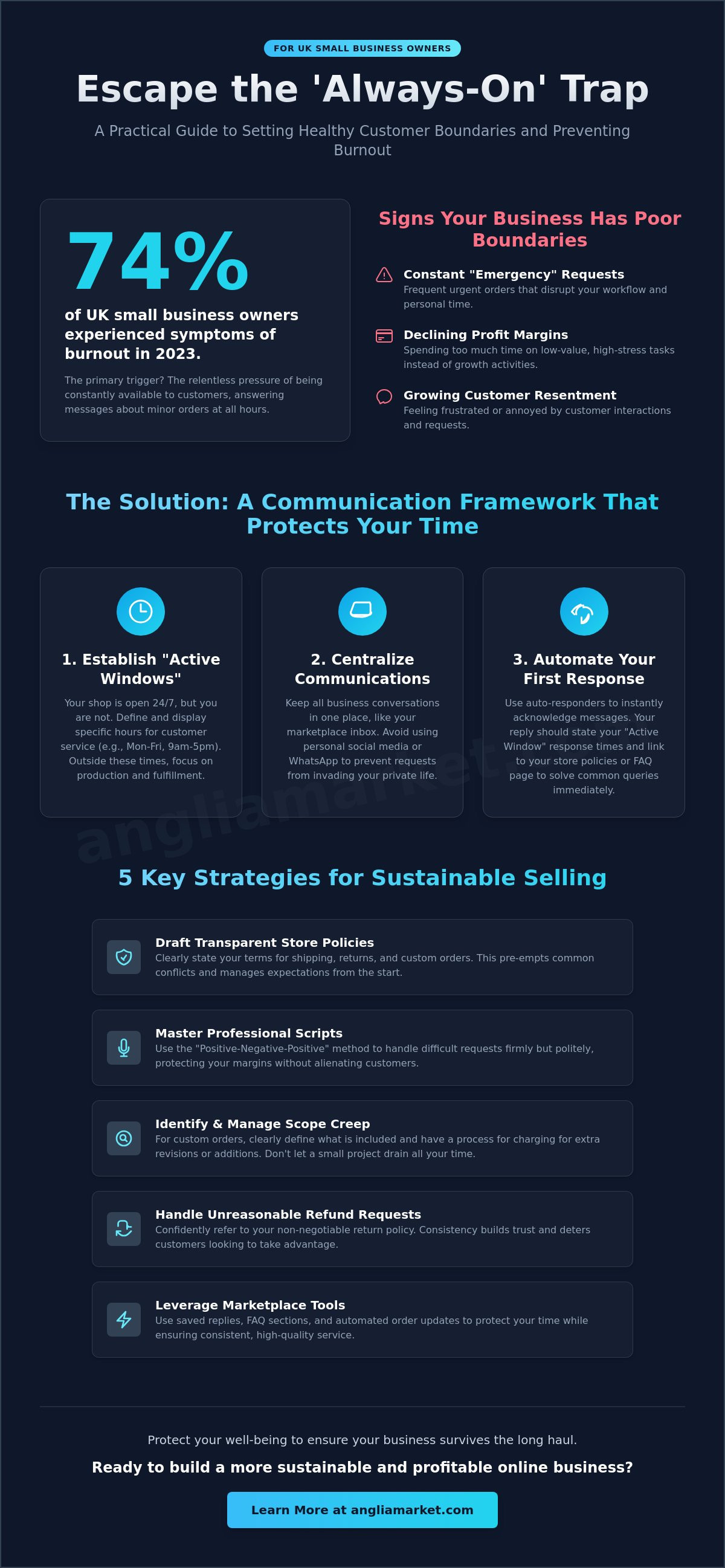
In 2023, a report by Simply Business revealed that 74% of UK small business owners experienced symptoms of burnout, often triggered by the pressure of being constantly available to buyers. You likely started your shop to enjoy more freedom, yet you now find yourself replying to queries about a £15 order at 11 PM on a Sunday. It's a common struggle for independent vendors who worry that a delayed response might result in a damaging review. However, setting boundaries with online customers is the only way to ensure your business remains profitable without draining your personal reserves.
You don't have to choose between high satisfaction scores and your own well-being. This guide provides practical, commercial strategies to help you protect your time while maintaining a professional reputation. We'll explore how to implement standardised response protocols, manage scope creep on custom orders, and handle unreasonable refund requests with confidence. You'll learn how to create a sustainable framework that encourages customer respect and supports long-term growth for your UK business.
Key Takeaways
- Identify how to escape the "Always-On" trap by defining clear professional parameters for your UK-based online shop.
- Master the art of setting boundaries with online customers by establishing "Active Windows" for communication versus order fulfilment.
- Discover how to use transparent store policies and non-negotiable return terms to pre-empt common customer conflicts before they start.
- Access professional scripts using the "Positive-Negative-Positive" method to handle urgent requests without compromising your profit margins.
- Learn to leverage automated marketplace tools and saved replies to protect your time while ensuring consistent service for every buyer.
Why Setting Boundaries with Online Customers is Vital in 2026
Boundaries are professional parameters that dictate how, when, and where you conduct business. They create a clear framework for your daily operations and protect your time. Without these limits, your work life quickly bleeds into your personal hours, leading to exhaustion. This is why understanding personal boundaries is essential for every UK vendor. It ensures you maintain a professional distance while still delivering high-quality service to your buyers.
The "Always-On" trap has distorted what buyers expect from small businesses. Instant messaging, social media DMs, and smartphone notifications have created a culture where 24/7 availability is the perceived norm. This distortion puts immense pressure on entrepreneurs who feel obligated to reply to queries at 11 PM. Setting boundaries with online customers helps you reclaim your schedule and prevents the mental fatigue that comes with reactive communication.
To better understand the dynamics of professional limits, watch this helpful video:
Boundary-less selling directly impacts your mental health and the quality of your business decisions. When you're constantly available, your brain stays in a state of high stress, making it difficult to focus on growth strategies. Customers actually prefer predictable professionals over erratic responders. Consistency builds more trust than a midnight reply ever could. By being clear about your hours, you frame your business as a serious, organised entity.
The Psychology of the Modern Online Shopper
Digital anonymity often leads to increased entitlement. Shoppers feel detached from the person behind the screen, which can result in demanding or aggressive communication. Many small sellers feel they must match the "Amazon Effect" with 24/7 logistics and instant updates. You don't have to compete on those terms to thrive. The expectation-reality gap in modern e-commerce is the psychological distance between a buyer's demand for instant service and a seller's physical capacity to provide it.
Signs Your Business is Suffering from Poor Boundaries
Look for red flags like growing resentment toward your customers or taking frequent "emergency" orders that disrupt your workflow. These issues often lead to declining profit margins as you spend more time on low-value, high-stress tasks. There's a direct correlation between "hustle culture" and long-term business failure. A 2023 industry report showed that 64% of small business owners who ignored boundaries experienced severe burnout within two years. Lack of structure leads to inconsistent service and negative feedback. If you want to sell online successfully, you must establish a sustainable pace that protects your well-being. Setting boundaries with online customers isn't just about saying no; it's about ensuring your business survives the long haul.
Creating a Communication Framework that Protects Your Time
Successful setting boundaries with online customers starts with a clear communication framework. You must distinguish between being open for orders and being available for chat. Your online shop operates 24/7, but your personal availability shouldn't. Establish "Active Windows" for customer service. These are specific blocks of time where you focus solely on answering queries. Outside these windows, your focus shifts to production and fulfillment.
Prioritize your communication channels to avoid notification fatigue. Use the marketplace inbox as your primary hub. Avoid moving business conversations to personal social media or WhatsApp. This keeps your records in one place and prevents customers from invading your private life. A 2023 study by LeadConnect found that 78% of customers buy from the vendor who responds first. However, speed doesn't require 24-hour availability. It requires a strategic "First Response" rule.
Your very first interaction sets the tone for the entire relationship. Use auto-responders to acknowledge messages instantly without sounding like a robot. A good auto-responder provides value immediately. It should include your standard response times and links to helpful resources. This manages expectations and reduces the urge for the customer to send multiple "follow-up" messages.
Defining Your Business Hours and Response Times
Set realistic Service Level Agreements (SLAs) for different query types. For example, aim to answer order status questions within 4 hours and general product inquiries within 24 hours. Clearly display these hours on your seller profile. A consistent 4-hour response during business hours is more professional than a 5-minute response at midnight. Responding late at night trains customers to expect 24/7 access, which leads to burnout. Stick to UK business hours to maintain a professional standard.
The Ethics of Digital Accessibility
Protecting your "Deep Work" blocks is essential for fulfilling orders accurately. Research from the University of California, Irvine, indicates it takes an average of 23 minutes to refocus after a single interruption. Dedicate specific hours to packing and shipping where your phone is on "Do Not Disturb." Train your customers to use FAQ sections before reaching out. If you provide clear answers regarding shipping costs in GBP (£) and return policies, you'll reduce your message volume by up to 30%. Setting firm expectations for weekends and bank holidays ensures you return to work refreshed. If you're focused on growing your brand, a structured communication plan is your best tool for long-term setting boundaries with online customers.
Drafting Transparent Store Policies to Pre-empt Conflict
Your "About" and "Policy" pages serve as the primary legal and emotional contract between you and your buyer. Effective setting boundaries with online customers starts long before a complaint hits your inbox. It begins with clear, accessible language that defines what you will and won't do. A 2023 retail survey found that 67% of shoppers check a return policy before making a purchase. If yours is buried or vague, you're inviting friction. Use these pages to define your working hours, communication methods, and specific limitations on bespoke work.
For sellers offering customisations, scope creep is a major profit killer. You must state exactly when a design is "locked." If a customer asks for a third revision on a £45 personalised print, your policy should clearly state that additional changes incur a specific fee. This isn't being difficult; it's protecting your hourly rate and your schedule. Link to these terms in your order confirmation emails to ensure they're seen without feeling like a confrontation.
Standardising Returns and Refunds
Create a simple three-step guide for returns to reduce support tickets. Clearly define "non-returnable" items, such as earrings for hygiene reasons or custom-engraved gifts, as permitted under UK Consumer Contracts Regulations. For platform-specific guidance, check the Anglia Market support home to ensure your individual store rules align with marketplace standards. Standardising this process removes the emotional weight of saying "no" to an unreasonable request. By drafting these documents carefully, you're setting boundaries with online customers that protect your business from unnecessary losses.
Managing Shipping and Lead Time Expectations
The "Under-promise, Over-deliver" framework is your best friend for maintaining high ratings. If a product takes 3 days to make, tell the customer it takes 5. When it arrives early, you've won a fan. When couriers face delays, your policy should clarify that your responsibility covers dispatch times, not third-party transit issues. Use these tactics to manage expectations:
- Use bold "In-Stock" vs "Made-to-Order" labels on every product page.
- List the final "order by" dates for seasonal peaks like Christmas by 30 November.
- State clearly that shipping fees are non-refundable once a label is generated.
This clarity prevents customers from blaming you for external logistics issues beyond your control. It shifts the focus from your personal service to the objective facts of the transaction. You're a professional running a shop, not a personal assistant on call 24/7.
Practical Scripts for Handling Difficult Online Situations
Mastering the "Positive-Negative-Positive" sandwich method helps you maintain rapport while setting boundaries with online customers. You start with a helpful opening, deliver the firm "no," and finish with a solution. If a buyer asks for a £15 discount on a £40 item, don't just refuse. Try: "Thanks for your interest in our home range. We don't offer individual discounts as our prices reflect fair wages for UK staff, but you can find our latest offers on our promotions page."
When a customer demands delivery by tomorrow without paying for express shipping, stay firm. Remind them that standard delivery takes 2 to 3 working days. Offer the option to pay for a courier upgrade on their next order or provide a tracking number immediately. Business growth relies on systems, not miracles. If you break your process for one person, you risk delaying orders for the other 95% of your customers who followed the rules.
Data suggests that 5% of users often cause 80% of a small business's support stress. These are the individuals who demand constant updates or ignore your stated policies. If a buyer is consistently aggressive or makes unreasonable demands, it's time to stop the relationship. Professionalism doesn't mean accepting abuse. Identifying these "high-drain" customers early saves your energy for the 95% of shoppers who value your work.
De-escalation Templates for Common Disputes
Feedback blackmail is a breach of most marketplace terms. If a user threatens a 1-star review to get a freebie, don't engage in the threat. Use this script: "We value all feedback that reflects the actual service provided. However, we cannot provide free items outside of our standard returns policy. We'll document this conversation for platform mediation if necessary." Keep every message within the internal marketplace system. Evidence shows that seller protection claims are significantly more successful when communication stays on-platform for legal protection.
For late deliveries caused by courier delays, use empathy without taking personal blame: "I understand it's frustrating to wait. Your parcel was dispatched on time via Royal Mail. While I can't control the courier's speed, I'll contact them now to get an update for you."
Maintaining Professionalism Under Pressure
The "24-Hour Rule" is your best tool for abusive messages. Never reply while your adrenaline is high. Waiting one full day allows you to respond with facts rather than emotions. This creates a clear gap between your personal identity and your business persona. You aren't just an individual; you're a professional entity. Use a formal sign-off to reinforce this boundary.
Document every interaction, including dates and screenshots of messages. This evidence is vital if you need to block a user or report them to marketplace support for harassment. Clear documentation ensures that setting boundaries with online customers is backed by facts if a third party needs to intervene.
Leveraging Marketplace Tools to Automate Your Boundaries
You shouldn't spend every evening responding to the same three questions. When selling online through a structured platform, you gain access to built-in systems that act as your first line of defence. These tools are essential for setting boundaries with online customers because they standardise how information is shared without requiring your constant presence.
Saved replies are a simple but effective starting point. Create templates for returns, shipping delays, and common product queries to ensure your tone stays professional even when you're busy. Industry data suggests that nearly 40% of shoppers expect a response within an hour. Using automation helps you meet these expectations without being "on call" 24/7. Automated tracking also plays a massive role in boundary management. By providing real-time updates, you can reduce "Where is my order?" messages by as much as 50%, according to retail logistics reports.
It's also wise to reward the right behaviour. Using loyalty programs helps you attract and retain low-friction customers who already understand your process. These buyers are typically less likely to push your limits or demand exceptions because they value the long-term relationship with your brand. High-value customers appreciate the efficiency that clear boundaries provide.
The Power of the FAQ and Knowledge Base
Don't let your inbox become a dumping ground for basic queries. Build a "Living FAQ" that evolves every time a customer asks something new. Directing users to self-service options saves time for both parties. For technical categories like Electronics or Home and Garden, detailed specifications are vital. Providing exact dimensions, compatibility lists, and power requirements directly on the listing prevents the back-and-forth messaging that drains your daily energy.
Scaling Your Support Without Losing the Personal Touch
As your UK business grows, you'll eventually need extra hands. Consider hiring a part-time virtual assistant for routine admin tasks. You can often find reliable support for £12 to £20 per hour to manage the initial tier of customer queries. Use marketplace analytics to see exactly when your query volume peaks. If 65% of your messages arrive between 6 PM and 9 PM on weekdays, that's the specific window where you need support or automated "out of office" replies. Effective setting boundaries with online customers isn't about being unreachable; it's about being efficient. Clear systems let you focus on the parts of the business you actually enjoy, like sourcing new stock and growing your sales.
Build a Resilient Future for Your UK Business
Mastering the art of setting boundaries with online customers is the most effective way to protect your mental health and your profit margins heading into 2026. You've learned how to implement clear communication frameworks and use automation to handle late-night queries. These systems don't just save time; they create a professional standard that high-quality buyers respect. By drafting transparent policies and using practical scripts, you eliminate the friction that often leads to burnout.
You don't have to manage these challenges alone. Anglia Market provides a supportive marketplace built specifically for UK-based SMEs. Our platform offers a secure shopping environment with built-in vendor protection to keep your business safe. You'll gain immediate access to thousands of loyal shoppers through our loyalty program. It's time to reclaim your schedule and grow your brand on a platform that values your success.
Start selling professionally today on Anglia Market
Frequently Asked Questions
How do I tell a customer I don’t work on weekends without losing the sale?
You can tell customers you don't work weekends by setting an automated "Out of Office" reply on your email and marketplace accounts. This ensures they receive an immediate response without you being active. State clearly that you'll respond on Monday morning. This professional approach maintains trust and helps in setting boundaries with online customers while you enjoy your time off. According to a 2023 survey by BrightLocal, 76% of consumers read online reviews to evaluate local businesses; clear communication builds that essential trust.
What should I do if a customer keeps messaging me on my personal social media?
Politely redirect the customer to your official business email or marketplace messaging system. Avoid answering business questions on personal profiles to keep your private life separate. If they persist, you can use platform privacy settings to restrict messages from non-friends. Professionalism relies on consistent communication channels that protect your personal space. Keeping all transactions on one platform also ensures you have a clear paper trail for every £10 or £100 sale.
Is it okay to have a "No Refunds" policy for custom-made items?
Yes, it's legal to have a "No Refunds" policy for custom-made or personalised items under the UK Consumer Rights Act 2015. These items are exempt from the standard 14-day cooling-off period because they can't be resold. Ensure your terms and conditions clearly state this before the customer pays. This protects your margins on bespoke orders. Always display this policy prominently on your product pages to avoid confusion during the checkout process.
How can I set boundaries without sounding rude or unprofessional?
Use clear, positive language that focuses on what you can do rather than what you can't. Instead of saying "I don't answer after 5pm," try "I'll be back at my desk at 9am to help you." This keeps the tone helpful and efficient. Setting boundaries with online customers works best when you frame your availability as a way to provide better, focused service during business hours. It shows you're a serious professional who manages time effectively.
What is the best way to handle a customer who demands a discount after the sale?
Politely decline the request by stating that your prices are fixed to ensure fairness for all shoppers. You might offer a small discount code for their next purchase instead to encourage repeat business. This protects your profit margins and prevents a "haggling" culture that devalues your work. Stick to your listed prices to maintain a professional, value-driven brand image. Consistent pricing is a hallmark of a reliable UK marketplace seller.
How marketplace response time ratings affect my boundary setting?
Marketplace ratings like the Etsy Star Seller badge require a response within 24 hours for 95% of initial messages. You can meet these targets without working 24/7 by using built-in auto-reply tools. These tools count as a response in most algorithms, allowing you to maintain high search visibility while keeping your weekends free. This automated approach means you don't have to sacrifice your rating for the sake of your personal life.
Should I respond to customer queries immediately to get better search rankings?
While fast responses improve customer conversion rates, they don't directly impact your Google search rankings. SEO is driven by site structure, keywords, and quality content rather than how fast you reply to a DM. Focus on responding within 12 to 24 hours during the work week. This balance ensures you stay competitive without burning out. High-quality service is more important for long-term growth than 5-minute response times at midnight.
What do I do if a customer ignores my stated business hours?
Wait until your next scheduled start time to reply if a customer messages outside your hours. Responding at 11pm teaches the customer that your stated hours don't matter. Consistency is the key to training your audience. By waiting until 9am, you reinforce your professional schedule and protect your mental well-being for the long term. This helps maintain a sustainable business model that can grow without causing exhaustion.

Here to help — ask anything
For questions about this disclaimer or the site, contact us via the website’s Contact page.


