
Are you building your retail empire on solid ground, or is your entire business house built on rented land? Many British SMEs find that the convenience of third-party platforms is a double-edged sword. Whilst the immediate access to millions of shoppers is tempting, relying on a single channel can leave you vulnerable to sudden fee hikes and shifting algorithms. Understanding the pros and cons of selling only on marketplaces is essential for any small business owner looking to protect their profit margins in 2026.
We know how frustrating it is to see high commission fees and the 2% Digital Services Tax surcharge eat into your hard-earned revenue. It's difficult to stand out amongst thousands of competitors when you don't own your customer data for future marketing. This guide provides a clear decision framework to help you discover if a marketplace-only strategy is right for your British business or if you are missing out on vital brand growth. We'll explore the hidden costs of platform dependency, the impact of 2026 HMRC data-sharing rules, and how to balance marketplace reach with your own independent brand presence.
Key Takeaways
- Learn how to launch your brand faster by using established platforms to test products without the high costs of a custom site.
- Discover why platform-backed guarantees build instant trust with shoppers and how to leverage their infrastructure for seasonal spikes.
- Carefully weigh the pros and cons of selling only on marketplaces to ensure high fees and limited customer data don't stall your growth.
- Master the "Rule of Three" to spread your risk across multiple sales channels and keep your British business secure.
- Find out why partnering with a platform like Anglia Market can prioritise your independent identity whilst reaching a wider regional audience.
The Marketplace-Only Model: Why UK SMEs Start Here
Starting a retail business in 2026 doesn't require a computer science degree or a massive technical budget. For many British entrepreneurs, launching on an established platform is the quickest route to consistent revenue. This approach removes the significant upfront cost of building a custom e-commerce site and allows you to test your product-market fit with real customers almost immediately. It's a pragmatic choice for those who want to validate their business idea before committing to long-term overheads.
To fully grasp the mechanics, it helps to understand what an online marketplace is in the modern economy. Think of it as a digital version of a busy local market square. You gain access to the footfall and the infrastructure, even though you don't own the "land" your shop sits on. When reviewing the pros and cons of selling only on marketplaces, the speed of entry is usually the most significant advantage for a new SME. Launching an independent site often presents a psychological barrier for new UK sellers who fear the technical complexity of VAT compliance and secure data handling. Marketplaces simplify these hurdles.
The "Instant Audience" Factor
In 2026, UK online sales account for 30% of all retail transactions. A huge portion of these shoppers bypass Google entirely, using marketplace search bars as their primary discovery tool. This provides you with built-in traffic without the immediate need for a complex SEO strategy. Consumers also tap into established trust; they're more likely to buy from a new brand if the transaction is backed by a platform's familiar guarantees. This "borrowed" credibility is vital for independent sellers trying to break into crowded categories like home and garden or electronics. Shoppers prefer these one-stop-shop platforms because they can combine multiple orders into one delivery, reducing their carbon footprint and shipping costs.
Operational Simplicity for Small Teams
Small teams often struggle with the "heavy lifting" of digital retail. Marketplaces provide a ready-made infrastructure that includes secure payment processing and mobile-optimised storefronts as standard. This allows you to focus on product development and sourcing whilst the platform manages the technical backend. The checkout process is already familiar to the user, which reduces basket abandonment. If you are ready to sell online, these platforms offer a streamlined journey that helps you manage seasonal spikes without the fear of your own website crashing under the pressure of high traffic. You concentrate on the product; the platform handles the transaction.
The Compelling Pros: Immediate Wins for Your Business
Beyond the initial launch, the immediate wins for your business are substantial. For many, the decision comes down to balancing the pros and cons of selling only on marketplaces against the high cost of independent customer acquisition. One of the biggest wins is instant credibility. When you sell through an established platform, you aren't just a new vendor; you're a vendor backed by the platform's customer protection policies. This is a massive advantage when trying to convince a British shopper to try your brand for the first time.
Scalability is another critical factor. Handling seasonal spikes in the UK market, such as the frenzy of Black Friday or the December Christmas rush, can crash a small independent website. Marketplaces are built to handle millions of concurrent users. They offer sophisticated analytics and seller tools that would cost thousands of pounds to implement privately. These tools help you track inventory levels and sales trends in real-time. This level of insight is crucial when weighing the pros and cons of selling only on marketplaces as your business matures.
International reach also becomes more accessible. Even with the July 2026 EU customs duty of €3 on parcels under €150, marketplaces often simplify the logistical hurdles of cross-border trade. They provide the framework for VAT collection and customs documentation that many SMEs find daunting. This allows you to reach customers in the EU and beyond without needing a dedicated international logistics team.
Trust and Transactional Safety
Leveraging a platform’s reputation helps you overcome "new seller" scepticism. Secure payment gateways protect both you and the consumer, ensuring every transaction is safe. Whilst there are documented risks of selling on marketplaces regarding supply chain integrity, the social proof provided by verified reviews is a powerful conversion driver. A few positive ratings can do more for your sales than an expensive ad campaign. Customers feel comfortable sharing their payment details with a platform they already use daily.
Reduced Marketing Overhead
You benefit from the marketplace’s multi-million pound advertising spend. Your products can appear in platform-wide promotions and "favourite item" emails without you lifting a finger. This "Halo Effect" of being associated with a reputable UK marketplace significantly lowers your initial Customer Acquisition Cost (CAC). If you're looking to scale quickly, becoming one of our featured vendors can place your products directly in front of an active, high-intent audience. You focus on fulfilling orders whilst the platform handles the top-of-funnel marketing.
The Hidden Cons: The Risks of Selling Only on Marketplaces
Whilst the benefits of instant traffic are clear, the pros and cons of selling only on marketplaces often tilt towards significant risk as your business grows. The most immediate pressure is the "Commission Crunch". In 2026, UK sellers face an increasingly complex fee structure that can quickly erode margins on low-cost items. For instance, industry-wide adjustments in early 2026 have seen fixed per-order fees rise to £0.40 for transactions above £10. Additionally, new 1.5% fuel and logistics surcharges were applied to major fulfilment services in April 2026. These costs, combined with high referral fees, mean you are often paying a premium for every sale.
Intense price competition is another major hurdle. With millions of third-party sellers active across the largest global platforms, standing out is a constant battle. This environment frequently triggers a "race to the bottom" where vendors slash prices to win the featured listing position, leaving little room for profit. Perhaps the most daunting risk is account suspension. Relying on a single platform means your entire revenue stream can be "turned off" overnight due to an algorithm shift or a policy update. You are essentially building your business on rented land.
The Data Ownership Gap
The biggest long-term risk is that you don't own your customer data. Platforms act as gatekeepers, preventing you from building a direct relationship with the people who buy your products. Without access to customer email addresses, you cannot run retargeting campaigns or build a loyal community through email marketing. This data gap is compounded by the fact that many large marketplaces use aggregate sales data to identify trending categories. They can then use this insight to launch their own competing product lines, effectively using your success to fuel their own growth.
Restrictions on Brand Experience
Every storefront on a major platform follows a rigid, uniform template. This makes it incredibly difficult to tell your unique brand story or differentiate yourself from a sea of similar listings. You have almost no control over the unboxing experience or the post-purchase follow-up, which are vital for building brand equity. You are also forced to adhere to strict platform rules regarding communication and returns. These rules are designed to protect the platform's reputation, not necessarily to align with your specific business values or operational needs.
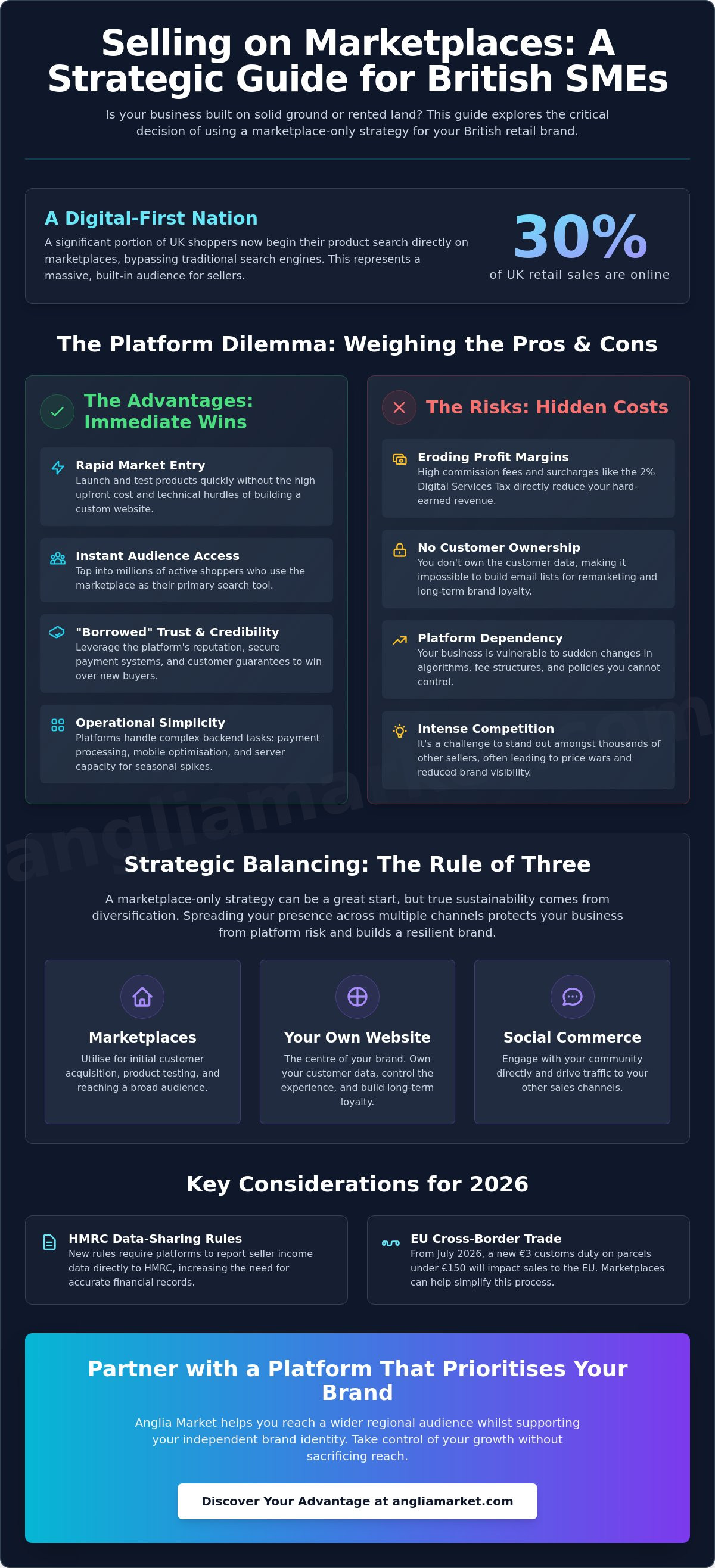
Strategic Balancing: Is a Marketplace-Only Strategy Sustainable?
Running a business solely on a platform is a tactical start, but long-term sustainability requires a broader view. As you evaluate the pros and cons of selling only on marketplaces, consider your specific product category. High-volume, low-margin items like pet supplies often thrive on platforms due to the sheer volume of traffic. However, bespoke products or high-ticket items like furniture eventually need a dedicated brand environment to justify their price point. The "Rule of Three" suggests you are only truly secure when your revenue is spread across at least three distinct channels.
Marketplaces should serve as your discovery engine. They are perfect for finding new customers who haven't heard of your brand yet. Once you've validated your product and hit the £90,000 VAT threshold, you might find the platform rules too restrictive. Signs of outgrowing the model include a high rate of repeat customers who specifically search for your brand name rather than generic product terms. If shoppers are looking for your specific brand and not just a "blue kettle," it's time to build your own digital home.
The Hybrid Approach for UK Growth
A hybrid model allows you to use marketplaces for volume whilst using your own site to build brand loyalty. Organise your inventory so that exclusive or customisable items are only available on your own store. This prevents over-reliance on a single platform's algorithm. Use the consistent cash flow from marketplace sales to fund your independent marketing efforts. This strategy ensures that even if one channel faces a sudden policy change or account issue, your British business remains operational.
Decision Framework for 2026
Assess your current margins after deducting all platform fees, the 2% Digital Services Tax surcharge, and mandatory advertising spend. If your net profit is shrinking despite rising sales, the marketplace model may be reaching its limit for you. Review your customer retention; if people aren't returning to find your brand specifically, you are still just a commodity in the platform's eyes. Identifying these trends early helps you decide when to pivot. Ready to take the next step? You can sell online with a partner that supports your independent growth rather than just your transactions.
Partnering with the Right Platform: The Anglia Market Advantage
Not all platforms are created equal. Whilst we've explored the general pros and cons of selling only on marketplaces, the specific partner you choose determines whether you are just another SKU or a valued business partner. Many global giants prioritise their own private-label brands, often competing directly with their most successful vendors. Anglia Market is built on a different philosophy. We focus on empowering independent UK enterprises by providing a platform where your growth is our primary metric of success.
Transparent fee structures are at the heart of our model. We understand that for a British SME to remain sustainable in 2026, margins must be protected. Unlike platforms that layer on hidden surcharges and complex digital taxes, we keep our costs straightforward. This allows you to plan your pricing strategy with confidence. We also facilitate a more personal connection between you and the shopper. By allowing your unique brand personality to shine through, we help you transition from a nameless vendor to a trusted local supplier.
Supportive Selling for British SMEs
Our platform is designed by people who understand the specific challenges of the UK retail climate. From managing VAT thresholds to navigating shift in consumer behaviour, we provide the tools you need to stay compliant and competitive. One of our most effective features is our loyalty program. This system is specifically designed to drive repeat business directly to your storefront, helping you build the kind of long-term customer relationships that are often missing on larger marketplaces. By being part of a curated community, you also face a significantly lower "copycat" risk compared to unmonitored global platforms.
Getting Started with Anglia Market
If you are ready to expand your reach without the technical stress of managing a standalone site, we offer a straightforward path to selling online. Our onboarding process is fast and modular, designed for busy business owners who need to see results quickly. You can also take advantage of our internal promotions to put your products in front of a high-intent British audience during peak shopping periods. When weighing the pros and cons of selling only on marketplaces, the support of a dedicated community is often the deciding factor. Join our growing network of vendors today and start scaling your business with a partner that actually wants you to succeed.
Future-Proof Your British Retail Strategy
Choosing the right path for your business in 2026 requires a clear-eyed look at the pros and cons of selling only on marketplaces. Whilst global platforms offer instant scale, they often come at the cost of high commission fees and a lack of direct customer ownership. The most successful UK SMEs are those that diversify their channels and use marketplaces as a discovery engine rather than their only revenue source. You don't have to sacrifice your brand identity just to reach a massive audience.
Sustainable growth comes from finding a platform that actually supports your independent identity. You need a partner that understands the local landscape and provides the tools to turn one-time shoppers into loyal fans. Balancing reach with brand equity is the only way to stay resilient in an evolving digital market. It's about working smarter and protecting your margins as you grow.
Ready to grow on your own terms? Join Anglia Market today and start selling to thousands of UK customers. Our platform is built specifically to be supportive of independent UK enterprises. We offer a transparent fee structure and built-in customer loyalty features to help you maintain healthy margins. We're here to help you scale your business with confidence.
Frequently Asked Questions
Is it better to sell on a marketplace or my own website first?
Starting on a marketplace is usually the most practical choice for new UK entrepreneurs. It provides instant traffic and removes the need for immediate technical investment. You can test your products whilst benefiting from established trust. Once your brand has a proven track record and consistent revenue, you can invest in a standalone website to build deeper customer loyalty.
What are the typical fees for selling on a UK marketplace in 2026?
Typical costs in 2026 include monthly subscription fees of approximately £25 excluding VAT for professional seller plans. You also face referral fees ranging from 8% to 15% and a 2% Digital Services Tax surcharge on most transactions. Fixed per-order fees for items over £10 have risen to roughly £0.40 on major platforms, whilst a 1.5% fuel and logistics surcharge applies to many fulfilment services.
Can I sell on multiple marketplaces at the same time?
Yes, selling across multiple platforms is a smart way to manage the pros and cons of selling only on marketplaces. This multi-channel approach reduces your dependency on a single algorithm and spreads your risk. It ensures that your business remains resilient if one platform changes its rules or increases its fees unexpectedly, keeping your revenue streams diversified.
How do I protect my brand when selling on a third-party platform?
You should enrol in brand protection programmes offered by the platform to secure your trademarks and intellectual property. Use high-quality, branded packaging and include your logo on all product images where permitted. Consistent brand messaging in your descriptions helps shoppers recognise your business amongst competitors and builds a sense of professional reliability.
What happens if a marketplace suspends my seller account?
If your account is suspended, your cash flow is cut off instantly and your listings are removed from search results. You will need to submit a formal appeal through the platform's support system, which can be a slow and frustrating process. This risk is a major factor when considering the pros and cons of selling only on marketplaces as a long-term strategy.
Is it possible to move my marketplace customers to my own website?
Moving customers directly is often against platform terms of service, so you must be subtle. You can build a bridge by including physical inserts in your packaging that invite shoppers to join your social media community or a loyalty programme. This creates a direct connection outside the marketplace environment, allowing you to market to them directly in the future.
How do I handle VAT and taxes when selling only on marketplaces?
Marketplaces in 2026 are required to share your sales data directly with HMRC, so transparency is essential. You must register for VAT if your 12-month rolling turnover exceeds £90,000. Ensure you use Making Tax Digital (MTD) compatible software to keep accurate digital records and avoid penalties. Always account for the 20% standard VAT rate in your pricing strategy.
What product categories perform best on UK marketplaces?
Fast-moving consumer goods generally see the highest engagement from British shoppers. Categories like pet supplies, home and garden, and electronics thrive because buyers value the convenience of combined shipping and platform-backed guarantees. These items benefit most from high-intent search traffic on large platforms, making them ideal for achieving high sales volumes quickly.

Here to help — ask anything
If you have any questions regarding this disclaimer or any of our policies, please contact Anglia Market through the contact page on our website, by email using the address provided on the site, or by phone at 0333 772 2593