

What if the most effective skincare you could buy is already being made a few miles from your door? It's a question worth sitting with, especially when the beauty aisle is crowded with imported products wrapped in vague claims about being "natural" or "organic" with very little to back them up. UK-made organic skincare has quietly become one of the most compelling choices for anyone who wants results they can trust, without the environmental cost of shipping products halfway around the world.
You're not wrong to feel confused. The gap between "natural" and genuinely certified organic is real, and brands don't always make it easy to tell the difference. Paying a premium for something that doesn't deliver is a frustrating experience nobody wants to repeat.
This guide cuts through the noise. You'll come away with a clear understanding of what UK organic certification actually means, how to build a simpler routine using British-made products, and where to discover the independent brands doing this properly. Whether you're new to organic beauty or just tired of guessing, here's everything you need to shop smarter and feel confident about every product you choose.
Key Takeaways
- UK-made organic skincare isn't just a feel-good choice — you'll discover why British-certified products consistently outperform imported alternatives on both ingredient quality and environmental impact.
- Not all "natural" or "organic" labels mean the same thing; this guide explains exactly what Soil Association and COSMOS certification actually guarantee, so you'll never pay a premium for greenwashing again.
- Transitioning to a fully organic routine is simpler than most people expect — you'll get a practical, step-by-step swap guide that removes the guesswork and protects your skin along the way.
- Independent British brands are producing some of the most nutrient-dense, effective formulations on the market, and you'll learn where to find and shop them without trawling dozens of separate websites.
- Anglia Market makes it straightforward to build your entire organic routine from multiple UK vendors in a single transaction — supporting small businesses whilst keeping your beauty miles to a minimum.
Why UK-Made Organic Skincare is the Superior Choice in 2026
UK-made organic skincare refers to products that are both formulated and manufactured within Britain, using certified organic ingredients that meet recognised standards. That definition matters more than it might seem. It rules out the brands that simply blend or repackage imported ingredients on British soil, and it sets a meaningful bar for what "local" actually means.
The case for choosing British-made goes well beyond patriotism. It's practical, environmental, and increasingly economic.
The Environmental Impact of Local Sourcing
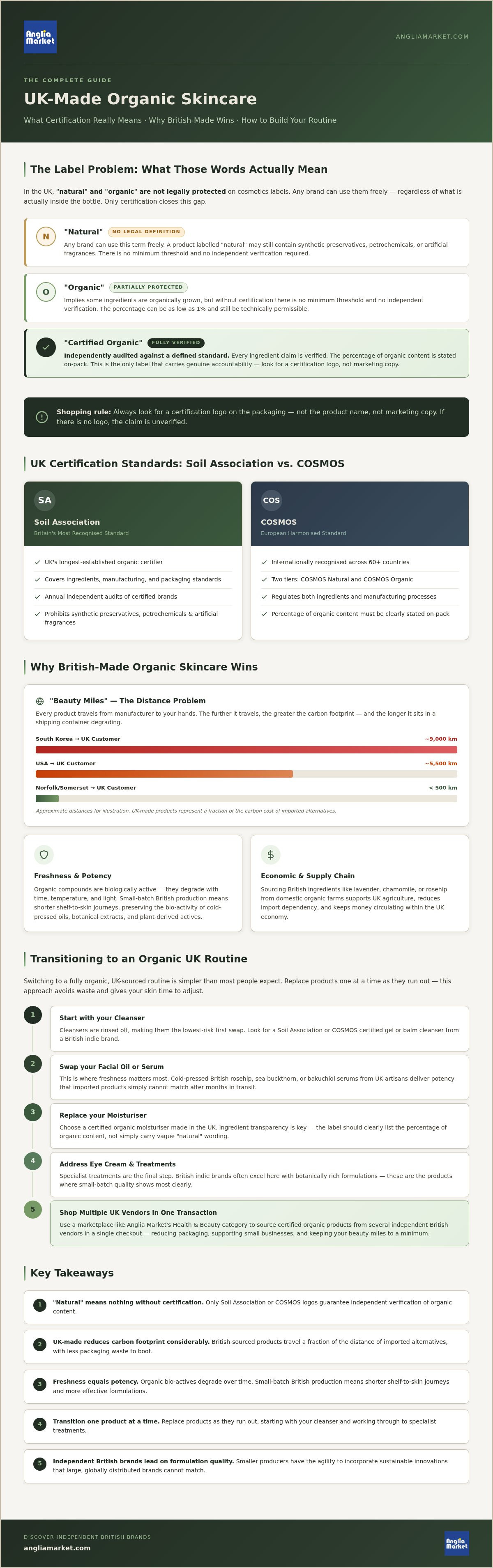
Every product you buy has travelled to reach you. "Beauty Miles" is the term used to describe the distance a skincare product travels from the point of manufacture to the consumer's hands, and for many imported brands, that figure runs into the thousands. Long-haul shipping doesn't just burn fuel; it also demands heavier, more protective packaging to survive transit, which compounds the waste problem at both ends of the supply chain.
Choosing British-made changes that equation immediately. When a product is made in Norfolk, Somerset, or the Scottish Highlands and shipped to a customer within the UK, the carbon footprint shrinks considerably. The benefits compound further when brands source ingredients like lavender, chamomile, or rosehip from British organic farms. That kind of local supply chain supports domestic agriculture, reduces import dependency, and keeps money circulating within the UK economy rather than leaving it.
Freshness and Potency of Small-Batch Production
Here's something most large imported brands won't tell you: the longer a product sits in a shipping container or a distribution warehouse, the more its active ingredients degrade. Organic compounds are biologically active, which means they respond to time, temperature, and light. A face oil that left a facility in South Korea six months ago isn't delivering the same potency it had on day one.
Small-batch UK production solves this directly. Shorter production runs mean products reach customers faster, which preserves the bio-activity of ingredients like cold-pressed oils, botanical extracts, and plant-derived actives. Fewer synthetic preservatives are needed when the shelf-to-skin journey is measured in days rather than months. Independent British artisans also have the agility to incorporate new sustainable innovations quickly, without the lengthy reformulation cycles that slow down larger, globally distributed brands.
Shopping for UK-made organic skincare through a platform like Anglia Market's Health & Beauty category gives you access to exactly these kinds of independent British vendors, all in a single transaction. Supporting their craft isn't just a feel-good choice; it's a genuinely smarter one.
Understanding Organic Certifications and British Standards
Walk down any pharmacy aisle and you'll see the words "natural" and "organic" scattered across dozens of labels. They sound reassuring. Most of the time, they mean very little. In the UK, neither term is legally protected in the same way that food labelling is, which means a brand can print "natural" on a product that contains synthetic preservatives, petrochemicals, or artificial fragrances without breaking any rules. That's the gap that certification exists to close.
Understanding the difference between these three terms is the single most useful thing you can do before spending money on skincare:
- Natural: No regulated definition in UK cosmetics law. Any brand can use it freely, regardless of what's actually inside the bottle.
- Organic: Implies that some ingredients are organically grown, but without certification, there's no minimum threshold and no independent verification.
- Certified Organic: Independently audited against a defined standard. Every ingredient claim is verified. This is the only label that carries genuine accountability.
Reading a British skincare label with this in mind changes everything. Look for a certification logo rather than relying on the product name or marketing copy. The percentage of organic content should be stated clearly, and reputable certified products will specify it on-pack, often distinguishing between organic ingredients and the total natural content.
The Soil Association vs. COSMOS: What You Need to Know
The Soil Association is the UK's longest-established organic certifier, founded in 1946 and now recognised as the gold standard for British organic integrity. Its COSMOS-certified logo on a skincare product tells you that the formulation has been independently audited, that prohibited substances are absent, and that organic ingredient claims are verified. COSMOS is the pan-European standard that harmonised organic beauty criteria across multiple countries whilst preserving the rigour that British consumers expect. The two work together: the Soil Association certifies to the COSMOS standard, so a product carrying their logo satisfies both frameworks simultaneously.
Prohibited ingredients under COSMOS certification include parabens, phthalates, synthetic fragrances, silicones, and GM-derived materials. These aren't excluded as a marketing gesture; they're excluded because the evidence base for their long-term safety or environmental impact raises legitimate concerns. When you see that logo, those substances aren't present. Full stop.
This is your most reliable defence against greenwashing, and it's exactly why genuinely certified UK-made organic skincare commands the trust it does amongst informed shoppers.
Common British Botanical Ingredients and Their Benefits
Certification matters, but so does what's actually inside the product. British-grown botanicals are increasingly recognised for their potency, partly because the UK's temperate climate produces plants with distinct phytochemical profiles.
- Calendula: Grown widely across English and Welsh organic farms, calendula is rich in flavonoids and known for its skin-soothing and anti-inflammatory properties. It's particularly effective in formulations for sensitive or reactive skin.
- Borage oil: One of the highest natural sources of gamma-linolenic acid (GLA), borage supports the skin's moisture barrier and is used in serums targeting dryness and premature ageing.
- British seaweed: Harvested sustainably from Scottish and Welsh coastlines, seaweed is rich in minerals, polysaccharides, and antioxidants. It's appearing in an increasing number of organic anti-ageing formulations for its ability to support collagen structure and hydration.
- Upcycled food industry ingredients: British brands are leading a quiet innovation here, incorporating by-products from the domestic food sector, such as fruit seed oils pressed from juice production waste, into certified skincare. It's a genuinely circular approach that reduces waste without compromising efficacy.
Knowing which ingredients to look for makes shopping far more straightforward. If you'd like to explore certified organic products from independent British vendors without visiting a dozen separate websites, Anglia Market's Health & Beauty category brings them together in one place, making it easier to compare, choose, and buy with confidence.
Organic vs Conventional Skincare: Myths and Realities
The most persistent myth in beauty is that synthetic equals effective and organic equals gentle-but-weak. It's a narrative that benefits large conventional brands, and it doesn't hold up under scrutiny. The reality is more nuanced, and once you understand what's actually inside most high-street products, the comparison shifts considerably.
Conventional skincare formulations frequently rely on water as their primary ingredient, sometimes comprising 60 to 80 percent of a product's total volume. That water acts as a carrier, but it also dilutes everything else. Emulsifiers, synthetic thickeners, and preservatives fill the remainder, leaving relatively little room for the actives that are doing the actual work on your skin. Organic formulations built around cold-pressed oils, botanical extracts, and plant-derived actives are, by contrast, nutrient-dense from the first ingredient to the last.
The Efficacy Debate: Do Organic Actives Really Work?
Take Vitamin C as a direct example. Synthetic ascorbic acid is widely used in conventional serums, but it's notoriously unstable; it oxidises quickly once a product is opened and can cause irritation at higher concentrations. British rosehip oil delivers Vitamin C alongside naturally occurring trans-retinoic acid and essential fatty acids in a stable, bioavailable form that the skin recognises and absorbs readily. You're not just getting one active in isolation; you're getting a complex of complementary compounds that work together.
There's also growing evidence that plant-based antioxidants support the skin's ability to repair UV-induced oxidative stress. Polyphenols found in botanical extracts such as green tea, sea buckthorn, and calendula have been studied for their role in neutralising free radicals generated by sun exposure. Equally important is the impact on the skin's microbiome. Synthetic preservatives like parabens and certain alcohols can disrupt the balance of beneficial bacteria on the skin's surface, compromising the barrier function over time. Organic formulations, free from these disruptors, tend to support rather than undermine the skin's natural defences.
The long-term health case is equally compelling. Some synthetic ingredients found in conventional products, including certain phthalates and chemical UV filters, are classified as potential endocrine disruptors. These are compounds that may interfere with hormonal signalling even at low doses, and their cumulative effect across multiple daily-use products is a legitimate concern that researchers continue to investigate.
Cost-Per-Use: Is Organic Beauty Actually More Expensive?
The upfront price of UK-made organic skincare is often higher, and that's a fair observation. But price-per-bottle is the wrong metric. When a face oil contains no water filler and no synthetic bulking agents, a single drop delivers genuine concentration. Most users find they use significantly less product per application compared to a conventional moisturiser or serum, which means a smaller bottle lasts considerably longer.
Consider also the hidden costs that rarely appear on a price label:
- Skin sensitivity and reactions: Synthetic fragrances and preservatives are among the most common triggers for contact dermatitis and chronic skin irritation. The ongoing cost of managing reactions, from GP visits to additional soothing products, adds up quickly.
- Environmental remediation: Synthetic chemicals that wash off skin and into waterways carry an environmental cost that isn't priced into the product. Certified organic formulations are designed to biodegrade cleanly.
- Reformulation churn: Conventional brands frequently reformulate, discontinue, and relaunch products. When a product that worked for your skin disappears, the cost of finding a replacement is real, in both money and time.
Making the switch more accessible is straightforward when you know where to look. Anglia Market's promotions page regularly features offers from independent British vendors, including those in the health and beauty space, so you can explore certified organic options at a reduced entry price without committing to full-price purchases from brands you haven't tried yet. It's a practical way to test what works for your skin before building a longer-term routine.
How to Transition to a 100% Organic, UK-Sourced Routine
Switching to UK-made organic skincare doesn't have to mean throwing everything out at once. A phased approach is kinder to your skin, your budget, and your sanity. The goal is progress, not perfection, and the process is far more manageable than most people expect.
Step 1: The "Clean Sweep" — Auditing Your Current Cabinet
Start by identifying what's worth replacing first. The "Dirty Dozen" refers to the twelve most common harmful chemicals found in conventional cosmetics, including parabens, phthalates, synthetic fragrances, formaldehyde-releasing preservatives, and certain chemical UV filters. You don't need to memorise every name; download a free ingredient scanner app and run your current products through it in an afternoon.
Prioritise swapping products that stay on your skin over wash-off formulations. A leave-on moisturiser or facial oil has prolonged contact with your skin barrier, which means its ingredient list matters considerably more than a cleanser that rinses away within seconds. Start there. Your shampoo can wait.
Step 2: Building a Core British Organic Routine
Three products cover the essentials for most skin types:
- Cream cleanser: Look for a UK-made certified organic option built around botanical oils rather than synthetic surfactants. It should remove impurities without stripping your skin's natural moisture balance.
- Facial oil: British heritage seed oils are genuinely impressive here. Hemp seed oil suits oily and combination skin because it's non-comedogenic and rich in omega-6. Raspberry seed oil works well for dry or mature skin, delivering essential fatty acids alongside natural antioxidants.
- Serum layering: Apply the thinnest consistency first and allow each layer to absorb before adding the next. Water-based serums go on before oil-based ones. Patience here pays off in results.
Patch test every new product before full application. Apply a small amount to your inner wrist or behind your ear for 24 hours. High-potency botanical extracts are effective precisely because they're bioactive, and that same potency means individual reactions, though uncommon, are worth ruling out.
Step 3: Monitoring Skin Behaviour During the Switch
Some people experience a short adjustment period in the first two to three weeks. Minor congestion or temporary changes in skin texture can occur as your skin recalibrates without the synthetic compounds it's been exposed to daily. This isn't a reason to stop; it's a reason to slow down and introduce one new product at a time.
UK seasons also affect your routine. The damp, cold months from October through February typically demand richer formulations and more occlusive oils, whilst spring and summer call for lighter textures that won't feel heavy in warmer weather. Adjusting your routine seasonally, rather than sticking rigidly to one set of products year-round, makes a noticeable difference.
Unsure whether a product actually delivers? Customer testimonials on Anglia Market offer real-world feedback from shoppers who've already made the switch, which is far more useful than marketing copy when you're deciding whether something is worth trying.
Building your routine from multiple British vendors used to mean managing several separate orders. Anglia Market's Health & Beauty category brings independent UK organic brands together in one place, so you can shop your entire core routine in a single transaction and support small British businesses at the same time.
Supporting Independent British Brands through Anglia Market
Finding genuinely certified UK-made organic skincare from independent British makers used to mean hours of searching across separate websites, managing multiple checkouts, and hoping each brand's delivery timescales aligned. Anglia Market changes that equation entirely. As a UK-focused online marketplace built specifically to support small and medium-sized businesses, it brings independent vendors together in one place so shoppers can build a complete routine without the logistical headache.
That distinction matters. Single-brand direct-to-consumer sites, however well-regarded, offer only their own range. If their formulations don't suit your skin type, you're back to square one. A multi-vendor marketplace gives you genuine choice, the kind that lets you mix a cleanser from one British artisan with a facial oil from another, all settled in a single transaction.
The Marketplace Advantage for Conscious Shoppers
The Health & Beauty category on Anglia Market is curated around quality British goods, which means you're browsing vendors who've been listed on a platform that prioritises domestic enterprise. Many of the brands you'll find there aren't stocked on the high street. That's not a limitation; it's the point. Artisan producers working in small batches rarely have the volume to supply national retailers, so a marketplace like this is often the only place to find them.
Buyer feedback plays a practical role here too. When shoppers leave honest reviews, independent sellers can refine their formulations, adjust their packaging, and respond to what their customers actually need. That feedback loop is far tighter than anything a large imported brand operates on, and it benefits everyone who shops the platform.
Explore the full range of UK vendors on Anglia Market to see the breadth of independent businesses currently selling through the platform.
Maximising Value with the Anglia Market Loyalty Program
Organic skincare is a long-term commitment, not a one-off purchase. The Anglia Market loyalty programme is built with exactly that in mind, rewarding repeat purchases so that the cost of maintaining a quality routine becomes more manageable over time. Earning rewards on your essential skincare orders means your investment in British independent brands compounds in your favour with every basket.
The broader mission connects directly to the programme's value. Anglia Market's purpose is to make reliable, varied, and fairly priced British goods accessible to more people. When you shop through the loyalty programme, you're not just saving money; you're sustaining the small producers who make UK-made organic skincare worth choosing in the first place.
Straightforward checkout. British vendors. Real rewards. It's a practical way to shop consciously without making it complicated.
Your Cleaner Routine Starts Here
UK-made organic skincare isn't a compromise. It's a smarter choice backed by genuine certification, shorter supply chains, and independent British makers who care about what goes into every bottle. You now know how to read a label, what certifications actually mean, and how to build a routine that works without the guesswork.
The practical case is straightforward: certified organic formulations deliver concentrated, bioactive ingredients without the synthetic fillers and potential disruptors found in conventional alternatives. And when those products are made in Britain, the environmental and economic benefits compound with every purchase.
You don't need to search across dozens of separate websites to find them. Anglia Market brings independent UK vendors together in one place, with secure checkout, reliable UK delivery, and a loyalty programme that rewards you for every order.
Ready to make the switch? Shop the best of UK-made organic beauty at Anglia Market today and support the independent British brands doing this properly.
Your skin, and the makers behind these products, will thank you for it.
Frequently Asked Questions About UK-Made Organic Skincare
What qualifies as "UK-made" in organic skincare?
A product genuinely qualifies as UK-made when it's both formulated and manufactured within Britain, not simply packaged or distributed here. Some brands import pre-blended bases from overseas and finish them domestically, which doesn't meet the same standard. If provenance matters to you, look for brands that explicitly state their manufacturing location and, ideally, name their ingredient suppliers. Certification bodies like the Soil Association may also provide additional traceability information on request.
Is organic skincare better for sensitive skin?
Generally, yes. Certified organic formulations exclude synthetic fragrances, parabens, and certain preservatives that are amongst the most common triggers for contact dermatitis and skin reactivity. That said, "organic" doesn't automatically mean hypoallergenic. Potent botanical extracts like essential oils can still cause reactions in some individuals. Always patch test a new product on your inner wrist for 24 hours before applying it to your face, regardless of how clean the ingredient list looks.
How can I tell if a British skincare brand is truly organic?
Look for a recognised certification logo on the packaging rather than relying on the product name or marketing language. The Soil Association's COSMOS-certified mark is the most reliable indicator for UK-made organic skincare, confirming that the formulation has been independently audited. Reputable certified products will also state the percentage of organic content clearly on-pack. If a brand uses the word "organic" prominently but carries no third-party certification logo, treat that claim with scepticism.
Does organic skincare have a shorter shelf life?
It can, yes. Without synthetic preservatives to extend stability, some certified organic products have a shorter period-after-opening than conventional alternatives. Most will display a small jar symbol on the packaging indicating how many months the product remains effective once opened, typically between six and twelve months. Storing products away from direct sunlight and heat helps preserve their potency. UK-made products from small-batch producers tend to reach you fresher than imported equivalents, which partially offsets this consideration.
Can I use organic skincare during pregnancy?
Many certified organic formulations are well-suited to pregnancy because they exclude synthetic chemicals that raise concern during this period. That said, certain potent botanical ingredients require caution regardless of their organic status. High concentrations of essential oils, retinol-adjacent plant compounds, and some herbal extracts aren't recommended during pregnancy. Always consult your midwife or GP before introducing new skincare products whilst pregnant, and check individual product guidance carefully rather than assuming certified organic means universally safe.
Are UK-made organic products always vegan and cruelty-free?
Not automatically. Certified organic and vegan are separate standards with separate certification processes. Some organic formulations include beeswax, lanolin, or honey, which are animal-derived but not cruelly obtained. If vegan status matters to you, look for a Vegan Society trademark alongside the organic certification. Similarly, cruelty-free status requires its own verification. Many independent British organic brands do hold both accreditations, but it's worth checking each product individually rather than assuming.
How do I find independent British skincare brands online?
Independent British organic brands rarely appear on major high-street retail platforms because their small-batch production volumes don't suit large-scale distribution. Dedicated UK marketplaces are a more practical starting point. Anglia Market's Health & Beauty category brings together independent UK vendors in one place, letting you browse and purchase from multiple British makers in a single transaction without managing separate checkouts. It's a straightforward way to discover producers you wouldn't find through conventional retail searches.
Why is the Soil Association logo important for UK beauty products?
The Soil Association is the UK's longest-established organic certifier, and its logo on a beauty product confirms independent, third-party verification rather than a self-declared claim. It certifies to the COSMOS standard, meaning prohibited substances including parabens, phthalates, silicones, and synthetic fragrances have been independently confirmed as absent. For shoppers, it removes the guesswork entirely. You don't need to scrutinise every ingredient; the logo tells you the work has already been done by an accredited auditor with no commercial interest in the outcome.

Here to help — ask anything
For questions about this disclaimer or the site, contact us via the website’s Contact page.


