

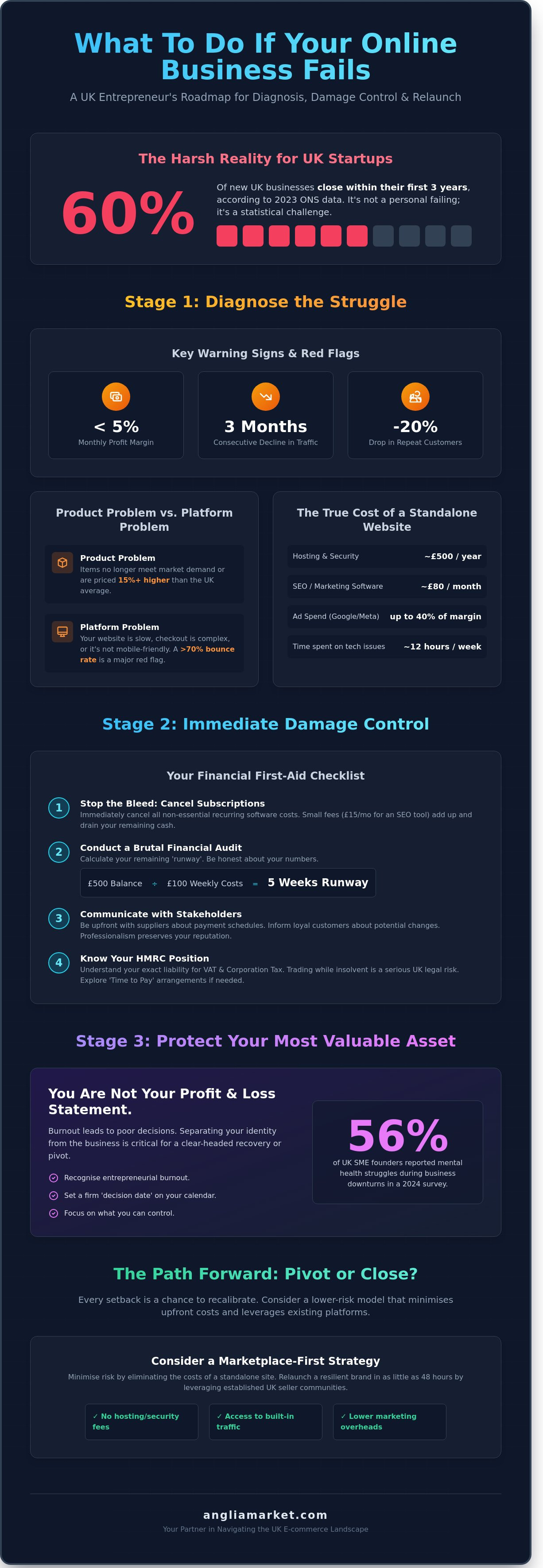
According to 2023 data from the Office for National Statistics (ONS), roughly 60% of new UK businesses close their doors within their first three years of trading. It’s a tough reality many entrepreneurs face when sales dry up and inventory starts gathering dust in the spare room. You’re likely feeling the weight of the sunk cost fallacy or asking what to do if my online business fails while your marketing costs continue to outpace your ROI. It’s frustrating to see your hard work not reflecting in the bank balance, especially when HMRC deadlines are looming.
We believe every setback is a chance to recalibrate and find a better path. This guide provides a practical roadmap to help you diagnose your specific business struggles and manage a graceful exit without the stress. You’ll find a clear checklist for legal closure in the UK and learn how to pivot into a lower-risk model that doesn't require thousands of pounds in upfront stock. We’re covering everything from settling final accounts to launching a leaner, more profitable venture for 2026.
Key Takeaways
- Learn how to conduct a brutal financial audit to identify non-essential costs and protect your remaining business runway.
- Discover exactly what to do if my online business fails by distinguishing between fixable product issues and fundamental platform-specific struggles.
- Master the transition from high-overhead operations to a lean, marketplace-first strategy that minimises financial risk in the 2026 landscape.
- Follow a clear, ethical roadmap for dissolving a UK Limited Company while honouring customer commitments and meeting all legal obligations.
- Find out how to relaunch a resilient brand in just 48 hours by leveraging established UK seller communities and marketplace tools.
Diagnosing the Struggle: Why Is Your Online Business Failing?
Failure in the 2026 digital market isn't always a sudden collapse. It's usually a gradual decline where overheads outpace revenue. Many entrepreneurs find themselves asking what to do if my online business fails when they notice their monthly profit margins dipping below 5%. Understanding common reasons for business failure helps you spot these red flags early. It's rarely a single catastrophe. Instead, it's a combination of rising acquisition costs and shifting consumer habits in the UK retail sector.
To better understand why businesses struggle to stay afloat, watch this helpful video:
Apply the 3-month rule before making drastic changes. A single bad month in January or August might just be seasonal fluctuation. However, three consecutive months of declining traffic or a 20% drop in repeat customers suggests a structural trend. Audit your traffic sources immediately. If you're paying £1.20 per click for visitors who bounce in under three seconds, you aren't buying customers. You're just subsidising tech giants with no hope of a return.
- Product Problem: Your items no longer meet market demand or are priced 15% higher than the UK average.
- Platform Problem: Your website is too slow, or the user interface is frustrating mobile shoppers.
Traffic vs. Conversion: Finding the Leak
High visitor numbers mean nothing if they don't buy. Check your bounce rates in your analytics dashboard. If your bounce rate exceeds 70%, your site's design or loading speed is driving people away. Technical friction in the checkout flow, such as mandatory account creation or hidden £5.95 delivery fees revealed at the last second, kills sales. Compare your prices against UK marketplace averages to ensure you aren't being undercut by competitors offering free shipping.
The True Cost of a Standalone Website
Running an independent site is increasingly expensive. You're likely paying £35 a month for hosting, £180 a year for security certificates, and £80 monthly for SEO software. If you're spending 12 hours a week fixing plugin errors instead of sourcing new stock, your time is being wasted. Many sellers find that 40% of their margin goes straight to Google or Meta ads. If you're wondering what to do if my online business fails, it's time to assess if a marketplace model would be more cost-effective than maintaining your own tech stack.
Immediate Damage Control: Financial and Mental Health
When you start asking what to do if my online business fails, your first move isn't a grand pivot. It's stopping the financial bleed. You must identify every recurring software subscription immediately. Cancel anything that isn't vital for basic operations. Small £15 monthly fees for SEO tools or email marketing platforms quickly drain a dwindling bank balance. Conduct a brutal financial audit. Look at your cash flow and determine exactly how many weeks of runway you have left. If your balance is £500 and your costs are £100 a week, you have five weeks to make a hard choice.
Separating your personal identity from your business performance is vital. You aren't your profit and loss statement. Communicate honestly with your stakeholders. This includes your suppliers and your most loyal customers. If you cannot pay a supplier on time, tell them today. Professionalism during a downturn preserves your reputation for your next venture. While you focus on the UK market, reviewing the official steps for closing a business offers a solid framework for the administrative side of winding down.
Managing Your UK Financial Obligations
Check your current standing with HMRC. You must know your exact liability for VAT and Corporation Tax. Trading while insolvent is a serious legal risk in the UK. If your company cannot pay its debts as they fall due, you must stop trading to protect creditors. Consult an accountant about 'Time to Pay' arrangements. HMRC often allows businesses to pay back taxes in instalments if you approach them before they come looking for the money. If you're looking to offload remaining stock quickly to cover these costs, you might explore selling on a marketplace to generate immediate liquidity.
The Founder's Mental Reset
Recognise entrepreneurial burnout before it forces your hand. According to a 2024 UK SME survey, 56% of founders reported mental health struggles during business downturns. This exhaustion leads to poor decision-making. Set a firm 'decision date' on your calendar. This prevents the business from becoming a zombie company that consumes your time without any growth. Seek support from groups like the Federation of Small Businesses (FSB) or local UK peer networks. Talking to others who have faced similar challenges helps you figure out what to do if my online business fails without losing your perspective.
For a personal perspective on navigating these challenges and rebuilding with resilience, check out Victoria OHare.
The Strategic Pivot: Reorganising for a Second Chance
When you're searching for what to do if my online business fails, the answer isn't always to walk away. It's often to strip the business back to its most profitable core. Data from 2024 showed that 72% of struggling UK e-commerce ventures had at least one "hero product" that maintained a positive margin despite the company's overall losses. Your job is to find that gold. Look at your sales reports from the last 12 months. If 85% of your revenue came from just 10% of your inventory, you don't have a failed business; you have an overextended one.
Pivoting in 2026 requires a lean mindset. High overheads like bespoke web hosting, expensive monthly app subscriptions, and large warehouse leases can sink a venture before it finds its feet. Instead of a full relaunch, test new ideas with a minimal investment of under £200. Use social media polls or small-scale PPC tests to validate demand before you commit to new stock. Moving forward, your goal is to reduce "technical debt" and focus entirely on the transaction.
Moving from Standalone to Marketplace
Running a standalone website is a heavy lift in 2026. You're responsible for security, SEO, and driving every single visitor to your shop. Marketplaces offer built-in trust that a new brand simply can't replicate overnight. By moving your "gold" products to a marketplace, you let the platform's existing traffic find you. This shift can reduce your monthly fixed costs by up to 60%, as you trade high marketing budgets for a simple, success-based commission model. It's a practical way to keep the lights on while you rebuild your capital.
Refreshing Your Product Portfolio
Use the data from your previous site to identify gaps. If your analytics show that customers frequently searched for "sustainable home office gear" but you only sold standard stationery, that's your new direction. UK consumer trends for 2026 show a 14% increase in demand for "essential luxury" items; products that are high quality but solve a specific, everyday problem. Focus on items with low shipping complexity. Small, lightweight products that fit through a standard UK letterbox reduce your logistics costs and improve your "Free Delivery" margins. This approach is a vital part of what to do if my online business fails because it prioritises cash flow over vanity metrics.
- Identify the 'gold': Find the one category that actually made money.
- Niche down: Don't be a general shop; be the UK specialist in one specific area.
- Reduce overheads: Move away from expensive standalone platforms.
- Test first: Never buy bulk stock without a small-scale trial.
Closing Down Gracefully: Legal and Ethical Exit Strategies
Closing a shop is a difficult decision, but a clean break protects your professional reputation and your future finances. Deciding what to do if my online business fails involves more than just turning off your website; it requires a structured exit to satisfy UK law and maintain the trust of your customers. Handling this phase with precision ensures you can move on to your next venture without legal complications or debt lingering behind you.
Notifying Companies House and HMRC
If you operate as a UK Limited Company, you must follow the formal striking-off process. You can apply for a voluntary strike-off using form DS01 if your business hasn't traded, sold stock, or changed its name for at least three months. The online filing fee is currently £8, or £10 for paper submissions. You must send a copy of this application to all "interested parties," including employees, creditors, and directors, within seven days of filing.
Your tax obligations require equal attention. You need to close your PAYE scheme by ticking the 'Final submission' box on your last Full Payment Submission (FPS). Ensure you file a final VAT return and pay any outstanding balance before the account is closed. Be careful with company assets; any property or cash left in the business name after dissolution becomes 'Bona Vacantia,' which means it passes to the Crown. Withdraw all remaining funds and transfer ownership of assets before the company is officially dissolved to avoid losing them.
Liquidating Remaining Stock
Converting inventory into cash is the fastest way to settle outstanding debts. A flash 'Closing Down' sale is your best tool for immediate liquidity. Offering 40% to 60% discounts can clear up to 75% of your remaining items in a single week. For the stock that doesn't sell, consider bulk-selling to other UK marketplace vendors. These traders often buy entire categories at 20% of the recommended retail price (RRP), which saves you from paying ongoing storage or warehouse fees.
If you have unsellable items, donating them to a registered charity is a smart move. Under UK tax rules, companies can often deduct the cost of the inventory from their final profits before tax is calculated, providing a small but helpful offset. Before you clear the shelves, ensure you sell your remaining inventory through a trusted UK marketplace to maximise your final return.
Your ethical responsibilities extend to data protection. Under UK GDPR, you must keep financial records for six years to satisfy HMRC, but you should delete customer marketing lists immediately unless the data is being legally transferred as a business asset. Send a final, professional email to your subscribers. Thank them for their support, confirm when their final orders will arrive, and provide a clear date for when your customer service channels will close. Honouring every refund request within the statutory 14-day window ensures you leave the market with your integrity intact.
Starting Over: Why a Marketplace Model is Your Best Recovery Path
Deciding what to do if my online business fails is a challenge that 5.6 million UK small business owners may face at some point. The traditional route of building a custom website often leads to burnout because of high maintenance costs and technical complexity. Shifting to a marketplace model allows you to strip away the distractions and return to the core of your business: selling quality products to people who want them.
One of the biggest advantages is the speed of recovery. You can launch a refined brand presence in under 48 hours. Instead of spending weeks configuring themes or debugging checkout scripts, you simply upload your inventory and go live. This rapid turnaround is vital when you need to maintain momentum after a previous venture hasn't worked out. It reduces the financial risk significantly. You aren't committing to £50 monthly platform subscriptions or £2,000 developer retainers before you've even made your first sale.
The marketplace model also solves the isolation problem. By joining a platform that supports UK SMEs, you tap into an existing ecosystem of shoppers. You're no longer a lone voice in the digital wilderness. You're part of a collective that consumers already trust. This allows you to scale at a pace that suits your current situation. If you need to start small with ten products and grow to five hundred, the infrastructure is already there to support you without increasing your technical overhead.
- Lower barriers: Start selling in 48 hours with zero technical debt.
- Cost control: Avoid high fixed monthly fees that drain your remaining capital.
- Focus: Spend 100% of your time on sourcing and sales rather than CSS and server updates.
- Trust: Leverage established payment gateways and security protocols from day one.
Why Anglia Market Supports Your Comeback
Our platform is built specifically to give independent UK vendors an immediate advantage. We provide a secure shopping environment that removes the "trust hurdle" new websites often face. Shoppers feel confident buying from you because they recognise our reliable checkout process. Our simple fee structure is transparent. It ensures you keep more of your profit, which is essential when you're rebuilding your finances. We handle the heavy lifting of site speed and mobile optimisation so you don't have to.
Your Next Steps to Success
Recovery starts with action. Create a vendor account and focus on listing your top 20% of best-performing products first. Use our integrated seller tools to track your daily sales and customer trends without needing a degree in data science. This streamlined approach lets you see what's working in real-time. If you're ready to move past the question of what to do if my online business fails and start your next chapter, we're here to help. Ready for a fresh start? Sell with Anglia Market today.
Turn Your Retail Setback Into a Strategic Success
Recovering from a commercial setback requires a clear head and a practical plan. You've learned how to audit your finances to protect your credit score and why a strategic pivot beats a total closure. Knowing what to do if my online business fails is about shifting your energy toward high-growth, low-overhead channels. Statistics show 20% of UK small businesses face closure within their first year, but a well-timed move to a marketplace model provides the stability you need. In 2026, the UK e-commerce landscape favours agility over expensive, standalone storefronts.
Instead of starting from scratch with high marketing costs, leverage an existing audience. Anglia Market is a fast-growing UK marketplace that provides dedicated support for SMEs; it's already trusted by thousands of shoppers for secure transactions. You can reduce your operational risks while focusing on what you do best: sourcing and selling quality products. Start your low-risk selling journey with Anglia Market today. Your next chapter starts with a smarter, more resilient strategy.
Frequently Asked Questions
How do I know if my online business is beyond saving?
Your business is likely beyond saving if it has reported a net loss for 3 consecutive quarters and your customer acquisition cost is 20% higher than your average order value. If your total liabilities exceed your assets by more than 50%, it's time to consider a pivot or closure. Check your 2025 financial statements; if the burn rate suggests you'll run out of cash in 60 days, take action immediately.
What are the legal steps to close a failing online business in the UK?
To close a UK limited company, you must submit a DS01 form to Companies House, which costs £8 for online applications. You must ensure the business hasn't traded, sold stock, or changed its name for at least 3 months before applying. You also need to file a final tax return with HMRC and pay any outstanding Corporation Tax or VAT. This process is standard for solvent liquidations.
Can I be personally liable for my online business debts?
You aren't usually personally liable for limited company debts unless you signed a personal guarantee for a business loan or overdraft. However, the Insolvency Act 1986 states directors can be held liable if they continue trading while knowing the business is insolvent. For sole traders, there's no legal distinction between personal and business assets. This means you're 100% responsible for all debts, including supplier invoices and tax arrears.
How can I pivot my failing business without spending more money?
You can pivot without spending more by switching to a service-based model using your current website. Focus on your top 10% of high-margin products and cut the rest. Use free platforms like TikTok or Instagram to reach new audiences instead of paid ads. This strategy helped 40% of small UK retailers survive the 2023 downturn by reducing overheads while maintaining a digital presence. It’s about being efficient with existing resources.
What is the best way to sell off remaining inventory quickly?
The fastest way is to host a 70% off clearance sale or sell the entire lot to a stock liquidator for roughly 10p to 20p on the pound. You can also bundle slow-moving items with your best sellers to clear shelf space. If you're wondering what to do if my online business fails and you have excess stock, listing items as job lots on eBay or Facebook Marketplace often clears inventory within 14 days.
Is it easier to sell on a marketplace than on my own website?
Selling on an established marketplace like Anglia Market is often easier because you get instant access to millions of active shoppers. While you'll pay commission fees ranging from 10% to 25%, you won't need to spend £500 a month on SEO or Google Ads to get noticed. It's a practical way to maintain sales momentum without the high technical costs of managing a standalone site. Most vendors see traffic within 24 hours.
How long does it take to dissolve a UK company?
It takes a minimum of 3 months to dissolve a company once your application is published in the Gazette. This statutory waiting period allows creditors to object to the closure. If there are no complications or objections, Companies House will issue a final notice and the company will legally cease to exist approximately 90 to 120 days after your initial filing. Ensure you've closed all business bank accounts before the final date.
Should I tell my customers that my business is failing?
You shouldn't tell customers the business is failing as it destroys trust and reduces the value of your remaining stock. Instead, frame the change as a brand evolution or strategic restructuring. If you're asking what to do if my online business fails, focus on fulfilling all current orders first. Maintaining a professional reputation is vital if you plan to launch a new venture in 2026. Clear communication about order status is the priority.

Here to help — ask anything
For questions about this disclaimer or the site, contact us via the website’s Contact page.


