
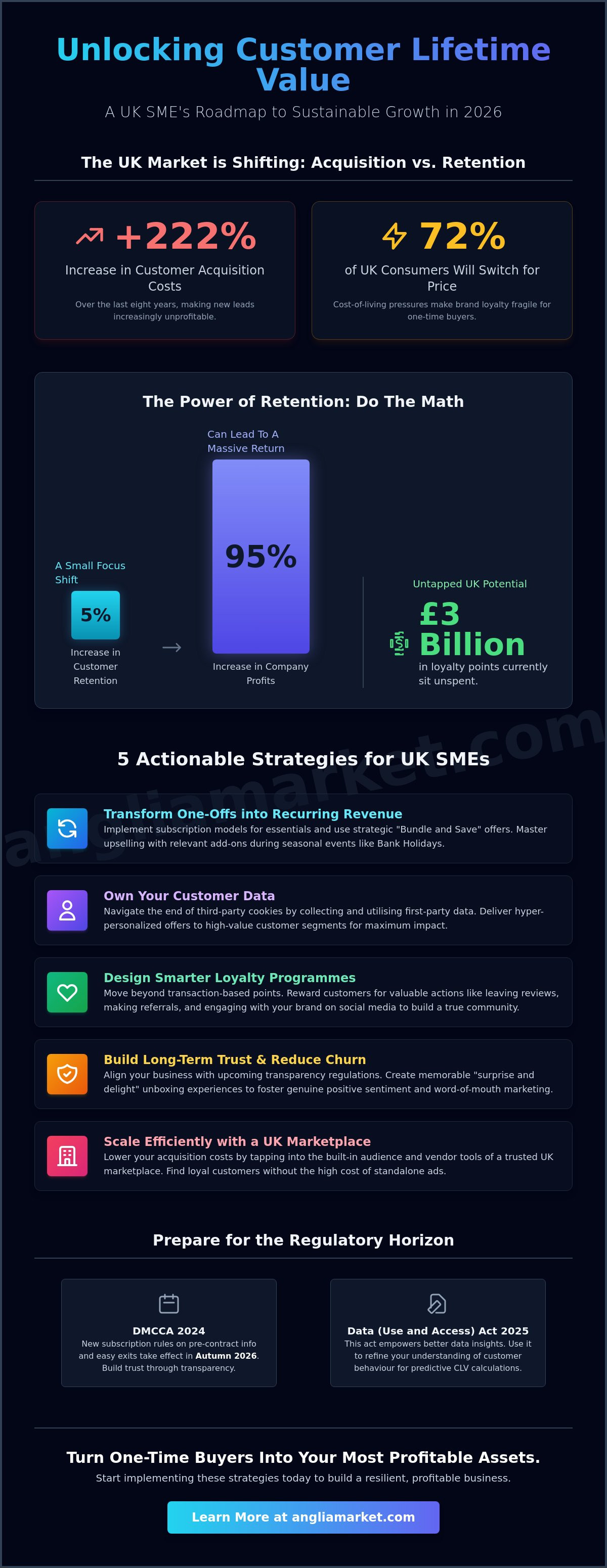
With the cost of acquiring new customers soaring by 222% over the last eight years, your marketing budget is likely feeling the squeeze. You've probably noticed that relying on new leads is a losing game, especially when 72% of UK consumers are ready to switch to cheaper brands at a moment's notice. It's frustrating to watch profit margins shrink while churn rates stay high. You need a way to make existing customers stay longer and spend more. This requires a shift in focus.
This guide provides the roadmap you need to implement effective strategies to increase customer lifetime value uk. You'll discover how to drive sustainable growth and build genuine loyalty using UK-specific retention frameworks. A 5% increase in retention can boost profits by up to 95%, yet £3 billion in UK loyalty points currently sit unspent. We'll cover ten actionable tactics, including how to use the Data (Use and Access) Act 2025 for better insights and how to master the new DMCCA 2024 subscription rules taking effect in Autumn 2026. Turn one-time buyers into your most profitable assets today.
Key Takeaways
- Transform one-off transactions into recurring revenue by implementing subscription models and strategic upselling tailored for the UK market.
- Own your customer data to navigate the end of third-party cookies and deliver hyper-personalized offers to specific buyer segments.
- Discover proven strategies to increase customer lifetime value uk by designing loyalty programmes that reward reviews and referrals rather than just spending.
- Build long-term trust and reduce churn by aligning your business with 2026 transparency regulations and "surprise and delight" unboxing experiences.
- Scale your SME efficiently by using the built-in audience and vendor tools of a trusted UK marketplace like Anglia Market to lower your acquisition costs.
What is Customer Lifetime Value (CLV) and Why Does it Matter in the UK in 2026?
In the competitive British retail market, What is Customer Lifetime Value (CLV) represents the total revenue a UK business expects from a single customer account throughout the entire relationship. It's not just about the first sale. It's about the second, fifth, and tenth purchase. For SMEs, understanding this metric is the difference between struggling with tight margins and building a sustainable, profitable brand. Implementing effective strategies to increase customer lifetime value uk has become the top priority for 2026.
The 2026 UK landscape is tough. Digital advertising costs on social media have climbed by 222% over the last eight years. This makes acquisition incredibly expensive. Meanwhile, 72% of UK consumers are now likely to switch to cheaper brands due to ongoing cost-of-living pressures. If you're constantly paying to find new buyers who only purchase once, your profit margins will vanish. Retention is now the primary profit driver. The "Retention Math" proves this; a 5% increase in customer retention can boost your profits by 25% or more. In the British market, you must distinguish between transactional buyers who chase a single deal and "Brand Advocates" who return for your reliability.
The Shift from Acquisition to Retention
UK digital ad spend is yielding lower ROI in 2026 because the market is saturated. The "Retention Gap" in UK retail is the growing distance between a customer's first purchase and their eventual churn due to a lack of engagement. British consumers are tired of "newness" for the sake of it. Instead, they are prioritising reliability and value. They want brands that offer consistency and transparency, especially following the 2026 advertising restrictions on less healthy products and stricter data rules. Focusing on retention fills this gap and stabilises your revenue.
Calculating CLV for Your UK Business
You can't improve what you don't measure. Use this simplified formula: (Average Order Value x Purchase Frequency) x Customer Lifespan. While historical data is useful, UK SMEs should focus on "Predictive CLV" in 2026. This uses AI and first-party data to guess how much a customer will spend in the future based on their current behaviour. By identifying "High-Value Segments," you can tailor your marketing to the people most likely to stay loyal. If you want to reach a wider audience without the high cost of standalone ads, consider how selling online through a trusted marketplace can help you find these long-term customers.
Core Strategies to Boost Purchase Frequency and Order Value
Boosting purchase frequency is about making the next transaction inevitable. In 2026, UK SMEs must move beyond simply hoping for a return visit. Successful strategies to increase customer lifetime value uk rely on "Frequently Bought Together" logic. This isn't just a tactic for global giants. Small vendors can use these associations to increase basket size by showing complementary items, like bulbs for a lamp or filters for a coffee machine. It's a simple way to add value while increasing the total order amount.
Subscription models are another heavy hitter for 2026. By Autumn 2026, the Digital Markets, Competition, and Consumers Act (DMCCA) will require clearer pre-contract info and easy exit routes. While these rules are strict, they actually help build the trust needed for long-term loyalty. Transforming one-off purchases into recurring revenue for items like pet supplies or office essentials ensures a steady cash flow. Pair this with "Bundle and Save" promotions. Offering a small discount when three items are bought together often costs much less than acquiring three separate customers through paid ads.
Post-purchase workflows are the final piece of the puzzle. Use automated emails timed to UK time zones to encourage that crucial second purchase. A simple "Thank You" followed by a tailored recommendation three days later keeps your brand at the front of the customer's mind. If you want to see how these deals look in practice, explore the latest clearance offers to understand how top vendors structure their value-driven pricing.
Mastering the Upsell in the UK Market
British consumers value transparency over high-pressure sales. To upsell effectively, offer relevant additions that genuinely enhance the primary product. Use seasonal UK events to your advantage. High-value bundles perform exceptionally well during Bank Holiday sales or the lead-up to Christmas. You can easily set up these value-driven offers using Anglia Market Promotions to capture attention and reward your most frequent shoppers without appearing pushy.
The Power of Replenishment Reminders
Timing is everything for repeat business. If a customer buys a 30-day supply of a product, an email on day 25 is far more effective than a generic monthly newsletter. Use first-party data, managed under the Data (Use and Access) Act 2025 reforms, to predict when stock is low. Personalise these nudges based on previous UK delivery preferences. A well-timed replenishment email can achieve an ROI of up to 20 times the spend because it solves a problem before the customer even notices it.
Leveraging Personalisation and First-Party Data
The total phase-out of third-party cookies in 2026 means UK businesses can no longer rely on external trackers to understand their audience. To succeed, you must own your data. This shift is a core part of modern strategies to increase customer lifetime value uk. Relying on first-party data—information given directly by your shoppers—allows you to build a more accurate picture of their needs. Since the Data (Use and Access) Act 2025 reforms took effect on February 5, 2026, UK SMEs have more flexibility in how they use data, provided they remain transparent about automated decision-making.
Effective segmentation is the next step. In a market where 72% of consumers are likely to switch to cheaper brands, you need to know who you're talking to. Divide your database into groups like "Bargain Hunters," who respond to clearance deals, and "Premium Seekers," who value quality and exclusive launches. Companies that master this type of personalisation generate 40% more revenue than those that don't. By delivering the right offer to the right group, you reduce wasted ad spend and keep your profit margins healthy.
Transparency is vital for the British shopper. While shoppers want a tailored experience, they also value their privacy. Navigating UK GDPR and the new mandatory data protection complaints procedure starting in June 2026 requires a clear "privacy-first" approach. Be honest about why you're collecting data. When customers trust how you handle their information, they are far more likely to stay loyal to your brand over the long term.
Building Your First-Party Data Asset
Collecting data doesn't have to be complicated. UK SMEs can use simple tools like preference centres, unboxing quizzes, or account creation prompts. The key is the "Value Exchange." Give your customers a reason to share their details, such as early access to new arrivals or personalised style guides. You can also use Anglia Market Profiles to manage your vendor-customer visibility. This helps you build a direct line to your buyers while staying within a trusted marketplace environment.
AI-Driven Personalisation for SMEs
In 2026, AI tools allow small businesses to act like enterprise giants. You can now use predictive models to suggest products based on local UK trends or a shopper's specific browsing history. Dynamic content is particularly effective; try changing your homepage banners or email headers based on whether a shopper is in London or Edinburgh. Just be careful to avoid "creepy" personalisation. British retail culture prefers a helpful facilitator over an intrusive tracker. Keep your suggestions relevant and helpful to maintain a positive brand image.
Building a UK-Centric Retention Framework: Loyalty and Community
In a market where 72% of UK consumers are prepared to switch brands for a better price, traditional loyalty is under pressure. You cannot rely on brand name alone to keep customers coming back. Building a robust retention framework is one of the most effective strategies to increase customer lifetime value uk. This starts by rewarding more than just spending. In 2026, savvy businesses reward engagement. Offer points for product reviews, social media shares, or successful referrals. This turns your customers into active participants in your growth rather than passive buyers.
The second step involves "Surprise and Delight" moments. In an era of automated logistics, a personal touch stands out. Including a handwritten thank-you note or a small unboxing gift can drastically improve customer sentiment. These small gestures build the trust needed to reduce churn. Pair this with a clear feedback loop. Actively soliciting and acting on customer feedback shows you value their input. When shoppers see their suggestions implemented, they feel a sense of ownership in your brand. This emotional connection is a powerful barrier against competitors offering lower prices.
Effective Loyalty Programmes for 2026
UK retail generally favours two models: points-based and tier-based systems. Points-based systems are simple and provide immediate gratification. However, tier-based systems often drive higher lifetime value by offering exclusive perks to your "VIP" shoppers. The key is to offer "Easy Wins." Give new members a reward early in their journey to prove the value of the programme. For a practical example of how to structure these rewards, you can study the Anglia Market Loyalty Program. It serves as a model for how vendors can incentivise repeat purchases without complex hurdles. If you want to start building your own loyal following, consider how you can become a vendor and access these built-in tools.
Community as a Retention Moat
Community-Led Growth in 2026 is a strategy where a business treats its customer base as a primary engine for organic acquisition through shared values and active participation. UK SMEs can use platforms like Facebook and Instagram to build a "tribe" around their niche. Encourage User-Generated Content (UGC) by running competitions for the best customer photos. This provides you with authentic marketing material and makes your customers feel like stars. A strong community acts as a moat, making it much harder for customers to leave just because a competitor has a sale. When people feel they belong to a community, their loyalty shifts from the product to the group itself.
Scaling Your SME with Anglia Market: A Partner in CLV
Selling on a UK-focused marketplace like Anglia Market provides built-in trust from day one. This is a critical component of strategies to increase customer lifetime value uk because it removes the initial barrier of shopper skepticism. When you join a platform that specifically supports small and medium businesses, you benefit from a collective reputation. Shoppers looking for home and garden essentials or toys and games already trust the marketplace environment. This allows you to reach a broader UK audience without the high individual cost of digital advertising. You can focus your budget on retention rather than fighting the 222% increase in acquisition costs seen over recent years.
Anglia Market supports independent vendors by providing the infrastructure needed for long-term relationships. In 2026, UK consumers are increasingly value-led. They want to support genuine, independent brands that align with their beliefs. By being part of a trusted ecosystem, you gain access to marketplace tools that facilitate repeat purchases. Features like secure shopping and transparent delivery updates build the reliability British shoppers crave. This platform model allows you to leverage "Frequently Bought Together" logic and promotional tools to increase order value effortlessly. You are not just making a sale; you are joining a community designed for sustainable growth.
Becoming a Successful Vendor
You can sell online and immediately access features that drive customer loyalty. The platform handles the technical complexities of the Data (Use and Access) Act 2025 and DMCCA 2024 compliance. This lets you focus on your products. Utilise the platform's security and dedicated support through Anglia Market Support to build buyer confidence. Showcasing your unique brand story in the Anglia Market Vendors directory is essential. It helps you stand out to the 72% of UK consumers who are currently looking for better value and more authentic shopping experiences. A clear profile helps turn a casual browser into a repeat customer.
Next Steps for Your Growth Strategy
Audit your current retention rate today to see where you are losing shoppers. Pick one "Quick Win" to implement immediately, such as setting up an automated follow-up email or creating a "Bundle and Save" deal. In the 2026 retail landscape, small adjustments lead to significant profit improvements. Companies that excel at this level of focus generate 40% more revenue than their competitors. Don't let your marketing budget balloon while your margins shrink. Start selling and growing with Anglia Market today.
Future-Proof Your UK Business Growth
The 2026 retail landscape rewards businesses that prioritise existing relationships over expensive new acquisitions. With the cost of finding new customers up by 222% since 2018, your success depends on how well you keep people coming back. Implementing the right strategies to increase customer lifetime value uk turns casual shoppers into long-term advocates who drive sustainable profit. By owning your first-party data under the Data (Use and Access) Act 2025 and building a community-led brand, you create a moat that competitors can't easily cross.
Scaling doesn't have to mean ballooning your marketing budget. Joining a trusted ecosystem provides the visibility and support you need to thrive. As a dedicated marketplace supporting UK small and medium businesses, Anglia Market offers a secure shopping environment for categories like furniture, electronics, and home goods. You get access to dedicated vendor support and built-in tools designed to foster trust and repeat business. Take the next step in your growth journey and Join Anglia Market and start scaling your UK business today. Your most profitable customers are waiting to discover your brand.
Frequently Asked Questions
What is a good Customer Lifetime Value for a UK eCommerce business?
A benchmark for UK e-commerce CLV typically falls between £80 and £240 per customer. You should aim for a value that is at least three times your acquisition cost to remain profitable. If your average order value is lower, you must focus on increasing purchase frequency. Monitoring this ratio helps you refine your strategies to increase customer lifetime value uk without overspending on marketing.
How does the UK cost-of-living crisis affect CLV in 2026?
Economic pressure makes UK shoppers more sensitive to price, but they also value long-term reliability. In 2026, consumers are making decisions based on brand values and transparency regarding pricing. While loyalty is harder to win, shoppers stay longer with brands that offer genuine value. Focusing on trust and clear communication is the best way to protect your margins during periods of high inflation.
Can small businesses compete with retail giants on customer loyalty?
SMEs compete by offering niche expertise and a community feel that global marketplaces lack. While mass-market platforms win on logistics, small vendors build loyalty through "Brand Advocacy" and high-quality unboxing experiences. Shoppers in 2026 have a clear appetite for rewards from independent sellers who provide a more personal and rewarding shopping journey. This personal touch builds a connection that large-scale automation can't replicate.
How often should I calculate my CLV?
Calculate your CLV at least once every quarter to stay ahead of market shifts. High-volume sellers should perform monthly audits to track the impact of specific campaigns or seasonal events. Use "Predictive CLV" to identify which customers are likely to spend more in the future. Regular calculations ensure you can adjust your retention tactics before high-value shoppers begin to churn.
Does offering discounts harm my long-term Customer Lifetime Value?
Constant discounting can devalue your brand and attract shoppers who only buy during sales. This creates a cycle of low-margin transactions that hurts your long-term growth. Instead of deep price cuts, use tiered pricing or "Bundle and Save" promotions. These methods increase the initial order value without damaging the perceived quality of your products or your overall profit margins.
What is the most effective way to reduce customer churn in the UK?
Proactive service is the most successful way to keep UK customers from leaving your brand. Use your data to anticipate when a customer might need assistance or a product restock. The trend in 2026 has moved from reactive support to solving problems before the customer even notices them. Providing helpful, timely information builds the trust necessary for a long-term commercial relationship.
Is a loyalty programme worth the investment for an SME?
Loyalty programs are highly effective for SMEs because they provide a structured way to reward repeat engagement. A program that rewards reviews and referrals, rather than just spending, turns customers into active growth partners. This structure is far more cost-effective than constantly paying for new social media leads. Most UK consumers are eager to join schemes that offer genuine, easy-to-reach benefits.
How can I increase CLV on a third-party marketplace?
Focus on building a strong vendor profile and providing exceptional after-sales support. Use marketplace tools to showcase your unique brand story and encourage repeat purchases through tailored promotions. Reliable delivery and secure shopping are the foundations of trust in a marketplace environment. When you provide a consistent, high-quality experience, buyers will look for your specific shop name the next time they need similar products.

Here to help — ask anything
If you have any questions regarding this disclaimer or any of our policies, please contact Anglia Market through the contact page on our website, by email using the address provided on the site, or by phone at 0333 772 2593