
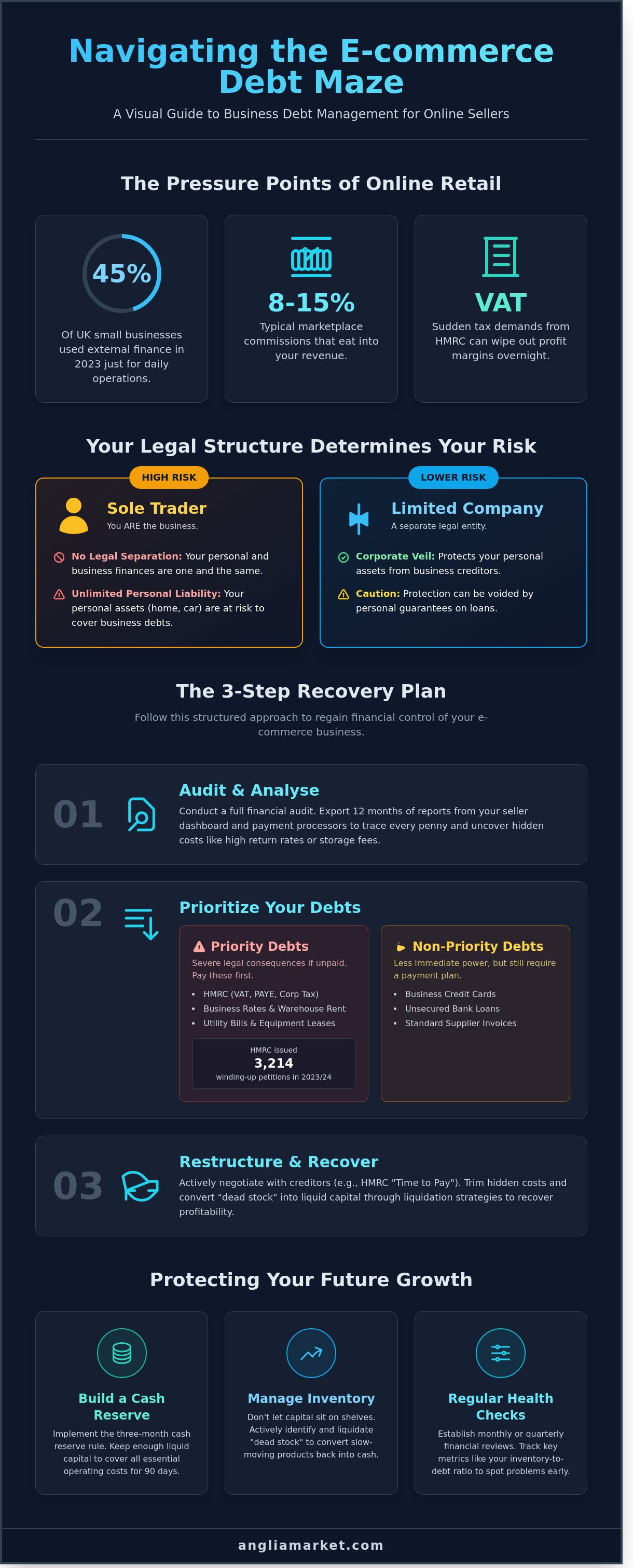
Did you know that 45% of UK small businesses relied on external finance in 2023 just to keep their daily operations running? For many e-commerce entrepreneurs, a credit card used for seasonal stock can quickly spiral into a cycle of high-interest repayments. When you add 15% marketplace commissions and a sudden VAT demand from HMRC, your profit margins can vanish overnight. Mastering business debt management for online sellers is the only way to break this cycle and regain control of your shop's future.
It's frustrating to watch your hard-earned revenue go straight to interest charges rather than back into your inventory. You deserve a clear path forward that protects your personal assets and keeps your business active on platforms like Anglia Market. This guide shows you how to prioritise your debts, negotiate effectively with creditors, and restructure your cash flow for long-term stability. We'll give you the practical steps needed to clear your arrears and return to profitability.
Key Takeaways
- Conduct a full financial audit to categorise your shop's liabilities into priority and non-priority debts based on UK commercial standards.
- Explore practical business debt management for online sellers, including the specific steps to secure a "Time to Pay" (TTP) arrangement with HMRC.
- Recover profitability by trimming hidden e-commerce costs and converting "dead stock" into immediate liquid capital through liquidation strategies.
- Protect your future growth by implementing the three-month cash reserve rule and establishing regular financial health checks for your business.
Understanding Business Debt Management for Online Sellers
Business debt management for online sellers is a structured strategy to reorganise and repay commercial liabilities while maintaining daily operations. It involves more than just paying invoices. Effective management requires a clear plan to handle the specific cash flow hurdles found in digital retail. E-commerce businesses often face unique debt cycles because of inventory lag. You might spend £15,000 on stock in August to prepare for the Q4 peak, but you won't see that cash return until December. This gap creates a reliance on credit that can quickly spiral if sales targets aren't met.
The "E-commerce Debt Trap" occurs when a seller balances high advertising spend against fluctuating marketplace sales. Many retailers spend 15% to 25% of their total revenue on digital ads. If a platform algorithm changes or a competitor slashes prices, your sales may drop by 30% overnight, leaving you with massive ad bills and no revenue to cover them. Staying ahead of these shifts is vital for survival. If you want to expand your reach safely, you can sell online through established platforms to diversify your income streams.
The unique financial pressures of online retail
Marketplace commissions and payment delays significantly impact your liquidity. Most platforms charge between 8% and 15% in fees, and some hold your funds for 7 to 14 days before a payout. This delay makes it difficult to pay suppliers on time. Many sellers turn to "revenue-based" financing for a quick fix. While these loans are easy to get, they often carry high costs that eat into your remaining margins. Tracking your metrics is the only way to stay safe. The inventory-to-debt ratio is a key health metric that compares the value of your current stock against your total outstanding commercial loans.
Sole Trader vs. Limited Company: Why it matters for your debt
Your legal structure determines who is responsible when things go wrong. For a sole trader in the UK, there's no legal separation between personal and business finances. This means your personal assets, including your home and car, are at risk if the business cannot pay its debts. You are personally liable for every penny the business owes.
Limited company directors have more protection through the "Corporate Veil," which treats the company as a separate legal entity. This usually limits your liability to the amount you invested. However, this veil can be pierced if you've signed personal guarantees for business loans or credit cards. If the business enters insolvency, the Insolvency Service has the power to investigate your conduct. They can disqualify directors for up to 15 years if they find evidence of "unfit" behaviour, such as taking out loans you knew the company couldn't repay.
Step 1: Auditing and Prioritising Your E-commerce Debts
To regain control, you must first look at the cold, hard numbers. A financial audit isn't just about checking your bank balance; it's about tracing every penny from your sales platform to your pocket. Start by exporting 12 months of reports from your seller dashboard and payment processors like Stripe or PayPal. This helps you spot hidden costs like high return rates or rising storage fees. Effective business debt management for online sellers begins with this clarity. You need to know exactly who you owe and what happens if you don't pay them immediately.
Debt directly affects your shop's performance. If you lack the cash to restock, your "Out of Stock" rate climbs. On platforms like Amazon, this kills your Buy Box percentage. A drop in inventory levels can lead to a 20% decrease in organic search visibility within 48 hours. Maintaining your account health requires a clear understanding of which debts threaten your ability to trade.
Identifying your priority creditors
In the UK, priority debts are those with the most severe legal consequences. HMRC is your most dangerous creditor. Arrears in VAT, PAYE, or Corporation Tax can lead to a winding-up petition or bailiff action. HMRC issued 3,214 winding-up petitions in the 2023/24 tax year, showing they're quick to act on unpaid tax. Don't ignore business rates or rent for your stock warehouse either. If you lose your storage space, your business stops. Ignoring these can lead to court orders or, in extreme cases, personal bankruptcy. Keep your office running by treating utility bills and equipment leases as essential. You can't ship orders if your internet is cut off.
Managing non-priority liabilities
Non-priority debts include business credit cards, unsecured bank loans, and standard supplier invoices. While these creditors might call you more often, they don't have the same immediate powers as HMRC. You should only address these once your priority payments are stable. Successful business debt management for online sellers involves keeping these creditors informed without sacrificing your essential tax obligations. To prepare for negotiations, gather your documentation:
- Current balance statements for all credit cards and overdrafts.
- Original loan contracts and interest rate terms.
- Any formal default notices or "Letters Before Action" received in the last 30 days.
- A list of all outstanding supplier invoices and their due dates.
If you're looking to boost your margins to cover these costs, check out our latest deals to source more affordable stock for your shop. Organising your paperwork now makes the recovery process much faster and prevents nasty surprises during negotiations.
Step 2: Choosing a Debt Management Strategy for Your Business
Selecting the right path depends on your business structure and the total amount you owe. Effective business debt management for online sellers often starts with a choice between informal agreements and formal legal processes. If you're a sole trader, your personal and business debts are treated as one. If you operate a limited company, the debts belong to the business entity, provided you haven't signed personal guarantees.
- Informal Debt Management Plan (DMP): Best for sole traders. You or a provider negotiate lower monthly payments. It isn't legally binding, so creditors can still start court action.
- Time to Pay (TTP) Arrangement: This is a specific deal with HMRC. Most TTPs last up to 12 months. You must prove your business is viable and that you'll pay future taxes on time.
- Company Voluntary Arrangement (CVA): For limited companies. An insolvency practitioner helps you pay back a percentage of debt over three to five years while you keep trading.
- Individual Voluntary Arrangement (IVA): The sole trader version of a CVA. It stops interest and legal action but will appear on your credit file for six years.
Negotiating with suppliers and HMRC
Don't wait for a final demand to arrive. Proactive communication is the best way to prevent a County Court Judgement (CCJ). If a CCJ isn't paid within 30 days, it stays on your record for six years, making it nearly impossible to get business credit or a new warehouse lease. Use this script when contacting your stockists:
"Hi [Supplier Name], I’m the owner of [Your Shop]. We value our partnership, but a temporary dip in marketplace sales has tightened our cash flow. Can we move my current £1,500 balance to a weekly payment plan of £150 for the next ten weeks?"
If you have a lump sum available, try a "Full and Final Settlement." Offer 50% to 70% of the total debt in exchange for the creditor writing off the remaining balance. Always get this agreement in writing before sending the funds.
Formal insolvency options: when to consider them
When business debt management for online sellers becomes unmanageable, formal insolvency might be the only route. For independent vendors acting as sole traders with less than £2,000 in assets, a Debt Relief Order (DRO) is often the most affordable choice. As of June 2024, the debt limit for a DRO is £30,000.
Bankruptcy is a last resort. It's important to understand that most major marketplaces, including Amazon and eBay, perform periodic credit checks. A bankruptcy filing often leads to immediate account suspension or permanent closure. If you're in a mental health crisis, use the "Breathing Space" scheme. This gives you 60 days of legal protection from creditors while you seek professional debt advice. This moratorium stops interest, fees, and enforcement action, giving you the room to reorganise your finances.
Step 3: Restructuring Cash Flow and Recovering Profitability
Cash flow is the priority when executing business debt management for online sellers. You can't pay down creditors if your liquidity is trapped in unsold stock or drained by "invisible" expenses. Start by auditing your monthly SaaS subscriptions. Research from 2023 suggests that 35% of small businesses pay for software they rarely use. Cancel these immediately. A £20 monthly fee for an unused SEO tool or email plugin adds up to hundreds of pounds annually that could go toward debt repayment.
Next, look at your "dead stock." Inventory sitting in a warehouse for over 90 days isn't an asset. It's a liability costing you storage fees. Liquidation is essential. Accept a lower margin now to get the cash back into your bank account. Implement a "Cash-First" approach for new inventory procurement. Don't commit to new orders until you've cleared existing debt or generated the capital from actual sales. This stops the debt cycle from expanding and keeps your business lean.
- Audit recurring costs: Review bank statements for forgotten trials and redundant tools.
- Liquidate slow movers: Use steep discounts to free up warehouse space and capital.
- Tighten procurement: Only buy what you know you can sell within a 30-day window.
Optimising your marketplace margins
Review your pricing strategy to ensure it covers your basic costs and your debt interest. If your loan repayments have increased, your old margins might now be loss-making. Monitor your Cost-Per-Acquisition (CPA) daily. If ad spend on major social platforms exceeds 20% of your revenue, it's likely worsening your debt. You can use Anglia Market’s promotions to move stock quickly without the heavy ad costs associated with larger search engines. Focus on products with high turnover rates to keep money moving through the business.
Leveraging independent platforms for better cash flow
High fees on global marketplaces can eat up to 30% of your sale price. Moving some of your inventory to a platform like Anglia Market provides a more supportive environment for SMEs. You get lower overheads and more direct access to your customer base. This shift helps you retain more profit from every transaction. Use specific sale events to clear seasonal inventory and boost your immediate liquidity. This strategy ensures you aren't reliant on a single, expensive channel for your survival.
Long-term Financial Health: Preventing Future Business Debt
Success in e-commerce isn't just about high sales volumes. It's about what you keep. Sustainable business debt management for online sellers requires a proactive approach to cash flow. Start by building an emergency cash reserve. Aim for the 3-month rule. This means having enough liquid cash to cover three months of essential operating costs, such as warehouse rent and software subscriptions. If your monthly outgoings are £2,500, your target is £7,500. This buffer prevents you from reaching for high-interest credit cards when sales dip during seasonal lulls.
Distinguishing between types of borrowing is equally vital. Good debt involves low-interest loans used to purchase inventory that you've already proven will sell. Bad debt is high-interest credit used to cover recurring losses or survival costs. According to the British Business Bank’s 2023 Small Business Finance Markets report, 36% of smaller firms used external finance, but those who used it for growth rather than cash flow gaps remained more resilient. Don't go it alone. Join a community of UK sellers to share advice on supplier negotiations and shipping hacks. Professional bookkeeping acts as an early warning system, so don't view it as an optional expense.
Implementing robust financial controls
Poor record-keeping is a primary driver of insolvency. You must set up a dedicated business bank account immediately. Mixing personal and business funds makes it impossible to see your true margins. Schedule a review of your Profit & Loss (P&L) statement on the first Monday of every month. This helps you spot rising costs before they become crises. Use automated tools to track VAT liabilities in real-time. This ensures you don't accidentally spend money that actually belongs to HMRC. Modern business debt management for online sellers relies on these digital safeguards to maintain a healthy balance sheet.
Scaling your business sustainably
Growth shouldn't come at the cost of your stability. Many global platforms charge high commissions that eat into your recovery fund. You can start selling with Anglia Market to access a fair-fee marketplace designed to support UK independent vendors. Lower overheads mean more profit stays in your business. Focus on repeat buyers rather than expensive customer acquisition. You can boost your retention rates through the Anglia Market loyalty programme, which rewards your customers for their continued support.
Debt is a hurdle, not a dead end for your e-commerce journey. By sticking to these financial controls, you turn your shop from a struggling venture into a resilient brand. Stay focused on the numbers. Your future self will thank you for the discipline you show today.
Take Control of Your E-commerce Finances Today
Reclaiming your financial independence starts with a clear audit of what you owe. Focus on prioritising high-interest repayments first to stop debt from spiralling. Effective business debt management for online sellers isn't just about clearing balances; it's about restructuring your cash flow to ensure long-term stability. Recent data from the British Business Bank shows that 36% of UK small businesses used external finance in 2023, making strategic debt handling a vital skill for survival.
By choosing platforms with transparent commission structures and secure shopping environments, you protect your margins from unexpected fees. Secure vendor profiles and trusted UK-based support can make the difference between struggling and scaling. It's time to build a sustainable future on a platform that values your growth as much as you do. You've got the tools to recover; now take the next step toward a debt-free business.
Join Anglia Market today and grow your business on a platform that supports independent UK sellers.
Frequently Asked Questions
Can I keep my online shop open if I am in a Debt Management Plan?
You can usually keep your online shop trading while you're in a Debt Management Plan (DMP). Since a DMP is an informal agreement, it doesn't carry the same legal restrictions as bankruptcy or certain types of liquidation. You'll need to ensure your monthly repayments are set at a level that doesn't drain the cash you need for stock and shipping costs.
Maintaining a steady cash flow is vital for your shop's survival. As long as you meet your agreed payments, creditors are often happy for you to continue trading. This keeps your income flowing and helps you pay off what you owe over time.
What happens if I cannot pay my VAT bill to HMRC?
HMRC will apply a 5% penalty if your VAT payment is more than 30 days late, which increases to 10% after six months. You should contact them immediately to request a Time to Pay (TTP) arrangement. This allows you to spread the cost over a period of up to 12 months, depending on your business's financial health.
Ignoring the bill leads to more aggressive collection efforts. HMRC has the power to seize business assets or even petition to shut your business down. Acting quickly shows you're responsible and often stops these harsher measures from starting.
Will business debt affect my personal credit score in the UK?
Business debt affects your personal credit score if you operate as a sole trader. The law doesn't distinguish between your personal finances and your business activities in this setup. If you run a limited company, your personal score is usually protected unless you've signed a personal guarantee for a loan or a warehouse lease.
If a creditor takes you to court and wins a County Court Judgment (CCJ), it'll stay on your credit file for six years. This makes it much harder to get a personal mortgage or a car loan. Always check the terms of any finance you've signed to see if you're personally liable.
How do I stop bailiffs from visiting my home if I am a sole trader?
You can't stop a bailiff who has a warrant, but you don't have to let them into your home. Keep your doors locked and speak to them through a window or a letterbox. As a sole trader, they aren't allowed to take "tools of the trade" like your computer or phone if the total value is under £1,350.
Provide them with proof that you're in a debt solution or show them a copy of your repayment plan. This often triggers a pause in their visit. If you're considered a vulnerable person due to illness or disability, they must follow specific National Standards that offer you extra protection.
Is it better to take out a debt consolidation loan for my online business?
A debt consolidation loan is only a good idea if the new interest rate is lower than your current average. If you're paying 18% on a business credit card and can get a loan at 8%, you'll save a significant amount. Effective business debt management for online sellers requires you to stop using the original credit cards once they're paid off.
Taking out more credit can be risky if you haven't fixed the underlying profit issues. Use a calculator to see if the monthly payment is actually lower than what you're paying now. If the total cost over the life of the loan is higher, it might not be the right choice.
What is the "Breathing Space" scheme and can online sellers use it?
The Debt Respite Scheme, known as Breathing Space, gives online sellers 60 days of legal protection from creditor action. During this time, interest and fees are frozen, and creditors can't start court proceedings or send bailiffs. You must apply through a debt adviser who is authorised by the Financial Conduct Authority to enter the scheme.
There's also a "Mental Health Crisis Breathing Space" which lasts for the duration of a person's treatment plus 30 days. This scheme is designed to give you time to get professional advice without the pressure of constant phone calls. It's a powerful tool for regaining control of your business finances.
Can a marketplace close my account because of my business debts?
Marketplaces like Amazon or eBay can suspend your account if your debts lead to poor performance. If you can't pay suppliers and your "Out of Stock" rate increases, or if you can't afford shipping and your delivery times lag, you'll trigger an automatic review. These platforms prioritise the customer experience and will remove sellers who look financially unstable.
Amazon's Business Solutions Agreement allows them to terminate accounts for "commercial reasons" at their discretion. Keeping your account healthy means managing your debt before it impacts your inventory levels. Once an account is closed for performance issues, it's very difficult to get it reopened.
How do I negotiate with overseas suppliers if I owe them money?
Negotiate with overseas suppliers by offering a clear repayment schedule, such as paying 25% of the balance now and the rest over four months. Be honest about your situation and highlight your history of past orders to show your value. Using business debt management for online sellers involves keeping these vital supply lines open for future growth.
Since around 70% of UK online inventory is sourced internationally, maintaining these relationships is crucial. Use a professional tone and provide data on your projected sales to reassure them. Most suppliers prefer a slow payment over no payment at all and will work with you to keep the partnership alive.

Here to help — ask anything
For questions about this disclaimer or the site, contact us via the website’s Contact page.


