Did you know that 61% of consumers trust influencer recommendations more than brand-produced content, yet many UK small businesses are still quoted upwards of £1,000 for a single social media post? It's a frustrating barrier that makes the idea of collaborating with uk influencers on a small budget feel out of reach for most independent vendors. You've likely felt the sting of high agency fees or the silence that follows a cold outreach email. It's common to worry about wasting your limited marketing spend on accounts with inflated follower counts. We agree that your budget should work as hard as you do.
This guide will show you how to build high-impact UK influencer partnerships using product exchanges, affiliate models, and strategic outreach without a massive bank balance. You'll learn how to secure high-quality user-generated content and drive sales on your marketplace listings while staying on the right side of ASA disclosure guidelines. We're diving into the practical steps you need to get your brand noticed by authentic UK creators in 2026.
Key Takeaways
- Discover why micro and nano-influencers are the most trusted voices in the 2026 UK market and how their niche authority drives better results than celebrity ads.
- Master cost-effective compensation models like product-for-post and affiliate commissions to start collaborating with uk influencers on a small budget while only paying for actual sales.
- Learn a proven two-step outreach strategy that uses "warm-up" engagement and high-open subject lines to secure partnerships with top-tier UK creators.
- Boost your brand trust by whitelabeling influencer content and integrating social proof directly into your online vendor storefront to drive marketplace conversions.
The UK Influencer Landscape in 2026: Why Small Budgets are an Advantage
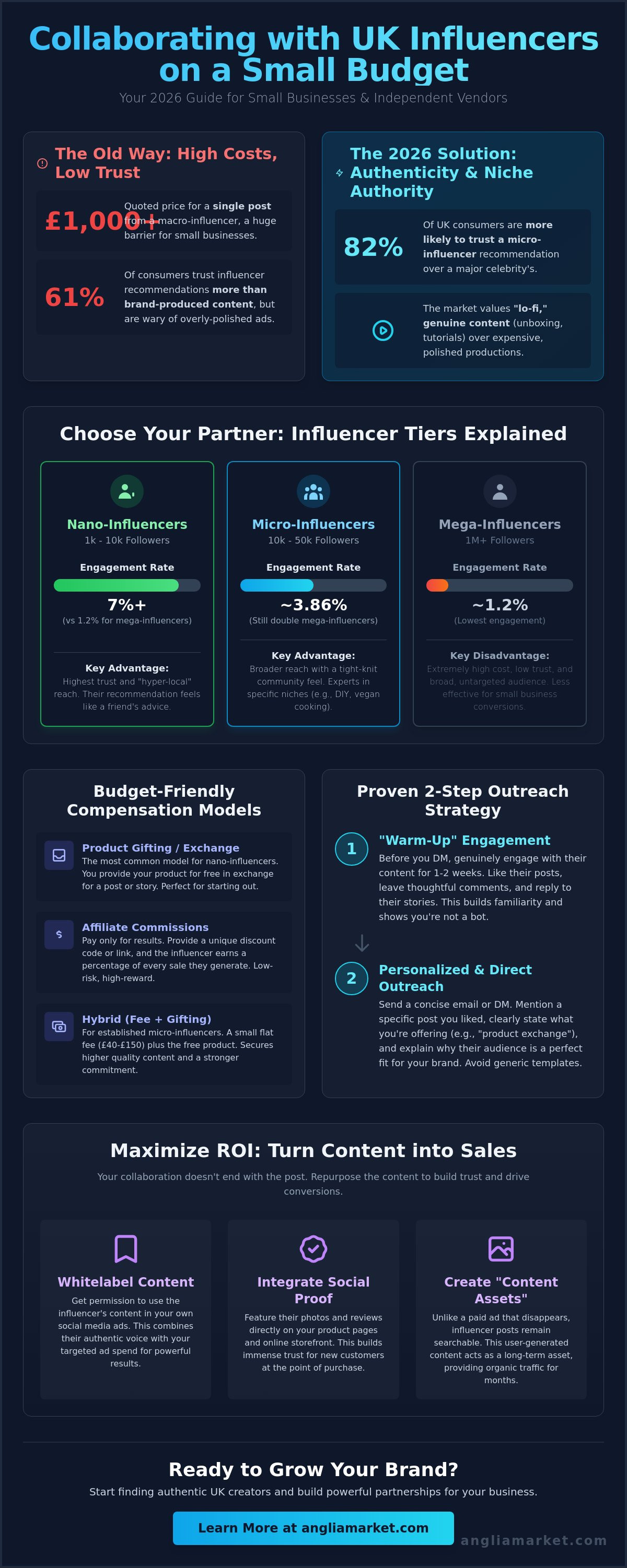
By 2026, the UK market has shifted away from the era of the distant celebrity. Small and medium businesses (SMEs) now find that The UK Influencer Landscape in 2026 favors those who prioritize community over massive reach. Successfully collaborating with uk influencers on a small budget isn't just a cost-saving measure; it's a strategic choice to reach shoppers who habitually ignore traditional banner ads. Data from early 2026 suggests that 82% of UK consumers are more likely to follow a recommendation from a micro-influencer than a high-profile celebrity.
To better understand how these partnerships work for growing brands, watch this helpful video:
The demand for authenticity has replaced the need for polished, studio-quality productions. UK shoppers now respond to "lo-fi" content, such as raw unboxing videos or "get ready with me" segments filmed on a smartphone in a bedroom. This shift levels the playing field. You don't need a £10,000 production budget when a £50 product sample and a genuine creator can generate more engagement. It's about finding voices that resonate with everyday British life, from the rainy streets of Glasgow to the bustling markets of London.
Understanding Micro vs. Nano-Influencers
Nano-influencers typically hold between 1,000 and 10,000 followers. They often boast engagement rates of 7% or higher, significantly outperforming the 1.2% average seen with larger accounts. Micro-influencers scale up to 50,000 followers but maintain a tight-knit community feel. For a business in Norfolk or Manchester, these creators offer a "Hyper-Local" advantage. They speak directly to residents in specific regions, making them perfect for those looking to sell online to a targeted demographic. Because their circles are smaller, their recommendations carry the weight of a friend's advice rather than a paid pitch.
The Economics of Small-Scale Collaborations
Traditional UK social ads now face rising costs, with some competitive sectors hitting a £2.80 cost-per-click. In contrast, many nano-influencers accept product exchanges or small fees starting at £40 to £150 per post. This drastically reduces the cost-per-acquisition (CPA). These partnerships create "Content Assets" that independent vendors can reuse on their own social feeds, saving hundreds on professional photography. Collaborating with uk influencers on a small budget also provides a long-tail effect. Unlike a disappearing ad, a creator's post remains searchable, providing organic traffic and social proof for months after the initial campaign ends.
Identifying the Right UK Partners: Beyond Follower Counts
Forget vanity metrics. For SMEs, niche authority beats broad popularity every time. A creator with 3,000 loyal followers in a specific UK region is more valuable than a global account with 100,000. When collaborating with uk influencers on a small budget, your goal is conversion, not just impressions. Look for "Problem-Solvers." These are creators who provide tutorials, DIY hacks, or "how-to" content. They've built trust by being useful. According to 2024 industry data, micro-influencers with 1,000 to 10,000 followers often see engagement rates of 3.86%, which is nearly double that of mega-influencers.
The "Vibe-Check" is your most important filter. Your chosen partner must align with your brand values. If your brand focuses on affordable, practical solutions, don't partner with a creator who only showcases luxury items. Search for influencers who already mention your competitors or similar UK brands. This proves their audience is already interested in your category. It's a simple way to find pre-qualified leads without spending a penny on expensive databases.
Auditing Engagement and UK Audience Density
UK audience density is non-negotiable. Use free tools like HypeAuditor or Modash to check where a creator's followers live. A UK influencer with a 60% US audience won't help you sell locally. Calculate the True Engagement Rate yourself. Divide the total comments and shares by the follower count. Likes are easy to fake; genuine conversations are not. Watch for red flags. Sudden spikes in followers usually indicate bot purchases. Generic comments like "Great pic!" or "Nice!" from accounts with no profile pictures are 100% bots. Aim for creators where at least 70% of the audience is UK-based to ensure your shipping and logistics remain cost-effective.
Matching Products to Niche Creators
Target creators who fit your specific product categories. If you sell outdoor gear or DIY tools, look for influencers tagging home and garden brands in their videos. For those in the pet industry, find accounts that share "day in the life" content with their animals. These creators often need a steady supply of pet supplies for their daily posts. Evaluate a creator's past collaborations for consistency. If they've promoted 10 different brands in 10 days, their audience will likely tune out your message. You want a partner who values quality over quantity. If you're an independent vendor looking to scale, you can sell online through our platform to complement your influencer marketing efforts and reach more UK shoppers.
Budget-Friendly Compensation Models: Gifting, Affiliate, and Hybrid
Small businesses often worry about the high costs of marketing. You don't need a massive bank balance to start collaborating with uk influencers on a small budget. By 2026, the influencer market has shifted toward authenticity over high production values. Pure "gifting" models are becoming harder to execute because creators understand their commercial value. Data from 2025 shows that only 22% of UK micro-influencers now accept "gift-only" deals for high-effort content like long-form video. You've got to be more creative with how you pay.
The affiliate model is a safer bet for SMEs. You only pay when a sale happens. This shifts the risk from your business to the performance of the content. Many UK brands find success with a hybrid approach. This involves paying a small base fee, perhaps £50 to £100, combined with a performance bonus. It covers the creator's basic time while incentivising them to actually drive traffic. It's a fair middle ground that builds longer-term loyalty than a one-off freebie.
Legal compliance is non-negotiable in the UK. The Advertising Standards Authority (ASA) requires clear disclosure for any post where a brand has provided a "benefit" to the creator. This includes free products. Every post must feature a clear #AD tag at the start of the caption. Failure to comply can lead to public "naming and shaming" by the ASA or even legal action under consumer protection laws. Don't ask influencers to hide the partnership; transparency actually builds trust with 74% of UK consumers.
The Art of the Product Exchange
Packaging is your best marketing tool. 68% of UK shoppers say premium packaging makes a brand feel more professional. If you're sending a £50 product, make it "unboxing-worthy" with branded tissue paper or a handwritten note. Don't demand a 60-second produced video for a low-value item. Instead, ask for a series of authentic Instagram Stories. Try the "Surprise and Delight" tactic. Send a small, unannounced extra item. This often triggers an organic, unscheduled mention because the creator feels genuinely valued.
Setting Up a UK-Based Affiliate Program
Tracking is essential for proving ROI. Use unique discount codes like "SAVE15" to see exactly which influencer brings in the most revenue. Most UK retail sectors set commission rates between 8% and 12%. Higher-margin categories like beauty might go up to 20%. You can use promotions to give the influencer's audience an exclusive deal. This makes the creator look like they're providing value to their followers while giving you a clear path to track your spending. It's a win-win for everyone involved.
The Step-by-Step Outreach Strategy for UK Small Businesses
Success when collaborating with uk influencers on a small budget depends on your approach. Cold emails rarely work. You need a systematic process that prioritises human connection over automated templates. Following a structured path ensures you don't waste time on unresponsive leads.
Step 1: The Warm-Up. Start interacting with the creator at least 10 days before your pitch. Like their posts, leave thoughtful comments, and share their content to your stories. This ensures your brand name is familiar when you finally land in their inbox. It moves you from a "stranger" to a "supporter."
Step 2: The Subject Line. Avoid generic phrases like "Collaboration Request." Instead, use something specific like "Loved your recent reel on sustainable home decor." Industry data from 2025 indicates that subject lines mentioning a creator's specific work have a 35% higher open rate than generic ones.
Step 3: The Pitch. Focus on their audience. Explain how your product provides value to their followers. If you sell eco-friendly kitchenware, highlight how it solves a problem for their budget-conscious, green-living community. Make it about their content goals, not your sales targets.
Step 4: Negotiation. Be clear about what you want. Small businesses often find success by asking for one high-quality Reel and two supporting Stories in exchange for product and a small fee or affiliate commission. Clear deliverables prevent scope creep later on.
Step 5: Onboarding. Send a "Creator Pack." Include high-res logos, key talking points, and a unique tracking link. This reduces their workload and ensures brand consistency. Providing the right tools from day one makes the creator's job easier and the results better.
The Perfect SME Outreach Script
Keep your opening concise. Mention a specific detail from their last three posts to prove you aren't mass-mailing. Share the story of your UK small business. Creators love supporting independent brands with a clear mission. End with a low-pressure call to action. Ask if you can send them a sample or have a quick five-minute chat. Don't send a contract in the first message; focus on starting a conversation first.
Managing Relationships for Long-Term Growth
One-off posts often fail to convert. Data from 2026 marketing reports shows that brand ambassador models, where an influencer posts monthly, generate 3x more trust than single shout-outs. Use a simple spreadsheet to track your communications, post dates, and engagement rates. If a creator says no, respond professionally. 15% of successful UK collaborations start after an initial "not right now" response. Keeping the door open is vital for future growth.
Maximising ROI: Turning Influencer Content into Marketplace Sales
Small budgets require smart recycling. Once a creator posts about your product, the value shouldn't end when the Story expires. Whitelabeling is the most efficient way to stretch your investment. This means securing the rights to use influencer-generated content (IGC) on your own UK social media channels and paid ads. It's often cheaper than hiring a professional production team. You get authentic, high-quality assets for the price of a product gift or a small fee.
Don't let traffic go to waste. Always encourage creators to link directly to your specific marketplace listings. Direct links reduce friction and speed up the journey from discovery to checkout. When collaborating with uk influencers on a small budget, every click counts. If a customer has to search for your brand manually, you'll lose them to a competitor. Use trackable URLs to see exactly which creators are driving the most traffic to your products.
Boosting Marketplace Credibility with Social Proof
Your vendor storefront needs to look professional to convert traffic. Integrating influencer testimonials directly into your product descriptions builds immediate trust. A quote from a relatable UK creator carries more weight than standard marketing copy. Industry data shows that including customer or influencer photos in galleries can increase click-through rates (CTR) by up to 25% compared to plain studio shots.
Third-party validation is essential. When you sell online, shoppers can't touch the product. They rely on the creator's "real-life" demonstration to gauge quality. Use influencer images to show your products in a home or garden setting. This helps buyers visualise the item in their own lives, which significantly reduces return rates and boosts buyer confidence.
Reviewing and Refining Your Strategy
Success isn't just about the immediate "Add to Cart" button. Effective measurement involves looking at brand sentiment and follower growth. Did the campaign spark positive conversations in the comments? Did your own brand page see a spike in UK-based followers? These are leading indicators of future sales. Analyse which creator niches delivered the best return. You might find that a micro-influencer in the "budget DIY" niche outperformed a larger "lifestyle" creator.
Once you identify a high-performer, move from one-off gifting to a "Power Partnership." This offers more stability for your brand and better results as their audience sees your product repeatedly. Use this 5-point checklist after every campaign to stay on track:
- Download and archive: Save all creator content for future marketing use.
- Update listings: Add new testimonials to your product pages.
- Analyse engagement: Check which posts had the highest save and share counts.
- Calculate Cost Per Acquisition (CPA): Divide your total spend by the number of sales generated.
- Send a thank you: Maintaining good relationships with UK creators makes collaborating with uk influencers on a small budget easier the next time around.
Scale Your British Brand Through Strategic Partnerships
Success in the 2026 retail landscape doesn't require a massive marketing department. Small UK businesses can achieve higher engagement by prioritising nano-influencers with under 10,000 followers, as these creators often deliver better engagement rates than major celebrities. By using performance-based affiliate models and genuine product gifting, you'll protect your cash flow while reaching niche audiences. Collaborating with uk influencers on a small budget is a practical way to build the social proof that translates directly into marketplace sales.
Once you've secured your content, you need a reliable platform to convert that interest into revenue. Anglia Market supports over 1,000 independent UK vendors through a secure, UK-based marketplace platform. You'll gain direct access to a growing British customer base looking for quality products from local sellers. It's an efficient way to manage your orders while your influencer partners drive new traffic to your listings. Your brand's growth depends on using the right tools to reach the right people.
Start selling on Anglia Market and grow your UK brand today. We're here to help your business thrive.
Frequently Asked Questions
Do I legally have to pay UK influencers if I give them free products?
You don't have to pay a cash fee if the influencer agrees to a product-only exchange. However, the UK's Consumer Protection from Unfair Trading Regulations 2008 still apply to these deals. If you provide a product worth any amount, it's a commercial relationship. Both you and the creator must follow transparency rules to avoid legal action from the CMA.
How many followers should a UK influencer have for a small budget campaign?
Target nano-influencers with 1,000 to 10,000 followers for the best return on investment. These creators often achieve engagement rates of 5% or higher, which is double the average for celebrity accounts. Collaborating with UK influencers on a small budget is most effective when you prioritize these niche experts over total follower counts.
What is the UK ASA "AD" disclosure rule and how does it affect my business?
The ASA requires all paid or gifted content to be clearly labeled with "Ad" or "Advertisement" at the very start of the caption. This rule ensures shoppers know when they're looking at promotional material. If your influencer fails to disclose properly, your business risks being named on the ASA’s public list of non-compliant brands.
Can I use an influencer’s photos on my own website or marketplace listing?
You can only use their photos if your written contract includes a specific usage rights clause. Under the Copyright, Designs and Patents Act 1988, the creator owns the image rights by default. Many micro-influencers will grant a 12 month digital usage license for a small fee or as part of the initial product exchange.
How do I track sales from an influencer if I don’t have a massive tech budget?
Use unique discount codes or free UTM tracking links through Google Analytics 4 to monitor your traffic. These simple tools let you see exactly how many clicks and sales each individual creator generates. It's a practical way to measure your ROI without paying for expensive affiliate platform subscriptions.
What should I do if an influencer takes my product but never posts?
Send a polite follow up email 14 days after the delivery date to check for any shipping or quality issues. If they continue to ignore you, send a formal letter via email requesting the return of the item. Most SMEs find that using a simple written agreement at the start prevents these ghosting situations from occurring.
How much time should I spend on influencer outreach every week?
Dedicate 5 to 10 hours per week to finding and messaging new creators to maintain a steady pipeline. This time allows you to send roughly 20 personalized pitches, which is the volume needed to secure 2 or 3 active partnerships. Consistency is more important than bulk messaging when you're trying to build a reliable brand presence.
Is Instagram or TikTok better for UK influencer marketing in 2026?
TikTok is currently superior for viral reach, while Instagram remains the leader for direct product conversions. 2024 Ofcom reports showed TikTok is the fastest growing shopping source for UK adults, making it vital for discovery. Collaborating with UK influencers on a small budget works best when you use TikTok for awareness and Instagram for detailed product showcases.
Here to help — ask anything
If you have any questions regarding this disclaimer or any of our policies, please contact Anglia Market through the contact page on our website, by email using the address provided on the site, or by phone at 0333 772 2593