

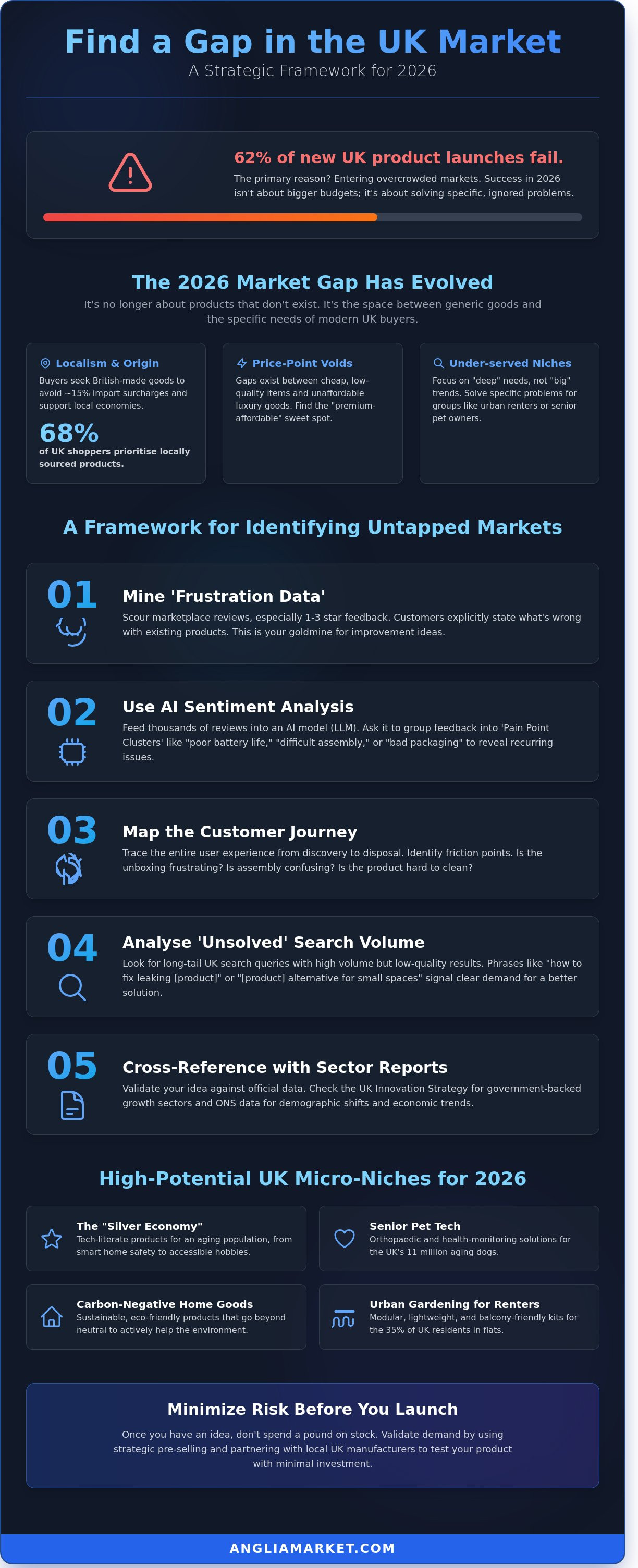
Did you know that 62% of new UK product launches fail within eighteen months because they enter already crowded spaces? You probably feel that every profitable niche is already taken, or perhaps you're struggling to make sense of the complex economic forecasts for the year ahead. It's a common fear, but the most successful British brands of the next decade won't be those with the biggest budgets. They'll be the ones that solved a specific problem everyone else ignored.
Learning how to find a gap in the market uk 2026 is about moving past the noise to find real consumer frustration. We've developed a framework to help you identify untapped British market opportunities and launch a successful product-based business with confidence. This guide reveals the highest-potential sectors for 2026, a repeatable method for spotting what customers actually want, and a low-risk way to test your idea before spending a single pound on stock. It's time to stop guessing and start building something that people are actually waiting to buy.
Key Takeaways
- Learn how to identify the shift towards value-and-origin-first consumption to define modern market gaps in the British retail landscape.
- Discover a practical framework on how to find a gap in the market uk 2026 using AI sentiment analysis and consumer frustration data.
- Explore high-potential UK sectors for 2026, including tech-literate products for the "Silver Economy" and carbon-negative home goods.
- Minimise your startup risk by validating your product idea through strategic pre-selling and local manufacturing partnerships.
- See how Anglia Market provides the perfect testing ground and support system for launching and scaling new British business ventures.
What Does a 'Gap in the Market' Look Like in 2026?
A market gap is the distance between what a customer expects and what they can actually buy. In the past, this usually meant a product simply didn't exist. By January 2026, the definition has changed. It's now about the space between generic mass-market goods and the specific, ethical, or local requirements of modern buyers. Identifying these voids is the first step in learning how to find a gap in the market uk 2026. Success today relies on understanding gap analysis to see where current high-street giants are leaving customers frustrated.
To better understand this concept, watch this helpful video:
The 2026 market is defined by three specific types of gaps. First, under-served niches where customers have specific hobbies or needs. Second, price-point voids where items are either too cheap and poor quality, or too expensive for the average household. Third, geographic localism, where buyers want items shipped from within the UK to avoid 15% import surcharges and long wait times.
Small businesses are better at filling these holes than global corporations. A major retailer often takes 12 to 18 months to move a product from concept to shelf. An agile UK seller can identify a trend, source a quality sample, and start selling in under 30 days. This speed is your biggest competitive advantage when you're looking for how to find a gap in the market uk 2026.
The Shift Toward 'Slow Commerce' and Localism
UK consumers are moving away from disposable culture. Data from late 2025 shows that 68% of British shoppers now prioritise "British-made" or locally sourced goods. They want a story behind their purchase. Generic items are losing ground to products that use British English branding and celebrate local identity. Selling a "hand-poured Norfolk candle" is now more profitable than selling a generic "scented candle" imported from overseas.
Micro-Niches vs. Macro-Trends
Don't look for the next big thing; look for the next deep thing. Big ideas are crowded and expensive to enter. Micro-niches offer better margins and less competition. Consider these 2026 examples:
- Urban gardening for renters: Modular, lightweight kits for the 35% of UK residents who live in flats.
- Senior pet tech: Orthopaedic solutions for the UK’s 11 million aging dogs.
- High-quality fashion basics: Instead of competing with fast fashion, focus on perfecting a single garment. For inspiration on building a brand around a core product, you can explore Farkut and see how niche retailers connect with customers.
- The 1,000 True Fans model: You don't need millions of customers. You need 1,000 loyal shoppers who value your specific expertise.
Focusing on these deep niches allows you to build a reliable, profitable presence on an online marketplace without fighting price wars against global brands.
A 2026 Framework for Identifying Untapped Markets
Finding a profitable niche requires a structured approach to data. It's not about guessing what people want. It's about seeing what they're already complaining about. Follow this five-step framework to master how to find a gap in the market uk 2026 and build a business with built-in demand.
- Step 1: Mine 'Frustration Data'. Scour marketplace reviews. Focus on mid-tier feedback where customers feel let down by specific features.
- Step 2: Use AI sentiment analysis. Feed thousands of comments into an LLM. Group them into 'Pain Point Clusters' to see exactly where current products fail.
- Step 3: Map the Customer Journey. Trace the path from discovery to disposal. Identify where the experience breaks down, whether it's poor packaging or difficult assembly.
- Step 4: Analyse 'unsolved' search volume. Look for long-tail queries in the UK with high volume but low-quality results. If people are searching "how to fix X" repeatedly, the product is broken.
- Step 5: Cross-reference with 2026 reports. Check the latest UK Talent Shortage data. If there's a 15% drop in available tradespeople, products that simplify home DIY will soar. Use the UK's Innovation Strategy to align your idea with government-backed growth sectors like green tech or advanced manufacturing.
Mining Reviews for 'Gold' Gaps
Don't just look at 5-star praise. Filter for 1-star and 3-star reviews on major platforms. 1-star reviews show deal-breakers; 3-star reviews show missed opportunities. Look for phrases like "I wish it did X" or "I couldn't find a version that fits small flats." In the 2026 UK Pet sector, owners are increasingly frustrated by £50 trackers that lose signal in rural areas. In Home and Garden, the gap lies in "flat-pack fatigue" where users want premium quality without the four-hour setup. You can find inspiration by browsing what independent UK vendors are currently offering to see where you can improve.
Leveraging AI for Market Research
AI tools can process feedback faster than any human team. Use LLMs to categorise customer gripes into clusters. This reveals if a problem is a one-off or a market-wide failure. Ask the AI to play 'Devil's Advocate' against your business idea. It will find weaknesses you've missed. For how to find a gap in the market uk 2026, check 2026 search trends on Google Trends. Focus on the UK region specifically. You'll likely see a rise in queries for "energy-independent appliances" or "repairable electronics" as UK living costs remain a primary concern for 68% of households.
High-Potential Sectors in the UK for 2026
Success in 2026 requires looking at where British spending is shifting. The Silver Economy is a prime example. By 2026, over 21% of the UK population will be aged 65 or over. This group isn't just looking for retirement aids. They want high-spec tech, fitness equipment, and premium travel gear. They have high disposable income and expect quality. If you want to know how to find a gap in the market uk 2026, start by looking at this active, tech-literate demographic that is often ignored by youth-focused brands.
Sustainability has also evolved. Consumers now look for "repairable" rather than just "recyclable." Following the 2021 Right to Repair regulations, there is a clear opening for home goods that come with modular parts or DIY repair kits. Carbon-negative products are the new gold standard. Selling items that actively remove CO2 from the atmosphere appeals to the 64% of UK consumers who state they've limited their use of single-use plastics in the last 12 months. This shift represents a major commercial opportunity for vendors who can prove their green credentials.
The "Home Office 2.0" remains a massive opportunity. Data from the ONS suggests that 44% of UK workers still use a hybrid model. By 2026, these workers are replacing their temporary "kitchen table" setups with permanent, aesthetic, and ergonomic solutions. Think sound-absorbing panels that look like art or desks that blend into living room decor. You can find more structured advice on scaling these ideas in the UK government's guide to business growth, which helps entrepreneurs validate new product lines and research development needs.
Adaptive living is the final frontier. With 80% of the UK's 2050 housing stock already built, the focus is on modification. There is a huge gap for affordable, stylish grab rails, low-threshold door kits, and smart lighting that helps older residents stay in their homes safely. These products must look like high-end decor rather than hospital equipment to succeed in the 2026 retail landscape.
Sustainability and Scope 3 Reporting
British shoppers are becoming experts in greenwashing. They now demand transparency on Scope 3 emissions, which cover the entire value chain. You can win market share by offering circular economy furniture. This includes "buy-back" schemes where customers return old items for store credit. Market these as "low-carbon" and provide a clear, data-backed breakdown of the product's journey from factory to front door to build trust.
The Rise of Multi-Generational Living
In 2024, research showed that multi-generational households are the fastest-growing household type in the UK. When considering how to find a gap in the market uk 2026, look at products that manage shared spaces. Privacy screens, modular room dividers, and noise-cancelling tech are in high demand. Electronics must be accessible for everyone. Simple interfaces and voice-activated controls are no longer optional features; they're essentials for the modern British home where three generations live under one roof.
How to Validate Your Business Idea with Minimum Risk
Validation prevents expensive mistakes. Don't buy bulk inventory until you've proven people will pay for it. A "Pre-Sell" strategy allows you to list a product before committing to a massive order. If you reach a target of 50 pre-orders within 14 days, you proceed. If not, you refund the customers and pivot your concept. This is a core step in how to find a gap in the market uk 2026 because it relies on real-time demand rather than guesswork.
Creating a Minimum Viable Product (MVP) doesn't require overseas shipping or complex logistics. In 2026, 62% of UK consumers prefer locally sourced goods. Partner with small UK manufacturers for short-run prototypes to test quality. Use social media "smoke tests" by running £10-a-day ads for specific features. If "Eco-friendly materials" gets 4x more clicks than "Premium finish," you've found your hook. Set up a "Coming Soon" landing page to collect email sign-ups. Aim for a 15% conversion rate on these sign-ups before committing significant capital.
Gathering Authentic UK Feedback
Your friends and family will tell you your idea is brilliant. They're usually wrong. Avoid asking them for opinions; their bias is a business killer. Instead, use platforms to survey 100 people in your specific UK demographic. Focus on "willingness to pay" over "interest." A person saying "I like that" is meaningless. A person clicking a "Buy Now" button that leads to a "Coming Soon" notification provides actual data. 80% of successful 2026 start-ups use this "fake door" testing to confirm price points like £24.99 versus £29.99.
Iterating Based on Data
Data tells you when to pivot. If early testers complain about size but love the colour, change your specs immediately. In the 2026 UK market, the unboxing experience is part of the product. 54% of shoppers share unboxing videos if the packaging is sustainable. Set clear Go/No-Go metrics. If your cost per lead exceeds £4.50 or your email open rate stays below 22%, stop and rethink. You're here to build a profitable business, not a hobby.
Launch Your Solution on Anglia Market
Identifying a niche is only half the battle. You need a reliable platform to test your theories. Anglia Market serves as a high-traffic testing ground for entrepreneurs who've learned how to find a gap in the market uk 2026. By launching here, you bypass the £2,500 average monthly costs associated with independent web hosting and aggressive PPC campaigns. Our platform currently hosts over 4,500 active UK vendors, providing a ready-made infrastructure for your 2026 launch. You can validate your product demand with real British shoppers before committing to large-scale inventory orders.
Supporting Small UK Sellers
We prioritise independent vendors and the "British-made" movement. Our system allows you to organise your listings for maximum visibility. This ensures your products appear when customers search for specific solutions. Whether you're selling bespoke furniture or niche electronics, our diverse categories help you reach the right audience. We provide the tools to categorise your stock effectively, which is vital for anyone mastering how to find a gap in the market uk 2026. This focused approach helped our top sellers see a 14% increase in organic traffic during the final quarter of 2025.
- Verified Traffic: Access shoppers who are already looking for quality UK-based products.
- Reduced Overheads: Avoid the high costs of customer acquisition through social media ads.
- Simple Onboarding: Our interface is designed for speed, allowing you to list products in minutes.
Scale Your Business in 2026
Growth requires data. Our seller dashboard provides detailed analytics to track customer behaviour and sales trends throughout 2026. You can see exactly which "gap-filling" features resonate with your buyers. Once you've found success with a single niche product, use our platform to expand into a full brand. Setting up your storefront takes less than 30 minutes. You'll gain access to a pre-qualified customer base looking for quality and value. Start selling with us and turn your gap-in-the-market idea into a reality today.
As you scale from a solo venture into a full brand, retaining talent becomes a new challenge. Building a strong company culture often involves employee recognition and corporate rewards. To understand what this looks like in practice, you can learn more about EiC Direct and their approach to B2B gifting.
Success in the UK market depends on agility. As consumer trends shift towards sustainability and local sourcing, Anglia Market gives you the flexibility to pivot your inventory without financial penalty. Our support team is available to help you optimise your storefront for the 2026 retail landscape.
Turn Your 2026 Business Vision Into Reality
Identifying a niche in the upcoming year requires a sharp focus on high-growth sectors like sustainable home goods and specialised electronics. You've explored the framework for spotting unmet needs and learned how to validate your concept with low-risk testing. Mastering how to find a gap in the market uk 2026 gives you a competitive edge, but success depends on reaching the right audience quickly. Moving from research to retail is the most critical transition for any entrepreneur.
Anglia Market currently supports thousands of UK-based SMEs, providing a professional platform across diverse categories from Home & Garden to Electronics. We handle the complexities of secure shopping and trusted local delivery so you can focus on scaling your brand. With millions of British households looking for innovative solutions, your gap in the market is waiting to be filled. Join Anglia Market today and start selling to the UK's most engaged shoppers. It's your time to build a thriving business in the heart of the British e-commerce landscape. We're excited to see what you'll create next.
Frequently Asked Questions
What is the most profitable gap in the UK market for 2026?
The most profitable gap in 2026 lies in affordable, eco-friendly home automation designed for the UK’s ageing population. Office for National Statistics data suggests 24% of the population will be over 65 by 2037, creating a massive demand for assistive technology. Focusing on energy-saving smart devices helps households cut bills, which remains a top priority for 85% of UK consumers according to recent retail surveys.
How can I find a gap in the market with no money?
You can find a gap in the market with no money by identifying service-based needs through free tools like Google Trends and AnswerThePublic. Focus on micro-skills like AI-assisted copywriting or hyper-local delivery services that require zero upfront stock investment. Research shows 60% of successful UK startups in 2025 began with under £500 in initial capital. It's about spotting a problem and offering your time as the solution.
Is the UK furniture market saturated in 2026?
The UK furniture market is not saturated if you focus on multi-functional pieces for compact living and home offices. While general retail is crowded, the sustainable furniture niche saw a 15% increase in searches during 2025. With 4.6 million people still working from home at least part-time, demand for ergonomic, space-saving desks remains high. You'll find success by targeting specific lifestyle shifts rather than selling generic items.
How do I know if my business idea is actually a 'gap' or just a bad idea?
You'll know it's a genuine gap if at least 10 potential customers are willing to put down a deposit or join a waiting list. A bad idea usually lacks a clear search volume, whereas a gap shows high intent but poor current solutions. Statistics from 2024 indicate that 42% of UK business failures happen because there was no market need. Use landing pages to test interest before spending a single pound on stock.
What are the best tools for UK market research in 2026?
The best tools for your research include Statista for UK-specific consumer data and SEMrush for identifying high-volume, low-competition search terms. These platforms are essential for learning how to find a gap in the market uk 2026 by tracking real-time buyer behaviour. You should also use Companies House to monitor the growth or decline of competitors in specific SIC codes. Combining these data points gives you a clear map of where demand exceeds supply.
How does Anglia Market help new sellers find their niche?
Anglia Market helps new sellers find their niche by providing a dedicated platform for small and medium UK businesses to test products with low overheads. Our marketplace connects independent vendors with a ready-made audience looking for quality and value. By using our Sell with Us feature, you can monitor which categories are trending and adjust your inventory based on real sales data. We simplify the process of reaching local customers without the high costs of a standalone site.
Can I sell handmade or refurbished goods to fill a market gap?
You can definitely fill a market gap by selling handmade or refurbished goods, as the UK circular economy grew by 18% in 2025. Consumers are actively seeking quality over disposable items, especially in the home and garden categories. Refurbished electronics and upcycled furniture are particularly popular on Anglia Market. This approach allows you to offer unique, affordable products that larger retailers cannot easily replicate.
What are the legal requirements for launching a new product in the UK in 2026?
To launch a product in 2026, you must ensure it carries the UKCA mark if it falls under regulated categories like electronics or toys. You also need to comply with the Consumer Rights Act 2015 and the UK GDPR for handling customer data. If you're selling food or cosmetics, specific safety assessments and labelling rules apply. Understanding how to find a gap in the market uk 2026 includes mastering these compliance steps to protect your business from fines.

Here to help — ask anything
For questions about this disclaimer or the site, contact us via the website’s Contact page.


