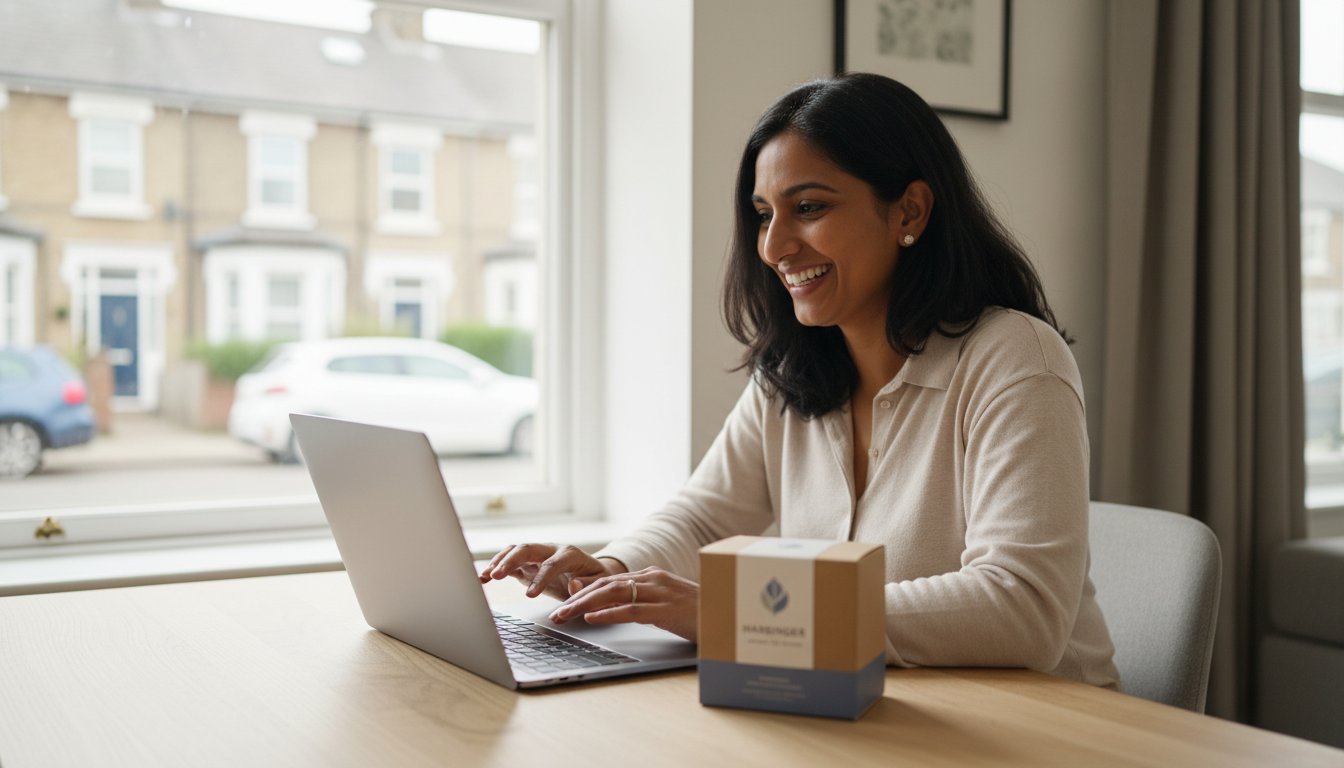
According to BrightLocal’s 2023 research, 98% of consumers read online reviews before they spend their money with a local UK business. You probably know that social proof is your most effective sales tool, but learning how to get customer testimonials and reviews can often feel like you're shouting into a void. It's frustrating when you deliver a quality product and your request for feedback goes ignored. Many independent sellers worry that chasing customers makes their brand look annoying, especially when they're just trying to grow.
Mastering this process doesn't have to be a chore or an awkward exchange. We'll show you how to build a reliable system for collecting authentic feedback that boosts your credibility and increases conversion rates on your product pages. You will learn the exact steps to generate a steady stream of fresh, positive reviews that help you stand out from the competition. This guide covers the best timing for requests, simple templates for UK sellers, and professional ways to handle negative feedback to keep your marketplace rankings high.
Key Takeaways
- Understand why UK consumers in 2026 prioritise authentic social proof over brand messaging to build instant marketplace credibility.
- Discover how to get customer testimonials and reviews using a 5-step system that identifies the "Moment of Maximum Delight" for automated outreach.
- Master the 6-question framework to extract specific, story-based details that turn simple feedback into powerful marketing assets.
- Learn to navigate UK GDPR and the "Incentive Tightrope" to reward customers ethically while maintaining high transparency and trust.
- Boost your conversion rates by strategically placing testimonials at high-friction checkout points and creating a dedicated "Wall of Love."
The Impact of Social Proof on UK Marketplace Success
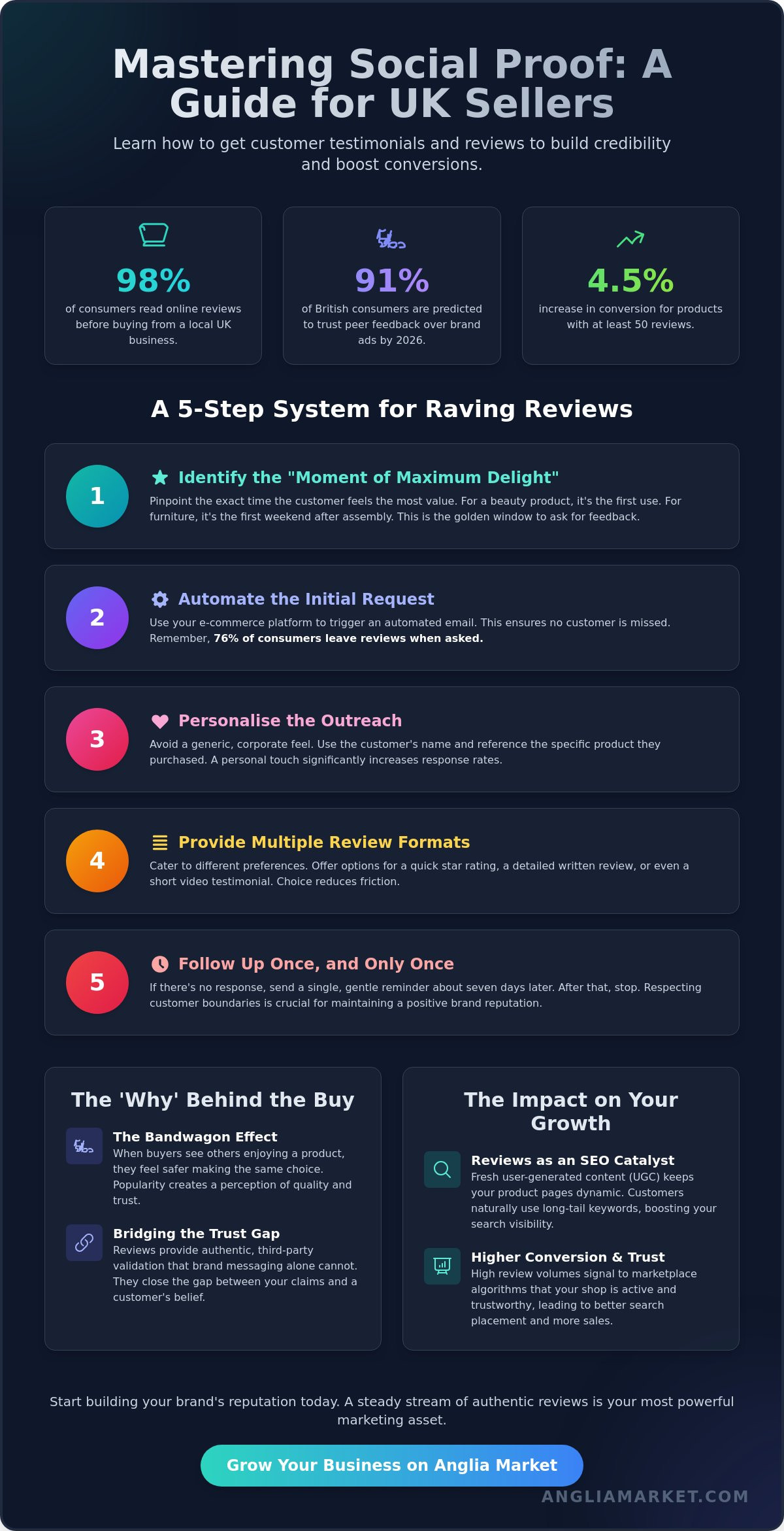
Social proof is the psychological trigger where people look to others to determine correct behaviour. In the UK e-commerce sector, Social proof has become the primary currency for SME growth. By early 2026, data indicates that 91% of British consumers trust peer feedback over traditional brand advertising. For a small business, understanding how to get customer testimonials and reviews is a vital survival strategy that directly influences the bottom line.
High-ticket items like electronics or designer furniture often carry a high perceived risk for shoppers. Reviews act as a risk-reduction tool by providing evidence of quality and reliability. A 2025 consumer report found that products with at least 50 reviews saw a 4.5% increase in conversion rates compared to those with no feedback. On platforms like Anglia Market, high review volumes signal to the algorithm that your shop is active and trustworthy, which boosts your search visibility significantly.
To better understand this concept, watch this helpful video:
The Psychology Behind the Review
The "Bandwagon Effect" explains why customers flock to popular items. When a buyer sees others enjoying a product, they feel safer making the same choice. Customers also look for "Relatable Proof," which means they seek reviews from people with similar needs or lifestyles. The Trust Gap is the distance between a brand's claims and a customer's willingness to believe them without external verification. Reviews bridge this gap by providing authentic, third-party validation that a small brand cannot manufacture itself.
Reviews as an SEO Catalyst
Fresh user-generated content (UGC) is a powerful signal to search engines. Every time a customer leaves a review, they provide search bots with new, relevant text to crawl. This keeps your product pages dynamic and relevant. Customers often use natural language and specific long-tail keywords in their feedback, such as "best waterproof hiking boots for rainy UK weather," which helps your shop appear in more specific search queries.
Sellers who actively manage their reputation often see better placement within marketplace categories. You can see how successful shops manage their presence by visiting the Anglia Market vendors page. Learning how to get customer testimonials and reviews consistently ensures that your SEO remains competitive without relying solely on paid ads. Fresh content tells search engines that your business is still operational and meeting customer needs in real-time.
A 5-Step System for Requesting Raving Reviews
Generating social proof shouldn't be a manual chore that you remember only when sales dip. To master how to get customer testimonials and reviews, you need a repeatable process that runs in the background. This five-step system ensures your SME captures high-quality feedback without draining your team's time.
- Step 1: Identify the "Moment of Maximum Delight". This is the exact point where the customer feels the most value. For a £15 beauty product, it's often the first time they use it. For a £400 garden set, it might be the first sunny weekend after assembly.
- Step 2: Automate the initial request. 76% of consumers leave reviews when asked. Use your e-commerce platform to trigger an email automatically so no customer is missed.
- Step 3: Personalise the outreach. Avoid the "corporate bot" feel by using the customer's name and referencing the specific item they bought.
- Step 4: Provide multiple formats. Some customers prefer a quick five-star click, while others enjoy filming a 20-second video. Give them the choice.
- Step 5: Follow up once. If they don't respond to the first nudge, send one more reminder seven days later. After that, stop. Respecting boundaries protects your brand reputation.
The Art of Perfect Timing
Timing determines whether your request is helpful or annoying. Immediate requests work for impulse buys like small gifts or stationery. However, complex products require a "Usage Buffer". If you sell electronics, a request sent two hours after delivery is useless because the customer hasn't even unboxed the item yet. Data from 2023 shipping benchmarks suggest triggering your request exactly 48 hours after the tracking status marks the parcel as "Delivered" for standard retail goods. This gives the buyer enough time to test the product but keeps the excitement fresh. If you want to see how other sellers manage this, check out our customer testimonials for real-world examples.
Personalisation at Scale
You don't need to write every email from scratch to make it feel personal. Use dynamic tags to pull the specific product name into the subject line. A "Founder-led" email template often performs better for SMEs than a generic "Customer Service" message. When a note comes from the business owner, it feels like a personal favour rather than a marketing requirement. Leveraging positive customer reviews starts with a sincere request; try adding a "P.S." line at the bottom of your email. This small addition is often the most-read part of a message and is the perfect place to mention how much a review helps your small UK business grow. If you're ready to reach more shoppers, you can start selling with us today to put these systems into practice.
Crafting the Perfect Testimonial Questionnaire
A generic "Tell us what you think" email rarely gets results. If you want to know how to get customer testimonials and reviews that actually sell, you need to ask better questions. Most SMEs make the mistake of asking for general feedback, which leads to vague responses like "It was good." To build real trust, you need specific, marketable details that highlight your business's strengths.
The "Before and After" technique is a powerful way to frame your request. It forces the customer to explain the problem they had and how your product provided the solution. This narrative structure is far more persuasive than a simple star rating. You can guide customers to mention specific benefits like "fast delivery" or "quality" by phrasing your questions around those exact themes. For example, instead of asking about the service, ask "How would you describe our delivery speed compared to other UK retailers?"
- What was the main obstacle that almost prevented you from buying this product?
- What did you find as a result of purchasing from us?
- Which specific feature did you like most about this product?
- What are three other benefits you've experienced?
- Would you recommend this to a friend? If so, why?
- Is there anything else you'd like to add?
Questions that Trigger High-Value Responses
Ask about the #1 hesitation they had before clicking "buy." This might seem counterintuitive, but it addresses the fears of future customers directly. When a reviewer says, "I was worried about the assembly, but it took 10 minutes," they're doing your sales work for you. Ask for a specific feature that surprised or delighted them to move beyond surface-level praise. Finally, request a comparison to their previous solution. This highlights your value proposition without you having to name competitors yourself.
Text vs. Video Testimonials: Which is Best?
Text reviews are great for high-volume social proof, but video is the king of conversion. This is especially true for high-trust, high-ticket categories like furniture. According to 2023 consumer research, 88% of shoppers say they've been convinced to buy a product by watching a brand's video. A video allows potential buyers to see the item in a real home environment, which builds immediate credibility.
Don't let the technical side stop you. Use tools like VideoAsk or VocalVideo to make collection frictionless. These platforms allow customers to record a response on their phone with one click. For quick, high-volume social proof on social media, text is still your best bet. It's easier to skim and simple to repurpose into graphic quotes for your Instagram or Facebook feed.
Incentives, Ethics, and Overcoming Friction
Building trust through feedback requires a delicate balance between encouraging customers and maintaining integrity. You can't buy a 5-star rating. In fact, offering rewards specifically for positive comments violates UK consumer protection laws. Instead, focus on rewarding the act of sharing an honest opinion. Learning how to get customer testimonials and reviews ethically is about removing hurdles for the customer while staying compliant with UK GDPR. Under UK GDPR, you can typically contact customers for a review under "legitimate interests" if they've recently purchased from you. You don't always need explicit opt-in for a one-off service email, but you must provide a clear way to opt out. Keep your outreach simple. Every extra click reduces the response rate by approximately 20%. Use the "One-Click" method by embedding direct links to your review profile in the email. This allows the customer to land straight on the text box.Ethical Incentive Structures
The best way to boost volume without compromising ethics is through a structured loyalty program. Reward points for any feedback submitted, whether it's three stars or five. This shows you value the customer's time, not just their praise. Another effective UK model is the "Charity Donation." Tell your customers that for every review submitted, you'll donate £0.50 to a local charity. This builds community goodwill and removes the "bribe" feel of a personal discount. If you need pure volume, prize draws for a £50 voucher often outperform 10% discount codes. A 2022 industry report found that prize draws can increase review acquisition by 35% compared to static discounts.Managing the "Negative Review" Fear
Many SMEs fear a single bad comment will ruin their reputation. The opposite is often true. A 2021 study by PowerReviews found that 95% of consumers suspect censorship or fake reviews if they don't see any negative feedback. A 4.7-star rating is statistically more likely to drive a sale than a perfect 5.0. Use the "24-Hour Rule" for public complaints. Respond within one business day to show you're active and helpful. Your goal isn't to win an argument; it's to show potential shoppers how you handle mistakes.- Acknowledge the issue immediately.
- Apologise for the specific frustration.
- Move the technical dispute offline.
Leveraging Your Social Proof to Close More Sales
Collecting feedback is just the start. To see a real return on investment, you must deploy those words where they influence the final decision. High-friction points, like the checkout page or the final payment screen, are where customers hesitate most. Placing a short, punchy review right next to the "Pay Now" button can reduce cart abandonment by addressing last-minute doubts. You've worked hard on how to get customer testimonials and reviews; don't let them sit idle on a hidden page.
Repurpose your best feedback across all digital channels. Create a dedicated testimonials page to serve as a central trust hub for new visitors. For social media, turn text-based reviews into visual tiles for Instagram or Facebook. In your email marketing, include a "Customer Spotlight" section in abandoned cart reminders. This reminds the shopper why they liked the product in the first place, using the voice of a peer rather than a sales pitch.
Placement Strategy for Maximum Conversion
Specific product reviews should live directly under the "Add to Cart" button. This provides immediate validation at the moment of intent. Use "customer quotes" as the primary headlines in your promotions banners to make offers feel more authentic. Don't forget your search presence. Including star ratings or review snippets in your meta descriptions can increase your Click-Through Rate (CTR) by up to 35 percent. It makes your link stand out in a crowded search result list.
Ongoing Social Proof Maintenance
Social proof has an expiry date. The "Recency Rule" is vital because 85 percent of consumers believe reviews older than three months are no longer relevant. If your latest feedback is from 2022, it looks like your service has stalled. Set a monthly "Review Harvest" goal for your marketing team to ensure a steady stream of fresh content. Aim for at least five new reviews every 30 days to keep your profile active.
- Encourage customers to share photos of products in their own homes for authentic visual proof.
- Update your "Wall of Love" every quarter to remove outdated mentions.
- Ask for specific feedback on delivery speed and packaging quality to reassure UK shoppers.
Consistent effort in how to get customer testimonials and reviews ensures your brand remains competitive. Fresh, local feedback from UK buyers builds a level of trust that generic marketing copy simply cannot match. Keep your social proof current, visible, and focused on the customer's journey to drive more sales.
Scale Your Sales with Verified Social Proof
Building a credible brand in the UK marketplace starts with active feedback. You've learned that social proof isn't just a "nice to have" feature; it's a commercial necessity. By applying a structured 5-step system and using targeted questionnaires, you'll master how to get customer testimonials and reviews that actually convert. Data from G2 shows that 92% of buyers are more likely to purchase after reading a trusted review. This makes your collection process vital for long-term growth.
Anglia Market provides the infrastructure you need to succeed. We already support over 1,000 UK independent vendors with a secure platform featuring integrated review tools. If you run into any hurdles, our dedicated support team is available via our Freshdesk hub to keep your shop running smoothly. Don't let your hard work go unnoticed. Use these strategies to turn happy customers into your most effective sales force.
Start selling on Anglia Market today and build your brand reputation
We're ready to help you reach more shoppers across the country and build a business that lasts.
Frequently Asked Questions
Is it legal to offer a discount in exchange for a review in the UK?
You can offer a discount in exchange for a review in the UK, provided the incentive is transparently disclosed. The Competition and Markets Authority (CMA) requires that any incentivised review is clearly labelled so customers aren't misled. Always state that the reviewer received a benefit, such as a 10% discount code, to ensure your business stays compliant with UK consumer protection laws.
How many reviews do I need before my product looks trustworthy?
Most shoppers look for a minimum of 5 to 10 reviews before they consider a product trustworthy. Research from BrightLocal shows that 76% of consumers regularly read reviews when browsing local businesses. Having at least 10 reviews helps you establish a solid average rating. This volume provides enough social proof to convince 57% of buyers to move forward with a purchase.
What is the best time of day to send a review request email?
The best time to send a review request email is between 1:00 PM and 3:00 PM on Tuesday, Wednesday, or Thursday. Data from email marketing platforms indicates that open rates peak during these mid-afternoon slots when people are taking lunch breaks or finishing daily tasks. Learning how to get customer testimonials and reviews effectively involves timing your outreach to hit the inbox when customers have 5 minutes to spare.
How do I get customers to leave reviews with photos or videos?
Offer a specific incentive, like an entry into a £50 monthly prize draw, for reviews that include photos or videos. Visual social proof is highly effective, as 62% of consumers are more likely to buy if they see customer photos. Use automated request tools that allow users to upload media directly from their smartphones. This makes the process simple and increases the likelihood of receiving high-quality visual content.
What should I do if a customer leaves a fake negative review?
Report the review immediately to the platform's moderation team using their report function. You should also post a calm, factual response that clarifies the situation for other readers. Mention that you have no record of a transaction matching their details. Since 89% of consumers read business responses, a professional reply protects your reputation while you wait for the platform to investigate the claim.
Can I use a testimonial from my website on my social media ads?
You can use website testimonials in social media ads, but you must ensure the usage aligns with UK GDPR and advertising standards. It's best practice to get explicit written consent from the customer before featuring their name or image in a paid promotion. This protects your SME from potential legal disputes. Using real feedback in ads can increase click-through rates by 40% compared to standard brand copy.
Do I need a customer’s permission to use their review in my marketing materials?
You need explicit permission to use a customer's review in marketing materials like brochures or billboards. While a review posted on a public site is visible to all, your right to use it for commercial gain depends on the platform's terms and privacy laws. Understanding how to get customer testimonials and reviews properly includes asking for permission at the point of submission. This ensures you're legally covered for future campaigns.

Here to help — ask anything
If you have any questions regarding this disclaimer or any of our policies, please contact Anglia Market through the contact page on our website, by email using the address provided on the site, or by phone at 0333 772 2593