

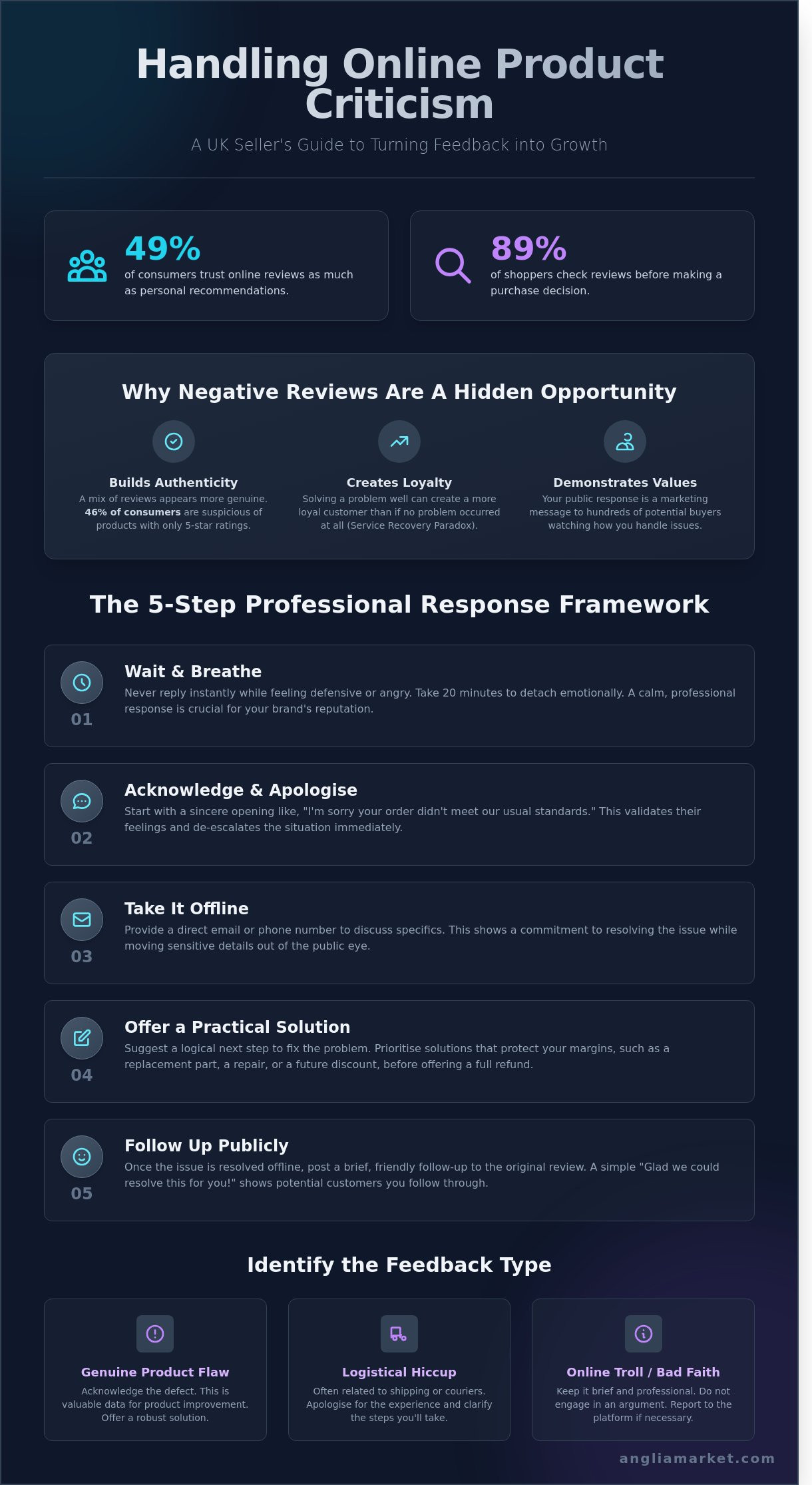
Last Tuesday, a small business owner in Manchester opened their shop dashboard to find a stinging 1-star review. It's a gut-punch that makes you want to delete your listings and hide. We know that feeling. You've poured hours into your products, so a public critique feels like a personal attack. You aren't alone in your worry. A 2023 BrightLocal survey revealed that 49% of consumers trust online reviews as much as personal recommendations. This is why knowing how to handle criticism of your products online is now a vital survival skill for every UK seller.
It's tempting to ignore the comment or send a defensive reply. However, there's a much better way to protect your brand. You're about to learn how to transform negative feedback into a powerful tool for product improvement and customer loyalty. We'll provide a professional response template and a clear plan to fix actual product issues. You'll see how to turn a disgruntled buyer into a repeat customer while significantly improving your trust ratings across the marketplace.
Key Takeaways
- Discover why a mix of reviews builds more trust with UK shoppers than a perfect score and how to use feedback to fuel your business growth.
- Master a professional step-by-step framework on how to handle criticism of your products online without letting emotions cloud your commercial judgment.
- Learn to distinguish between genuine product flaws, logistical hiccups, and online trolls to ensure you spend your energy where it actually improves your bottom line.
- Find out how to organise qualitative customer data into a product improvement spreadsheet that pre-emptively answers future buyer concerns.
- See how leveraging professional marketplace vendor tools can help you maintain brand credibility and manage customer relations more efficiently.
Why Online Product Criticism is Your Best Growth Tool
Criticism isn't a sign of failure. It's a direct line to your customer's genuine needs. For UK sellers, understanding how to handle criticism of your products online is a vital part of online reputation management. Leveraging an AI-powered reputation intelligence agent like Aria Operations allows you to proactively protect and elevate your digital standing. This feedback loop helps you refine your stock and fix operational gaps that might otherwise go unnoticed. UK shoppers are naturally savvy. A 2023 study by BrightLocal found that 46% of consumers feel suspicious if a product only has five-star reviews. A handful of balanced critiques makes your brand look authentic and trustworthy rather than manufactured.
To better understand this concept, watch this helpful video:
Fixing a mistake often leads to higher customer retention than if the mistake never happened. This is known as the Service Recovery Paradox. When you resolve an issue publicly, you show potential buyers that you're reliable and supportive. You must also detach your personal identity from your inventory. Your products are your commercial assets, not your character. Detaching your identity allows you to respond professionally rather than defensively, which is essential when you sell online to a wide audience.
The Psychology of the Negative Review
Most critics aren't out to destroy your business. They want acknowledgement. They post publicly because they feel it guarantees a faster response than a private email. You're also writing for the "silent majority." For every one vocal critic, hundreds of potential buyers are watching your reaction. Your response isn't just for the unhappy customer; it's a public demonstration of your values to every future shopper.
Impact on UK Consumer Trust
UK shoppers place a high value on transparent customer service. Research from Trustpilot indicates that 89% of shoppers check reviews before making a purchase. Handled correctly, criticism improves conversion rates by showing your brand is dependable. Marketplace platforms play a key role here, as they mediate interactions and provide a structured environment for dispute resolution. This transparency is why many independent vendors thrive on professional marketplaces. Use these moments to prove your commitment to quality and value.
- Acknowledge quickly: Respond within 24 hours to show you care.
- Be practical: Offer a solution, such as a refund or replacement, rather than an excuse.
- Stay commercial: Keep the conversation focused on the product and the solution.
Learning how to handle criticism of your products online turns a potential PR disaster into a marketing win. It builds a bridge of trust between you and the UK consumer, ensuring they feel secure when clicking the "buy" button.
The Professional Framework for Responding to Negative Feedback
Receiving a one-star review feels personal, but your response must remain strictly commercial. Emotional reactions often lead to public arguments that damage your brand's reputation for years. Instead, follow a structured professional framework for responding to ensure every critique becomes a marketing opportunity. A 2023 BrightLocal survey found that 88% of consumers are likely to use a business if they see the owner responds to all reviews, whether positive or negative. Success depends on your ability to remain calm and systematic.
- Wait and Breathe: Never reply instantly while feeling defensive. Take 20 minutes to detach from the emotion.
- Acknowledge and Apologise: Start with a sincere opening. Use "I am sorry that your order didn't meet our usual standards" rather than shifting blame.
- Take it Offline: Provide a direct email address or phone number. Specific resolutions shouldn't happen in a public comment section.
- Offer a Logical Next Step: Protect your margins by suggesting a repair, a replacement part, or a discount on a future order rather than an immediate full refund.
- Public Resolution: Once the issue is fixed, post a final brief comment. This shows other buyers that you follow through on your promises.
Learning how to handle criticism of your products online is about more than just being polite. It is about demonstrating reliability to the thousands of silent browsers who are watching how you treat unhappy customers. If you sell online through a marketplace, these public interactions are your most visible form of customer service.
The 'Golden Hour' of Response
Speed matters in the UK e-commerce market. Aim to respond within 24 hours. This timeframe shows you are active and attentive without appearing desperate. To stay on top of this, enable push notifications in your marketplace seller app and set up email alerts for new storefront comments. Balancing speed with a professional tone is easier when you have a template ready to customise. Promptness can prevent a frustrated buyer from escalating their complaint to a formal dispute.
Drafting the Perfect Reply
Use clear British English and avoid "non-apologies" like "I am sorry you feel that way," which often sounds condescending to UK shoppers. Stick to straightforward vocabulary that focuses on the solution. Your brand persona should be consistent across every interaction. The Helpful Responder persona: A calm, solution-oriented partner who prioritises customer satisfaction while maintaining brand integrity. This approach builds trust and encourages repeat business even after a rocky start.
Distinguishing Genuine Product Flaws from Logistics and Trolls
Effective response strategies start with categorisation. You can't fix a delivery issue by changing your product design. To master how to handle criticism of your products online, you must divide feedback into three distinct buckets: Product, Process, or Personality. Understanding which category a comment falls into determines your next move. It's about sorting the signal from the noise so you can spend your energy where it actually helps your bottom line.
- Product Flaws: These happen when the item doesn't match the description or quality standards. UK retail data from 2023 shows that "item not as described" remains a primary driver for e-commerce returns.
- Logistics Complaints: This is about the journey, not the object. Late arrivals, courier delays, or crushed boxes fall here. These are process failures that require a logistical fix.
- Personality (Trolls): These are bad-faith actors. They aren't looking for a resolution or a refund. They want to vent or intentionally damage your brand's reputation.
Learning how to handle criticism of your products online means identifying these categories before you type a single word. A customer complaining about a late delivery needs an apology and perhaps a shipping refund, not a technical manual. Conversely, a shopper unhappy with a material's texture needs a clear explanation of your quality standards or a return label. Spotting bad-faith reviewers is also a vital skill. Look for vague language like "this is rubbish" without explaining why. Genuine customers usually want to tell you exactly what went wrong. If a reviewer uses aggressive language or refuses a fair resolution, they're likely a troll. In these cases, a short, professional public reply is enough.
Handling Technical and Quality Critiques
Specific complaints about electronics often stem from setup confusion rather than hardware failure. If a buyer claims a device is "broken," offer a technical walkthrough or a troubleshooting link first. Replacing a functional item is a waste of capital. For furniture, durability critiques often relate to assembly errors. If multiple reviews mention the same "weak point" during builds, update your product listings immediately. Adding a "Pro Tip" or a clearer diagram to your listing can cut support tickets by 15% within a single month.
For appliance sellers, referring to a specialist database like Hvidevaredele.dk can provide a blueprint for helping customers source spare parts and fix minor issues themselves, turning a potential complaint into a positive interaction.
When to Ignore or Escalate
Identify "Review Bombing" early. This is a coordinated attack where your rating drops significantly in a few hours. If you see five or more identical low-star reviews without verified purchases, report them to marketplace support. Follow the "Rule of Three" for genuine critiques. If three separate customers report the same defect, it's a pattern, not an outlier. That's when you need a major business pivot. Don't let aggressive users ruin your day. Set boundaries by only checking reviews during set business hours. Protecting your mental health ensures you stay sharp for the customers who actually value your work.
Turning Feedback into Product Development and Better Sales
Don't let negative reviews sit idle. Use them as free market research. Smart sellers organise qualitative data into a 'Product Improvement' spreadsheet. In this document, track the date, the specific complaint, and the frequency of the issue. If 15% of your customers mention a strap breaking on a bag, you've found a manufacturing flaw that needs fixing. Learning how to handle criticism of your products online means moving beyond damage control and into product evolution.
- Update product descriptions: Use common complaints to pre-emptively answer questions. If people think a lamp is too small, add a photo next to a standard mug for scale.
- Clarify with 'negative' keywords: Use your FAQ to state what a product isn't. If a 'water-resistant' jacket isn't 'waterproof' for heavy rain, say so clearly to prevent future disappointment.
- Reward constructive critics: Send a £5 voucher or a discount code to customers who provide detailed, actionable feedback. It turns a critic into a brand consultant.
Updating Your Storefront Based on Criticism
You can sell online more effectively by being brutally honest. If a fabric has a slight sheen that doesn't show well in photos, mention it in the first two sentences of your description. High-quality photography is essential. Use a colour-calibrated monitor to ensure your product photos match the physical item. When you fix a known issue, tag the listing as 'New and Improved' to show you listen to your audience.
For clothing retailers like Elegant Rose, who focus on timeless, soft, and elegant women's wear, providing this depth of descriptive detail is essential for managing customer expectations and maintaining high satisfaction ratings.
For specialist sellers dealing in collectibles like comic books, movies, and TV-themed merchandise, providing this level of detail is crucial for maintaining a positive reputation. To see how specialized retail shops present their stock to meet these high standards, read more.
The Long-term Benefits of the Feedback Loop
Listening to critics reduces your long-term return rates by aligning customer expectations with reality. This process builds a brand that customers feel they have 'co-created' with you. Loyalty increases when shoppers see their suggestions implemented. One UK kitchenware brand saved their £15,000 silicone mould line in April 2024 by switching to a higher heat-resistance grade after three customers reported warping. Understanding how to handle criticism of your products online is a direct path to higher profit margins and better brand authority.
Maintaining Brand Credibility on a Professional Marketplace
Selling on a curated platform like Anglia Market provides an immediate layer of trust that standalone websites often struggle to build. UK shoppers feel more secure when they browse a marketplace that actively vets its sellers. When you are learning how to handle criticism of your products online, having access to integrated vendor tools is a distinct advantage. These dashboards allow you to manage customer relations centrally, ensuring that no feedback goes unanswered or ignored. This professional structure signals to the buyer that you are a legitimate business committed to high standards.
Consistency is the backbone of brand credibility. Your behaviour must remain the same across every customer touchpoint, from the initial product description to the final resolution of a complaint. If your tone is friendly in marketing but becomes defensive when faced with a critique, customers will notice the disconnect. A 2023 study by BrightLocal found that 46% of consumers trust online reviews as much as personal recommendations. Maintaining a steady, helpful presence helps you stay on the right side of that trust. You should aim to dilute the impact of occasional outliers by encouraging a high volume of positive feedback. One or two negative comments carry much less weight when they are surrounded by fifty glowing 5-star reviews.
This commitment to excellence should be reflected in how you interact with everyone associated with your brand. As you scale, you might also explore Candidate Experience Benchmarking to ensure your recruitment standards are as high as your customer service benchmarks. Beyond professional metrics, maintaining a healthy and inspired mindset is essential for long-term success, a topic frequently explored by Wellthy.
Boosting Positive Sentiment
Proactive engagement is the best way to manage your reputation. Use a loyalty program to reward your most vocal supporters and repeat buyers. These customers are your best advocates. Master the art of the follow-up email by checking in with a customer three days after their order arrives. This gives you a chance to fix issues before a review is even written. Finally, showcase your best testimonials prominently. Highlighting success stories helps balance the narrative and shows potential buyers that the majority of people have a fantastic experience with your shop.
Leveraging Platform Support
You don't have to face every challenge alone. There are times when feedback is demonstrably unfair or violates marketplace terms of service. In these cases, involve marketplace mediation to address unfair product strikes. Professional support channels are designed to handle complex disputes that require a neutral third party. This ensures that your seller rating isn't unfairly tarnished by "review bombing" or fraudulent claims. Knowing how to handle criticism of your products online includes knowing when to ask for help from the platform itself. Join a community that supports your growth as a UK seller and provides the tools you need to thrive in a competitive retail environment.
Turn Feedback Into Future Sales
Mastering how to handle criticism of your products online transforms negative reviews into a strategic advantage for your brand. Research from Trustpilot in 2023 shows that 89% of global consumers read reviews before making a purchase, making your professional response a vital part of the sales funnel. By separating genuine product flaws from logistics issues or trolls, you can implement changes that directly improve your bottom line and customer loyalty. It’s about being proactive rather than defensive.
You don't have to navigate these challenges in isolation. Anglia Market offers dedicated support for small and medium UK businesses, providing secure shopping environments and robust vendor management tools. Our platform gives you direct access to a broad, trust-oriented customer base that values transparency and quality. This support system allows you to focus on scaling while we help maintain your professional reputation.
Start selling with a marketplace that supports your business growth
Take the next step today and watch your UK business thrive in a supportive professional environment.
Frequently Asked Questions
Should I delete negative comments about my products?
No, you shouldn't delete negative comments unless they contain profanity or illegal content. A 2023 Trustpilot report found that 62% of consumers suspect censorship when they only see 5-star reviews. Keeping them visible shows you're a transparent UK seller. It's better to respond professionally than to hide the feedback. This builds trust with potential shoppers looking for authentic experiences on your site.
Is it ever okay to argue with a customer online?
It's never a good idea to argue with a customer on public platforms. Arguments damage your brand's reputation and drive away 80% of potential buyers who read your responses. Stay calm and offer to move the conversation to a private email or phone call. This approach keeps your public profile professional while you resolve the issue. Focus on being a helpful facilitator rather than being right.
How do I handle a product review that is factually incorrect?
Address factually incorrect reviews by politely stating the correct information backed by your product specifications. If a customer claims a toaster doesn't have a crumb tray when it does, mention where to find it. This is how to handle criticism of your products online without being confrontational. Provide clear, helpful details to ensure other shoppers aren't misled by the original comment. Stick to the facts to maintain your authority.
Can negative feedback actually help my SEO or sales?
Yes, negative feedback can improve your conversion rates and SEO. Research from the PowerReviews group shows that products with a 4.2 to 4.5 star rating sell better than those with a perfect 5.0. Fresh reviews also provide search engines with new content to index. A mix of feedback proves your reviews are genuine, which 95% of shoppers value when making a purchase. It makes your brand look more realistic.
What should I do if a competitor is leaving fake negative reviews?
Report suspected fake reviews immediately to the platform's moderation team using their specific reporting tools. Gather evidence such as the reviewer's lack of purchase history or similar patterns across other listings. Under the UK's Consumer Protection from Unfair Trading Regulations 2008, businesses mustn't commission fake reviews. Most marketplaces will remove content that violates these legal standards once you provide sufficient proof of foul play. Don't engage with them directly.
How much time should I spend responding to online criticism?
Aim to spend 30 minutes each day monitoring and responding to feedback. A 2022 BrightLocal survey indicated that 77% of consumers always or regularly read reviews when browsing local businesses. Quick responses within 24 hours show you're an active, reliable UK seller. Use templates for common issues to stay efficient while maintaining a personal touch. This keeps your communication rhythm fast-paced and professional without draining your day.
Does offering a refund always fix the problem?
A refund isn't a universal fix and sometimes customers just want their problem acknowledged or solved. While 90% of unhappy buyers might appreciate their money back, others prefer a replacement or a simple apology. Ask the customer what resolution they'd prefer before processing a payment. This saves you money on unnecessary returns and shows you genuinely care about their shopping experience. It's about finding the right value for them.
What are the legal limits of customer criticism in the UK?
Customer criticism is protected as long as it's an honest opinion or a true statement. The Defamation Act 2013 protects UK sellers from comments that cause serious harm to their reputation and are factually false. You can't sue for a bad review if the customer is simply sharing their genuine experience. Always seek professional legal advice if you believe a review has crossed into illegal territory or harassment. Most cases are best handled through platform moderation.

Here to help — ask anything
For questions about this disclaimer or the site, contact us via the website’s Contact page.


