Did you know that the UK e-commerce market is projected to hit £160 billion by 2026? It's a massive opportunity, yet 40% of aspiring entrepreneurs hesitate because they're unsure how to sell online for the first time uk and fear getting their HMRC registration wrong. Starting a business often feels like a mountain of confusing paperwork. You want to focus on your quality products, not spend hours worrying about VAT thresholds or whether your shipping labels meet Royal Mail standards. It's natural to feel some anxiety about online security when your own money and reputation are on the line.
You've come to the right place for simple, practical advice. We'll provide a clear legal roadmap and help you pick a low-risk marketplace like Anglia Market to get started. You'll learn exactly how to handle your first order and master the logistics of delivery with confidence. This guide breaks down the six essential steps to turn your idea into a fully compliant, profitable UK business by the end of the week.
Key Takeaways
- Understand the 2026 UK e-commerce landscape and why starting now positions your business at the forefront of global online retail.
- Navigate legal essentials confidently by choosing between Sole Trader or Limited Company status and utilising the £1,000 HMRC Trading Allowance.
- Master how to sell online for the first time uk by evaluating the pros and cons of marketplaces versus building your own dedicated storefront.
- Learn to source a high-demand "Hero Product" and capture professional-standard imagery using only natural light and a smartphone.
- Discover how Anglia Market’s commission-based model protects your margins while providing a supportive launchpad for independent British brands.
The UK E-commerce Landscape: Why 2026 is the Year to Start
The UK is an e-commerce powerhouse. It currently holds the highest online spend per capita in Europe. By 2026, digital sales will likely hit 38% of all retail transactions, marking a permanent shift in how Britons spend their money. If you're wondering how to sell online for the first time uk, the timing is perfect. The market is moving away from faceless global giants and towards trusted local vendors.
At its core, What is E-commerce? It's the digital exchange of goods and services, but for a 2026 start-up, it's about building a brand. British shoppers now prioritise independent vendors over massive conglomerates. Recent data shows that 64% of UK consumers prefer buying from local SMEs to support the domestic economy. This creates a massive opening for new sellers who can offer a personal touch.
To get a practical start on the basics, watch this helpful video:
Success in 2026 requires a focus on quality over mass-production. Market saturation from global drop-shippers has led to buyer fatigue. People want items that last and stories they can trust. When learning how to sell online for the first time uk, focus on a specific niche. This allows you to provide expert knowledge and curated products that big retailers simply can't match. Quality and local origin are your biggest competitive advantages.
Identifying Your Target UK Customer
British shoppers in 2026 demand transparency. 72% of UK buyers check a brand's sustainability credentials before they hit the checkout button. You've got to understand these expectations early. Use free digital tools like Google Trends or AnswerThePublic to see what people in specific regions are searching for. Local demand often beats national trends, so look for gaps in your own community first. Ethical sourcing isn't just a trend; it's a requirement for modern UK retail.
Setting Realistic First-Year Goals
Don't expect overnight riches. A healthy first-year conversion rate for a new UK site typically sits between 1% and 2.5%. Your first 10 sales are your most vital. These provide the social proof and reviews needed to build long-term trust. Decide if you're running a side hustle for an extra £500 a month or a scalable business. A scalable model focuses on reinvesting every penny into inventory and marketing during those first twelve months to ensure growth.
Legal and Financial Essentials for First-Time UK Sellers
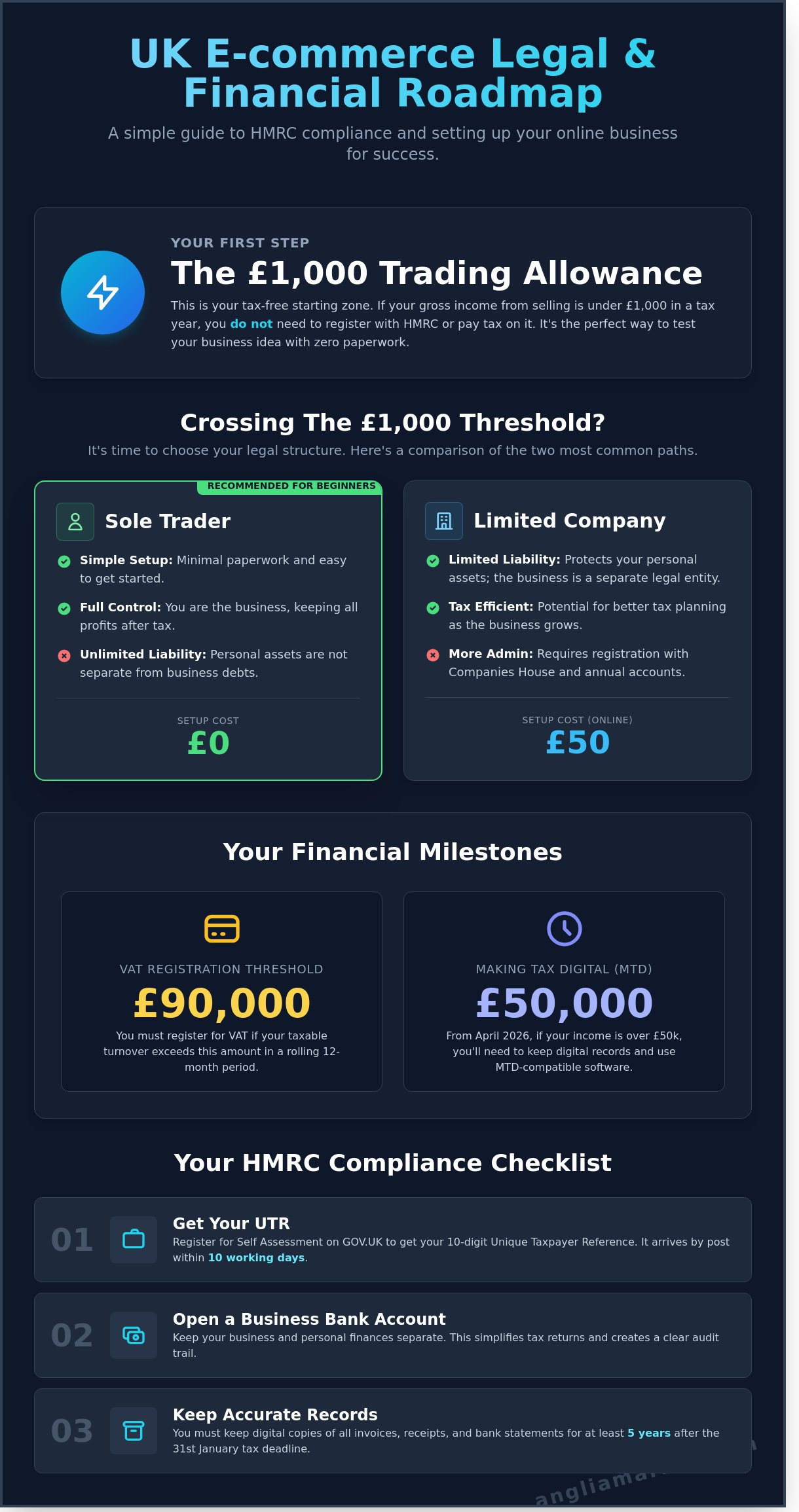
Setting up your business correctly ensures you stay on the right side of HMRC from day one. If you're learning how to sell online for the first time uk, start by understanding the £1,000 Trading Allowance. This rule allows you to earn up to £1,000 in gross income within a tax year without paying tax or registering with HMRC. It's perfect for testing the waters. Once your sales exceed this limit, you must register as a sole trader or set up a limited company through Companies House. Most new sellers start as sole traders because it involves less paperwork and a lower setup cost of £0, compared to the £50 fee for online company incorporation.
Tax thresholds are a critical part of your growth strategy. The VAT registration threshold currently sits at £90,000. You only need to register for VAT if your taxable turnover exceeds this amount over a rolling 12-month period. Monitoring the UK E-commerce Landscape in 2026 provides insight into how these regulations evolve alongside market growth. Accurate record-keeping is your best defence against stress. You must keep digital copies of all invoices, receipts, and bank statements for at least five years after the 31 January tax return deadline.
HMRC and Tax Compliance Simplified
Obtaining your Unique Taxpayer Reference (UTR) is a straightforward process. Register for Self Assessment on the GOV.UK website as soon as you pass the £1,000 income mark. HMRC will send your 10-digit UTR through the post, usually within 10 working days. Use this number for all official correspondence. Open a dedicated business bank account immediately to keep your professional transactions separate from your grocery shopping. This makes calculating profits easier and provides a clear audit trail. From April 2026, self-employed individuals with qualifying income over £50,000 must use compatible software to keep digital records and submit quarterly updates to HMRC under the Making Tax Digital programme.
UK Consumer Rights and Online Regulations
Selling online means you must follow the Consumer Rights Act 2015. Your products must be of satisfactory quality, fit for purpose, and exactly as described in your listing. You're legally required to provide clear 'Distance Selling' terms and conditions on your shop page before a customer completes a purchase. This includes your business address and a clear explanation of delivery costs. UK shoppers benefit from a mandatory 14-day 'right to cancel' rule. Customers can return most items for any reason within 14 days of receiving them. You must then refund them within 14 days of receiving the goods back. High standards in customer service help you support UK small businesses while building a loyal buyer base. Knowing how to sell online for the first time uk involves mastering these rules to avoid costly disputes.
Choosing Your Platform: Marketplace vs. Own Website
Deciding where to list your products is a critical step when learning how to sell online for the first time uk. You generally have three paths. Marketplaces like Anglia Market provide an immediate storefront. SaaS (Software as a Service) builders like Shopify offer templates for a monthly subscription. Open Source platforms like WooCommerce give you total code control but require technical management. Most beginners find that marketplaces offer the fastest route to profit because they remove the technical barriers of web development.
While platforms like Shopify offer great templates, standing out in a crowded market often requires a professional touch. To ensure your storefront looks credible and is optimized to convert visitors, you can check out Frooition, an agency specializing in e-commerce design.
Many new entrepreneurs fall for the "build it and they will come" myth. They spend upwards of £1,500 on a beautiful standalone website, only to realise nobody is visiting it. A private website starts with zero traffic. You must pay for every visitor through Google Ads or wait months for SEO to kick in. Before committing to these costs, review the Legal and Financial Essentials for UK Sellers to ensure your budget covers more than just a domain name. Hidden costs like SSL certificates (£50+ per year), secure hosting (£15+ per month), and payment processing fees can drain your margins quickly.
The "Marketplace Advantage" is simple: access. In 2023, over 80% of UK consumers used online marketplaces to find new products. These platforms already have the shoppers you need. You trade a small commission for immediate visibility and a functional checkout system that works on day one.
The Benefits of Selling on a UK-Focused Marketplace
Selling on a UK-centric platform like Anglia Market reduces your technical overhead. You don't need to be a web designer to start. These platforms provide built-in trust for hesitant buyers who might worry about security on an unknown site. Anglia Market specifically supports SME visibility, giving smaller vendors a fair chance against larger corporations. It's a practical way to test your product's appeal without a heavy upfront investment in software.
When to Consider a Standalone Website
You might consider a standalone site once your monthly revenue consistently exceeds £5,000 or your brand identity requires a bespoke experience. This move offers total control over customer data, but it brings total responsibility for security and maintenance. A hybrid strategy is often the most effective way to manage how to sell online for the first time uk. Use a marketplace to generate immediate cash flow and brand awareness while slowly building your own site in the background. This dual-channel approach ensures you aren't reliant on a single platform for your entire income.
Five Steps to Launching Your First Online Storefront
Success begins with a Hero Product. This is a single item with high demand and manageable competition. Research shows that 62% of new UK sellers find success by focusing on a specific niche, such as sustainable homeware or handmade gifts, rather than a broad range. When you learn how to sell online for the first time uk, your initial inventory should be small. Test the waters with 10 to 20 units to validate your idea before scaling up.
This strategy applies even in highly specific markets. For example, by focusing on the dedicated community of vaping enthusiasts, the online store Vape Center has successfully built a brand around a specialized product range, proving the power of a well-chosen niche.
This strategy of serving a passionate fanbase works across many areas. For inspiration, visit The Jazz House, which has built a successful brand around unique, jazz-themed apparel.
Visuals sell products. You don't need a professional studio; a smartphone and a window are enough. Position your product on a plain white background near a north-facing window between 10:00 and 14:00 for the most consistent light. Capture the front, back, side, and any unique textures. High-quality images can increase conversion rates by up to 30% compared to blurry or dark photos.
Your descriptions must answer UK buyer concerns immediately. Mention if the item includes a UK 3-pin plug, specific metric measurements (cm/kg), and the exact materials used. Clear communication builds trust. Your pricing strategy must be precise. Calculate your 'landed cost' by adding the product cost, a 10% to 15% marketplace commission, and your packaging. Remember that if your turnover exceeds £90,000, you must register for VAT at the standard 20% rate.
Choosing a delivery partner is your final hurdle. Royal Mail is reliable for small parcels under 2kg, while Evri and DPD offer competitive rates for larger items. A standard tracked delivery usually costs between £2.99 and £4.50 for small parcels. Always use sturdy, recyclable packaging to protect the goods and your reputation.
Product Listing Optimisation (SEO)
Identify keywords by using the search bar on major marketplaces to see what terms auto-suggest. If you sell "ceramic mugs," you might find customers are actually typing "handmade blue coffee cups." Use these phrases in your titles. Your 'What's in the Box' section should be a bulleted list to prevent any customer confusion. Alt text on images is vital for SEO because it describes your visuals to search engine crawlers and improves accessibility for visually impaired users.
Managing Your First Sale and Shipping
The unboxing experience is your best marketing tool. Include a simple, printed thank-you note or a 5% discount code for their next purchase to encourage repeat business. For your first trip to the post office, print your labels at home to save time and ensure the address is legible. UK law, specifically the Consumer Rights Act 2015, gives buyers a 14-day right to change their mind. Handle these returns professionally; a smooth refund process often results in a customer returning later when they find the right item.
Ready to get started? Start selling with Anglia Market today and reach thousands of UK shoppers.
Why Anglia Market is the Ideal Launchpad for UK SMEs
Anglia Market exists to empower the 5.5 million small and medium enterprises currently driving the British economy. If you are researching how to sell online for the first time uk, you need a partner that understands the local landscape. We've built our platform to remove the technical hurdles that often stop great businesses from growing. Our mission is simple; we provide a reliable, homegrown alternative to global giants, ensuring that UK wealth stays within UK communities.
Our commission-based model is a game-changer for new vendors. Unlike platforms that charge £30 or £40 per month just to exist, we only take a fee when you actually make money. This protects your margins from the very first day. You can explore a massive range of categories, including Home and Garden, Electronics, and Beauty. We've cultivated a community of independent vendors who prioritise service over mass production. When you join us, you aren't just another account number; you're part of a network that values British quality.
Simplified Vendor Onboarding
We've stripped away the complexity of traditional e-commerce. Learning how to sell online for the first time uk doesn't have to be a multi-month project. You can set up your Anglia Market shop in under 60 minutes. Our registration process is straightforward. Once approved, you get immediate access to seller support tools designed to help you scale. These include inventory tracking and sales reports that show exactly where your growth is coming from. By choosing a homegrown platform, you're directly supporting the UK economy and reaching customers who want to shop local.
Take the First Step Today
Don't wait for the perfect moment to launch your brand. Most successful sellers on our platform started with a handful of products and refined their approach as they grew. We offer exclusive promotional opportunities for new vendors, including featured placements that can increase your initial shop traffic by up to 40% in your first month. There is no better time to expand your reach. Start your UK selling journey with Anglia Market today and turn your business goals into a reality.
Launch Your UK E-commerce Journey Today
The 2026 digital landscape offers unprecedented opportunities for those who master the legal essentials and choose the right sales channel. You've seen that success requires a mix of HMRC compliance, smart platform selection, and a streamlined five-step launch strategy. Learning how to sell online for the first time uk doesn't have to be overwhelming when you have the right tools at your disposal. Focus on your product quality and let a proven platform handle the technical heavy lifting.
Anglia Market currently supports thousands of UK SMEs by providing a reliable, commercial space to grow. We prioritise secure shopping for your customers and offer an easy-to-use vendor dashboard that puts you in full control of your stock and sales. With the UK e-commerce sector continuing to expand, there's never been a better time to establish your digital presence. Join a community of independent vendors who are already reaching millions of shoppers across the country.
Register as a Vendor on Anglia Market and start building your future today. It's time to turn your passion into a profitable online store.
Frequently Asked Questions
Do I need a business licence to sell online in the UK?
You don't need a specific "online selling licence" to trade in the UK. However, if your annual gross income from sales exceeds the £1,000 Trading Allowance, you must register as a sole trader or a limited company with HMRC. Most beginners start as sole traders. This registration ensures you're legally compliant while keeping your business structure simple and manageable for your first year of trading.
How much does it cost to start an online shop for the first time?
Starting costs range from £0 to £50 depending on your choice of platform. Selling on a marketplace often involves no upfront fees, just a commission of 10% to 15% per sale. If you choose a dedicated website builder, expect to pay around £25 per month for a basic subscription. You should also budget £10 for a domain name and £20 for initial packaging supplies.
When do I have to tell HMRC that I am selling online?
You must notify HMRC once your total gross income from sales exceeds £1,000 within a single tax year. This is the point where you're learning how to sell online for the first time uk. Register for Self Assessment by 5 October following the end of the tax year in which you started trading. Keeping accurate digital records of every transaction is essential for your first tax return.
What are the most popular items to sell online in the UK in 2026?
In 2026, the UK market shows high demand for sustainable home products and smart office accessories, niches where retailers like Klevaro are thriving. Data suggests that eco-friendly kitchenware sales grew by 18% in the last 12 months. Other top performers include pet health supplements and modular garden furniture. Focus on these niches to capture current consumer interest. These categories offer high margins and consistent search volume across UK marketplaces and independent shops.
Can I sell online if I have a full-time job in the UK?
Yes, you can absolutely run an online shop alongside a full-time job. Many UK sellers begin as "side hustlers" to test the market without financial risk. Just check your employment contract for any non-compete clauses that might restrict your business activities. You'll still benefit from the £1,000 tax-free Trading Allowance on top of your PAYE earnings, making it a low-risk way to start your journey.
How do I handle shipping and returns for my first online sale?
For your first sale, use a reliable courier like Royal Mail or Evri, which offer tracked services from approximately £2.70. Under the Consumer Contracts Regulations, you must offer a 14-day cooling-off period where buyers can change their minds. Clearly state your returns policy on your shop page. This builds trust with your customers and ensures you comply with UK distance selling laws from day one.
Is it better to sell on a marketplace or my own website as a beginner?
Beginners usually find more success starting on an established marketplace. These platforms provide immediate access to millions of active shoppers, so you don't have to worry about driving traffic yourself. While your own website offers more brand control, it requires significant investment in SEO and marketing. Starting on a marketplace allows you to learn how to sell online for the first time uk with much lower initial risk.
What is the VAT threshold for UK online sellers in 2026?
The VAT registration threshold for UK sellers in 2026 remains at £90,000 in taxable turnover over a 12-month period. You don't need to register or charge VAT if your sales stay below this figure. If you expect to exceed this amount, you must register with HMRC. Some sellers choose to register voluntarily if they sell mainly to other VAT-registered businesses to reclaim VAT on their own business purchases.

Here to help — ask anything
If you have any questions regarding this disclaimer or any of our policies, please contact Anglia Market through the contact page on our website, by email using the address provided on the site, or by phone at 0333 772 2593