
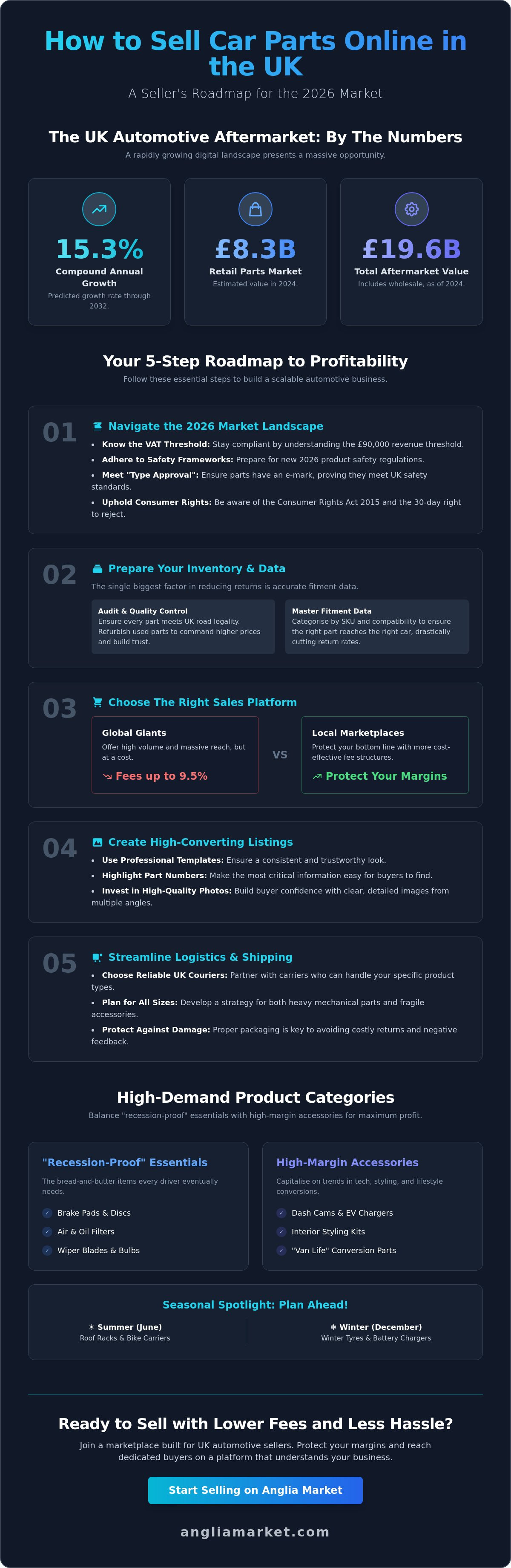
The UK online automotive parts and accessories market is predicted to grow at a compound annual rate of 15.3% through 2032. It's a massive opportunity. However, learning how to sell car parts and accessories online uk profitably in 2026 means navigating a minefield of high platform fees and complex fitment data. You likely already know that one wrong compatibility listing can lead to a wave of expensive returns. It's frustrating to see your margins disappear into shipping costs for heavy items or tiered fees that can reach 9.5% on major platforms.
We're here to help you master the logistics, legalities, and platform choices needed to build a scalable automotive business. This article provides a clear roadmap for selecting the right sales channels and reducing your return rates. You'll learn how to balance high-volume giants with local marketplaces like Anglia Market to protect your bottom line. We'll also cover the £90,000 VAT threshold and the 2026 product safety frameworks you need to stay compliant while you scale your operations.
Key Takeaways
- Navigate the 2026 UK market landscape. Understand the £90,000 VAT threshold and new product safety rules for automotive sellers.
- Minimise returns through precise fitment data. Learn to categorise inventory by SKU and compatibility to ensure the right part reaches the right car.
- Learn how to sell car parts and accessories online uk profitably. Compare global platforms against local marketplaces to find the most cost-effective fee structure.
- Drive sales with professional listing templates. Focus on part number visibility and high-quality photography to build buyer trust.
- Streamline your logistics and shipping. Choose the right UK courier partners to handle everything from heavy mechanical parts to fragile accessories.
Navigating the UK Car Parts and Accessories Market in 2026
The UK automotive sector is undergoing a massive digital transformation. In 2024, the retail auto parts market reached an estimated £8.3 billion. With a compound annual growth rate of 15.3% predicted through 2032, the opportunity for online sellers is clear. Rising garage labour costs across Britain have triggered a surge in DIY maintenance. Car owners are no longer just buying air fresheners; they are sourcing brake discs and sensors to install themselves. Understanding how to sell car parts and accessories online uk starts with recognising this shift from professional-only repairs to consumer-led sourcing.
The year 2026 is an ideal entry point for small and medium enterprises. Digital tools for managing inventory have become more accessible, allowing smaller vendors to compete with national chains. You don't need a massive warehouse to start. You need a strategy that targets the specific needs of modern UK drivers, from those maintaining older petrol cars to early adopters of electric vehicles.
Understanding the £20bn+ UK Automotive Aftermarket
The total automotive aftermarket, including wholesale, was worth approximately £19.6 billion in 2024. This market is split between Original Equipment (OE) components and aftermarket alternatives. While OE parts offer brand trust, aftermarket parts often win on price and availability. The UK's ageing vehicle fleet is a primary driver here. Older cars require more frequent component replacements, creating a built-in customer base. Regional demand hubs also play a role. You might see higher demand for 4x4 accessories in rural Scotland compared to compact city car parts in London. Small businesses can thrive by targeting these specific niches without the overheads of a physical storefront.
Identifying High-Demand Accessories vs. Essential Parts
Profitable sellers balance "recession-proof" essentials with high-margin lifestyle accessories. Essential parts are the bread and butter of the industry. These include items every driver needs eventually, such as:
- Brake pads and discs
- Air and oil filters
- Wiper blades and bulbs
Accessories offer a different growth path. In 2026, tech-heavy items like dash cams and EV charging cables are top performers. Interior styling and "van life" conversion kits have also seen a spike in interest. Seasonal planning is vital. Roof racks and bike carriers sell fast in June. Winter tyres and battery chargers dominate in December. If you are ready to reach these customers, you can sell online via marketplaces that support independent vendors. This allows you to scale without the complexity of building a site from scratch while keeping your margins healthy.
Essential Steps to Prepare Your Automotive Inventory
Audit your stock before it goes live. Quality is your brand's foundation. Mastering how to sell car parts and accessories online uk requires more than just listing an item; it starts with a rigorous inventory audit. Ensure every component meets UK road legality standards. This is especially vital for lighting, tyres, and exhaust systems. If you're dealing in used parts, invest time in refurbishment. A clean alternator or a polished wing mirror commands a higher price than a greasy one. It also reduces buyer disputes and negative feedback.
Electronic components require extra care. Test sensors, ECUs, and infotainment units before packing. For security-sensitive parts like ignition barrels or steering columns, keep V5C references on file where appropriate. This builds trust and ensures you're following best practices for traceability. Once your inventory is ready, you can sell online through reliable channels that support UK vendors and independent enterprises.
Legal Compliance and Safety Standards in the UK
Compliance isn't optional. Most aftermarket parts sold in the UK must meet "Type Approval" requirements, often indicated by an e-mark. This proves the part meets safety and environmental standards. Be extremely cautious with safety-critical parts. Selling used airbags or seatbelt tensioners is highly regulated and often restricted by major marketplaces due to liability risks. You must also adhere to the Consumer Rights Act 2015. This gives buyers a 30-day right to reject faulty goods. Aligning your business with the UK's Automotive Sector Deal standards for supply chain competitiveness ensures you remain a reputable player in the market.
Mastering Fitment Data and Compatibility
Fitment data is the bridge between a part and a specific vehicle VIN. This data is the most critical tool for reducing return rates. If a buyer orders a water pump for a 2018 Ford Focus and receives one for a 2012 model, you lose money on shipping and trust. Use Vehicle Registration Mark (VRM) lookup tools whenever possible. These allow buyers to enter their number plate to confirm compatibility instantly. Accurate fitment data includes the make, model, year, engine size, and sometimes the specific trim level. Categorise your inventory using standard SKUs to keep your warehouse organised and your digital listings precise.
Choosing the Right Platform: Where to Sell Car Parts Online
Selecting the right sales channel is just as important as the inventory you stock. When you're deciding how to sell car parts and accessories online uk, you must weigh visibility against the cost of doing business. High-volume sites offer immediate traffic. However, they often eat into your profits with complex tiered fees and per-order charges. A strategic seller doesn't just look for the most users; they look for the most profitable users.
Global giants like eBay and Amazon dominate the search results. eBay Motors UK is a leader for used parts. It offers massive reach but comes with a 9.5% final value fee on the first £750 of a sale. For heavy mechanical components where shipping is already expensive, these fees can be a dealbreaker. Amazon Automotive is equally competitive. It requires a £25 monthly subscription for professional sellers plus referral fees that typically range between 8% and 15%. These platforms often prioritise large-scale retailers, making it difficult for independent shops to stand out without spending heavily on internal ads.
High-Volume Global Giants vs. Specialist UK Marketplaces
General classified sites like Gumtree or Facebook Marketplace are useful for local "cash on collection" deals. They aren't built for scaling a professional brand. Buyers in 2026 expect secure payments and clear return policies. Specialist marketplaces bridge this gap. They provide the professional tools of a giant platform but focus on a more targeted audience. This is particularly true for classic car parts or high-end performance accessories. Enthusiasts often frequent niche forums and dedicated UK sites where they can find expert advice alongside the products they need.
The Benefits of Selling on Anglia Market for SMEs
For small and medium enterprises, a hybrid approach is the most sustainable strategy. Use the global giants for moving common stock but leverage local marketplaces to protect your margins. Anglia Market is built to support independent UK vendors. It removes the high fee barriers that often make selling heavy car parts or fragile accessories unprofitable on global sites. By focusing on a community-oriented platform, you can offer better pricing while still maintaining healthy profits.
The platform prioritises the growth of UK SMEs, providing a space where your brand identity isn't buried under a mountain of generic listings. Accessing a local, motivated buyer base is straightforward. You can register as a vendor today to start listing your inventory. This allows you to scale your business at your own pace while keeping your overheads manageable and your customer service personal.
Creating High-Converting Listings for UK Automotive Buyers
Consistency is the key to professional listings. Developing a standard template for your part descriptions saves time and builds brand recognition. When you're mastering how to sell car parts and accessories online uk, your listings must act as a digital salesperson. Provide every detail a mechanic or DIY enthusiast needs to make a confident purchase. High-quality listings do more than drive sales; they drastically reduce the time you spend answering basic compatibility questions.
Transparency is your best tool for building long-term trust. Always list defects, wear, or cosmetic marks clearly. A buyer who knows exactly what to expect is less likely to open a return case. Use keywords that UK buyers actually type into search bars. For example, use terms like "nearside" or "offside" rather than just "left" or "right" to cater to the local market's technical language. If you're ready to reach a motivated audience, you can start selling your car parts today on a platform that values independent UK vendors.
Mastering Automotive Photography and Fitment Visuals
Photography for car parts is about information, not just aesthetics. Buyers need to see manufacturer stamps and part numbers clearly. Ensure these are in focus and well-lit. For complex mechanical components like gearboxes or alternators, follow the "360-degree" rule. Take photos from every angle to show the condition of all mounting points and connectors. If you're selling small accessories, bolts, or clips, place a common scale indicator like a 50p coin in the frame. This helps the buyer understand the physical size instantly and prevents "item not as described" disputes.
Writing Descriptions that Reduce Returns
A great description bridges the gap between your inventory and the buyer's vehicle. Always include the Original Equipment Manufacturer (OEM) part number as the primary identifier. Add cross-reference numbers for aftermarket equivalents to capture more search traffic. Use specific UK terminology to avoid confusion. Clearly mark items as "Nearside" (NS) for the passenger side or "Offside" (OS) for the driver's side. Implementing a condition grading system is also highly effective for used parts:
- Grade A: Excellent condition with minimal signs of use.
- Grade B: Fully functional but with visible cosmetic wear or minor marks.
- Grade C: Heavy cosmetic wear but tested and confirmed to be in working order.
By providing this level of detail, you ensure the buyer has all the facts before they click buy. This practical approach protects your margins and keeps your customer satisfaction scores high.
Managing Logistics and Scaling Your Automotive Brand
Shipping is the final step in the customer journey. It's often the most difficult to get right. Mastering how to sell car parts and accessories online uk requires a logistics strategy that handles everything from a tiny sensor to a complete engine block. You need specific courier partners for different product categories. Heavy mechanical parts don't belong in standard parcel networks. Fragile items like headlights need specialised packaging to survive the trip. Streamlining these processes allows you to scale your brand while keeping overheads low.
A robust packaging strategy is essential for reducing breakages. For fragile items like wing mirrors or tail lights, double-boxing is the industry standard. Use high-quality void fill to ensure the part cannot move inside the box. This simple step prevents expensive "damaged in transit" claims. If you have slow-moving inventory, use targeted promotions to clear space in your storage area. This keeps your cash flow moving and allows you to reinvest in high-demand stock for the next season.
Shipping Heavy Parts and Fragile Accessories Across the UK
Engines, gearboxes, and large body panels require pallet shipping. Standard couriers have weight limits, usually around 30kg. Exceeding these leads to fines or damaged stock. You must also navigate regulations for 'hazardous' goods. Batteries, oils, and gas-filled dampers are subject to strict UK transport rules. Many couriers have specific prohibited lists for these items. Always verify if your courier accepts these goods before you book. Remember to account for shipping surcharges for the Highlands and Islands. Automated systems sometimes miss these. This can turn a profitable sale into a loss instantly. Clear communication about delivery times to these regions helps manage buyer expectations.
Building Reputation and Customer Loyalty
Customer service is a massive differentiator in the automotive market. Handling returns professionally is vital for your reputation. In this sector, "wrong part" returns happen frequently. Process them fast to protect your seller rating and keep the buyer happy. You should also focus on repeat business. The Anglia Market Loyalty Program helps you build a base of returning customers who trust your expertise.
Encourage happy buyers to leave testimonials after a successful transaction. Social proof is essential when selling high-value items like refurbished engines or performance kits. It is the most effective way to prove your reliability as you master how to sell car parts and accessories online uk at scale. A strong reputation for quality and honest descriptions will always outperform the lowest price in the long run.
Drive Your Automotive Business Forward
Success in this market requires a balance of technical precision and strategic platform choice. You've learned that mastering fitment data is the most effective way to slash return rates and protect your margins. By combining high-volume sales with local marketplaces, you can build a sustainable brand that isn't eroded by excessive fees. Understanding how to sell car parts and accessories online uk is about more than just listing parts; it's about providing the reliability and transparency that UK drivers demand.
If you're ready to scale, choose a partner that understands the needs of independent sellers. Start selling your car parts and accessories on Anglia Market today. You'll get competitive commission rates, direct access to local automotive buyers, and UK-based support tailored for SMEs. It's time to turn your inventory into a profitable enterprise. We're excited to see your business grow.
Frequently Asked Questions
Do I need a licence to sell car parts online in the UK?
You don't need a specific "parts licence" just to sell online, but you must register as a business with HMRC if you're trading for profit. If your business involves dismantling vehicles yourself, you are legally required to hold an Authorised Treatment Facility (ATF) licence. Always check your local council's regulations if you're operating from a residential address to ensure you're compliant with storage and noise rules.
What are the most profitable car parts to sell online?
High-margin items typically include tech-heavy accessories like dash cams, EV charging cables, and interior styling kits. For mechanical components, "recession-proof" parts like brake pads, filters, and sensors offer consistent sales. Rare electronic control units (ECUs) and infotainment modules also command high prices because they are difficult for buyers to source through traditional retail channels or local breakers.
How do I handle shipping for heavy items like engines or car doors?
Pallet shipping is the only reliable way to transport engines, gearboxes, and large body panels. Standard UK couriers usually have a 30kg weight limit and aren't equipped to handle oversized automotive components safely. Using a dedicated pallet network ensures your heavy stock is moved via forklift, which significantly reduces the risk of structural damage or accidental drops during the delivery process.
Can I sell used car parts on Anglia Market?
Yes, you can sell both new and used inventory on the platform. It's a practical way to learn how to sell car parts and accessories online uk while reaching a targeted local audience. To succeed, ensure your used parts are thoroughly cleaned, tested for functionality, and assigned a clear condition grade. This transparency builds trust with buyers and helps you maintain a high seller rating.
What is fitment data and why is it important for my listings?
Fitment data is the technical compatibility list that links a specific part to vehicle makes, models, years, and engine types. It is the most critical tool for reducing return rates in the automotive sector. When you provide accurate fitment information, you give buyers the confidence that the part will actually fit their car, preventing the "wrong part" disputes that drain your profits.
How do I protect myself from fraudulent "part-swapping" returns?
Protect your business by using tamper-evident warranty stickers or marking your parts with UV ink before shipping. Always document and photograph the unique serial numbers of every component. If a buyer tries to return their old, faulty part instead of the one you sent, this evidence is vital for winning disputes. It's a simple, low-cost way to safeguard your inventory and margins.
Are there specific UK regulations for selling car batteries online?
Car batteries are classified as hazardous goods because they contain lead and corrosive acid. You must use a courier service that is certified to carry ADR (Dangerous Goods) and follow strict leak-proof packaging requirements. UK regulations are very firm on this; shipping batteries through standard parcel networks without the correct labelling can result in your shipments being seized or your business facing heavy fines.
How can I compete with large scrap yards and breakers?
Small sellers compete by offering superior presentation and niche expertise. While large yards move high volumes, they often lack the time for detailed photography or individual part testing. You can win by providing high-resolution images, cleaning every item, and specialising in a specific vehicle brand or part category. Providing a personal, expert service makes you the preferred choice for enthusiasts and DIY mechanics.

Here to help — ask anything
If you have any questions regarding this disclaimer or any of our policies, please contact Anglia Market through the contact page on our website, by email using the address provided on the site, or by phone at 0333 772 2593