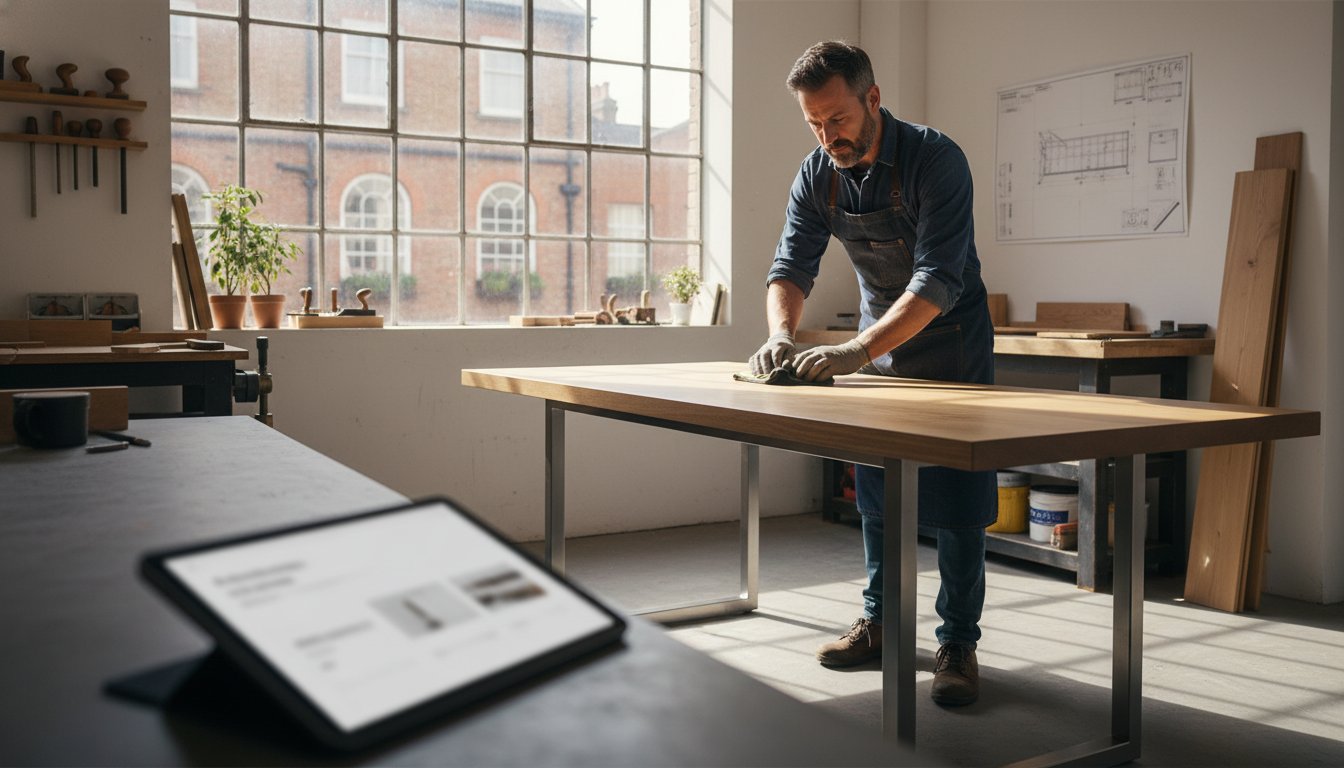
Did you know that 70.8% of consumers are now willing to pay more for high-quality, original, handmade products? It is a great time to be a maker. However, finding the right platform for selling bespoke furniture uk often feels like a trade-off between visibility and profit. You've likely dealt with generic checkout systems that can't handle custom dimensions or global platforms that take a massive 25% cut of your hard-earned sales. It's frustrating when you spend weeks on a build only to lose your margin to hidden fees and a lack of local support.
You can grow your business without the high overheads of a standalone website. This guide will show you how to choose a marketplace that connects you with serious UK buyers while protecting your bottom line. We'll explore the latest 2026 fee structures for major sites, the impact of the June 2026 fire safety reforms, and how to find a supportive community for independent British SMEs. Discover how to secure a reliable stream of enquiries and maximise your margins by choosing a platform that actually understands the bespoke furniture trade.
Key Takeaways
- Learn why choosing a dedicated platform for selling bespoke furniture uk beats global marketplaces by targeting buyers who value British craftsmanship.
- Identify and avoid hidden fees like regulatory operating charges and offsite ad costs that eat into your custom furniture margins.
- Master the balance between lifestyle photography and technical specs to convert casual enquiries into high-ticket sales.
- Discover how local vendor support and flat commission models simplify business operations compared to complex global checkout systems.
- Find out how to scale your reach by joining a marketplace specifically designed to empower independent British makers.
Choosing the Best Platform for Selling Bespoke Furniture in the UK
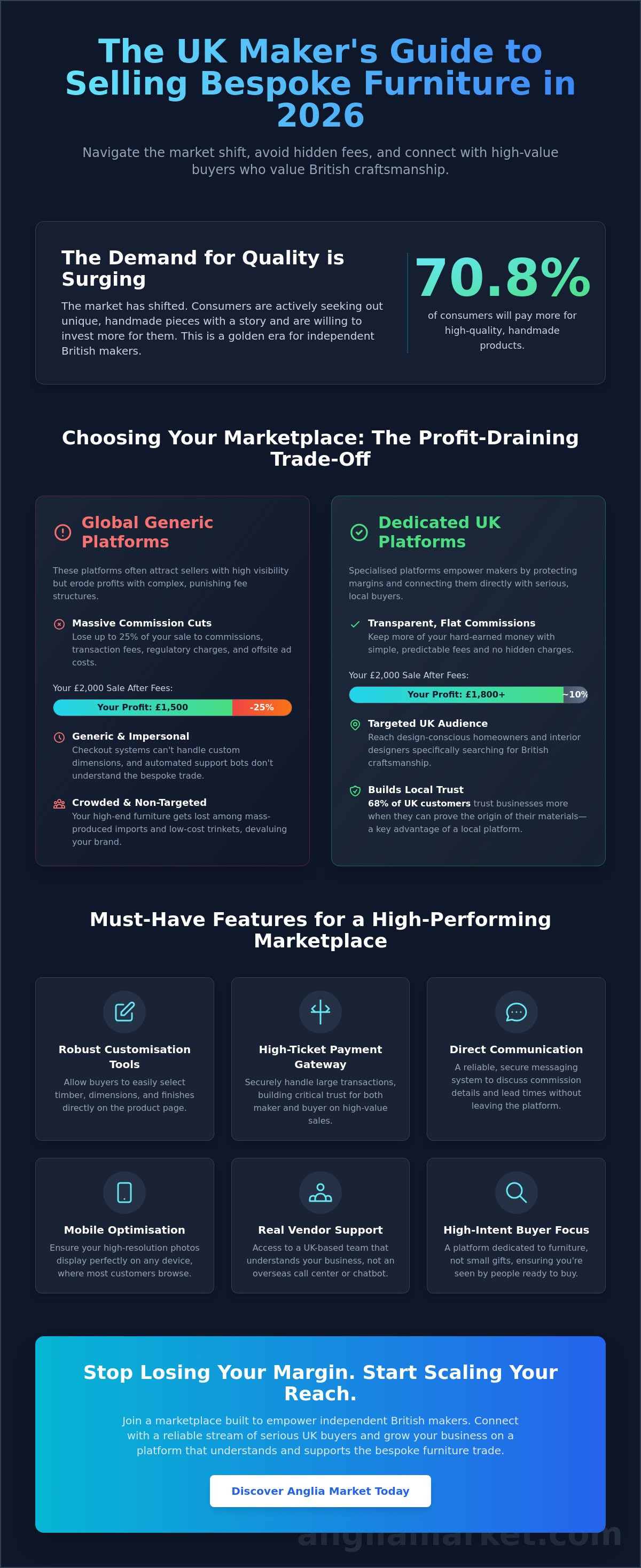
The UK bespoke furniture market in 2026 is defined by a deep consumer shift toward sustainability and provenance. Shoppers no longer want generic, flat-pack items that lack character. Instead, they seek pieces with a story. Research shows that 70.8% of consumers are willing to pay more for high-quality, handmade products. This creates a massive opportunity for independent makers to reach a wider audience. However, success depends on where you list your work. A bespoke furniture marketplace acts as a bridge between artisan craftsmanship and commercial scale.
Many sellers start on global, high-volume sites, but these platforms often feel crowded and impersonal. High commission fees on these international marketplaces can eat into your profit margins, sometimes taking nearly a quarter of your sale price once transaction and advertising fees are settled. A dedicated UK platform offers a distinct advantage. It aligns your brand with British quality and ensures you aren't competing with mass-produced imports. Understanding what bespoke means in a modern retail context is vital; it's about providing a tailored solution that generic global sites struggle to facilitate. British shoppers prefer buying from local vendors because it simplifies logistics and builds trust. In fact, 68% of UK customers report trusting businesses more when they can prove the origin of their materials.
The Shift from Social Media to Professional Marketplaces
Relying solely on social media channels is no longer a viable strategy for a growing business. Algorithms are unpredictable and can hide your best work from your followers at a moment's notice. More importantly, high-ticket furniture sales require transactional security. Buyers are hesitant to send hundreds of pounds via a direct message or an unsecured link. A professional platform for selling bespoke furniture uk provides the buyer protection and searchable presence you need. It ensures your brand remains visible to people specifically looking to buy, not just browse, while providing a secure environment for high-value payments.
Identifying Your Target UK Audience
Your choice of platform dictates how customers perceive your value. If you list on a site known for low-cost "bargains," you'll struggle to justify the price of custom-made oak tables. You need to reach design-conscious homeowners and commercial interior designers who value regional identity. These buyers look for markers of quality and local craftsmanship. By positioning your business on a reputable UK marketplace, you instantly gain the credibility required to attract high-budget clients who appreciate the time and skill involved in custom furniture production.
Key Features of a High-Performing Furniture Marketplace
A successful platform for selling bespoke furniture uk must do more than just host a listing. It needs to attract high-intent buyers who are searching specifically for large-ticket furniture items. Many craft-focused sites cater primarily to small gifts. This means your hand-carved dining tables often get lost among £10 keyrings and trinkets. High-performing marketplaces provide vendor support from real people who understand the UK SME landscape. If a query arises about a custom order, you need a facilitator who understands British trade, not an automated bot.
Mobile optimisation is non-negotiable in 2026. High-resolution photography is your primary sales tool. If your shop doesn't load quickly or display your timber's grain clearly on a smartphone, you lose the sale. Ease of use also matters. You shouldn't spend hours wrestling with a complex backend system. Listing a product should be fast and intuitive. This gives you more time in the workshop and less time behind a screen. A streamlined interface allows you to update stock levels or lead times with just a few clicks.
Essential Tools for Bespoke Sellers
Bespoke work is rarely "off the shelf." Your chosen marketplace must offer robust customisation tools. Buyers need to select timber types, specific dimensions, or fabric finishes directly on the product page. Direct communication channels are equally vital. Discussing commission details or lead times requires a reliable, secure messaging system. Finally, integrated payment gateways must handle high-value transactions safely. This builds essential trust for both the maker and the buyer during a thousand-pound purchase. It ensures funds are held securely until the project reaches the agreed milestones.
Comparing UK Marketplace Features
Niche sites often focus heavily on vintage or antique items. This can make brand-new bespoke pieces feel out of place or overpriced by comparison. Multi-category marketplaces offer a broader reach while still championing independent makers. Look closely at the difference between professional and individual accounts. Professional accounts often provide better search visibility and more predictable fee structures for high-volume sellers. Additionally, integrated loyalty programs help retain furniture buyers by rewarding their investment in quality British goods.
Choosing the right platform for selling bespoke furniture uk is about finding a balance between commercial traffic and dedicated support for your craft. If you want to expand your reach and join a community of British SMEs, you can start selling online with a partner that values your independence and growth.
Navigating Commissions and Selling Costs in 2026
The financial stakes are higher when selling a bespoke oak wardrobe compared to a mass-produced chair. Every percentage point taken by a platform for selling bespoke furniture uk affects your ability to reinvest in quality tools or sustainable timber. Understanding the total cost of a sale is vital for maintaining a healthy bottom line. Many sellers focus only on the headline commission, but hidden costs often lurk beneath the surface. For instance, several global marketplaces have introduced regulatory operating fees that continue to rise, with some reaching nearly 0.5% on top of existing transaction and payment processing costs as of June 2026. These small increments add up quickly on high-ticket items.
A flat commission model is often safer for high-ticket bespoke items because it provides price certainty. Beyond commissions, you must account for listing fees and transaction charges that may apply per order. In the UK, business sellers must also factor in the 20% VAT on all seller fees, which can significantly reduce your take-home pay. Calculating your net profit requires subtracting these platform costs along with UK shipping and specialized packaging expenses. A lower commission rate can be the difference between a hobby and a sustainable business.
Commission vs. Subscription Models
Pay-as-you-go selling is popular for furniture makers because it limits upfront risk. You only pay when you make a sale, which is helpful when your output is focused on quality over quantity. However, if you have a consistent volume of high-value orders, a subscription might offer better tools and lower per-transaction costs. Monthly fees can be a barrier for artisans with low-volume, high-value output, but they often provide more predictable overheads. To protect your margins, you must price your furniture to absorb these platform fees while remaining competitive. This involves building the commission cost directly into your retail price while highlighting the unique value of your custom work.
Marketing and Promotion Costs
Visibility is rarely free on large, multi-category marketplaces. You often have to decide between paying for internal ads or relying on organic search traffic. Some platforms now charge mandatory fees for sales generated through their own offsite advertising, which can take an additional 12% to 15% of your revenue. Leveraging platform promotions can boost your visibility during peak seasons without the complexity of managing individual ad campaigns. Being featured in curated category highlights provides a massive traffic boost, but this usually requires a professional storefront that meets strict quality standards. Balancing these marketing expenses against your organic reach is the key to scaling without sacrificing your profit margins.
Optimising Your Storefront for Custom and Bespoke Orders
High-ticket furniture sales require more than just a price tag; they require visual proof of quality. Your storefront on a professional platform for selling bespoke furniture uk must build immediate trust. Buyers cannot touch the timber or feel the finish through a screen. You must bridge this gap with high-resolution "Lifestyle" photography that places your work in a real-world setting. A well-staged photo helps a customer imagine your piece in their own home. Pair these visuals with descriptions that balance the "Story" of the maker with the "Specs" of the product. Clearly list dimensions, materials, and lead times to reduce unnecessary enquiries.
Strategic keyword use is vital for organic discovery. Phrases like "Handmade in the UK" or "Custom Oak Dining Table" should appear naturally in your titles and headers. This helps the internal search engine connect your work with buyers looking for specific British craftsmanship. Managing expectations is equally important. Bespoke items often have longer delivery windows, so communicate these clearly from the start. Transparency about your process prevents frustration and builds a reputation for reliability.
Photography Tips for Large Furniture
Your workshop is your brand. You don't need a professional studio to take great photos, but you do need good lighting. Natural light is best for showing the true colour of wood and fabric. When staging, keep the background clean to ensure the furniture remains the focus. Aim for the "Three Essential Shots" for every listing:
- The Hero Image: The finished piece in a styled lifestyle setting.
- The Detail Shot: A close-up of joinery, grain patterns, or hardware to show quality.
- The Scale Shot: The item placed next to a common object, like a chair or a plant, to show its true size.
Video content of the making process is another powerful tool. Seeing a craftsman at work builds immense trust and justifies the premium price of a bespoke order.
Managing Custom Commissions
Bespoke work often starts with a conversation. Set up a clear "Request a Quote" workflow for non-standard pieces. This allows you to discuss specific requirements before any money changes hands. For high-value projects, use the platform's secure system to handle deposits and final payments. This protects both you and the buyer. Once a build begins, provide regular updates. A simple message or photo during the 4-8 week build time keeps the buyer engaged and excited about their purchase. If you are ready to showcase your craftsmanship to a wider audience, set up your professional shop today and start reaching dedicated UK buyers.
Scaling Your Furniture Business with Anglia Market
Scaling a craft from a small workshop to a full-time enterprise requires a reliable partner. While previous sections covered the technicalities of fees and photography, the final piece of the puzzle is the environment where you trade. Anglia Market is the premier online marketplace for sellers in the UK because it bridges the gap between local craftsmanship and national reach. You don't have to manage the technical burden of a standalone site. Instead, you can focus on your workshop while we facilitate the traffic and transactions.
As a dedicated platform for selling bespoke furniture uk, we understand that makers need more than just a checkout button. You need a space that respects the value of your work and the time it takes to create it. Our mission is to empower British makers by providing a level playing field. We don't favour global brands over independent SMEs. This ensures your custom oak desk or hand-turned chair gets the visibility it deserves alongside established retailers, allowing you to build a searchable brand presence that social media cannot offer.
Why We Support UK Independent Businesses
Our commitment to local commerce is built into our platform structure. We provide a diverse category reach that spans from home and garden enthusiasts to professional office buyers. This broad audience is essential for scaling. A maker who starts by selling coffee tables often finds new revenue streams in commercial office fit-outs or garden furniture. By listing on a multi-category marketplace, you expose your brand to buyers who might not have been looking for bespoke furniture initially but are won over by your quality and provenance.
Getting Started: Your First 30 Days
Transitioning to a professional seller model is straightforward and efficient. The first step is to register as a vendor. This gives you immediate access to your seller dashboard where you can begin adding your profile. Use this space to tell your brand story and upload the high-resolution lifestyle photography we discussed earlier. A complete profile builds trust with buyers and sets the stage for your first sale.
If you encounter any technical hurdles during setup, our support home provides a comprehensive knowledge base to get you back on track. Your first month should focus on listing your core items and setting clear, realistic lead times. Once your shop is live, you can start engaging with a community of buyers who value British quality. Join the community today and start selling your bespoke creations to a wider UK audience.
Build Your Future in the UK Furniture Trade
Success in the bespoke furniture market requires more than just expert joinery; it demands a smart commercial strategy. Choosing the right platform for selling bespoke furniture uk is the most critical decision you'll make for your brand's long-term growth. By focusing on transparent fee structures and high-quality lifestyle photography, you can protect your margins and attract high-value clients who appreciate British craftsmanship. It's about finding a balance between your time in the workshop and your visibility online.
You don't have to navigate these commercial challenges alone. A marketplace that offers dedicated support for UK SMEs and secure payment processing provides the stability you need to scale. With a broad reach across Home, Garden, and Office categories, you can find the right audience for every custom piece you create. It's time to move beyond unpredictable social media algorithms and find a permanent, professional home for your artisan business.
Start selling your bespoke furniture on Anglia Market today. We are here to help you turn your workshop passion into a thriving, sustainable enterprise. Your next custom commission is just a listing away.
Frequently Asked Questions
What is the best platform for selling bespoke furniture in the UK?
The best platform for selling bespoke furniture uk is one that prioritizes British SMEs and provides a secure environment for high-ticket transactions. Anglia Market stands out by offering a dedicated space where local craftsmanship isn't overshadowed by mass-produced imports. This local focus helps build immediate trust with UK buyers who want to verify the provenance of their furniture while enjoying dedicated vendor support.
How much commission do furniture marketplaces typically charge?
Commission rates across the industry vary, with some high-end design platforms charging as much as 24% per sale. Other marketplaces use a combination of listing fees, which are often around £0.15, and transaction percentages. When choosing a partner, look for a transparent fee structure that allows you to maintain healthy margins on labour-intensive custom builds without hidden regulatory operating charges.
Do I need a business licence to sell handmade furniture online?
You don't need a specific "furniture licence," but you must register as a sole trader or limited company with HMRC. It is also mandatory to register for VAT if your rolling 12-month turnover exceeds £90,000. Regardless of the platform, your products must comply with UK fire safety regulations, including mandatory permanent labelling and meeting specific ignition resistance standards for all upholstered items.
Can I sell custom-made furniture on Anglia Market?
Yes, Anglia Market is specifically designed to host independent makers who offer customisable goods. You can create a professional vendor profile that allows you to manage "Request a Quote" workflows for non-standard pieces. This system is ideal for handling the unique lead times and detailed specifications required for bespoke work while ensuring all high-value payments are processed through a secure gateway.
How do I handle shipping for large bespoke furniture pieces?
Shipping large, heavy items is best managed through specialist two-man delivery services that offer "white-glove" handling. These couriers specialise in furniture logistics and often include assembly in the buyer's home, which reduces the risk of damage. Most sellers find it most accurate to provide shipping quotes based on the buyer's postcode rather than using a flat-rate parcel service.
Is it better to sell on a niche site or a general marketplace?
While niche sites target design enthusiasts, a general marketplace provides much broader visibility across different buyer types. For example, your work might be discovered by a commercial buyer looking for office furniture or a homeowner browsing for garden upgrades. This cross-category reach often leads to more consistent enquiries and larger-scale commissions than a highly restricted niche site can offer.
How do I protect my bespoke designs from being copied online?
Protecting your designs involves maintaining a detailed build log and documenting your creative process from the initial sketch to the finished piece. For formal protection, you can register your designs with the Intellectual Property Office (IPO). On your storefront, using distinct brand watermarks on your photography and highlighting your unique joinery techniques helps establish your brand's authority and discourages copycats.
What are the most popular types of bespoke furniture sold online in 2026?
In 2026, there is significant demand for multifunctional home office furniture and modular storage solutions that fit specific UK room dimensions. Custom alcove units, ergonomic desks, and live-edge dining tables remain top performers. Buyers are increasingly focused on pieces that offer both utility and a high-end aesthetic, often requesting sustainable hardwoods like oak, ash, or walnut for their durability and grain patterns.

Here to help — ask anything
If you have any questions regarding this disclaimer or any of our policies, please contact Anglia Market through the contact page on our website, by email using the address provided on the site, or by phone at 0333 772 2593