
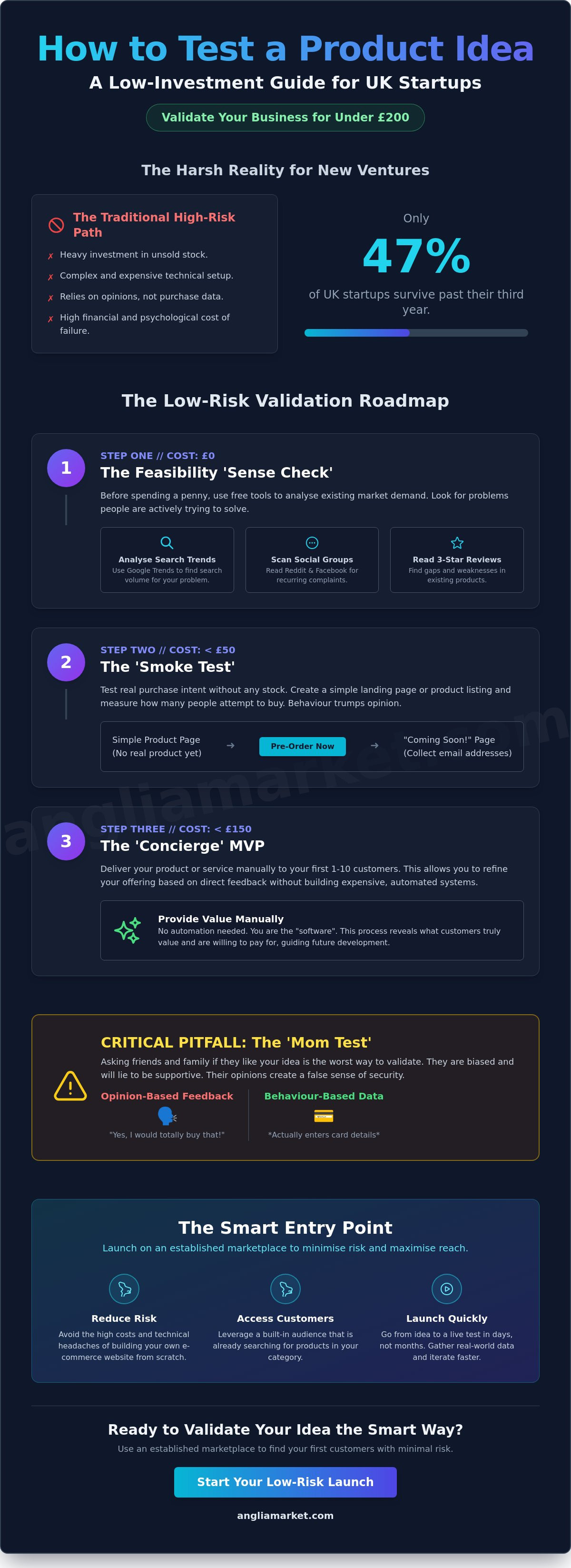
Only 47% of UK startups survive to their third year. It's a tough reality for any new founder. Most entrepreneurs worry about losing their savings on unsold stock or getting stuck in complex technical setups. You need a better way. This guide explains how to test a product idea with low investment before you commit your capital. The goal is to create a friction point where customers prove they want to buy. Don't just rely on opinions; look for real intent.
We understand that the fear of financial loss is a major hurdle. You want to find your first 10 customers without the stress of a massive, expensive launch. We'll show you how to validate your business idea for under £200 by using existing platforms to save money. This article provides a clear, practical roadmap for your next steps. You will gain the confidence to either pivot your concept or proceed with your business based on genuine market feedback and proven demand.
Key Takeaways
- Learn how to use free search data and social media trends to perform a feasibility "sense check" before spending a penny.
- Discover exactly how to test a product idea with low investment by setting up a simple "smoke test" to gauge real customer purchase intent.
- Master the "concierge" MVP approach to provide value manually and refine your offering without expensive technical automation.
- Understand why launching on an established marketplace like Anglia Market reduces risk and provides immediate access to a built-in customer base.
The Importance of Validating Your Idea Before Spending a Penny
Product validation isn't about hope; it's about evidence. It's the process of proving a market exists for your concept while keeping your financial exposure to an absolute minimum. In the fast-paced 2026 retail environment, traditional business plans are often too slow. You need to move faster. Learning how to test a product idea with low investment allows you to fail quickly and cheaply, or scale with confidence. Many UK entrepreneurs fall victim to the "sunk cost fallacy," where they continue pouring money into unsold inventory just because they've already spent thousands. They confuse being busy with being profitable.
True validation relies on behaviour-based data rather than opinion-based research. It doesn't matter if people like your idea; it only matters if they open their wallets. This is why a Minimum Viable Product (MVP) is so effective. It forces a transaction or a measurable action that proves real demand exists. By focusing on behaviour, you remove the guesswork from your business model.
Why "Asking Friends" is the Worst Way to Test an Idea
Your social circle is a terrible focus group. Most people will lie to you because they want to be supportive. This is often called the "Mom Test." If you ask your favourite people if they like your new business idea, they'll almost certainly say yes to avoid hurting your feelings. There's a massive gap between someone saying "I would buy that" and actually entering their credit card details. Friends and family are naturally biased. Their feedback creates a false sense of security that can lead to disastrous financial decisions later on.
The Real Cost of Skipping the Validation Phase
Skipping validation is expensive. You risk the heavy financial drain of storage fees, mountains of unsold stock, and marketing campaigns that fall on deaf ears. Beyond the money, there's a significant psychological impact. A "failed" launch can feel like a personal defeat, whereas a failed test is simply a data point that leads to a successful pivot. For a typical UK startup, the burn rate is the monthly speed at which the business spends its initial capital or savings before reaching a positive cash flow. Without validation, your burn rate will likely outpace your progress, leaving you with an empty bank account and a garage full of products nobody wants.
Low-Cost Feasibility Checks: Is There a Market for Your Product?
Before you commit a single penny to stock, you must perform a "Sense Check." Ask yourself: does this product solve a genuine, everyday problem for UK consumers? You don't need a massive research budget for this. A core part of market validation is ensuring that the problem you're solving actually exists in the real world. Start by browsing established marketplaces to see what's already moving. Look at the best-sellers in your category. More importantly, read the three-star reviews. These often highlight exactly what customers feel is missing or where a product falls short of expectations.
Finding these gaps allows you to "niche down." Instead of entering a crowded, generic market, find a specific underserved group. This is the smartest way to understand how to test a product idea with low investment. By targeting a smaller, more focused audience, your marketing becomes significantly more effective. Your competition effectively disappears because you're offering something tailored rather than something generic.
Analysing Market Demand Using Free Digital Tools
You can find your target audience for free using digital search data. Tools like Google Trends or AnswerThePublic show exactly what people are typing into search engines across the UK. If you see high search volume for a specific problem but very few product solutions, you've found a potential winner. Don't stop at search data. Monitor UK-based forums, Reddit threads, and Facebook groups. Listen to recurring complaints. If people are constantly asking "where can I find a product that does X?", you have your answer. You can also browse the "frequently bought together" sections on major retail sites. These pairings often reveal gaps where a single, hybrid product could satisfy two needs at once.
Creating Your Ideal Customer Profile (ICP)
Move beyond basic demographics like age or location. You need to understand customer behaviour and pain points. Why do they wake up in the middle of the night? What are their daily frustrations? Build a "pen portrait" of your ideal buyer. This is a detailed description of the one person who would happily pay full price for your solution right now. If you're looking for a platform to reach these buyers without the high costs of a custom site, consider looking at how to sell online with an established marketplace. This gives you immediate visibility to an existing audience whilst you continue your research.
Use this checklist to identify where your customers spend their time:
- Which specific social media groups do they contribute to?
- What publications or blogs do they trust for advice?
- What specific keywords do they use when they're expressing frustration?
- Which influencers or experts do they follow for product recommendations?
The "Smoke Test" Strategy: Testing Real Purchase Intent
A smoke test is the ultimate way to gauge real purchase intent. It's essentially a "fake-door" test. You present a product as if it's ready for sale, but the "buy" button leads to a sign-up form or a "coming soon" notification. This method is the gold standard for how to test a product idea with low investment because it measures actions, not just words. It moves you past the "polite lies" of friends and family into the world of hard data.
You don't need a complex, multi-page website to run this test. A simple one-page landing site with a clear Call-to-Action (CTA) is enough. Research from March 2026 shows that DIY landing page builders in the UK start from approximately £21 per month. This is a small price to pay for market clarity. Your page should focus on one thing: the specific problem your product solves and a single button that asks the user to commit.
Ethics are vital when running a smoke test. Never take money for a product you cannot deliver. If a customer tries to buy, be honest. Tell them the product is currently in development and offer a reward for their patience. To get people to the page, allocate a small budget of £50 to £100 for targeted social media ads. This drives specific traffic to your test without risking your life savings. It's a controlled experiment that provides immediate feedback on your value proposition.
How to Pre-Sell Without a Finished Product
The "Coming Soon" email capture method is excellent for building a waiting list. When users enter their email, they're giving you permission to sell to them later. This is a high-intent action. You can also use "Pre-order" buttons to track how many people actually reach the final checkout stage. Offering a "founder’s discount" to those who sign up early increases your conversion data and rewards early adopters. It turns a potential customer into a stakeholder in your success.
Measuring Success: What Metrics Actually Matter?
Forget likes and follows; these are vanity metrics that don't pay the bills. Focus on intent metrics like email sign-ups, click-through rates, and button clicks. A 3% click-through rate on a validation ad is a strong signal for UK SMEs that their product concept has genuine market legs. If your conversion rate from visitor to sign-up is above 5%, you likely have a viable idea. If it's lower, you have the data you need to pivot your messaging or your product features before spending more capital.
Prototyping and Minimum Viable Products (MVPs) on a Budget
A Minimum Viable Product (MVP) is the simplest version of your concept that still delivers its core value to the customer. It's not a half-finished product; it's a focused one. By stripping away non-essential features, you can significantly reduce your initial costs. This approach is central to how to test a product idea with low investment. Instead of building a complex automated system, consider "concierging" your service. This means doing manually what your final product will eventually do. If you're launching a subscription box for pet supplies, pack and post the first ten boxes yourself. You'll learn more about your customers' preferences through direct interaction than any automated survey could provide.
For physical goods like furniture or kitchenware, low-cost prototyping has never been more accessible. 3D printing allows you to create physical models for a fraction of the cost of traditional tooling. You can also look into small-batch manufacturing, where you produce limited runs to test quality and demand. Visual appeal is often just as important as functionality. High-quality mock-ups or "lifestyle photography" can be used to gauge interest on social media. If people engage with the aesthetic of your product, you have a strong signal to move forward with production.
Building Your MVP Without a Developer
You don't need a technical background to create a functional digital MVP. No-code tools allow you to build websites, apps, and databases using simple drag-and-drop interfaces. Another effective strategy is using "white-label" products. These are generic items manufactured by one company that you can rebrand as your own. It's a fantastic way to test a brand concept without the high costs of original product development. Once you have your MVP ready, you can sell online by listing it on the Anglia Market Sellers page. This gives you immediate access to a ready-made audience of UK shoppers, allowing you to gather real-world sales data without building your own storefront from scratch.
The 4-Week Validation Sprint
Time-boxing your validation process prevents you from over-analysing. Follow this structured four-week sprint to get your answers quickly:
- Week 1: Focus on market research and customer profiling. Identify your niche and where they spend their time online.
- Week 2: Build your MVP or a high-converting landing page. Keep it simple and focused on one core problem.
- Week 3: Run low-cost social media ads to drive targeted traffic to your test. Gather data on clicks and sign-ups.
- Week 4: Analyse your results. Look at your conversion rates and customer feedback to decide whether to pivot your idea or persevere with your current plan.
By the end of this month, you'll have the evidence you need to make an informed decision. If the data is positive, you can begin to scale. If not, you've saved yourself months of work and thousands of pounds in potential losses.
Launching Your Test on Anglia Market: The Low-Risk Entry Point
Building an independent e-commerce site from scratch is often a significant financial burden for new founders. You have to worry about hosting, security certificates, and web design before you've even sold a single item. Using a marketplace is both cheaper and faster. It's a strategic shortcut for anyone figuring out how to test a product idea with low investment. Instead of shouting into the void of a new URL, you place your product where shoppers are already looking. You skip the technical headaches and go straight to the selling part.
Anglia Market is specifically designed to support small and medium-sized businesses by providing the tools they need to succeed. You can test your concept amongst diverse categories, including home, garden, and electronics. This breadth is essential for validation. It helps you see which category attracts the most clicks and where your margins are strongest. Most importantly, the platform handles the "transactional trust." Customers feel safe buying from a known marketplace with secure payment systems, which removes a major barrier for a brand nobody has heard of yet.
Leveraging Existing Traffic to Save on Marketing
Marketplace SEO is a powerful, free tool. Your products can be discovered through the platform's internal search results without you spending a fortune on external ads. There's also a clear "halo effect" when you're listed amongst established UK vendors. It lends your new business instant credibility. You can also use the platform's built-in tools for promotions and sales. This is a practical way to test price elasticity. By adjusting your prices slightly during a sale, you can see exactly how much your target audience is willing to pay whilst still maintaining a profit.
Scaling from Test to Full-Time Business
Once your test listings prove there's a market, moving to a full storefront is a natural next step. This is where you begin to build a lasting brand identity. Pay close attention to customer feedback during this phase. Positive testimonials are gold for new entrepreneurs; they provide the social proof needed to scale. Every review is a data point that helps you refine your offering. You can use this feedback to tweak your product features or improve your packaging before you invest in larger stock volumes.
Validation doesn't have to be a multi-year project. By following the steps in this guide, you can move from a rough idea to a proven business model in just a few weeks. If you're ready to put your concept to the test, start selling online today. It's time to stop wondering if your idea works and start gathering the data that proves it.
Turn Your Business Concept into a Validated Reality
Testing a new concept doesn't require a massive bank balance or a finished warehouse. You've learned how to test a product idea with low investment by focusing on real customer behaviour instead of polite opinions. By using feasibility checks, smoke tests, and the 4-week validation sprint, you can protect your savings whilst gathering the data needed to scale. These lean methods ensure that when you finally commit your capital, you're doing so with the confidence that a genuine market exists.
Choosing the right platform is the final piece of the validation puzzle. Anglia Market is a dedicated partner for UK-based small and medium enterprises. It provides a secure transactional platform and instant access to a broad customer base across numerous categories. You don't need to build an expensive storefront to find your first ten customers. Start testing your product idea on Anglia Market today to begin your journey with minimal risk. Your success starts with a single, data-driven test. Be bold, stay lean, and start selling.
Frequently Asked Questions
How much money do I really need to test a product idea?
You can conduct a comprehensive validation test for under £200. This modest budget covers basic landing page fees and a small initial spend on targeted social media ads. By avoiding bulk inventory and expensive custom web development, you keep your financial risk low. Focus your spending on gathering real-world data from potential buyers rather than building the final version of the business. It's about buying information, not stock.
Is it legal to test a product before I have the stock?
Yes, it is legal to gauge interest as long as you don't take money for a product you can't deliver. If you use a "buy now" button that leads to a sign-up form, you aren't completing a transaction. Always be transparent with users. If they try to purchase, explain the product is in development and offer them an early-access discount or a notification when it's ready for dispatch.
How do I know if my validation results are "good enough" to launch?
Look for a conversion rate of at least 3% to 5% on your landing page or test ads. This percentage suggests a strong market fit and genuine interest from your target audience. High engagement levels, such as email sign-ups or clicks on "pre-order" buttons, are better indicators than social media likes. If your data consistently shows people are willing to take action, you have a viable foundation for a full launch.
What is the most common mistake people make when testing a product?
The most frequent error is relying on opinion-based feedback from friends and family. People often lie to be polite, which gives you false confidence. Another mistake is over-investing in stock before proving demand. Knowing how to test a product idea with low investment requires you to prioritise hard data over gut feelings. Always look for evidence of real purchase intent before spending your life savings on inventory.
Can I test a product idea while working a full-time job?
Absolutely, and it's often the safest way to begin your entrepreneurial journey. Validation tests like landing pages and social media ads can run in the background whilst you work your usual 9-to-5. You only need a few hours a week to monitor results and respond to customer enquiries. This approach allows you to build a steady evidence base without the pressure of needing an immediate income from your new venture.
Should I protect my idea with a patent before testing it?
Generally, no, because most ideas change significantly during the validation phase. Patents are expensive and time-consuming; you could spend thousands protecting a concept that the market doesn't actually want. Focus on proving the business model first. Once you have a final, validated product and real sales data, you can then decide if legal protection is a necessary investment for your specific niche or unique invention.
How long should a product validation test last?
A standard validation test should last approximately four weeks. This timeframe is long enough to gather a statistically significant amount of data without losing your momentum. Spend the first week on research, the second on setup, and the final two weeks on running ads and analysing results. If you don't see clear signals of interest within a month, it's usually time to pivot your strategy or refine your message.
What happens if no one clicks on my test ads?
Zero clicks are still valuable data; it means your current messaging or product doesn't resonate with that specific audience. It's better to find this out for £50 than £5,000. Use these results to refine your target audience or change your value proposition. You might need to "niche down" further or address a different pain point. Low engagement is a signal to adjust your approach, not to quit entirely.

Here to help — ask anything
For questions about this disclaimer or the site, contact us via the website’s Contact page.


