
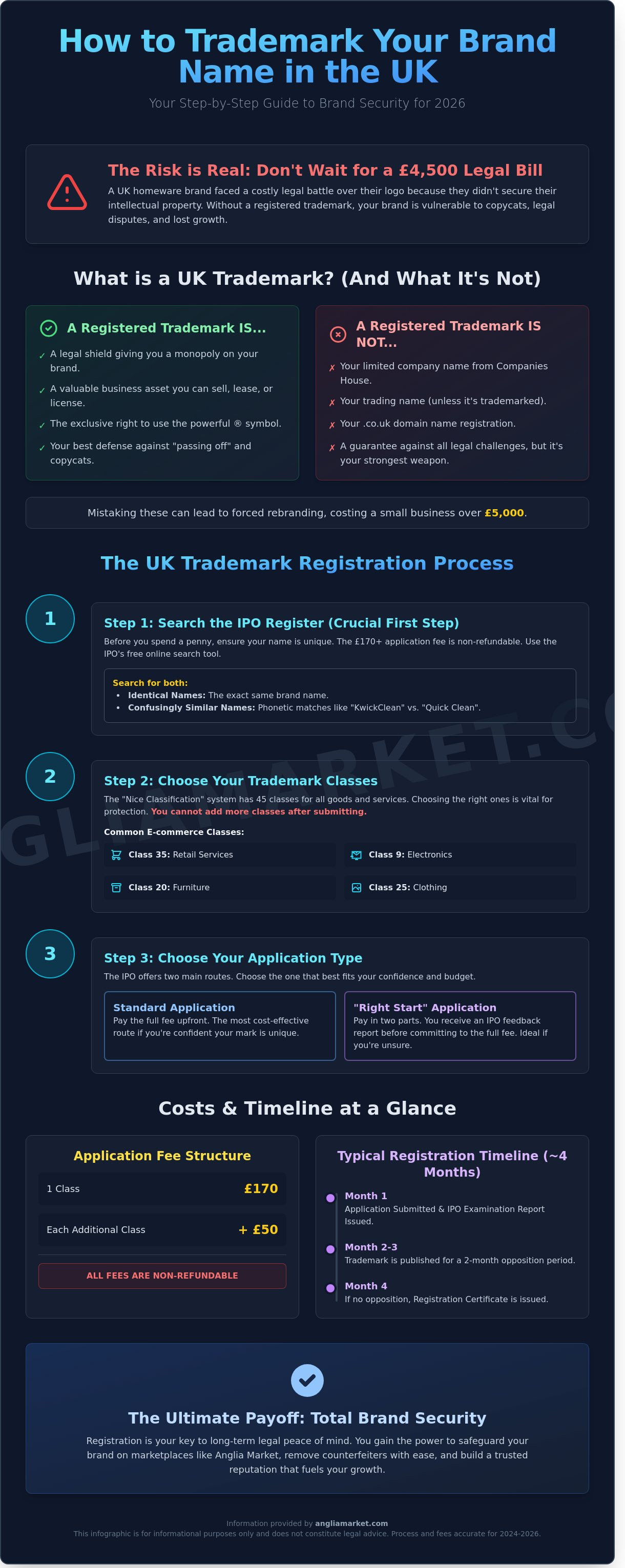
On 14 February 2024, a small UK homeware brand discovered a rival using their exact logo, resulting in a £4,500 legal bill because they hadn't secured their intellectual property. It's a frustrating reality for many entrepreneurs who feel confused by the 45 different trademark classes or the fear of wasting a £170 application fee. You've worked hard to build your business and create a name that customers trust. You shouldn't have to worry about copycats stealing your identity or legal disputes halting your growth.
This guide shows you exactly how to trademark a brand name uk to protect your reputation and secure your commercial future. We'll help you navigate the Intellectual Property Office (IPO) rules with confidence so you can trade safely on platforms like Anglia Market. You are going to learn the precise, step-by-step process to achieve total brand exclusivity and long-term legal peace of mind in the 2026 market.
Key Takeaways
- Understand the vital legal distinctions between brand names, logos, and registered trademarks to ensure your business identity is fully protected.
- Learn exactly how to trademark a brand name uk by effectively searching the IPO register and selecting the correct classes for your products.
- Compare "Standard" and "Right Start" application types to determine the most efficient and cost-effective route for your 2026 registration.
- Master the current UK fee structure in £ and registration timelines to avoid common pitfalls that could delay your application or lead to lost fees.
- Discover how to use your trademark to safeguard your brand on Anglia Market and other platforms by removing counterfeiters and unauthorised sellers with ease.
Understanding Trademarks: Why Protecting Your Brand Name Matters
Protecting your business starts with securing your identity. A UK trademark is a legal registration that gives you exclusive rights to your brand's unique markers. It's different from a simple brand name or a logo. While those are creative elements, a trademark is the legal shield that stops others from using them. Most businesses rely on the Trade Marks Act 1994 to define these rights. Understanding United Kingdom trade mark law helps you see why registration is safer than relying on common law rights. Common law requires you to prove "passing off," which is often expensive and difficult in court. By the year 2026, a registered trademark will be one of your most valuable business assets. You can sell it, lease it, or use it to secure funding. It's a piece of property, much like a building or a vehicle.
To better understand this concept, watch this helpful video:
The Benefits of a Registered UK Trademark
Registering gives you the legal monopoly on your name within your specific industry classes. You get the power to stop competitors from using similar names that confuse your customers. Once registered, you can use the ® symbol. This isn't just for show. It builds immediate trust with consumers who prefer buying from established, protected brands. It makes taking legal action against "passing off" much simpler because your ownership is already on the official record. If you're wondering how to trademark a brand name uk, the first step is realising that registration is your best defence against copycats.
Trademarks vs. Trading Names and Limited Companies
Don't confuse a Companies House registration with a trademark. Registering a limited company name only stops others from using that exact name for another company registration. It doesn't give you intellectual property rights or the right to stop others from using the name in trade. Similarly, owning a .co.uk domain name offers no legal protection against someone else using your brand name. Learning how to trademark a brand name uk early prevents the high costs of rebranding. In 2023, many UK startups faced legal challenges because they didn't register their marks before launching. Rebranding costs can easily exceed £5,000 for a small business.
Preparing Your Application: Searching the Register and Choosing Classes
Skipping the search phase is a costly mistake for any entrepreneur. A standard online application costs £170 for a single class, with an additional £50 for every extra class added. These fees are non-refundable. If the Intellectual Property Office (IPO) finds a conflict, you lose your investment. You must confirm your brand is unique before you commit to the process of how to trademark a brand name uk.
How to Search the UK Trademark Register
The IPO provides a free online search tool to check existing records. Start by searching for identical names. You must also identify "confiningly similar" marks. This includes phonetic similarities. If your brand is "KwickClean" and another firm owns "Quick Clean," your application will likely face an opposition. Use the official GOV.UK portal to follow the exact steps on how to register a trade mark properly. For high-stakes brands, a professional clearance search is a smart move. These reports identify potential legal threats that basic searches often miss.
Selecting the Right Classes for E-commerce
The "Nice Classification" system organises all products and services into 45 distinct classes. Choosing the wrong ones leaves your brand unprotected. For online sellers, Class 35 is vital. It covers retail services and marketplaces, making it a priority for anyone looking to sell with us or launch their own store. You also need classes for your specific goods. Furniture belongs in Class 20, while electronics typically fall under Class 9.
Accuracy is critical during this stage. You cannot add more classes to an application once it has been submitted. If you launch a clothing line in Class 25 but later decide to sell matching jewellery in Class 14, you'll have to pay for an entirely new application. Research your competitors to see which classes they use. This ensures you cover every area of your business from day one. Understanding these categories is a fundamental part of learning how to trademark a brand name uk effectively.
Most successful UK applications in 2023 were processed within four months because the owners did their homework first. Taking the time to search and classify correctly prevents delays and keeps your costs down. Once you've mapped out your classes and cleared your search, you're ready to file.
The UK Trademark Registration Process: Step-by-Step Instructions
Your journey begins at the official government portal. You'll need to set up a personal or business account to manage your filings and track your progress. It's a simple setup. This digital hub is essential for anyone learning how to trademark a brand name uk effectively. Once your account is live, you'll select your application type and provide your specific brand details.
Standard vs. Right Start Applications
Choosing the Standard application is the most direct route for confident applicants. It costs £170 for one class of goods, with an additional £50 for every extra class you add. You pay the full amount upfront. This path works best if you've already conducted a thorough search and feel certain your mark is unique.
Small and medium businesses often prefer the Right Start service to manage financial risk. It's a pay-as-you-go model. You pay an initial £100 fee to have the Intellectual Property Office review your application. If the examiner identifies problems in their report, you can choose to let the application lapse without paying the remaining £100. It's a practical safety net for first-time sellers.
The Examination and Publication Phases
After submission, an examiner reviews your request for legal compliance. They check if your brand name is too descriptive or if it conflicts with existing marks. You'll typically receive an examination report within 20 working days. If the IPO raises objections, you have 2 months to respond or amend your application to meet their requirements.
Success leads to the publication phase. Your mark is listed in the Trade Marks Journal for a 2-month period. This allows other brand owners to file an opposition if they believe your mark is too similar to theirs. IPO data from 2023 shows that approximately 5% of applications face some form of opposition during this window. If no one objects, your trademark is officially registered. You'll receive a digital certificate via your account, and your brand name is protected for 10 years from the date you first applied.
UK Trademark Cost, Timelines, and Common Pitfalls to Avoid
Protecting your business identity involves clear costs and strict timelines. For 2026, the standard online application fee for a single class is £170. If your business expands into multiple categories, you'll pay £50 for each additional class. These fees are non-refundable. Getting the details right the first time is vital for your budget. Once registered, your protection lasts for 10 years. You must pay a renewal fee every decade to keep the mark active and your brand safe.
The process usually takes between three and four months from start to finish. After you submit, the Intellectual Property Office (IPO) sends an examination report within 20 working days. If they approve it, your mark is published in the trade marks journal for two months. This period allows others to object. If no one opposes your application, you'll receive your registration certificate shortly after. Understanding how to trademark a brand name uk requires patience during these statutory waiting periods.
Budgeting for Your Trademark Registration
Planning your finances helps avoid surprises. The £170 basic fee covers one class of goods or services. Many retail businesses find they need at least two classes to cover both physical products and online retail services. This brings the initial cost to £220. Remember that these costs only cover the UK. If you plan to sell in Europe or globally, you'll need separate applications and significantly higher budgets. Stay focused on your primary market first to manage cash flow effectively.
Avoiding Frequent Application Mistakes
The IPO rejects many applications on "absolute grounds" because the name isn't distinctive. You can't trademark descriptive terms like "The Furniture Shop" or "Quality Cotton". These words describe the product rather than identifying a specific brand. Using geographic locations like "London" or "Scottish" also leads to immediate refusal. A successful brand, however, might combine these elements to define a specific niche, such as the travel guide The Nordic Travel. The IPO ensures other local businesses can still use these common terms. If you receive a "threat of opposition" from another brand, don't panic. About 75% of these disputes are settled through simple co-existence agreements or minor changes to your class list without reaching a full hearing.
Choosing a unique, invented word is the most reliable way to ensure your application succeeds. This prevents legal hurdles and makes your brand easier for customers to find. Once you've secured your name, it's time to focus on reaching your audience. Start selling with us to connect with more UK shoppers and grow your newly protected brand.
Securing Your Intellectual Property on Online Marketplaces
Registering your trademark is the most effective way to lock down your brand on digital shelves. When you understand how to trademark a brand name uk, you gain more than legal rights; you gain a powerful enforcement tool for platforms like Anglia Market. Without a registered mark, removing a copycat seller who uses your name or logo is difficult and often depends on the platform's goodwill. With a registration number from the UK Intellectual Property Office (IPO), you can issue formal takedown notices that marketplaces must act upon quickly.
Modern e-commerce sites use Brand Registry programmes to automate protection. These systems use your trademark data to scan for counterfeit listings before they even go live. Data from 2023 suggests that brands with active registrations see a 40% faster response time from marketplace support teams when reporting IP infringements. Registered brands also enjoy better placement in search results and access to "A+" content features. Marketplaces prefer promoting verified brands because they offer a more reliable experience for the shopper, reducing the risk of returns or disputes.
Protecting Your Brand on Anglia Market
Start by submitting your IPO certificate to our seller support team. This verifies your status as the rightful owner of your intellectual property. Being a verified brand boosts customer confidence instantly. A 2023 retail study found that 62% of UK shoppers feel more secure buying from sellers with a verified brand badge. You can also use your trademark to unlock custom storefront tools. These features allow you to organise your products in a way that highlights your unique identity and keeps competitors off your pages.
Scaling Your Brand Beyond the UK
Your UK trademark is your foundation for global growth. Once you've secured your rights at home, you can use the Madrid Protocol to apply for protection in over 120 countries. This international system is cost-effective for British SMEs looking to export. Learning how to trademark a brand name uk is the essential first step before you even think about shipping to the EU or North America. Start small, protect your home market first, and build a brand that lasts for decades. Secure your trademark today to ensure your hard work stays your own.
Secure Your Brand Identity for 2026
Securing your intellectual property is the most effective way to safeguard your hard work. By following the steps on how to trademark a brand name uk, you gain legal protection that lasts for 10 years before renewal is required. A standard online application for a single class currently starts at £170. Most successful registrations are completed within 3 to 4 months of the initial filing date. Avoiding common pitfalls like using purely descriptive terms will save you significant time and money. Once your certificate arrives, you're ready to scale your business with total confidence across digital platforms.
Anglia Market currently supports thousands of independent UK vendors through our secure UK-based marketplace platform. We provide dedicated support for small and medium-sized businesses looking to reach new customers without the stress of complex technical barriers. It's time to turn your protected brand into a thriving storefront. Start selling your protected brand on Anglia Market today and join a growing community that values quality and British entrepreneurship. Your brand deserves a professional home where growth and security are the top priorities. Let's get your products in front of the right audience right now.
Frequently Asked Questions
How much does it cost to trademark a brand name in the UK?
It costs £170 to register a trademark online for a single class of goods or services. You'll pay an additional £50 for every extra class you include in your application. If you use the Right Start service, you pay £100 upfront plus £25 per extra class, then pay the remaining balance only if your application meets the requirements. These fees are non-refundable regardless of whether your application is successful.
Can I trademark a name myself or do I need a solicitor?
You can trademark a brand name yourself through the Intellectual Property Office (IPO) website without hiring a legal professional. Statistics show that around 60% of UK applicants manage the process independently to keep costs low. While a solicitor provides valuable help for complex cases, the online system is designed for small business owners to use directly. Learning how to trademark a brand name UK independently is a practical way to protect your business assets.
How long does a UK trademark last once registered?
A UK trademark lasts for 10 years from the initial date of registration. You can renew your protection every 10 years indefinitely by paying a renewal fee to the IPO. The current cost to renew a trademark in a single class is £200. You'll receive a reminder from the registry six months before your trademark is due to expire so you don't lose your exclusive rights.
What is the difference between a trademark and a copyright?
Trademarks protect brand identity elements like names, logos, and slogans used to identify products in the marketplace. Copyright protects original creative works such as books, music, and software code automatically upon creation. You don't need to register copyright in the UK, but you must register a trademark to get legal protection for your brand name. Trademarks prevent competitors from using similar names that might confuse your customers.
While trademarks legally protect your brand, creating a strong visual identity with professional photography is just as important. For support with these creative services, you can visit AHS Digital.
Can someone else use my brand name if I haven’t trademarked it?
Other businesses can use your brand name if it isn't trademarked, though you might have limited protection under passing off laws. To win a passing off case, you must prove you've established a reputation and that the other party's use of the name is damaging your business. This legal route is often expensive and difficult to prove in court. Registering your mark gives you the automatic legal right to stop others from using identical or similar names in your industry.
What happens if my UK trademark application is opposed?
If your application is opposed, you'll receive a notification from the IPO and have the chance to defend your mark or negotiate with the opponent. Opponents have a two-month window after your application is published to file an objection. You can choose to withdraw your application, remove certain goods from your list, or enter a cooling-off period of up to nine months. Most oppositions are resolved through private settlements rather than formal legal hearings.
Is a UK trademark valid in Europe or the USA?
A UK trademark only provides legal protection within the United Kingdom and doesn't extend to Europe or the USA. To protect your brand in other countries, you must apply through the Madrid System managed by the World Intellectual Property Organization (WIPO). This system allows you to file one application to protect your brand in over 130 countries simultaneously. Each country's registry will still examine your application based on their specific local laws.
How long does the trademark registration process take in 2026?
The process for how to trademark a brand name UK typically takes between three and four months in 2026. The IPO usually issues an examination report within 10 working days of receiving your application. If your mark is accepted, it's published in the Trade Marks Journal for a two-month period to allow for public opposition. If nobody objects during this time, the registry will issue your registration certificate shortly after the window closes.

Here to help — ask anything
If you have any questions regarding this disclaimer or any of our policies, please contact Anglia Market through the contact page on our website, by email using the address provided on the site, or by phone at 0333 772 2593