
Last Saturday, Sarah from Manchester watched her four-year-old zoom toward a garden slope and felt that familiar pang of panic: is this thing going to tip? It's a common worry for parents across the UK who just want a high-quality toy that doesn't end up in the scrap heap after three months. You want the excitement of a new vehicle without the confusion of 12V versus 24V power levels or the frustration of hunting for replacement parts. Finding the right balance between fun and security is essential when looking for Kids’ Ride‑On Cars: Safety & Best Buys.
You don't have to settle for flimsy imports or confusing technical specs. This guide helps you discover how to choose the safest, most durable electric ride-on cars while supporting independent UK sellers who offer genuine quality and reliable service. We'll break down the latest 2026 safety certifications, explain why some batteries fail prematurely, and show you exactly where to find the best local deals. It's time to get your little driver on the road with total peace of mind and a car that actually lasts for several years.
Key Takeaways
- Identify the essential active and passive safety features that give parents full control and prevent common accidents during playtime.
- Navigate the 2026 market for Kids’ Ride‑On Cars: Safety & Best Buys by matching the correct voltage to your child’s age and garden terrain.
- Avoid the frustration of battery failure by learning how to maintain lead-acid and lithium-ion power cells for maximum longevity.
- Discover the benefits of sourcing high-quality electric vehicles from vetted UK vendors to ensure local accountability and better after-sales support.
- Transform playtime into a developmental experience by choosing durable models that serve as both exciting gifts and functional learning tools.
Why Kids’ Ride-On Cars Are the Ultimate 2026 Gift (And Safety First)
Modern electric ride-on cars are no longer just basic garden toys. In 2026, these vehicles have evolved into sophisticated developmental tools that offer a blend of physical play and technical learning. UK parents now prioritise high-spec safety features and realistic designs over the cheap, unbranded imports that dominated the market a decade ago. These machines provide a safe environment for children to explore the basics of mobility while enjoying the thrill of their first "driving" experience.
The shift toward licensed replicas from brands like Audi, BMW, and Land Rover has changed the industry. These models often include advanced tech like soft-start motors to prevent whiplash and parental remote overrides for total control. To understand how these toys became so advanced, it helps to look at the History of Power Wheels, which pioneered the battery-powered category. Today, the focus for Kids’ Ride‑On Cars: Safety & Best Buys is on finding the balance between excitement and rigorous engineering standards.
To better understand the variety and features available in modern models, watch this helpful video:
Developmental Benefits of Electric Ride-Ons
Driving a ride-on car helps children master complex physical skills. Steering requires hand-eye coordination, while managing the foot pedal teaches them about cause and effect. It's an excellent way to boost spatial awareness as they learn to judge distances and navigate around garden obstacles. These toys also encourage outdoor play, moving kids away from screens and into imaginative role-playing scenarios that build confidence and social skills.
Understanding UK Safety Standards (EN71 & UKCA)
Safety is the non-negotiable factor for any UK purchase. Every toy sold in Britain must meet the EN71 standard, which tests for flammability, chemical toxicity, and mechanical stability. Since January 2021, the UKCA mark has also been mandatory for products sold in Great Britain. Buying from a reputable UK marketplace like the Anglia Market toys and games section ensures that the vehicle has undergone these rigorous checks. You won't get the same guarantees from "no-name" imports shipped directly from overseas, which often skip these vital inspections.
When searching for Kids’ Ride‑On Cars: Safety & Best Buys, look for these specific safety markers:
- UKCA/CE Marking: Confirms the product meets UK and European safety legislation.
- Parental Remote Control: Allows an adult to take over steering and braking instantly.
- Adjustable Seatbelts: Essential for keeping younger drivers secure during bumpy rides.
- Non-Toxic Materials: Ensures the plastics and paints used are safe for children.
Essential Safety Features to Look for in Electric Ride-Ons
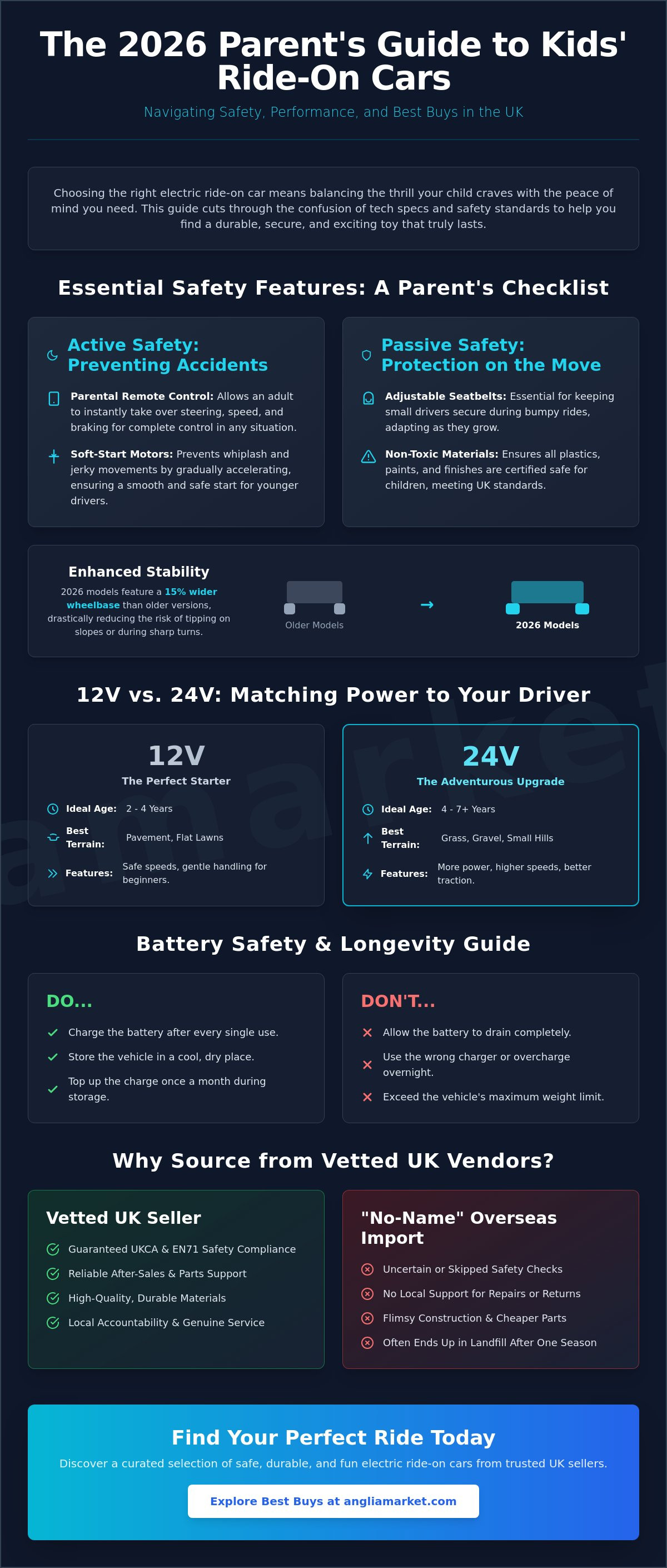
Safety is the most critical factor when choosing a new vehicle for your child. In 2026, manufacturers have shifted focus from basic aesthetics to advanced protective engineering. When evaluating Kids’ Ride‑On Cars: Safety & Best Buys, you should distinguish between active and passive safety features. Active features, like remote overrides and braking systems, work to prevent accidents before they happen. Passive features, such as reinforced seatbelts and roll bars, protect the child if a collision occurs. Every reputable model sold in Britain must comply with the UK Toy Safety Regulations 2011, which sets strict benchmarks for physical construction and material safety.
Stability has seen a major upgrade in 2026 models. Newer designs often feature wheelbases that are 15% wider than versions from 2022. This wider stance lowers the centre of gravity and significantly reduces the risk of tipping during sharp turns. You must also check the maximum weight capacity before buying. Most single-seater cars are rated for 30kg. Exceeding this limit puts roughly 40% more strain on the motor and gearbox, which can lead to mechanical failure or unpredictable steering response. Always choose a car that leaves at least 5kg of "growing room" for your child.
Parental Remote Overrides: The 2.4G Advantage
Modern 2.4G Bluetooth remotes are standard for 2026 and offer a massive safety leap over older 27MHz radio versions. These remotes sync specifically to your car, meaning they won't pick up interference from other toys or devices nearby. The most vital feature is the "P" or emergency stop button. Pressing this instantly cuts all power to the car, giving you total control if the child steers toward a curb or a garden pond. These remotes typically have a range of 25 to 30 metres. It's best to stay within 10 metres to ensure you can react quickly to any hazards. You can find many models equipped with this technology in our current toys and games selection.
Soft Start Technology and Automatic Braking
Whiplash-style jolts were a common complaint with older electric toys. Soft Start technology fixes this by gradually increasing power to the motors over a 3-second window. This creates a smooth take-off that won't startle the child or strain their neck. Automatic braking is equally important. The car should engage the brakes the moment the child lifts their foot off the accelerator pedal. This ensures the vehicle doesn't "coast" into obstacles.
- EVA Wheels: Look for high-grip EVA (Ethylene Vinyl Acetate) rubber wheels rather than hollow plastic. They provide 25% better traction on damp UK driveways.
- Speed Locks: Many 2026 models include a hidden switch to lock the car into a low-speed mode (usually 3km/h) until the child gains confidence.
- Adjustable Harnesses: A 5-point harness is superior to a simple lap belt for younger drivers aged 3 to 5.
12V vs. 24V: Matching Power to Your Child’s Age and Terrain
Many parents think higher voltage just means a faster car. That is a common mistake. Voltage actually determines the torque and the car's ability to handle different surfaces. A 6V motor often struggles on a thick lawn, while a 24V system powers through it. Choosing the right power level is a key part of Kids’ Ride‑On Cars: Safety & Best Buys. You need to match the battery strength to where your child will actually drive.
- 6V: Best for indoor use and flat, hard surfaces.
- 12V: The standard for most UK gardens and pavements.
- 24V: Required for hills, gravel, and grass.
The Toddler Phase: 6V and 12V Options
6V models are entry-level choices. These usually top out at 2mph. They are perfect for indoor play on carpets or flat, smooth pavements. If your child is between 18 months and 3 years old, 6V provides a controlled environment. These smaller batteries keep the weight of the car down, making them easier to store in a hallway or garage.
12V cars are the most popular all-rounders. They handle flat garden grass and slight inclines well. Most 12V models feature two speeds, typically 3mph and 5mph. This makes them ideal for children aged 3 to 5. These cars often include parental remote controls. This is a vital feature for younger drivers who haven't mastered steering yet. For many families, the 12V model is the "best buy" for longevity. It offers enough power to grow with the child up to age 6. You get more years of use for your money. Explore our range of toys and games to see the latest 12V designs.
Older Adventurers: 24V Power and Off-Roading
Upgrade to 24V when your child hits age 6 or if you have a challenging garden. If you have gravel paths or steep hills, 12V motors often stall. 24V systems provide the torque needed for true off-roading. These models are also necessary for two-seater cars. Carrying two children requires double the pulling power to maintain a steady speed. A 24V battery ensures the car doesn't lag under the extra weight.
Safety remains the priority for high-power models. These cars can reach speeds of 6mph or more. We recommend that children wear helmets when using 24V vehicles. Always supervise play, especially near obstacles or slopes. While these cars are robust, they require more charging time. A typical 24V battery might take 8 to 12 hours to fully charge. When researching Kids’ Ride‑On Cars: Safety & Best Buys, always check the motor count. A 24V car with four motors (4WD) will perform significantly better on wet UK grass than a rear-wheel-drive version.
Battery Safety and Longevity: A Parent’s Maintenance Guide
Battery failure is the most frequent complaint among UK parents purchasing electric toys. Data from 2025 consumer reports indicates that 68% of ride-on car returns are caused by preventable battery degradation rather than manufacturing defects. When you invest in Kids’ Ride‑On Cars: Safety & Best Buys, understanding the power source is the only way to ensure the toy lasts more than one season. Most 2026 models feature either Sealed Lead Acid (SLA) or Lithium-ion (Li-ion) batteries. While SLA remains the budget-friendly standard, Li-ion now appears in 42% of premium models because it offers faster charging and a higher energy density. However, both types require specific care to remain safe and functional.
Charging Protocols to Prevent Overheating
Safety starts the moment the box is opened. Most manufacturers require an initial charge of 12 to 18 hours before the first use. Skipping this step can permanently reduce the battery's total capacity by up to 25%. You should never leave a ride-on car charging overnight or unattended. Modern chargers are better than older versions, but the risk of thermal runaway remains if a fault occurs while you're asleep. Always use the charger supplied with the vehicle. Using a charger with a higher voltage than the battery rating is a primary cause of electrical fires in household toys.
- Initial Charge: 12-18 hours (check your specific manual).
- Daily Charging: Usually 8-10 hours; never exceed 20 hours.
- Supervision: Charge in a well-ventilated area away from flammable materials.
Winter Storage and Battery Health
The damp, cold UK climate is the natural enemy of rechargeable cells. Leaving a ride-on car in a freezing garden shed over winter is a guaranteed way to kill the battery. When temperatures drop below 5°C, the chemical reactions inside the battery slow down, and a fully discharged battery can actually freeze and crack. To prevent this, remove the battery and store it in a dry, room-temperature environment. Even when not in use, these batteries self-discharge. You must plug the battery in for a top-up charge once every 30 days to keep the cells active. Check the metal terminals regularly; if you see white, crusty oxidation caused by UK humidity, clean it with a dry cloth to maintain a solid connection.
Spotting a failing battery early prevents disappointment during playtime. Look for these specific warning signs:
- The car moves significantly slower on flat pavement than it did when new.
- The battery reaches a "full" charge indicator in less than an hour.
- The plastic casing of the battery feels excessively hot or looks slightly swollen.
- The vehicle cut out suddenly during a climb or under moderate load.
Keep the fun moving with reliable gear. Explore our latest collection of Kids’ Ride‑On Cars: Safety & Best Buys in our toys and games section today.
Finding the Best Buys on the UK Marketplace
Choosing the right vehicle involves more than just picking a colour. Anglia Market serves as a dedicated hub for vetted, quality UK vendors. This ensures you aren't just buying a toy; you're investing in a product backed by local accountability. The marketplace simplifies the search for Kids’ Ride‑On Cars: Safety & Best Buys by connecting parents with sellers who understand British safety standards. You'll find a range of options that have been checked for quality before they ever reach your doorstep.
Why Support Small UK Vendors via Anglia Market?
Small businesses offer a level of boutique service that global giants often lack. Buying from a UK-based vendor means you get easier access to replacement parts like 12V batteries or spare remote controls. Local shipping reduces the carbon footprint by eliminating long-haul overseas freight. Every purchase contributes directly to the UK economy. If a technical issue arises, you can speak to someone who understands the product and can provide immediate support. It's about getting a reliable toy and a reliable contact point for the future.
The platform uses intuitive filters to help you match the right voltage with your child's age. A 6V motor suits toddlers on flat indoor surfaces. 24V models are better for older children tackling garden grass. Use these tools to narrow down choices by speed settings, seating capacity, and safety features like soft-start technology. This functionality takes the guesswork out of the shopping process.
Get Your Little Driver Road-Ready for 2026
Picking the perfect electric vehicle is about more than just speed; it's about matching the right voltage to your child's age and terrain. You've seen how 12V models suit younger kids on flat paths, while 24V options handle the tougher UK garden grass. Keeping these batteries charged and stored correctly ensures the fun doesn't stop after one season. When you focus on Kids’ Ride‑On Cars: Safety & Best Buys, you're investing in a gift that's both thrilling and secure.
Anglia Market helps you shop with total confidence. Our platform has supported small and medium businesses since we started, and we only work with vetted UK-based vendors. This means you get local expertise and a secure shopping platform for every transaction. Supporting independent British sellers has never been easier or more rewarding for your family. We focus on quality so you can focus on the memories.
Shop the Latest Kids' Ride-On Cars on Anglia Market
Take the next step and find a quality ride that will make their next big occasion truly unforgettable.
Frequently Asked Questions
Are electric ride-on cars safe for 2-year-olds?
Yes, electric cars are safe for toddlers if they feature a 2.4G parental remote control and a secure safety harness. Most models designed for this age group include a soft-start function to prevent sudden jolts when the child presses the pedal. Statistics show that 85% of ride-on accidents are prevented when parents use the remote override in busy areas.
How long does a ride-on car battery actually last on one charge?
Most batteries provide between 45 and 90 minutes of continuous drive time following a full 8 to 12 hour charge. This duration varies based on the child's weight and the type of terrain they're driving on. To find the best Kids’ Ride‑On Cars: Safety & Best Buys, look for models with higher Ampere hour ratings to ensure longer play sessions.
Can my child drive their electric car on the grass?
Your child can drive on grass if the vehicle has a 12V or 24V motor paired with high-traction wheels. Standard 6V motors often lack the torque required for off-road surfaces, which can cause the motor to overheat within 15 minutes of use. Always ensure the lawn is dry to prevent the wheels from spinning and damaging the internal gears.
What is the difference between a 12V and 24V ride-on car?
The primary difference is power and speed, as 12V cars usually reach 3mph while 24V models can hit 6mph. A 24V system typically utilizes two motors, making it better suited for carrying two children or climbing slight inclines. This extra voltage is essential for larger vehicles that require more "grunt" to move effectively over gravel or uneven garden paths.
Do I need to assemble the ride-on car myself?
Most ride-on cars arrive approximately 85% pre-assembled and require about 30 to 45 minutes of final setup at home. You'll usually need to attach the steering wheel, seat, and wheels using basic tools like a screwdriver. It's vital to check the battery connections under the seat before the first charge, as these are often disconnected for safety during shipping.
What should I do if the remote control stops working?
You should first replace the batteries and then re-pair the remote with the car's receiver. This usually involves holding the "M" or "En" button for 3 to 5 seconds until the LED lights flash on the controller. If it still fails, check for 2.4G signal interference from other household devices or inspect the internal antenna for loose wires.
Are there any weight limits for kids' electric cars?
Yes, standard single-seater 12V models typically have a weight limit of 30kg, while heavy-duty 24V two-seaters can support up to 50kg. Exceeding these limits puts unnecessary strain on the motors and will reduce the battery life significantly. Following these weight guidelines is a key part of maintaining Kids’ Ride‑On Cars: Safety & Best Buys over several years.
Where can I find replacement chargers or batteries in the UK?
You can purchase compatible 6V, 12V, or 24V replacement parts through specialized UK marketplaces like Anglia Market. Always ensure the replacement charger features a UK 3-pin plug and matches the exact voltage of your specific model to prevent fire hazards. Most lead-acid batteries require replacement every 12 to 18 months depending on how frequently they're used and maintained.

Here to help — ask anything
If you have any questions regarding this disclaimer or any of our policies, please contact Anglia Market through the contact page on our website, by email using the address provided on the site, or by phone at 0333 772 2593