

Imagine checking your phone during a 15-minute tea break and seeing £342 in new orders that processed themselves while you were in a morning meeting. For many, the idea of managing an online store with a day job feels like a fast track to burnout, especially since 64% of UK side-hustlers report that time management is their primary struggle. You probably worry about technical glitches or missing a crucial shipping deadline while you are stuck at your desk. It is a valid concern that often stops great ideas before they even launch.
We are here to show you that a thriving e-commerce business doesn't require you to sacrifice your career or your sleep. You'll learn how to build a secondary income stream that can realistically grow to £2,000 per month by using smart automation and choosing the right UK-based marketplace. This guide provides a structured daily routine and a look at the tools that handle your logistics. We'll help you move from a stressful setup to a streamlined, profitable system that works as hard as you do.
Key Takeaways
- Learn how to adopt a "5-9 mindset" to build a profitable side hustle while maintaining the financial security of your monthly salary.
- Master the art of managing an online store with a day job by using time-blocking techniques and smart automation to handle repetitive tasks.
- Understand why choosing a marketplace over an independent site can significantly reduce your marketing workload and provide a ready-made audience.
- Discover how to streamline your UK logistics using Royal Mail and Evri integrations to keep your shipping efficient and stress-free.
- Explore how listing on Anglia Market provides UK-based independent vendors with the specific support and visibility needed to scale quickly.
The Reality of Managing an Online Store with a Day Job in 2026
Managing an online store with a day job is the most sustainable way to enter the UK retail market in 2026. You balance your 9-5 professional responsibilities with a 5-9 entrepreneurial mindset. This hybrid model allows you to test product niches and marketing strategies without risking your primary income or mortgage payments. By understanding e-commerce logistics and consumer trends, you can build a scalable asset while maintaining the safety of a monthly salary.
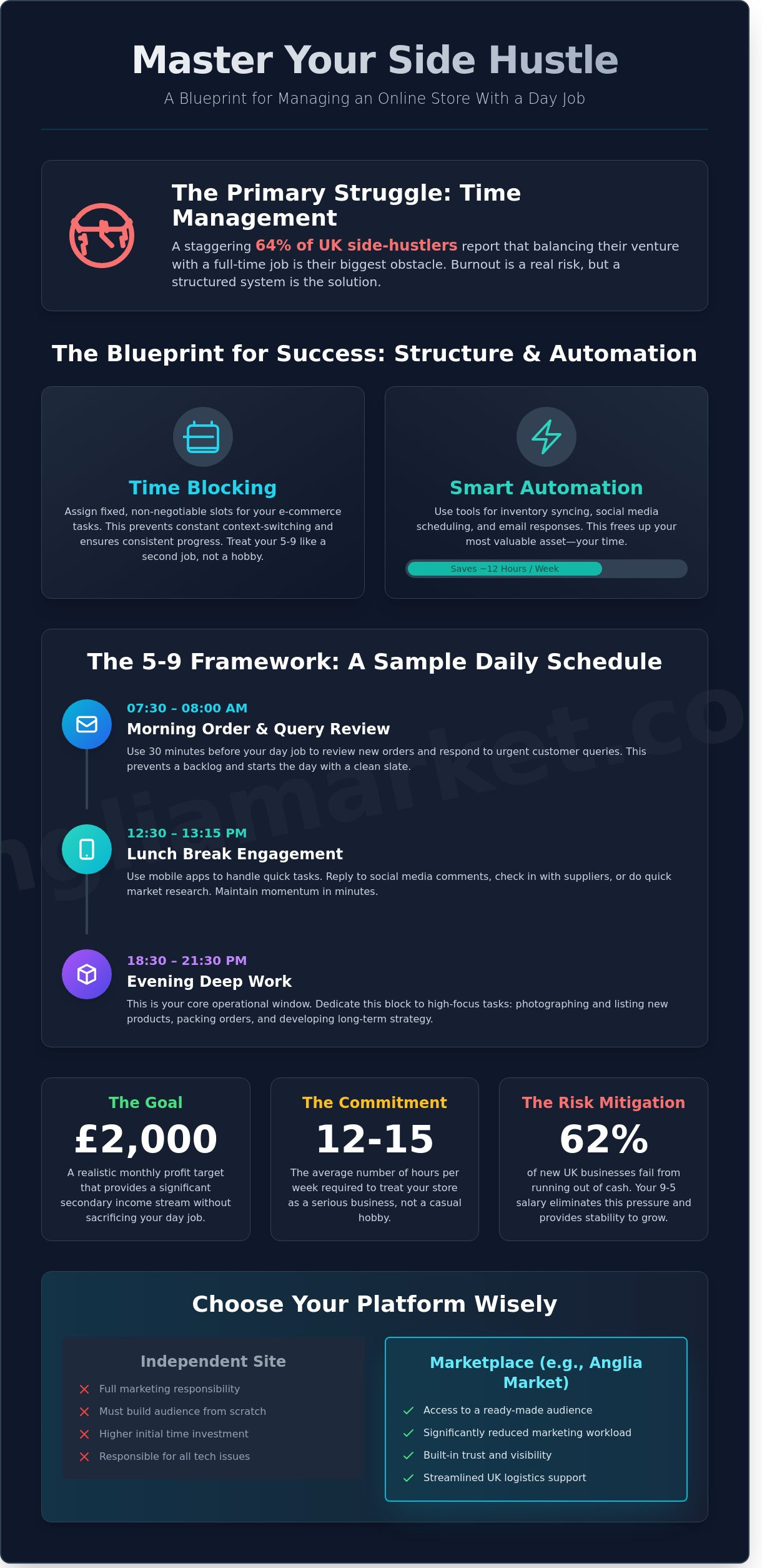
The financial benefits are clear. You don't need to take out high-interest director's loans or burn through your personal savings to keep the lights on. Every pound of profit can be reinvested into stock, better packaging, or targeted social media ads. Data from 2025 indicated that 62% of new UK businesses fail because they run out of cash. Keeping your day job eliminates this pressure, giving your brand the breathing room it needs to find its feet.
To better understand the blueprint for success, watch this helpful video:
Most part-time stores fail within the first 180 days. This usually happens because owners treat the venture like a casual hobby rather than a commercial operation. They don't account for the 12 to 15 hours a week required for customer service, inventory management, and packing. Setting realistic expectations is vital. In your first year, focus on consistency. Many UK sellers who sell online aim for a steady £400 to £1,000 monthly profit by their twelfth month. This is a significant achievement for a part-time venture and provides a solid foundation for future growth.
The Mindset Shift: From Hobbyist to Business Owner
You must treat your store as a second job. If you only work on it when you feel inspired, the business will stall. Organise your mental energy to avoid burnout. Use your commute for market research and your lunch break for customer emails. Identify your "Why" early on. Whether it's clearing debt or building a legacy, this motivation will get you through late-night packing sessions when you're tired after a long day at the office.
Assessing Your Current Capacity
Conduct a strict time audit of your typical week. Track every hour for seven days to find hidden pockets of productivity. You'll likely find 10 hours currently lost to scrolling or television. Set non-negotiable hours for your e-commerce tasks, such as Tuesday and Thursday evenings from 7 PM to 9 PM. Hybrid entrepreneurship is a low-risk path to financial independence. By dedicating specific blocks of time, you ensure your store grows without compromising your performance at your 9-5 role.
Essential Time Management Strategies for the Part-Time Seller
Managing an online store with a day job requires a structured approach to prevent burnout. Data from recent retail surveys indicates that 4.3 million UK workers now operate a side business; the most successful ones use time blocking to stay afloat. This method involves assigning fixed slots for e-commerce tasks, ensuring you aren't constantly switching between your professional role and your retail business. Automation is another essential pillar. Tools for inventory syncing or automated social media scheduling can reduce your manual workload by roughly 12 hours per week. While software subscriptions usually range from £20 to £55 monthly, they are often more cost-effective than hiring staff early on. Before diving into advanced automation, consult the UK government guidance to confirm your business structure is correctly registered for HMRC purposes.
The 5-9 Framework: A Sample Daily Schedule
Success in part-time e-commerce depends on how you utilise the hours outside your standard 9-5. A disciplined routine ensures no orders are missed and customer satisfaction remains high. If you want to expand your reach during these windows, you can start selling with us to access an established UK audience.
- Morning routine (07:30 – 08:00): Use 30 minutes for an order review and responding to urgent customer queries. This prevents a backlog from forming while you are at your primary job.
- Lunch break (12:30 – 13:15): Focus on social media engagement and supplier communication via mobile apps. Replying to a comment or checking stock levels takes minutes but maintains momentum.
- Evening block (18:30 – 21:30): This is your deep work phase. Dedicate this time to product listing, packaging orders, and long-term strategy development.
Batching Tasks for Maximum Efficiency
Context switching is a productivity killer. By grouping similar tasks together, you can complete them up to 40% faster than doing them sporadically throughout the week. This approach keeps your brand voice consistent and your workflow predictable.
- Photography Saturdays: Dedicate four hours on a Saturday morning to photograph your entire monthly inventory. This ensures consistent lighting and saves roughly six hours of setup and takedown time during the week.
- Bulk Copywriting: Write all 15 or 20 product descriptions in one sitting. This makes it easier to maintain a punchy, commercial tone across your whole range.
- Weekly Logistics: Avoid daily trips to the post office. Organise a single weekly drop-off or book a Royal Mail collection for a Tuesday or Wednesday to reclaim your evenings for business growth.
Selecting the Right Platform: Marketplace vs. Independent Site
Your platform choice dictates your daily workload. Managing an online store with a day job leaves little room for troubleshooting server errors at 10 PM. Standalone sites like Shopify or WooCommerce offer total control, but they demand constant maintenance. You'll spend roughly 5 to 10 hours a month just on security updates and app compatibility. In contrast, marketplaces handle the infrastructure, allowing you to focus on sales. UK SMEs are increasingly turning to local marketplaces like Anglia Market because they offer localised support that global giants often lack.
Comparing costs reveals significant differences. A basic Shopify plan starts at approximately £25 per month, but hidden costs for shipping apps or SEO tools often push monthly overheads above £80. Marketplaces typically operate on a commission-based model. Selling through established UK platforms means you only pay when you profit. This reduces the financial risk for 65% of new UK entrepreneurs who start as a side hustle.
The Case for the Online Marketplace
Marketplaces provide a built-in audience that slashes your marketing budget. Instead of spending £200 a month on Google Ads, you tap into existing traffic. This is vital when managing an online store with a day job because you can't monitor ad campaigns during office hours. Sell online with a platform that handles PCI compliance and payment security for you. Researching how to start an online store shows that technical barriers cause 20% of new UK ventures to fail in their first year. Using a marketplace removes this hurdle entirely.
When to Consider a Standalone Website
Ownership and data control are the primary reasons to build a standalone site. You own 100% of your customer emails for future marketing. However, the time costs are high. You are the IT department. If the site crashes during your 9-to-5, you lose sales until you're off the clock. Data from 2023 shows that 40% of part-time sellers who attempted a hybrid approach reported burnout within six months. Stick to one reliable platform until your monthly revenue consistently exceeds £2,000.
Streamlining Operations: Inventory, Shipping, and Customer Support
Efficiency is the only way to survive when managing an online store with a day job. You don't have the luxury of spending four hours every afternoon packing boxes. Your first major decision involves your business model. Dropshipping offers a hands-off approach, but holding your own stock typically increases profit margins by 22% according to 2024 UK e-commerce benchmarks. If you hold stock, focus on small, high-value items that fit into standard Royal Mail Large Letter dimensions to keep costs low.
Customer support can easily bleed into your professional life. Use automated helpdesk tools like Freshdesk to manage queries. Set an auto-responder that clearly states your operating hours. A message like "We process all enquiries between 6 PM and 9 PM GMT" manages expectations immediately. 74% of UK shoppers are happy to wait for a response if they know exactly when to expect it. This prevents you from checking your phone during office meetings.
Logistics in the UK have evolved to support the side-hustle economy. Integrating your store with Royal Mail Click & Drop or DPD allows you to buy postage in bulk. This automation removes the need for manual data entry, which saves the average part-time seller roughly five hours per week.
Effective Inventory Management for Small Spaces
You don't need a warehouse to succeed. Use the "Just-in-Time" inventory method to keep your home tidy. This involves maintaining minimum stock levels and timing supplier deliveries to arrive just as you run out. Use inventory software to sync your stock across different platforms. This prevents overselling, which accounts for 12% of negative seller ratings in the UK marketplace. Organise your space with a dedicated packing station. Having your tape, boxes, and thermal printer in one permanent spot reduces packing time by 40%.
Finding the right supplier is key to this model. Working with a versatile distributor and trading company like Portofbrands can give you access to a diverse range of consumer products without requiring massive bulk orders, helping you manage inventory effectively.
Shipping Hacks for the 9-5 Worker
Stop queuing at the Post Office during your lunch break. Utilise the UK's network of over 10,000 ParcelShop and Locker locations. Evri and DPD lockers are accessible 24/7, allowing you to drop off orders late at night or early in the morning. Invest in a thermal label printer; it's a £100 investment that eliminates the need for ink and scissors. Be transparent about your shipping schedule. If you only ship on Tuesdays and Fridays, state this clearly in your shipping policy. Accuracy is more important than speed for building long-term trust.
Ready to scale your side business with a platform built for UK growth? Start selling with Anglia Market today and reach more customers across the country.
Scaling Your Side Hustle with Anglia Market
Managing an online store with a day job is about working smarter. Anglia Market supports over 500 UK-based small and medium businesses by providing a high-traffic environment without the massive overheads of global giants. Independent vendors benefit from a platform that prioritises local quality over mass-produced imports. By the start of 2026, UK e-commerce is projected to account for 38% of all retail sales. Using a platform that specifically caters to the British market ensures your shipping costs and delivery times remain competitive for local buyers.
Why Anglia Market is the Ideal Partner
Efficiency is vital when you're working 9 to 5. The simplified vendor dashboard lets you manage inventory and track orders in minutes. You'll join a network of UK sellers who value secure shopping and reliable delivery. The platform covers everything from furniture to electronics, ensuring you find the right niche for your brand.
- Broad Reach: Access to diverse categories including home and garden and pet supplies.
- User-Friendly Tools: Dashboards designed for quick store management during lunch breaks or evenings.
- UK Community: A supportive network of independent entrepreneurs focused on the domestic market.
Taking the Next Step
Transitioning from a part-time seller to a full-time business owner requires data-driven decisions. Most entrepreneurs aim for a monthly profit of £3,000 before leaving their primary job. Use marketplace data to identify your next best-seller by looking at promotions and top-performing categories. Analysing search volume for specific items helps you stock products that are already in high demand.
Transitioning to full-time status is the ultimate goal for those managing an online store with a day job. To begin, apply to become a vendor today and focus on your first five product listings to build momentum. Research from 2025 indicates that listings with at least three high-resolution photos see a 30% higher conversion rate. Start selling with Anglia Market and grow your business today to turn your side hustle into a career.
Scale Your UK Business Growth in 2026
Success in managing an online store with a day job depends on two things: ruthless time management and the right retail platform. You've seen how automation and strategic shipping choices can save you up to 15 hours every week. By 2026, the UK's digital economy will reward sellers who focus on quality and leverage established marketplaces to reach local buyers quickly without the technical headache of a standalone site.
Anglia Market already supports hundreds of UK small businesses, offering a fast-growing marketplace with diverse categories ranging from home furniture to vehicle accessories. We provide secure shopping and robust vendor protection, so you don't have to worry about the risks of fraud or technical failures. Our platform is designed to help you grow without the massive overhead costs that usually eat into a new seller's profits.
Join Anglia Market as a Vendor to access a community of independent sellers and start building your brand today. It’s the simplest way to turn your evening passion project into a thriving commercial enterprise. We can't wait to see what you'll achieve.
Frequently Asked Questions
Is it legal to run an online store while employed in the UK?
Yes, it's legal to run an online store alongside your employment provided your contract doesn't explicitly forbid it. Most UK employment contracts allow for side businesses as long as they don't compete with your employer's interests. Check your 2026 contract for "conflict of interest" clauses. If you're unsure, a quick review of your staff handbook usually clarifies your rights.
How many hours a week does it really take to manage a side hustle store?
Managing an online store with a day job usually takes between 10 and 15 hours each week. You'll likely spend 4 hours on product sourcing, 3 hours on marketing, and 3 hours on order fulfilment. By using automation tools, you can reduce this commitment to under 8 hours. This balance allows you to grow your business without burning out at your main office.
Do I need to register as a business with HMRC immediately?
You must register with HMRC once your annual gross trading income exceeds £1,000. This threshold is known as the Trading Allowance. For the 2025/2026 tax year, you need to register for Self Assessment by 5 October following the end of the tax year. Keeping digital records of every sale helps you stay organised and avoids late filing penalties.
Can I manage my online store entirely from my smartphone?
Managing an online store with a day job is entirely possible using just a smartphone and dedicated seller apps. You can respond to customer enquiries, track inventory levels, and check sales data during your commute. While a laptop is better for detailed financial spreadsheets, mobile apps handle 90% of daily operations. This flexibility means you can run your business from anywhere in the UK.
What is the best type of product to sell when you have limited time?
How do I handle customer returns if I am at my day job?
You can handle returns efficiently by using automated labels and third-party drop-off points like Evri or CollectPlus. These services allow customers to return items at their convenience without you being present. You can then process the returns in the evening after your work shift ends. 63% of UK buyers are more likely to shop again if the return process is simple and hassle-free.
Should I tell my employer about my online business?
You should check your employment contract to see if you have a legal duty to disclose secondary income. If your contract is silent, you aren't strictly required to tell them, but transparency often builds trust. Many UK employers value the entrepreneurial skills you gain from running a side business. Just ensure your store activities never take place during your contracted working hours.
What are the most common mistakes people make when starting an e-commerce side hustle?
The most common mistake is failing to track all business expenses and platform fees from the start. Many new sellers forget to factor in the 20% VAT on certain services or shipping costs. Another error is overstocking inventory before testing the market. Start small with 5 to 10 products to see what sells before investing thousands of pounds in stock.

Here to help — ask anything
For questions about this disclaimer or the site, contact us via the website’s Contact page.


