
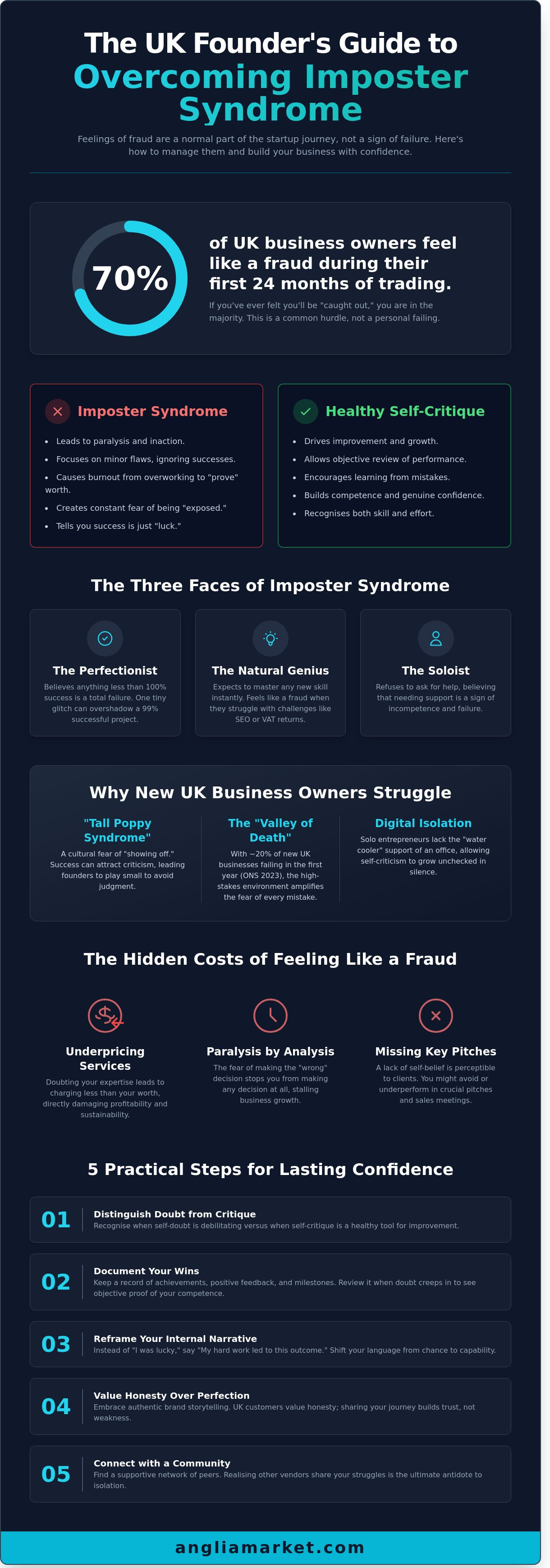
Did you know that 70% of UK business owners feel like a total fraud during their first 24 months of trading? If you have ever stared at your screen at 2 a.m. wondering when someone will finally "catch you out," you are definitely not alone. It is a common hurdle when dealing with imposter syndrome for new entrepreneurs uk, and it often leads to costly mistakes like underpricing your products or getting stuck in paralysis by analysis. You likely feel that every other founder has a secret manual for success that you somehow missed.
We're here to validate that these feelings are a normal part of the startup process, not a sign that you're failing. This guide shows you how to recognise these "fraud" feelings and manage them so you can build your UK small business with real confidence. You'll gain practical tools to silence self-doubt and sharpen your decision-making skills for better commercial results. We want to help you move from feeling like an outsider to acting like the capable leader your business requires.
We will walk through three specific strategies to end the isolation of working alone and start valuing your expertise correctly. It is time to stop second-guessing your worth and start focusing on the growth and profitability of your new venture.
Key Takeaways
- Learn to distinguish between healthy self-critique and the debilitating self-doubt associated with imposter syndrome for new entrepreneurs uk.
- Understand how cultural factors like "Tall Poppy Syndrome" and digital isolation specifically impact the growth of small businesses in Britain.
- Identify the hidden financial costs of feeling like a "fraud," including why you might be underpricing your services or missing key pitches.
- Discover five practical steps to reframe your internal narrative and document your professional wins for lasting commercial confidence.
- Find out how connecting with a supportive community of UK vendors can act as the ultimate antidote to solo-entrepreneur isolation.
What is Imposter Syndrome for UK Entrepreneurs?
Starting a business in 2026 brings unique pressures. Many founders feel they're just lucky rather than skilled. This feeling is known as imposter syndrome for new entrepreneurs uk. It often strikes when you're transitioning from an employee to a business owner. Understanding What is Impostor Syndrome? helps you realize it's a common psychological experience; it isn't a personal flaw. Watch this short explanation to see how these feelings develop: Healthy self-critique is useful. It helps you improve your service or check your accounts. Debilitating self-doubt is different. It stops you from making decisions. The old "fake it till you make it" advice often backfires. It creates a gap between your public image and your private reality. This gap leads to intense stress and burnout. Common symptoms include:- Perfectionism: Setting impossible standards and focusing on minor mistakes.
- Overworking: Staying at the desk for 14 hours a day to "prove" you belong.
- Fear of being found out: Living in constant dread that a client will realize you aren't an expert.
The Five Types of Imposter Syndrome
Most founders fall into specific categories. The Perfectionist believes that anything less than 100% success is a total failure. If a product launch has one small glitch, they ignore the 99% of things that went right. The Natural Genius expects to master every skill immediately. If they struggle with VAT returns or SEO, they feel like a fraud. Finally, the Soloist reflects a common British tendency to refuse help. They think asking for support proves they're incompetent. If you're feeling overwhelmed, you can sell online through established platforms to simplify your start-up process.
Why 2026 is a Challenging Year for New Founders
The 2026 business environment is fast. Social media "hustle culture" shows a filtered version of success that isn't real. Seeing others post about 6-figure months makes new owners feel behind. Economic uncertainty also plays a role. It's hard to look confident when market conditions change weekly. However, there is a positive shift toward authentic brand storytelling in the UK. Customers now value honesty over a polished corporate mask. Being open about your journey as you navigate imposter syndrome for new entrepreneurs uk can actually build trust with your audience. You don't need to be perfect to be a successful vendor.
Why New Business Owners in Britain Struggle with Self-Doubt
Starting a business in Britain brings specific cultural hurdles that fuel imposter syndrome for new entrepreneurs uk. Many founders face "Tall Poppy Syndrome." This is a social phenomenon where people who excel or stand out are often criticised or "cut down." For a new business owner, this creates a persistent fear that being visible or successful looks like "showing off." It makes you want to play small to avoid judgment.
The "Valley of Death" is another major factor. Data from the Office for National Statistics (ONS) in 2023 shows that approximately 20 percent of new UK businesses fail within their first 12 months. This high stakes environment makes every minor mistake feel like a sign of total incompetence. You aren't just fighting for sales; you're fighting a ticking clock. This pressure often leads to comparing your messy "behind-the-scenes" reality with the polished "highlight reels" of competitors on LinkedIn or Instagram.
Isolation also plays a role. Solo-entrepreneurs lack a traditional office "water cooler" where they can vent or realise that others share their frustrations. Without this social safety net, self-criticism grows unchecked. You might feel like the only person who doesn't have it all figured out, but the truth is that most people are simply better at hiding their confusion.
For many, finding a creative escape in atmospheric literature, such as the gothic fiction found in Graham Mulvein's World of Horrors, provides a healthy way to process the darker emotions of isolation and doubt that often accompany the entrepreneurial journey.
The British "Stiff Upper Lip" Mentality
Historical social norms in the UK often suggest we should "just get on with it" without complaining. This "stiff upper lip" prevents many founders from seeking the support they need. They view doubt as a weakness rather than a standard part of growth. However, breaking this silence is a competitive advantage. Owners who discuss their entrepreneurial journey with imposter syndrome often build more resilient networks. Finding a local tribe of peers helps ground your expectations in reality rather than global social media myths.
Navigating Uncharted Territory
The learning curve for a UK startup is steep and technical. You might be an expert in your product, but that doesn't mean you're an expert in business administration. New owners must quickly learn to handle:
- HMRC Compliance: Understanding tax codes and filing deadlines.
- VAT Registration: Managing the threshold, which sits at £90,000 as of April 2024.
- Business Regulations: Staying updated on UK employment and consumer laws.
Technical expertise in a craft doesn't equal expertise in management. It's common to feel like a fraud when you're staring at a VAT return you don't understand. Recognise that 100 percent of successful business owners started by learning on the job. If you want to focus more on your products and less on building a complex platform from scratch, you can sell online with us to reach customers more efficiently. This allows you to build confidence through sales while you master the administrative side of your company.
The Hidden Cost: How "Fraud Feelings" Harm Your Business Growth
Imposter syndrome for new entrepreneurs uk isn't just a mental hurdle; it's a financial drain. It directly impacts your bottom line. One of the most common symptoms is underpricing. You might feel "discount guilt" because you're convinced your expertise isn't worth the market rate. This isn't just being humble; it's dangerous for your business survival. Data from the Office for National Statistics (ONS) suggests that roughly 20% of new UK businesses fail within their first year. Poor margins caused by chronic underpricing are a primary driver of these early closures.
The cost also shows up in your daily operations and long-term strategy. It often manifests through these specific behaviours:
- Missed Opportunities: You skip local networking events or avoid pitching to major partners because you don't feel "ready" yet.
- Slow Decision Making: Perfectionism causes analysis paralysis. You spend weeks tweaking a website layout while your competitors are already making sales.
- Burnout: You try to "outwork" your fraud feelings by putting in 80-hour weeks. This is unsustainable and leads to costly mistakes.
Impact on Sales and Marketing
Many founders feel like a "dodgy" salesperson when they try to promote their own work. This leads to "hiding your face." You stay behind the scenes rather than becoming a visible brand ambassador, which makes it harder for customers to build trust with you. It's a cycle that limits your reach. Specifically, underpricing leads to poor cash flow, which prevents you from reinvesting in the quality stock or advertising needed to grow.
Platform Anxiety for Marketplace Sellers
It's intimidating to list your products next to established furniture or electronics brands. You might feel like a small fish in a massive pond. However, smaller UK vendors have a unique advantage. Current market trends show that shoppers increasingly value local support and independent quality. A 2023 retail report suggested that over 50% of UK consumers actively look for independent sellers to support the local economy. Don't let the fear of reviews stop you. Feedback is just data to help you grow your business on platforms like Anglia Market. Secure shopping and local trust are what buyers want, and as a small business, you can provide that personal touch larger corporations often lack.
Recognising these costs is the first step toward recovery. When you understand that imposter syndrome for new entrepreneurs uk is actually hurting your bank balance, it becomes a commercial priority to fix it. Efficiency and confidence go hand-in-hand in the retail world.
5 Practical Steps to Overcome Imposter Syndrome in 2026
Managing imposter syndrome for new entrepreneurs uk requires more than positive thinking. It needs a commercial strategy. By 2026, the UK small business landscape will be even more competitive; these five steps provide a functional framework to keep your business moving forward.
- Step 1: Document Your Wins. Create a "Success Folder" on your desktop. Save every positive customer review, successful delivery confirmation, and milestone reached. When self-doubt hits, look at the evidence. A 2024 survey by various UK business groups found that 70% of entrepreneurs feel like "frauds" at some point; having a physical log of facts helps dismantle that feeling.
- Step 2: Reframe Your Narrative. Stop saying "I don't know what I'm doing." Replace it with "I am learning this process." This shift moves you from a fixed mindset to a growth mindset. It's a practical adjustment that focuses on your current trajectory rather than a perceived lack of skill.
- Step 3: Find a Mentor or Peer Group. Isolation fuels imposter syndrome. Join a UK-based business network or a local chamber of commerce. Talking to others who have faced the same hurdles reduces the feeling that you're the only one struggling.
- Step 4: Set "Good Enough" Boundaries. Perfectionism is a common trait among new UK sellers. It often leads to burnout. Aim for "excellent" rather than "perfect." Set strict time limits for tasks like website tweaks or social media posts to prevent over-analysis.
- Step 5: Take Action Despite the Fear. Confidence follows action. You don't need to feel confident to start a task. Practice "courage over confidence" by completing one difficult task every morning before 10:00 AM.
The Entrepreneurial SWOT Analysis
Perform a SWOT analysis to separate facts from feelings. This is a vital tool for managing imposter syndrome for new entrepreneurs uk because it highlights objective reality. List your real strengths, such as your 10 years of industry experience or your unique product sourcing. Identify weaknesses, but keep them objective. If you're struggling with accounting, that's a skill gap, not a personal failure. Use your 2025 sales data or traffic reports to disprove the "fraud" narrative. Data doesn't lie; it shows exactly where you're succeeding.
Building a Resilience Routine
Self-doubt often peaks during physical exhaustion. Build a routine that includes a 15 minute screen break every two hours. Small milestones deserve recognition. If you secure your first 10 sales, celebrate it. This creates a positive feedback loop. A consistent routine helps you stay focused on operations rather than anxiety. If you're ready to take the next step in your business journey, you can start selling with us today and join our community of UK vendors.
Building Your Support Network with Anglia Market
Isolation is a breeding ground for self-doubt. When you work alone, every small mistake feels like proof that you don't belong. Community is the strongest antidote to imposter syndrome for new entrepreneurs uk. Joining a network of peers reminds you that your challenges are normal. Anglia Market serves as a dedicated platform for small and medium-sized UK businesses. We provide the infrastructure you need to grow without the crushing weight of going it alone. You're not just a number here. You're part of a growing ecosystem of independent sellers who understand the journey.
Empowering Independent UK Vendors
Low overheads are essential for new businesses. High street rents in the UK can exceed £200 per square foot in major cities, making physical stores risky for those just starting out. We help you reach a broader customer base while keeping costs manageable. You can see how others have transitioned by reading testimonials from successful UK sellers. These stories prove that your background doesn't limit your potential. Our secure marketplace handles the technical heavy lifting, so you can focus on your products. We're committed to a supportive environment where independent vendors thrive alongside one another. This focus on local, independent quality builds trust with shoppers who want to support UK talent.
Practical Tools for Success
Confidence often follows action. To help you gain momentum, we offer access to promotions and marketing support designed to boost visibility. These tools help you test the market and see real results quickly. If you've been waiting for the "perfect" moment, remember that 20% of new UK businesses fail in their first year often due to lack of market reach. We bridge that gap. If you're ready to grow, start selling with us today and join our community. Your unique perspective isn't a weakness. It's your greatest business asset. Stop thinking about your ideas and start putting them in front of customers who value quality and local enterprise. Every sale you make is a direct rebuttal to the inner critic that says you aren't ready. Success isn't about being perfect; it's about being present and active in the right marketplace.
Take the Next Step in Your Entrepreneurial Journey
Mastering imposter syndrome for new entrepreneurs uk is a vital part of scaling your business throughout 2026. You've learned that self-doubt is a common hurdle, but implementing five practical steps and building a solid support network keeps you moving forward. Success comes from consistent action. It's not about being perfect from day one. Anglia Market currently supports thousands of independent UK vendors with a platform built for straightforward commercial growth. Our transparent commission-based system means we only succeed when you do. If you hit a snag, our expert support team is available via our Freshdesk portal to provide technical assistance. It's time to transition from feeling like a fraud to operating as a confident business owner. You've got the tools and the drive to succeed in the British market. We're ready to help you reach more customers and simplify your online sales process today.
Start your journey as a vendor on Anglia Market today
Your business has incredible potential. Let's start building your future together right now.
Frequently Asked Questions
Is imposter syndrome common among UK entrepreneurs?
Yes, it's a widespread experience for business owners across the country. A 2023 study by NatWest revealed that 60% of UK small business owners struggle with these feelings during their first three years of operation. With over 5.5 million small businesses currently active in Britain, you're part of a massive group of professionals who occasionally feel like a fraud despite their hard work.
How do I know if I have imposter syndrome or if I am actually underqualified?
Check your tangible results like sales figures and customer feedback. Imposter syndrome for new entrepreneurs uk typically affects high achievers who can't internalise their success even when they have proof of their skills. If you've secured your first 10 orders or received five-star reviews on a platform like Anglia Market, you're qualified. Underqualification is a simple lack of technical knowledge that you can fix with a specific training course; for instance, the Institute of Wedding Photographers offers professional workshops designed to turn technical skill into business-ready expertise.
Can imposter syndrome ever be a good thing for my business?
It can actually drive you to maintain higher quality standards and better customer service. Research published in the Academy of Management Journal suggests that people with imposter thoughts often have stronger interpersonal skills because they work harder to prove their value. This extra effort leads to better communication with your buyers. Use that energy to refine your product descriptions and ensure your delivery times are always met.
How does self-doubt affect my business pricing strategy?
Self-doubt often leads to underpricing, which directly cuts into your profit margins. A 2022 survey by FreshBooks found that women entrepreneurs often earn 28% less than their male counterparts, partly due to confidence gaps when setting rates. You might feel tempted to offer "budget" prices even when your products are premium quality. Focus on the current market value for your category instead of your internal feelings of worth.
What are the best UK-based resources for entrepreneurs struggling with mental health?
You can access immediate support through the NHS Every Mind Matters campaign or the charity Mind. For business-specific guidance, the Federation of Small Businesses (FSB) provides a dedicated Wellbeing Hub for its 160,000 members. You should also look into the Start Up Loans mentoring scheme. It offers free, practical support to new business owners across England, Scotland, and Wales to help manage the pressures of a new venture.
How can I stop comparing my new business to established competitors?
Focus on your own 12-month growth plan and your unique selling points. Established brands have had years or even decades to build their infrastructure and loyal customer base. A 2021 report from the British Business Bank shows that most UK startups take at least 3 years to reach true stability. Compare your current progress to your own stats from 30 days ago rather than a competitor's decade of work.
Will imposter syndrome ever go away as my business grows?
The feeling usually evolves into a manageable hum rather than disappearing completely. As you reach milestones like your first 500 sales, your confidence grows, but new challenges can trigger old doubts. Managing imposter syndrome for new entrepreneurs uk is about building professional resilience. You eventually learn to recognise the feeling as a sign that you're pushing your boundaries and growing, rather than a signal to quit.
How can joining a marketplace like Anglia Market help with my confidence?
It provides a professional, structured environment that validates your brand immediately. We support small and medium businesses by providing a high-quality shopfront, so you don't have to worry about the technical side of web design. Seeing your items listed alongside other quality products builds instant credibility. Every successful transaction and positive customer review serves as concrete proof that your business is a success and belongs in the marketplace.
Here to help — ask anything
If you have any questions regarding this disclaimer or any of our policies, please contact Anglia Market through the contact page on our website, by email using the address provided on the site, or by phone at 0333 772 2593