Did you know that the average product liability settlement for UK SMEs rose to £35,000 in 2025? For an independent seller, a single defect isn't just a customer service headache. It's a financial crisis that could close your doors for good. You've worked hard to source quality goods and build a loyal following, so the thought of a lawsuit is naturally terrifying. It's frustrating when legal jargon and unpredictable 2026 premiums stand in the way of your peace of mind.
We're here to make things simple. This guide explains how to find the best product liability insurance for small business uk without overspending. You'll discover your exact obligations under the Consumer Protection Act and learn how to choose a policy that scales with your growth. We'll also share three practical ways to reduce your risks today. By the end of this article, you'll have a clear plan to protect your profits and keep your business safe from unexpected legal claims.
Key Takeaways
- Understand your legal obligations under the Consumer Protection Act 1987 to safeguard your business against expensive compensation claims.
- Discover how product liability insurance for small business uk covers legal fees and damages if a faulty item causes personal injury or property harm.
- Learn to distinguish between public and product liability to ensure your specific retail activities have the correct level of protection.
- Identify the "Importer Rule" and how white-labelling goods can significantly increase your financial risks as a UK reseller.
- Master proactive risk management and supplier vetting to build a secure brand and protect your reputation on Anglia Market.
Understanding Product Liability Insurance for Your UK Business
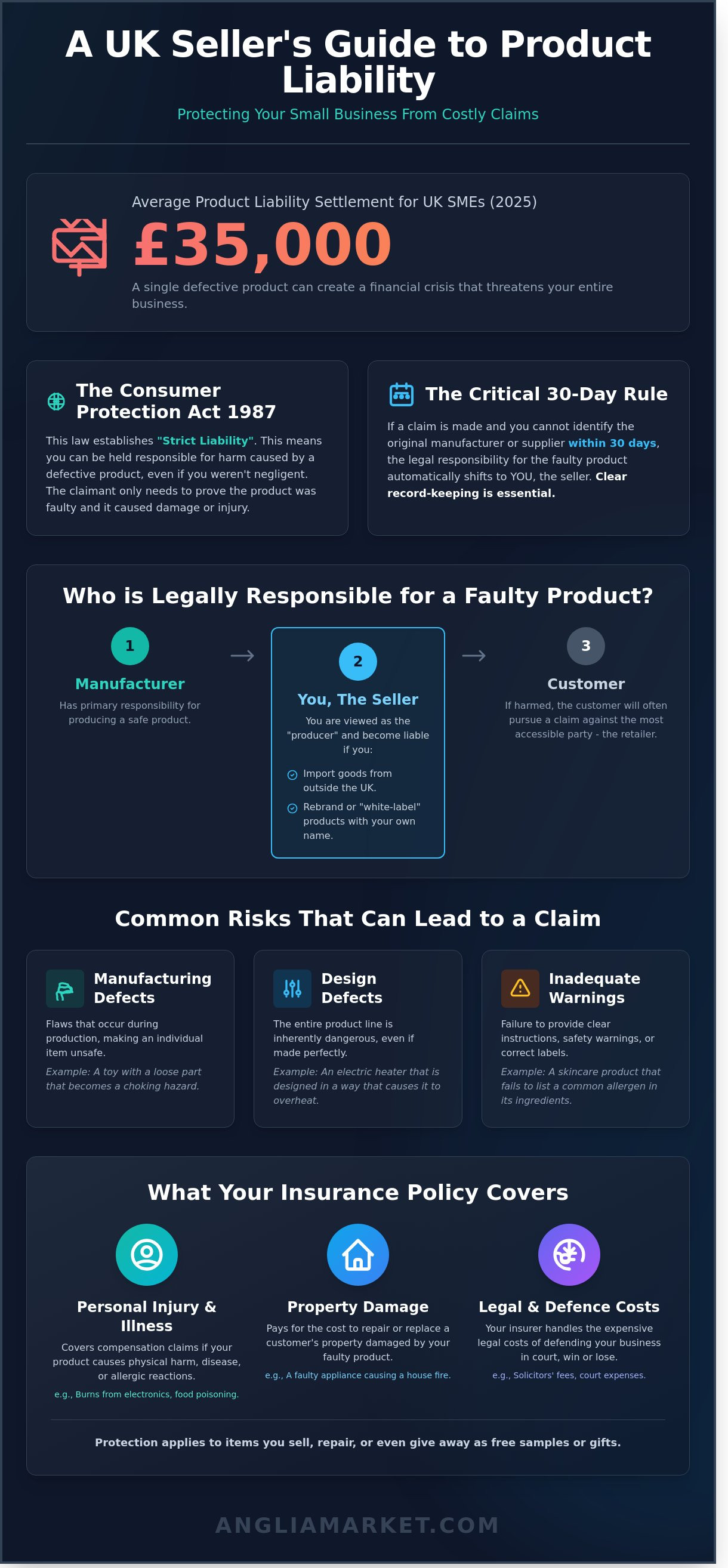
Product liability insurance covers your legal fees and compensation costs if a product you supply causes personal injury or property damage. Under Product liability law, specifically the Consumer Protection Act 1987, claimants don't always have to prove you were negligent. They only need to show the product was defective and caused harm. This "strict liability" means your small business could face a claim even if you didn't manufacture the item yourself.
To see how these risks impact your company, watch this helpful video:
By 2026, legal experts predict a rise in consumer protection claims as digital marketplaces grow. Having product liability insurance for small business uk ensures your company's financial future isn't wiped out by a single faulty batch or a simple error in a manual. Without cover, a single £50,000 claim for a house fire caused by a faulty charger could bankrupt a small enterprise.
Who is legally responsible for a faulty product?
Primary responsibility usually sits with the manufacturer. However, you're viewed as the "producer" if you put your own brand name on the item or import it from outside the UK. If a customer makes a claim and you can't identify the original supplier within 30 days, the legal burden shifts directly to you. Keep clear records of every transaction with your vendors to protect your position. Retailers and distributors are often the first point of contact for legal action.
Common product-related risks for small businesses
- Manufacturing defects: These occur during production. A chair with a weak leg or a toy with a choking hazard are typical examples of items made incorrectly.
- Design defects: These products are dangerous even when made perfectly. An electric heater that overheats due to its internal layout is a design flaw that affects the whole line.
- Inadequate warnings: You're liable if you fail to provide clear instructions or safety warnings. If a cleaning chemical lacks a "keep out of reach of children" label, the seller often pays the price.
For businesses selling high-value items like home furnishings, the stakes are even higher. A single defect in a sofa or bed frame can lead to significant claims. To see how a family-run specialist manages these challenges by focusing on quality and customer service, you can visit Sheepbridge Sofas & Beds.
The same principle applies to permanent fixtures like windows and doors, where manufacturing defects can lead to significant property damage or safety issues. For an example of a specialist manufacturer navigating these responsibilities, you can discover Grabex Windows Ltd.
Securing product liability insurance for small business uk is a practical step to manage these risks. It allows you to focus on growth while knowing your legal costs are handled if the worst happens.
What Does Product Liability Insurance Actually Cover?
Product liability insurance for small business uk providers protects your company if a product you supply causes harm or damage. This protection isn't limited to items you sell for a profit. It also covers goods you give away as free samples, promotional gifts, or even items you have merely supplied or repaired. According to the Association of British Insurers (ABI) guide, you can be held liable for compensation even if you didn't manufacture the product yourself, especially if the manufacturer is based outside the UK.
The policy typically handles three main areas: compensation for injury, repair costs for property damage, and legal expenses. If a claimant takes you to court, your insurer pays for the solicitors and court fees required to defend your business. This financial safety net allows you to focus on your online retail growth without fearing a single faulty batch could end your venture.
Injury and illness claims
Personal injury cover in the context of UK product law provides financial protection if a product causes physical harm, disease, or psychiatric injury to a consumer. Compensation is usually split into "general damages" for pain and "special damages" for financial losses like lost wages. For example, if a customer suffers an allergic reaction to mislabelled ingredients in a £15 skincare balm, the settlement is calculated based on the severity and duration of their symptoms. Common claims include:
- Severe burns from faulty electronic components or overheating batteries.
- Food poisoning resulting from contaminated ingredients in gourmet hampers.
- Cuts or physical trauma from sharp edges on poorly finished children's toys.
Property damage and financial loss
This cover kicks in when your product damages something else. If a faulty £30 charger overheats and causes a house fire, the policy covers the damage to the home, not just the £30 charger. In the UK market, most insurers recommend a minimum cover level of £1 million. This might sound high, but a single leak from a faulty plumbing fitting can easily cause £50,000 in flooring and structural damage to a modern flat.
It's vital to distinguish between the product and the damage. Most policies won't pay to replace the faulty item itself; they focus on the resulting destruction. Whether you are a manufacturer or an independent vendor, having the right product liability insurance for small business uk ensures a mistake doesn't become a bankrupting event. It's about protecting your business reputation while providing peace of mind to your customers.
Public Liability vs Product Liability UK: Identifying the Differences
Choosing the right cover is a vital step for your growth and security. While they sound similar, these two types of insurance protect your business from different risks. Public liability focuses on your daily actions and your physical workspace. Product liability protects you against claims arising from the items you sell. Most UK insurers bundle these covers into a single policy because small businesses often face both risks simultaneously.
Public liability: The "Accident" cover
Public liability handles the immediate risks of running a business. It covers you if a member of the public is injured or their property is damaged because of your business activities. It's essential if you have a physical shop, an office, or if you visit clients. The Health and Safety Executive (HSE) reported that 32% of all non-fatal workplace injuries in 2022/23 were caused by slips, trips, or falls. If a customer trips over a loose rug in your shop, public liability pays the legal fees and compensation costs. It doesn't matter if the accident happens at your registered business centre or a temporary pop-up stall.
Product liability: The "Faulty Item" cover
This cover takes over once a product leaves your control. It protects you if a product you sold, supplied, or repaired causes injury or property damage. Online-only sellers often prioritise this over public liability because their main risk is the "after-sale" phase. As the Federation of Small Businesses explains, you owe a duty of care to every person who uses your goods. Even if you didn't manufacture the item, you can still be held liable if the manufacturer is based outside the UK or no longer exists. Finding the right product liability insurance for small business uk vendors ensures you're protected if a faulty gadget causes a fire or a toy has a sharp edge you didn't spot.
- Scenario A: A customer spills hot coffee in your cafe and sues for a burn. This is Public Liability.
- Scenario B: A customer takes a packaged bottle of sauce home, the glass shatters due to a defect, and they get injured. This is Product Liability.
Securing product liability insurance for small business uk operations usually costs less when purchased as part of a combined package. Insurers know that a single incident, like a faulty chair collapsing, can involve both the "accident" and the "product." Having both ensures you aren't left with a gap in your protection.
Determining Your Risk: Do You Need Cover as a Reseller?
Many UK retailers believe they're safe from legal action because they don't manufacture the goods they sell. This is a dangerous misconception. Under the Consumer Protection Act 1987, your business can be held liable for injuries or property damage caused by a defective product just as if you had built it yourself. If you're a distributor or shop owner, having product liability insurance for small business uk is often the only thing standing between you and a devastating legal bill.
Your risk level depends heavily on where your stock originates and how you present it to the public. You face the highest risk in these three scenarios:
- The Importer Rule: If you source products from outside the UK, the law treats you as the manufacturer. You're the first point of contact in the UK supply chain.
- White Labelling: Placing your own brand name or logo on a generic product makes you legally responsible for its safety.
- Untraceable Origins: If the original manufacturer has gone out of business or cannot be identified, the legal responsibility for a claim falls directly on the seller.
Product categories also dictate your premiums. A business selling stationery faces lower risks than one selling children's toys or electrical items. In 2022, the Office for Product Safety and Standards (OPSS) issued over 500 product recalls; businesses selling high-risk goods must be prepared for the financial fallout of such events.
Special considerations for importers
Importing goods from outside the UK changes your legal status instantly. You cannot easily pass a claim back to a factory in a different jurisdiction; UK courts will look to you for compensation. It's essential to check that your policy specifically covers imported stock. Many standard policies have exclusions for certain territories, so you must be transparent with your insurer about your supply chain to avoid a voided claim.
Second-hand and refurbished goods
Selling used items doesn't exempt you from your statutory obligations. You still have a duty of care to ensure products are safe. While "sold as seen" might seem like a safety net, it doesn't override the Consumer Rights Act 2015. You should document all safety tests on refurbished electronics. Statistics show that roughly 15% of domestic fires caused by appliances involve faulty or poorly repaired second-hand goods, making robust cover a necessity for vintage or tech resellers.
Protect your growing venture and ensure you're covered for every sale. Explore how Anglia Market supports UK small businesses
How to Protect Your Small Business Beyond Insurance
Anglia Market focuses on helping independent vendors build resilient, trusted brands. While product liability insurance for small business uk provides a vital financial safety net, proactive risk management is your first line of defence. Preventing a claim is always more cost-effective than managing one. You can reduce your exposure by implementing strict quality control and ensuring every item you list meets the General Product Safety Regulations 2005.
Vetting your suppliers
Don't assume every wholesaler follows UK safety standards. You must verify that products carry the UKCA mark, which became the mandatory standard for most goods in Great Britain after 1 January 2021. Check that your suppliers have their own liability insurance in place; if they don't, you might face the full cost of a claim for a manufacturing defect you didn't cause. Collect and verify safety certificates for every new line. Keeping a clear paper trail of every item's origin ensures you can hold manufacturers accountable if things go wrong.
Documentation and record-keeping
The Consumer Protection Act 1987 allows individuals to bring claims for up to 10 years after a product was supplied. This makes long-term record-keeping a necessity for UK sellers. You should organise a digital filing system that links batch numbers to specific customer orders. If the Office for Product Safety and Standards (OPSS) flags a safety issue, having these records allows you to trigger an effective recall in hours. Rapid action protects your reputation and satisfies the requirements of your product liability insurance for small business uk. Clear, accurate product descriptions and prominent safety labels are also essential. They prevent customer misuse and provide evidence that you fulfilled your duty of care. Start selling safely with Anglia Market and join our community of UK vendors to grow your brand on a platform that values quality and security.
Secure Your Business Growth for 2026
Operating a successful venture in 2026 requires more than just great products; it demands a robust safety net. Whether you're a manufacturer or a reseller, securing product liability insurance for small business uk is a vital step to shield your assets from legal claims that often exceed £50,000. You've now seen how to distinguish between public and product cover and why assessing your specific risk level prevents costly oversights. Don't leave your brand's reputation to chance when a single faulty component could impact your entire financial future.
Protecting your business involves choosing the right platforms as much as the right insurance. Anglia Market proudly supports over 1,000 independent UK vendors and small businesses by providing a secure shopping environment. Our trusted marketplace features comprehensive categories for all types of physical goods, ensuring your products reach the right customers safely. We handle the technical hurdles so you can focus on delivering quality and value to your buyers.
Explore Anglia Market: The platform that supports UK small businesses and take the next step in your commercial journey. It's time to turn your hard work into lasting success.
Frequently Asked Questions
Is product liability insurance a legal requirement for small businesses in the UK?
Product liability insurance isn't a legal requirement for small businesses in the UK. Unlike Employers' Liability insurance, which is mandatory under the 1969 Act, this cover is optional. However, many major UK retailers and online marketplaces often require proof of cover before they'll list your products. Without it, you'll struggle to secure distribution deals or trade at professional local markets.
How much does product liability insurance cost for a small business in 2026?
Expect to pay around £50 to £150 per year for basic product liability insurance for small business uk in 2026. These figures apply to low-risk sectors like stationery or textiles. If you sell electronics or toys, premiums often rise by 25% or more due to higher safety risks. Your final price depends on your annual turnover and the volume of units sold each year.
What happens if I sell a product that causes an injury but I didn’t manufacture it?
You're still legally liable for injuries even if you didn't manufacture the product yourself. Under the Consumer Protection Act 1987, the producer includes anyone who puts their brand name on a product or imports it from outside the UK. If the original manufacturer is untraceable or has gone bankrupt, the legal responsibility for compensation claims falls directly on your business.
Does product liability insurance cover the cost of a product recall?
Standard product liability policies don't cover the costs of a product recall. A basic policy pays for legal fees and compensation if a customer is hurt. To cover the logistics of pulling 1,000 faulty units off the shelves, you'll need a specific Product Recall extension. This add-on handles shipping, disposal, and public relations costs during a safety crisis to protect your brand reputation.
Can I get product liability insurance for a side hustle or part-time business?
You can get insurance for a side hustle or part-time business through specialised small-business providers. Many UK insurers offer micro-business packages for people selling through various online platforms or craft fairs. These policies often start at roughly £5 per month. It's a vital safeguard because even a part-time hobbyist can face a £50,000 claim if a handmade candle causes a fire or injury.
Is product liability insurance tax-deductible for UK businesses?
Yes, product liability insurance is a fully tax-deductible business expense for UK companies. HMRC classifies these premiums as an allowable expense because they're strictly for business purposes. This means you can deduct the full cost of your premium from your total turnover when calculating your taxable profit. It's a simple way to reduce your Corporation Tax or Self-Assessment bill while staying protected.
What is the difference between product liability and professional indemnity insurance?
Product liability covers physical goods, while professional indemnity covers advice and services. If a faulty kettle burns a customer, product liability pays out. If you give bad financial advice that costs a client £10,000, professional indemnity covers the loss. Most UK tradespeople and designers need both to ensure full protection against physical damage and professional errors in their daily operations.
How much cover do I actually need (e.g., £1m, £2m, or £5m)?
Most small firms start with £1 million or £2 million in cover, but £5 million is often required for government contracts. If you supply large supermarkets or public sector bodies, they'll usually insist on a £5 million minimum. Check your specific supplier agreements carefully. A single serious injury claim in the UK can easily exceed £250,000 once legal fees and NHS recovery costs are included.

Here to help — ask anything
If you have any questions regarding this disclaimer or any of our policies, please contact Anglia Market through the contact page on our website, by email using the address provided on the site, or by phone at 0333 772 2593