
Did you know that 34% of craft buyers still prefer to purchase at markets and pop-ups over digital storefronts? Even in 2026, the tactile experience of meeting a maker face-to-face holds a powerful draw that a screen cannot replicate. You've likely felt the physical exhaustion of a long market weekend or the frustration of paying high stall fees with no guaranteed return. Perhaps you've also faced the technical overwhelm of digital marketing while trying to reach a consistent audience. We understand that finding the right balance for your business is difficult.
This guide provides a definitive comparison of selling at craft fairs vs online pros and cons to help you choose the most profitable path for your small business. You'll gain a clear understanding of the ROI for both channels and learn a strategy to manage both without burning out. We'll also show you how to lower your customer acquisition costs by using each platform for what it does best. Discover how to turn brand discovery at a physical stall into sustainable, scalable growth through your digital storefront.
Key Takeaways
- Compare the immediate ROI of physical market stalls against the long-term scalability of digital platforms to find your most profitable route.
- Navigate the selling at craft fairs vs online pros and cons to create a balanced business model that prevents burnout.
- Identify how to leverage direct customer feedback from in-person events to improve your online conversion rates and product descriptions.
- Understand the impact of the latest 2026 UK regulations and fee structures on your total take-home profit.
- Implement a hybrid "showrooming" strategy that uses physical stalls as a powerful discovery tool for your permanent online storefront.
The Modern Maker’s Dilemma: Choosing Your Sales Channel
The UK craft sector has transformed from a collection of weekend hobbyists into a sophisticated network of professionalised SME hubs. By 2026, the market is no longer just about local village halls; it's a multi-billion pound industry driven by skilled artisans who treat their craft as a serious commercial venture. This shift means makers must be more strategic about where they invest their time and capital. You're no longer just competing with the person at the next table. You're competing with global brands for a slice of the consumer's attention.
Choosing between physical and digital spaces isn't just about preference. It's about survival in a post-digital-saturated market. Consumers are increasingly wary of generic ads and lookalike products. They want authenticity. This makes the selling at craft fairs vs online pros and cons debate more relevant than ever. Success depends on identifying your primary goal. Are you looking for immediate cash flow to fund your next batch of materials? Or is your focus on long-term scalability and brand awareness? Each channel serves a different master.
The 2026 retail landscape shows a unique split. We see a resurgence of the "experience economy" where shoppers value the story and the interaction as much as the product. Simultaneously, e-commerce dominance remains absolute for convenience and repeat purchases. Balancing these two forces is the key to a sustainable business model that doesn't rely on a single point of failure.
Defining the Two Paths
The digital path is equally varied. While a standalone website offers control, the technical demands are often too high for beginners. Leveraging established e-commerce principles through a marketplace is often the smarter move. Platforms provide built-in trust and traffic that a new site lacks. For those looking to bridge the gap between local charm and digital reach, selling online with Anglia Market offers a practical way to support your independent enterprise while accessing a wider audience. It allows you to keep your local identity while removing the geographical limits of a physical stall.
The Allure of the Stall: Pros and Cons of Physical Craft Fairs
Physical markets offer a sensory buzz that digital platforms cannot match. There is a distinct commercial advantage in letting a customer feel the weight of a ceramic mug or smell the scent of a hand-poured candle. When analysing the selling at craft fairs vs online pros and cons, the primary benefit is the immediate transaction. You exchange goods for cash instantly. There are no shipping delays, no lost parcels, and no packaging materials to source for a post-event delivery. You also build a local community of regulars who look for your stall at every seasonal event.
However, the physical toll is significant. A typical market day involves a 5:00 am start, heavy lifting, and standing for eight hours regardless of the weather. Rain or high winds can decimate footfall, leaving you with high upfront costs and zero sales. The "introvert tax" is another factor often overlooked. The emotional energy required to maintain a professional, engaging presence for an entire day is a real cost for many makers. If you prefer to focus on creating rather than commuting, you might want to explore becoming a vendor on a platform that handles the footfall for you.
Inventory management at fairs is a constant gamble. Bringing too much stock means wasted fuel and physical strain; bringing too little results in missed opportunities. Unlike an online shop where your entire catalogue is visible, a physical stall limits your display space. You must curate your selection carefully to ensure your most profitable items are front and centre, as you cannot show your entire range to every passerby.
The Power of Face-to-Face Feedback
Fairs act as a live laboratory for your brand. You can observe customer behaviour in real time to see which colours or textures draw them in first. This direct interaction reduces the mystery of customer objections by allowing you to address concerns about materials or durability on the spot. You can use these insights to refine your product descriptions and photography for your digital storefront later.
The Hidden Costs of Physical Events
Calculating your real hourly rate is essential for a healthy business. Beyond the stall fee, you must account for prep time, travel, and the cost of display equipment like gazebos and branding materials. UK vendors also need to factor in mandatory public liability insurance to protect against accidental injury or damage. These cumulative expenses can significantly eat into your initial profits if the event footfall is lower than expected.
The Digital Storefront: Pros and Cons of Selling Online
Moving your business into the digital space offers a level of freedom that no physical event can provide. Your shop never closes. A customer in Cornwall can buy your work at 3:00 am whilst you're asleep in Norfolk. This 24/7 sales potential is the primary driver for many UK makers. The barrier to entry is also significantly lower. You don't need to invest in display equipment or travel across the country to find an audience. When weighing up selling at craft fairs vs online pros and cons, the digital storefront offers a level of accessibility that a weekend market cannot match.
The "shipping headache" is a real concern for 2026 SMEs. Unlike a fair where the customer carries the item away, online selling requires robust packaging, reliable couriers, and a clear returns policy. Technical requirements like SEO and high-quality photography are non-negotiable. If your product doesn't look professional on a screen, it won't sell. This is why marketplaces are the preferred entry point for most small businesses. They provide the infrastructure and trust signals, like secure payments and verified reviews, that a standalone site often lacks.
Scalability and the "Passive" Income Myth
The idea of passive income in the craft world is largely a myth. Whilst you can indeed sell whilst you sleep, the labour simply shifts. Instead of standing at a stall, your time is spent on digital marketing, inventory management, and packing orders. The real advantage here is data. Marketplace analytics allow you to track exactly what visitors are clicking on and which items have the highest conversion rates. You can view vendor profiles to see how successful makers organise their shops and present their collections to maximise this data-driven approach.
The Competitive Landscape of 2026
The digital market is crowded. Standing out requires a sharp focus on niche positioning. You cannot simply be "a jewellery maker"; you must be the specialist in a specific style or material. High-quality photography and precise British-English copywriting are essential tools for building buyer trust in a space where they cannot touch the product. Online platforms democratise access to the UK-wide market by allowing a maker in a remote village to compete directly with large urban boutiques. Success comes down to how well you signal your reliability through professional profiles and consistent customer service.
Head-to-Head: Comparing Costs, Logistics, and Reach
Comparing the financial outlay of selling at craft fairs vs online pros and cons requires looking at the raw numbers. A typical stall fee at a UK event like The Swallowfield Show is £70, whilst premium pitches at Craft & Flea can reach £120. Compare this to marketplace commissions. Fees range from 6% on Folksy to 25% or 30% on Not on the High Street. For a maker with a £20 product, a stall fee is a fixed risk. Commission is a variable cost that only applies when you win. You must decide if you prefer a one-off upfront cost or a percentage-based fee on every sale.
Logistics also follow different rhythms. Transporting inventory in bulk for a fair is a sprint. You pack the car, set up the display, and sell on the spot. Online logistics are a marathon. You manage individual postage and packaging for every order. This requires a dedicated workspace and a constant supply of boxes, tape, and labels. Bulk transport saves time per item sold, but individual shipping allows for a more controlled, steady workflow throughout the week.
Reach is where the two paths diverge most sharply. A local fair might attract 500 targeted visitors in a weekend. A national marketplace offers access to tens of thousands of potential buyers every single day. The trade-off is visibility. At a fair, you're one of 50 stalls. Online, you're one of thousands. Winning online requires consistent maintenance, whilst a fair requires intense, "burst" energy for 48 hours.
Analysing the ROI of Your Time
Calculate your real profit by including every hour spent on the business. This includes prep time, travel, and the 10-hour event day. Conversion rates are often higher in person because customers can't easily walk away from a conversation. Online conversion is lower, but the sheer volume of traffic often results in higher total sales over a month. UK seasonal peaks also play a role. Physical Christmas markets peak in early December. Online sales continue right up to the final shipping deadlines for Black Friday and late December.
Customer Acquisition Costs
Think of a stall fee as your customer acquisition cost (CAC). You're paying for the event organiser's marketing and the venue's footfall. Online, your CAC is spent on SEO or digital promotions. Retaining these customers is easier online. You can use loyalty programmes to encourage repeat purchases without paying for that customer a second time. An email list acts as the bridge. Use a QR code at your stall to sign people up, then sell to them online throughout the year. If you want to expand your reach without the physical strain, apply to sell online and start reaching customers nationwide.
Maximising Your Reach: Why a Hybrid Approach Wins
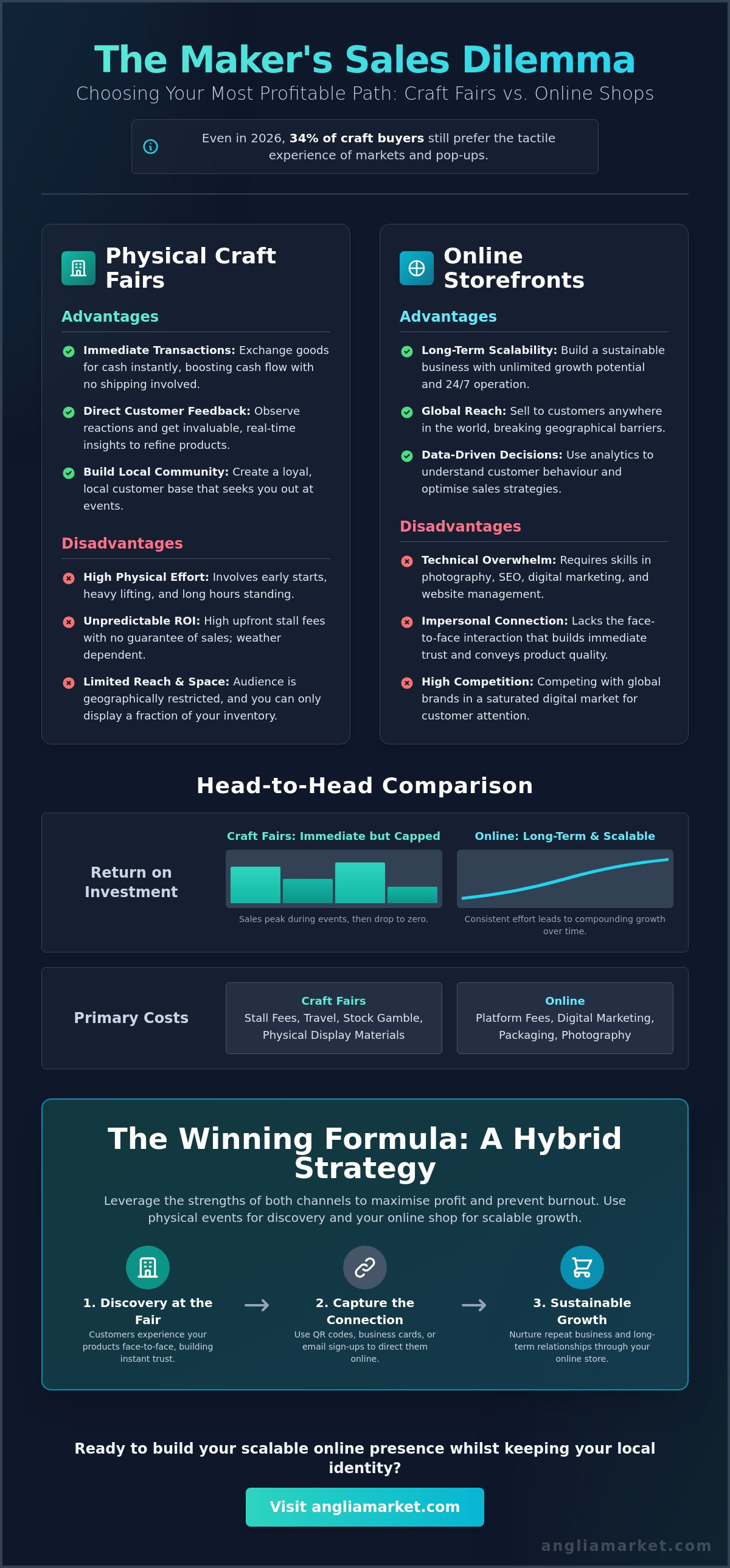
In 2026, the most successful makers don't treat this as a binary choice. The selling at craft fairs vs online pros and cons debate often overlooks how these channels feed each other. A hybrid model creates a vital safety net for your business. If a market is rained off, your online sales keep the revenue flowing. If your digital reach plateaus, a physical stall provides a fresh influx of local customers and instant brand recognition. This dual strategy allows you to capture different types of buyer behaviour simultaneously.
Many buyers use fairs as a showroom. They see your work, appreciate the quality, but aren't ready to carry a fragile item home. They'll search for you online later. Make it easy for them. Hand out business cards with a clear QR code that leads directly to your shop. This bridges the gap between the physical experience and the convenience of home delivery. You can also use marketplace tools to manage your inventory across both channels, ensuring you never "double sell" an item that just walked off your stall.
Bridging the Gap with Anglia Market
Transitioning from a purely physical business to a digital one doesn't have to be overwhelming. You can sell online effectively by joining a platform that understands the specific needs of UK-based SMEs. Unlike global giants, a UK-centric marketplace focuses on regional commerce and supports local vendors. You can use seasonal promotions and sales to clear any leftover stock after a busy fair season. This keeps your inventory fresh and your cash flow healthy throughout the quieter months.
Your 2026 Launch Checklist
If you are currently only selling at fairs, take these three steps to go digital:
- Capture high-resolution photos of your best-selling items in natural light to build your digital catalogue.
- Write product descriptions that mirror your "stall talk," answering common customer questions about materials and sizes.
- Join a trusted UK marketplace to capture those "showrooming" customers who prefer to buy later.
If you are only selling online and feeling "invisible," try this:
- Book one local tabletop event to test your products in a live environment and gather direct feedback.
- Observe which items people touch first to identify your strongest "hero" products for your online banners.
- Use the event to build a local email list, offering a small incentive for visitors to sign up at your stall.
Choose the path that matches your personality and lifestyle. If you love travel and talking to people, lean into fairs. If you value a quiet workspace and data analysis, focus on digital. Most makers find their sweet spot somewhere in the middle. Ready to expand your reach? Register as a vendor today and start reaching a UK-wide audience from your own studio.
Build Your Future-Proof Maker Business
You've explored the selling at craft fairs vs online pros and cons, and it's clear that the most resilient businesses in 2026 don't choose just one. Physical events provide the perfect laboratory for feedback and brand discovery. Digital storefronts offer the scalability and consistent cash flow needed for long-term success. Balancing the burst energy of a market with the steady maintenance of an online shop ensures you reach customers wherever they prefer to browse. Use your fair season to build a community and your digital platform to sustain it.
Anglia Market is here to facilitate your growth. We provide dedicated support for UK-based small and medium enterprises. You get access to a diverse UK-wide customer base across multiple categories. Our simple, transparent fee structures are designed specifically for growing makers who want to focus on their craft rather than technical hurdles. Start your digital storefront with Anglia Market today. Your craft deserves a platform that works as hard as you do.
Frequently Asked Questions
Is it cheaper to sell at craft fairs or online in the UK?
Online selling usually requires less upfront capital because you avoid the fixed costs of stall fees and travel. Physical fairs in 2026 can cost anywhere from £30 for a local tabletop pitch to over £195 for specialised events like Yarndale. Digital platforms typically operate on a commission basis, meaning you only pay when a customer completes a transaction.
Do I need a business licence to sell at craft fairs in 2026?
You don't typically need a specific "maker licence," but you must register as self-employed with HMRC if your annual profits exceed the £1,000 Trading Allowance. Some local authorities require a Street Trading Consent if the market is held on a public highway. Always check with the event organiser, as they often vet sellers for tax and insurance compliance.
How do I drive customers from a physical stall to my online shop?
Use QR codes on your display and packaging to bridge the gap between physical and digital spaces. This is a key strategy when weighing up selling at craft fairs vs online pros and cons; it allows you to capture the attention of the 34% of buyers who prefer browsing in person. Offering a "bounce-back" discount code for their first online purchase is a proven way to secure repeat business.
What are the best-selling items at UK craft fairs right now?
Handmade homeware and original artisanal goods are currently seeing the highest demand. Spending at independent UK homeware stores rose by 29% recently, reflecting a shift away from mass-produced items. Consumers are increasingly seeking high-quality, original products, with over 70% stating they are willing to pay more for genuine handmade items over mass-market alternatives.
Can I sell on an online marketplace if I only have a few items?
Yes, marketplaces are excellent for makers with limited inventory because a digital shop looks professional even with just a few listings. A physical stall requires a high volume of stock to look "full" and attractive to passersby. Selling online allows you to test the market with a small range before investing in a larger production run.
How do I handle shipping and returns when selling online in the UK?
Use tracked courier services to ensure peace of mind for both you and your customer. Under the Digital Markets, Competition and Consumers Act (DMCCA), you must provide a clear returns policy and a cooling-off period for most items. Keeping a steady supply of eco-friendly packaging in your studio makes the dispatch process much more efficient.
What insurance do I need for selling at craft fairs?
Public Liability Insurance (PLI) is a mandatory requirement for almost all UK craft fairs. It protects you if a member of the public is injured at your stall or if you accidentally damage the venue. Many professional makers also opt for Product Liability Insurance to cover their business in the event of a fault with a sold item.
How much commission do UK online marketplaces typically charge?
Commissions vary depending on the platform's reach and curation level. Folksy charges a 6% commission plus VAT, whilst more curated platforms like Not on the High Street typically charge between 25% and 30%. These fees cover the platform's overheads, payment processing, and the marketing required to bring a national audience to your products.

Here to help — ask anything
For questions about this disclaimer or the site, contact us via the website’s Contact page.


