
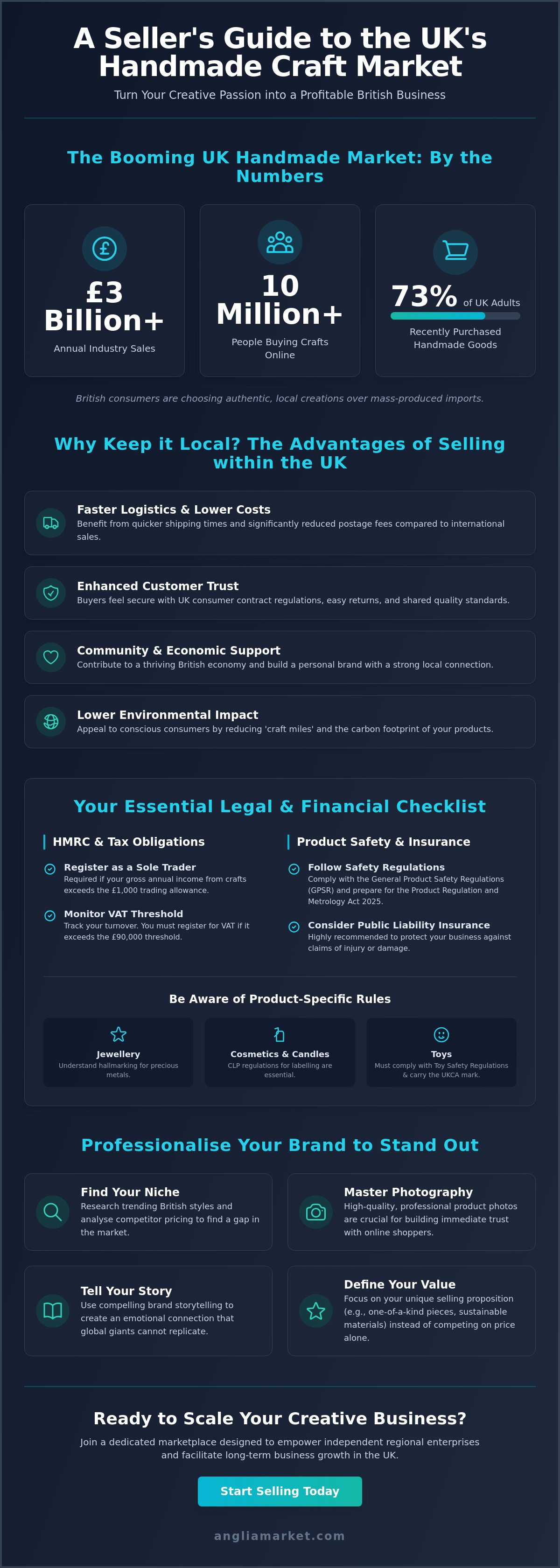
Did you know that over 10 million people in Britain now buy their gifts and home decor through independent digital storefronts? With 73% of UK adults purchasing handmade goods recently, the market for selling handmade crafts online uk has never been more lucrative. It's an industry worth over £3 billion, and there is plenty of room for your unique creations to shine.
It's exciting to think about turning your passion into a paycheck. However, the technical side often feels overwhelming. You're likely worried about the Product Regulation and Metrology Act 2025 or how to manage the £90,000 VAT threshold without a headache. Shipping logistics and platform fees can also make the dream feel like a chore if you don't have a plan.
This guide provides the clear roadmap you need. You'll learn how to build a profitable British business that follows every legal rule whilst keeping your overheads low. We'll compare the top marketplaces for 2026, explain the latest HMRC requirements, and show you how to master local logistics for a sustainable primary or secondary income.
Key Takeaways
- Identify why British consumers are prioritising local artisans over mass-produced imports and how to position your brand to meet this growing demand.
- Navigate the essential legal requirements for selling handmade crafts online uk, including HMRC registration and the latest product safety standards.
- Compare the fee structures of global marketplaces versus niche British platforms to ensure your retail prices remain both competitive and profitable.
- Professionalise your creative hobby with high-quality product photography and brand storytelling that builds immediate trust with UK shoppers.
- Scale your operations by joining a dedicated marketplace designed to empower independent regional enterprises and facilitate long-term business growth.
The Landscape of Selling Handmade Crafts Online in the UK
The UK's handmade sector is a commercial powerhouse. By June 2026, annual sales in this industry have exceeded £3 billion, proving that creative hobbies can become serious business. Over 10 million people in the UK now shop for crafts through digital storefronts. This figure has tripled over the last decade. British consumers are moving away from mass-produced imports. They want products with a story, authentic origins, and clear quality standards. Whilst the history of handicraft is rooted in traditional skills, modern buyers use high-tech platforms to find these unique items.
Sustainability is a primary driver of this growth. Shoppers are increasingly conscious of "craft miles" and the carbon footprint of their purchases. They prefer supporting local artisans to reduce the environmental impact of long-distance shipping. If you're interested in selling handmade crafts online uk, you'll find that eco-friendly credentials are a major selling point. Popular categories currently dominating the market include home and garden accessories, handmade jewellery, and eco-friendly beauty products like organic soaps or reusable skincare pads.
Why Sell Locally Within the UK?
Selling to a domestic audience offers significant logistical advantages. Shipping times are faster, and costs are much lower than international postage. This efficiency leads to higher customer satisfaction and better reviews. Trust is also a major factor. British buyers feel more secure when they're protected by UK consumer contract regulations. They appreciate the ease of returns and the shared standards of quality. Supporting independent UK enterprises creates an emotional connection that global giants can't replicate. It's about community and keeping the British economy thriving whilst building a personal brand.
Identifying Your Niche in a Saturated Market
Success requires more than just making beautiful things. You need to find a gap in the market. Start by researching trending British styles for 2026. Look for specific colours or materials that are gaining traction on social media. Analyse competitor pricing on various UK marketplaces to see where your products fit. Don't try to compete on price alone. Focus on your unique value proposition. You might offer "one-of-a-kind" pieces that collectors love, or you can develop repeatable product lines that provide a steady, sustainable income. If you're ready to start, you can sell online through platforms that specialise in supporting independent regional vendors.
Essential Legal Requirements for UK Craft Sellers
Compliance isn't just for large corporations. Even if you consider your work a hobby, you must follow British consumer laws. The UK creative industry statistics show that small-scale makers form the backbone of the sector. However, this independence comes with responsibilities. You need a solid legal foundation to protect both your business and your customers. The landscape for selling handmade crafts online uk is competitive. Legal compliance is a key differentiator that builds buyer confidence.
Registration is your first step. You must register as a sole trader with HMRC if your gross annual income from self-employment exceeds the £1,000 trading allowance for the 2026/27 tax year. This applies regardless of whether you're selling handmade crafts online uk as a side hustle or a full-time venture. Once you hit this threshold, you're officially a business. You should also track your turnover against the VAT registration threshold, which is currently £90,000. Staying on top of these figures prevents unexpected tax bills later.
Safety is non-negotiable. The General Product Safety Regulations (GPSR) require all products to be safe for consumer use. The UK is also reforming its framework with the Product Regulation and Metrology Act 2025. This may require you to display more safety information on your listings. You should also consider Public Liability Insurance. This protects you if a customer claims your product caused injury or damage. It's often a requirement for physical craft fairs, but it's equally vital for online sellers.
Product-Specific Regulations You Cannot Ignore
Different crafts have unique rules. Jewellery makers must understand hallmarking requirements for silver, gold, and platinum. For those selling candles or cosmetics, CLP (Classification, Labelling and Packaging) regulations are essential. You'll need safety assessments to ensure ingredients are legal. If you make toys, you must comply with the Toy Safety Regulations 2011. This involves rigorous testing and the UKCA mark. Skipping these steps can lead to fines or your shop being closed.
The Legal Side of Online Transactions
Online sales are governed by the Consumer Rights Act. This gives customers a 14-day cancellation period for most items. You must provide clear descriptions and transparent pricing to avoid "misleading descriptions" under trading standards. Data protection is another priority. Your shop must be GDPR compliant to handle UK customer information safely. Ensuring these details are correct helps you build a trustworthy brand. If you're looking for a platform that understands these local needs, you can sell online with a marketplace focused on British standards.
Choosing the Best Platform to Sell Your Crafts
Selecting where to host your shop is a commercial decision that directly impacts your profit margins. The right platform does more than just list items; it provides the tools to manage inventory, process payments, and reach the right audience. Whilst massive global platforms offer significant traffic, many British makers find that high competition and complex fee structures eat into their earnings. Success in selling handmade crafts online uk often depends on finding a balance between visibility and cost-effectiveness.
Global Platforms vs. Niche UK Marketplaces vs. Anglia Market
Large global marketplaces provide access to millions of active buyers worldwide. They offer huge reach but come with intense competition and multi-layered fee systems. UK sellers often face transaction fees, regulatory operating fees, and payment processing costs that can make it difficult for small-scale artisans to maintain healthy margins. Additionally, your products can easily get lost amongst millions of mass-produced listings that don't share your commitment to quality.
Folksy is a dedicated UK alternative that focuses strictly on the "Modern British Craft" aesthetic. It charges a 6% commission plus VAT, which is lower than many global competitors. However, its strict definition of what constitutes a "craft" can be limiting if your business expands into broader lifestyle categories. It's a strong community-focused choice but lacks the category breadth required for diverse inventory.
Anglia Market provides a middle ground by supporting independent UK enterprises across a vast range of product types. Unlike niche craft sites, it allows you to scale your business into diverse categories such as furniture and home and garden. This versatility is ideal for makers who produce larger items or those who want to reach a broader customer base without the saturated competition of global sites.
What to Look for in a Marketplace Vendor Account
A functional vendor account should act as a silent partner in your business. When comparing options for selling handmade crafts online uk, look for these essential features:
- Ease of use: You should be able to organise your storefront and upload new inventory quickly. Avoid platforms that require complex technical skills.
- Marketing tools: Check if the platform allows you to run promotions or set up seasonal sales to drive traffic.
- UK-based support: Ensure you can access reliable help if a delivery goes missing or a payment fails. Local support teams understand the specific challenges of the British logistics network.
- Transparent fees: Choose a platform that clearly outlines its commission and processing costs so you can price your products accurately.
Your platform choice should align with the growth goals you've set for your brand. Prioritise marketplaces that value regional commerce and provide the practical tools needed for professional expansion.
Professionalising Your Craft Brand for Growth
The label "handmade" should indicate quality and care, not amateurish execution. In the busy market for selling handmade crafts online uk, your brand presentation must match the standard of your products. Customers equate professional visuals with reliable service. If your storefront looks cluttered or your photos are blurry, shoppers will likely move to a competitor. Building a professional brand is about creating a consistent experience that justifies your price point. Every touchpoint, from your logo to your social media presence, should feel intentional.
High-quality product photography is your most powerful sales tool. UK consumers cannot touch or feel your items before purchasing, so your images must do the work. Use a clean, neutral background and take advantage of natural light. Include shots from multiple angles and a "lifestyle" photo that shows the item in use. This transparency reduces the likelihood of returns and builds immediate trust. Alongside visuals, integrate customer testimonials. Positive feedback from other British shoppers acts as social proof, reassuring new visitors that your business is legitimate and efficient.
When you focus on selling handmade crafts online uk, social media is your primary engine for traffic. Platforms like Instagram and Pinterest are visual-heavy and perfect for showcasing the making process. Don't just post the finished product. Share "behind the scenes" clips to humanise your brand. Link these posts directly to your marketplace storefront to make the journey from discovery to purchase as short as possible.
Building Customer Loyalty
Repeat business is the secret to a sustainable income. It's significantly cheaper to retain an existing customer than to find a new one. Implementing a loyalty programme is an effective way to reward repeat custom and keep your brand at the top of a buyer's mind. You can also use seasonal sales to clear out old inventory and attract bargain-hunters who might become long-term fans.
The "unboxing experience" is another vital touchpoint. Your packaging should reflect your brand values, whether that's through eco-friendly materials or a simple, handwritten thank-you note. This attention to detail encourages customers to share their purchases on social media, providing you with free marketing.
Effective Product Descriptions
Write your descriptions for humans first. Whilst SEO is important, a robotic list of keywords won't sell a product. Use natural British English and focus on the story of the item. Explain why it was made and what makes it special. However, don't forget the practicalities. Be clear about dimensions, weights, and materials. Addressing common questions upfront, such as durability or care instructions, removes barriers to purchase. If you're ready to scale your creative business, apply to become a vendor today and start reaching a wider British audience.
Scaling Your Creative Business with Anglia Market
Scaling a business requires more robust tools than a simple social media page or a personal blog. Anglia Market facilitates the transition from a casual hobbyist to a professional vendor by providing a commercial framework. By joining a platform that supports independent UK enterprises, you gain access to a dedicated infrastructure designed for long-term growth. You can streamline your entire sales process through a centralised dashboard that tracks orders, payments, and shipping status in one place. This efficiency is vital as you grow. It allows you to focus on creating whilst the platform handles the technical heavy lifting. Leveraging existing marketplace traffic is essential for selling handmade crafts online uk. With over 10 million people in the UK now buying crafts online, a marketplace provides the visibility needed to reach customers far beyond your immediate social circle.
Setting Up Your Shop for Success
Setting up your shop correctly from day one prevents future headaches. Start by selling online with your own dedicated storefront that reflects your brand identity. Organisation is vital for a professional appearance and a positive user experience. You should place your products into clear, searchable categories so buyers can find what they need in seconds. For example, artisans making wooden spoons or linen napkins should use kitchen and dining. Those creating educational puzzles or knitted dolls should select toys and games. Don't forget to optimise your vendor profile with a high-quality headshot and a clear mission statement. This is where you showcase your unique story and British provenance to build a personal connection with your audience.
Taking the Next Step
As your sales volume increases, your operational model must evolve to stay profitable. Many sellers move from "making to order" to holding small batches of inventory for their most popular lines. This shift significantly reduces lead times and improves customer satisfaction ratings. Use your shop analytics regularly to identify your "hero" items. These are the products that consistently drive the most revenue and traffic. Once you have delivered your first few orders, proactively invite your customers to leave testimonials. Positive reviews are a key factor in selling handmade crafts online uk successfully. They provide the social proof required to convert hesitant browsers into confident buyers. Taking these steps moves your creative passion from a simple hobby into a sustainable British business.
Build Your British Brand for 2026
Transitioning from a creative hobby to a commercial business is a significant milestone. Success in selling handmade crafts online uk requires more than just artistic talent. It demands a clear understanding of legal requirements like the £1,000 trading allowance and a commitment to professional branding. By choosing a platform that prioritises regional independent commerce, you can navigate these challenges with confidence. You've already learned how to niche down and professionalise your presentation. Now it's time to put that knowledge into practice.
We're dedicated to supporting small UK businesses through every stage of their growth. Our platform provides a dedicated vendor support centre to resolve delivery or payment issues quickly. You also get access to integrated loyalty and promotion tools to keep your customers coming back. The British handmade market is thriving, and your unique products deserve a professional home. Take the next step to secure your sustainable secondary or primary income. You have the skills and the roadmap. Start your journey as an Anglia Market vendor today and see your creative vision flourish.
Frequently Asked Questions
Do I need a licence to sell handmade crafts in the UK?
Most online crafters don't require a specific licence to trade. However, you should check with your local council if you're running a business from home to ensure you aren't breaching planning or tenancy agreements. If you plan to sell at physical markets, you may need a temporary street trading licence. Always verify if your specific product category, such as food or alcohol, requires additional permits from your local authority.
How much does it cost to start selling crafts online?
Starting costs are generally low but vary depending on your craft and chosen platform. You'll need to budget for raw materials, packaging, and basic tools. Platform fees often include a small listing charge or a percentage of each sale. Don't forget the cost of Public Liability Insurance and any required safety testing. Many successful makers start with a small inventory and reinvest their initial profits to scale the business gradually.
What are the rules for selling handmade candles in the UK?
Candle sellers must comply with strict Classification, Labelling and Packaging (CLP) regulations. Your products must feature a permanent label that includes safety pictograms, allergen information, and your business contact details. You're also responsible for ensuring your candles are safe through rigorous fire safety testing. Failure to provide correct CLP labelling can lead to your insurance being invalidated or legal action from trading standards officers.
Do I have to pay tax on my craft sales if it is just a hobby?
You only pay tax if your total gross trading income exceeds the £1,000 tax-free trading allowance for the tax year. If you earn less than this, you don't need to report it to HMRC. Once you cross this threshold, you must register as a sole trader and file a Self Assessment tax return. It's essential to keep accurate records of your sales and expenses from day one to simplify your tax filing.
Is it better to sell on a marketplace or my own website in the UK?
Marketplaces are generally the most efficient starting point for new vendors because they provide immediate visibility and trust. When selling handmade crafts online uk, platforms handle the technical infrastructure and payment processing for you. However, a personal website offers better profit margins and brand control. Many professionals use a hybrid model, using marketplaces for discovery whilst driving repeat customers to their own site for higher profitability.
What insurance do I need to sell handmade items at craft fairs and online?
Public Liability Insurance is the most important cover for any crafter. It protects you if a member of the public is injured or their property is damaged because of your business activities. You should also ensure your policy includes Product Liability Insurance. This covers claims related to injuries or damage caused by the actual items you've made. Most organisers require proof of insurance before allowing you to trade at physical events.
How do I handle returns for personalised handmade items?
Personalised or custom-made items are usually exempt from the standard 14-day right to cancel under UK consumer law. You don't have to accept returns if a customer simply changes their mind about a bespoke product. However, you must still offer a refund or replacement if the item is faulty or not as described. Clearly state your returns policy on your storefront to avoid confusion and protect your business from unnecessary losses.
What is the UKCA mark and does my craft need it?
The UKCA mark is a mandatory product marking used for certain goods sold in Great Britain. It proves that products like toys, electronics, and personal protective equipment meet specific safety standards. If you're selling handmade crafts online uk in these categories, you're legally required to self-certify or seek third-party testing. Always check the latest government guidance to see if your specific craft falls under these regulations to ensure your shop remains fully compliant.

Here to help ask anything
If you have any questions regarding this disclaimer or any of our policies, please contact Anglia Market through the contact page on our website, by email using the address provided on the site, or by phone at 0333 772 2593