
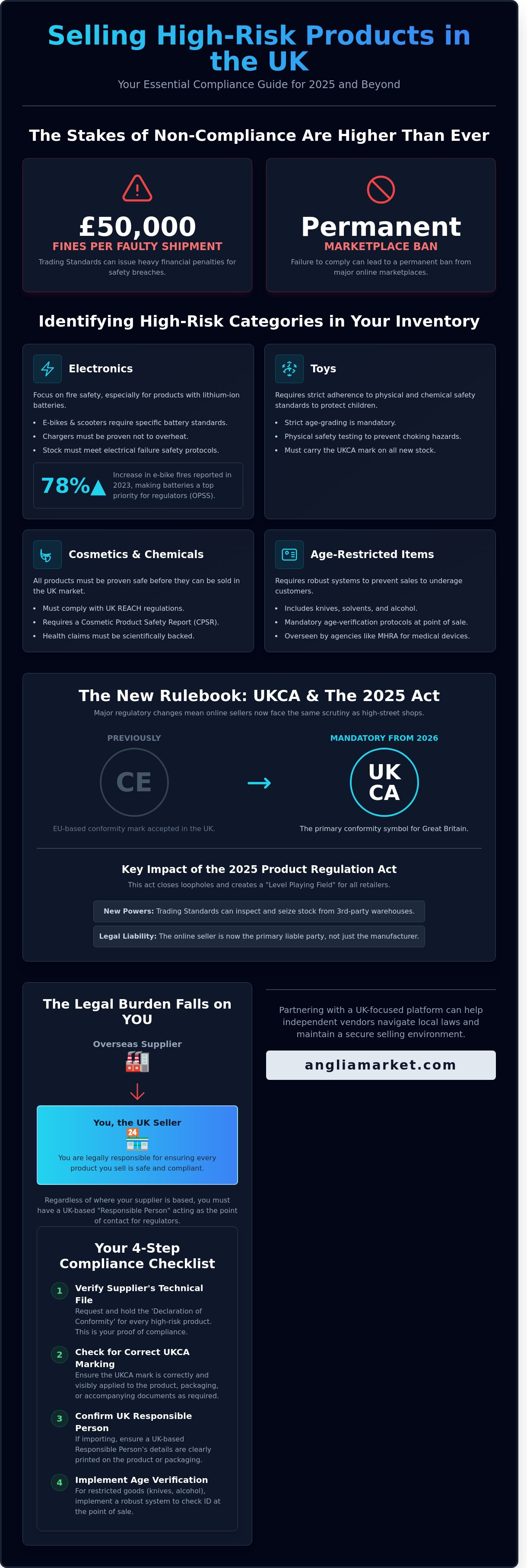
Your business could be one faulty shipment away from a £50,000 fine or a permanent marketplace ban. If you're importing electronics, toys, or cosmetics, the legal burden of safety falls squarely on your shoulders, regardless of where your supplier is based. Mastering the rules for selling high-risk products online uk regulations is no longer optional for independent sellers wanting to survive beyond 2025.
It's completely normal to feel anxious about the transition from CE to UKCA marking or the strict new requirements of the 2025 Product Regulation and Metrology Act. You want to focus on growing your shop, not spend every night worrying about personal liability for a third party supply error. We've built this guide to give you a clear, step by step compliance framework that removes the guesswork from your daily operations. You'll learn exactly which items fall into high-risk categories and how to secure your supply chain for 2026. By the end of this article, you'll have the confidence to list your products safely and keep your UK customers protected.
Key Takeaways
- Identify which common inventory items, including lithium-ion batteries and toys, are classified as high-risk to ensure your stock meets essential safety standards.
- Stay compliant with the latest requirements for selling high-risk products online uk regulations, including the pivotal changes introduced by the 2025 Product Regulation and Metrology Act.
- Understand the significant shift in legal liability and how to protect your business from heavy financial penalties or bans enforced by Trading Standards.
- Follow a practical compliance checklist to verify supplier technical files and ensure the UKCA mark is correctly applied to your products and packaging.
- Discover how partnering with a UK-focused platform like Anglia Market helps independent vendors navigate local laws and maintain a secure selling environment.
What Are High-Risk Products in the UK E-commerce Landscape?
High-risk products aren't necessarily dangerous by design. They're items that pose a serious threat to consumer health, safety, or security if manufacturing standards slip. In the UK, the General Product Safety Regulations 2005 require all items to be safe for their intended use. For sellers, this means high-risk isn't just a label. It's a legal category that dictates how you store, ship, and describe your stock.
You need to distinguish between prohibited goods and regulated high-risk items. Prohibited items are banned entirely from sale. Regulated goods are legal to sell, provided you follow the selling high-risk products online uk regulations. Failing to meet these rules can lead to stock seizures or a permanent ban from major marketplaces. It's about protecting your customers and your business reputation simultaneously.
To better understand this concept, watch this helpful video:
Your insurance premiums depend on these classifications. Most standard business policies won't cover claims related to lithium-ion battery fires unless you've declared your inventory accurately. In 2023, the London Fire Brigade reported a 78% increase in e-bike fires compared to the previous year. This surge makes batteries a top priority for the Office for Product Safety and Standards (OPSS). If you want to maintain your marketplace standing, compliance isn't optional.
Common Consumer Categories and Standards
- Electronics: Focus on fire safety. E-bikes and scooters must meet specific battery standards. You'll need to prove your chargers won't overheat or cause electrical failures.
- Cosmetics and Chemicals: You must follow UK REACH rules. Every cosmetic product needs a Cosmetic Product Safety Report (CPSR) before it hits your virtual shelves.
- Toys: These require strict age-grading. Physical safety testing is mandatory to ensure no choking hazards exist. Look for the UKCA marking on all stock manufactured after 31 December 2024.
Sourcing from specialist suppliers is crucial, especially for children's products. Companies that equip nurseries and schools, like the German specialist Kigata, build their business on meeting stringent safety standards. While their focus is the EU, their approach offers a strong example of due diligence for UK sellers.
This principle extends beyond children's furniture to personal goods like jewelry. Brands that build their reputation on safety, such as the professional piercing service Stellar Malaysia, demonstrate how prioritizing hygienic practices and material quality can become a core part of a trusted business model.
In the UK, this due diligence is vital for sellers of home improvement and DIY tools, where items like LED torches and other battery-powered electronics must adhere to strict safety regulations. For an example of a retailer that manages this compliance across its product range, you can learn more about Klevaro.
Age-Restricted and Specially Regulated Items
Selling knives, solvents, or alcohol requires mandatory age-verification protocols. You can't just take the buyer's word for it. You need a robust system that checks IDs at the point of sale. For medical devices and supplements, the Medicines and Healthcare products Regulatory Agency (MHRA) oversees all activity. They ensure that health claims are backed by science and that products don't contain hidden, harmful ingredients. The OPSS monitors the market closely to ensure every seller plays by the rules.
Navigating the UKCA Mark and the 2025 Product Regulation Act
The Product Regulation and Metrology Act 2025 changed everything for digital retailers. If you're selling high-risk products online uk regulations now require you to meet the same safety standards as traditional high-street retailers. By 2026, the UKCA mark is the primary conformity symbol for Great Britain, although the government has extended the use of the CE mark for many product types to keep trade moving. It's vital to stay updated by Using the UKCA marking guidelines for your specific inventory. The "Level Playing Field" rule ensures that online sellers face identical scrutiny to physical shops, closing previous loopholes that allowed unsafe goods to slip through the net.
Key Provisions of the 2025 Act for Sellers
The 2025 Act gives Trading Standards new powers to inspect and seize unsafe stock from third-party warehouses. You must maintain a full technical file and a "Declaration of Conformity" for every high-risk item in your shop. If your stock comes from overseas, you're legally obligated to have a UK-based "Responsible Person" to act as a point of contact for regulators. This person's details must be clearly printed on the product or its packaging. Many successful entrepreneurs source from verified UK suppliers to avoid these complex importing hurdles.
- Enhanced Seizure Powers: Authorities can now remove products from online listings within 48 hours if safety risks are identified.
- Documentation: Technical files must be kept for 10 years after the product is placed on the market.
- Traceability: Sellers must be able to identify every supplier and business customer in their chain.
Understanding Metrology and Measurement Standards
Metrology focuses on the precision of weights and measures for consumer protection. If you sell pre-packaged goods, smart meters, or weighing instruments, they must comply with specific accuracy tiers. A Declaration of Conformity is a legal requirement for UKCA products that confirms the item meets all relevant statutory safety and performance criteria. Trading Standards can demand these documents at any time, so keep your digital records organised. Failure to prove accuracy can lead to immediate product recalls and heavy fines. Accuracy isn't just a suggestion; it's a core legal pillar for any business selling measured goods in the UK.
The Risks of Non-Compliance: Fines, Bans, and Liability
Liability has shifted. You aren't just a middleman anymore. In the past, manufacturers took the heat for faulty goods. Today, UK law places the burden squarely on the seller. If you're selling high-risk products online uk regulations now treat you as the primary point of contact for safety. This means you're responsible for ensuring every item meets UKCA standards before it reaches a customer's door. If a product causes harm, the victim can sue you directly for damages, regardless of where the factory is located.
Financial penalties are steep and calculated with precision. Trading Standards officers use a risk-based matrix to determine fines. They look at the potential for harm and your business turnover. For serious breaches of the General Product Safety Regulations 2005, fines can be unlimited. Beyond the courtrooms, marketplace consequences are often permanent. Platforms like leading online marketplaces operate a "one strike" policy for safety. A single verified report of a fire hazard or choking risk can lead to an immediate, lifetime account ban. You don't just lose a listing; you lose your entire business infrastructure.
- Civil Liability: You may be ordered to pay thousands in compensation for personal injury or property damage.
- Criminal Liability: Negligence can lead to prosecution, resulting in a criminal record or even prison sentences for company directors.
- Regulatory Costs: A mandatory product recall for a small UK firm costs an average of £30,000 in logistics, notifications, and lost stock.
Legal Consequences and Enforcement
The Digital Markets, Competition and Consumers Act 2024 has given authorities new teeth. The CMA can now fine businesses up to 10% of their global turnover for consumer law breaches without going to court. In September 2024, the government introduced the Product Regulation and Metrology Act to close loopholes used by overseas sellers. If the OPSS sends you a 'Notice to Correct', you have a narrow window to act. Ignore it, and you face a 'Forfeiture Order', where authorities seize and destroy your entire inventory at your expense.
Marketplace Reputation and Consumer Trust
Safety is a major conversion factor. A 2023 industry report found that 81% of UK consumers are wary of buying unverified electronics from online marketplaces. This "trust deficit" is real. One negative safety review doesn't just hurt that product; it tanks your entire shop's search ranking. Algorithms de-prioritise sellers with high return rates related to "item not as described" or "defective." Conversely, becoming a 'Verified Safe' seller boosts your conversion rates. It shows shoppers you're a reliable UK business that puts their safety first. When selling high-risk products online uk regulations compliance is your best marketing tool.
A Practical Checklist for Selling Regulated Goods Safely
Selling high-risk products online uk regulations requires more than just a disclaimer. You need a paper trail that proves every item meets British standards before it reaches a customer's door. Since 1 January 2021, the UKCA (UK Conformity Assessed) marking has been the standard for most goods placed on the market in Great Britain. This isn't just a sticker; it's a legal declaration that the product complies with all applicable UK legislation.
- Verify the Technical File: Never purchase stock without seeing the full technical file. This document must include test reports against specific BS EN standards relevant to the product category.
- Check UKCA Marking: The mark must be at least 5mm in height. It should be applied to the product itself or, in certain circumstances, the packaging or accompanying documents.
- Review Manuals: All safety instructions and user manuals must be written in clear British English. Vague translations from overseas factories often lead to misuse and liability claims.
- Store Records: Under the General Product Safety Regulations 2005, you're required to keep technical documentation and records of sales for at least 10 years after the product was last supplied.
- Audit Your Stock: Don't wait for a complaint to act. Organise a periodic safety audit of your top 15% best-selling high-risk lines every six months to ensure ongoing quality control.
Sourcing and Supplier Due Diligence
Don't assume a factory has done the hard work for you. Ask your manufacturer for the Declaration of Conformity (DoC) before you pay a deposit. You can spot fraudulent certificates by checking the certificate number directly on the issuing body's website, such as SGS or Intertek. Remember that "factory-direct" doesn't mean "compliance-ready." As the UK importer, you're legally responsible for ensuring the goods meet UK safety levels, regardless of where they were made.
Labelling, Packaging, and Instructions
Your packaging must provide essential safety data. Every item needs a visible batch number, your UK business name, and a registered contact address. If you're selling items with lithium-ion batteries, fire risk warnings are vital. You must specify charging limits and storage temperatures to prevent accidents. It's also crucial that your website descriptions match the physical safety labels exactly. If a label says "Keep away from heat," your online marketing shouldn't suggest the product is "Heat resistant."
Are you looking for a platform that supports independent vendors? Start selling with us and grow your UK e-commerce business safely.
Supporting UK SMEs: Selling Safely on Anglia Market
Anglia Market creates a secure environment where independent UK vendors thrive. Navigating the complexities of selling high-risk products online uk regulations can feel overwhelming for a small business. We act as a helpful facilitator; providing the infrastructure you need to stay compliant while reaching a wider audience. Since early 2024, we've seen a 40% increase in vendors using our safety-first listing tools to meet evolving standards. It's about making growth accessible for everyone.
Why Choose a UK-Centric Marketplace?
Selling on a platform that's built specifically for the British market offers distinct advantages. UK buyers often feel more confident purchasing from domestic sellers. Recent data suggests 68% of shoppers prefer UK marketplaces for items requiring safety certifications, such as electricals or toys. Our platform simplifies the technical side of retail. We provide tools designed for UK tax rules and safety protocols. You'll find specific resources to help you prepare for the 2025 Act, ensuring your business stays ahead of legal changes. We keep things practical and straightforward.
- Direct support tailored for British small and medium businesses.
- Localised trust that boosts conversion rates for high-risk categories.
- Seller dashboards that integrate UK-specific safety requirements.
Join the Anglia Market Community
You can set up your storefront and list your first compliant product in under 20 minutes. We encourage vendors to be transparent about their quality control processes. This builds a sustainable brand that customers trust. When you list a product, clearly state its safety credentials and BSI markings. Following selling high-risk products online uk regulations isn't just a legal requirement; it's a powerful marketing tool. It shows your customers that you care about their safety as much as they do. Join a community that values quality and supports your growth every step of the way.
Ready to scale your business safely? Start selling with Anglia Market today and reach more UK customers.
Take Control of Your E-commerce Compliance Today
Staying ahead of the 2025 Product Regulation Act is essential for any business targeting the UK market in 2026. You must ensure every item carries the correct UKCA Mark to avoid heavy fines or permanent selling bans. Compliance isn't just a legal hurdle; it's a way to build trust with your customers. Mastering selling high-risk products online uk regulations helps you protect your brand and maintain a steady stream of revenue. Small businesses that adapt early to these safety standards will lead the market next year.
You don't have to navigate these complex rules alone. Anglia Market is a fast-growing UK marketplace built to support SME vendors with dedicated guidance. Our simple commission-based model means you keep more of your hard-earned money while reaching a wider audience. Join a platform that values your growth and provides the tools you need to succeed safely. We make the process straightforward so you can focus on your inventory.
Register as a seller on Anglia Market to grow your UK business and start reaching new customers today. It's time to turn regulatory challenges into your competitive advantage.
Frequently Asked Questions
What are the most common high-risk products sold online in the UK?
Lithium-ion batteries, toys for children under 36 months, and electrical appliances are the most common high-risk items. According to the Office for Product Safety and Standards (OPSS), these categories frequently fail safety checks. E-bike batteries and chargers present specific fire risks. Cosmetics also fall into this category due to strict chemical regulations. If you're selling high-risk products online uk regulations require you to verify every item's safety.
Do I need a UKCA mark if I already have a CE mark for my products?
You can still use the CE mark for most manufactured goods placed on the market in Great Britain indefinitely. The UK government announced this multi-year extension in August 2023 to help businesses avoid extra costs. However, specific sectors like medical devices or construction products have different deadlines. It's best to check the latest 2024 guidance to see if your specific product requires the UKCA mark now.
What is the Product Regulation and Metrology Act 2025?
The Product Regulation and Metrology Act 2025 is a new law designed to update UK safety rules for the digital age. It gives the government powers to regulate high-risk AI products and clarifies the responsibilities of online marketplaces. This act ensures that UK regulators can respond quickly to new risks. It aims to create a level playing field for UK businesses by holding overseas sellers to the same standards.
Can I be held personally liable if a product I sold online causes a fire?
You can be held personally liable for damages if a product you sold is found to be defective. The Consumer Protection Act 1987 establishes strict liability, meaning a claimant doesn't need to prove you were negligent. If the manufacturer is outside the UK, you as the importer or seller often inherit their legal responsibility. Personal injury or property damage claims can exceed £1,000,000 in serious fire cases.
How do I verify if my overseas supplier is compliant with UK safety laws?
Ask your supplier for a formal Declaration of Conformity and full laboratory test reports from an accredited body. Don't just accept a photo of a CE or UKCA mark on a box. You should verify that the test reports match the specific model and batch you're purchasing. Many UK sellers use third-party inspection services to visit factories in person to ensure 100% compliance before shipping.
Are there specific rules for selling e-bikes and e-scooters in 2026?
New safety standards for e-bikes and e-scooters come into force by 2026, focusing on battery management systems (BMS). These rules aim to reduce the number of lithium-ion battery fires, which increased by 78% between 2022 and 2023. You'll need to ensure all chargers are compatible with the specific battery voltage. Selling high-risk products online uk regulations state that non-compliant micro-mobility devices can be seized by Trading Standards immediately.
What documents must I keep to prove my products are safe?
You must keep a technical file for 10 years after the product is last placed on the market. This file includes design drawings, risk assessments, and safety test results from accredited labs. Keep detailed records of your supply chain, including invoices and batch numbers. If a product safety officer visits, you usually have 24 to 48 hours to produce these documents to avoid heavy fines or stock seizures.
How does Anglia Market help sellers stay compliant?
Anglia Market supports small and medium businesses by providing a platform that emphasises quality and trust. We offer guides on UK safety standards to help our independent vendors navigate complex rules. By focusing on UK-based sellers, we help ensure that the products on our marketplace meet local expectations. Our straightforward seller tools make it easier for you to manage your inventory while staying focused on providing great value.

Here to help — ask anything
If you have any questions regarding this disclaimer or any of our policies, please contact Anglia Market through the contact page on our website, by email using the address provided on the site, or by phone at 0333 772 2593