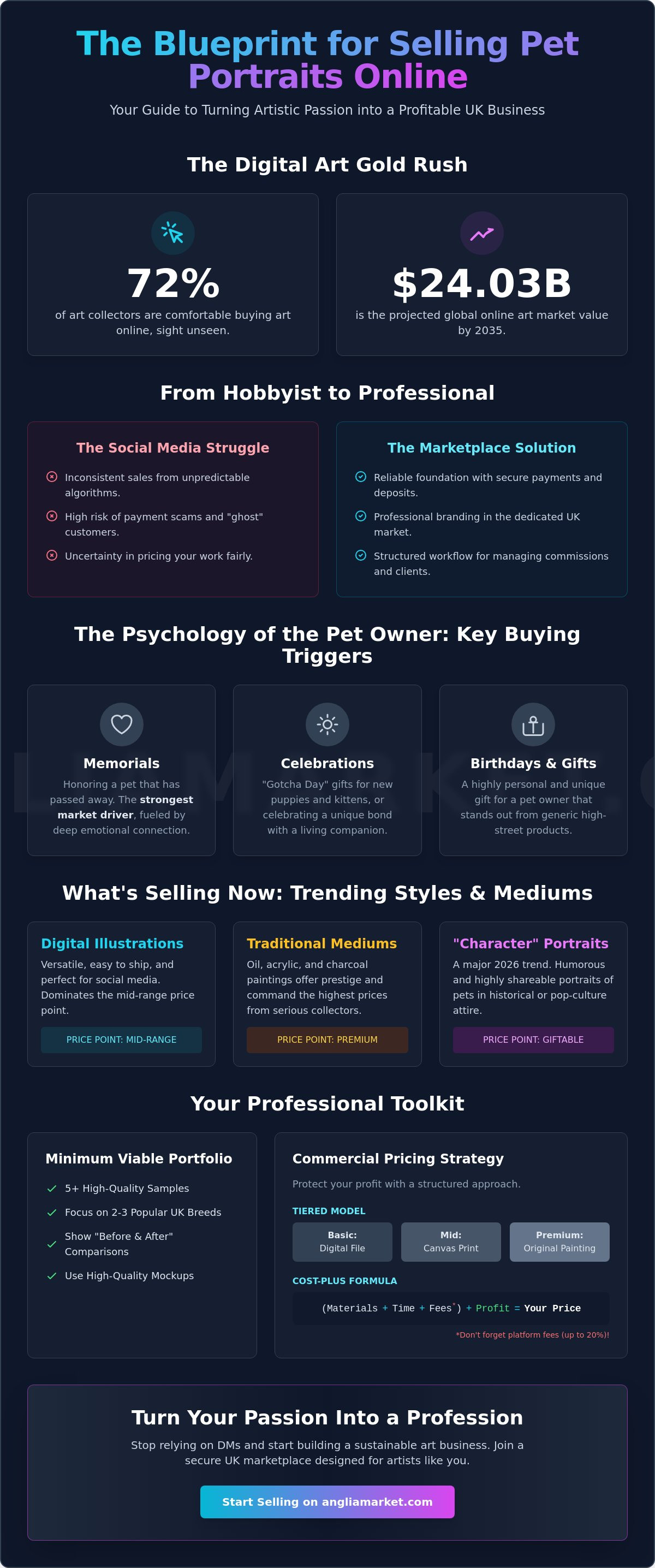
72% of art collectors are now comfortable buying art online without ever seeing it in person. With the global online art market projected to reach $24.03 billion by 2035, the opportunity for selling pet portraits and commissions online is expanding fast. More buyers. More platforms. More potential for your studio.
You likely know the struggle of inconsistent social media sales. It's stressful to deal with the fear of being scammed by "customers" or the uncertainty of pricing your work fairly. You want a professional system for deposits and a recognizable brand presence in the UK market. Talent is the start, but commercial structure is what keeps you profitable.
This guide helps you master the business of pet art. We'll cover 2026 platform fees, UK tax regulations, and professional commission management. You'll learn how to secure your payments, protect your copyright, and build a reliable stream of inquiries. Let's turn your artistic skill into a sustainable, professional operation.
Key Takeaways
- Identify high-growth niches like memorial art and digital illustrations to align your work with 2026 market demand.
- Establish a commercial pricing strategy that covers materials, UK logistics, and your time fairly.
- Discover why secure UK marketplaces provide a more reliable foundation for selling pet portraits and commissions online than social media algorithms.
- Professionalise your workflow with standardised inquiry filters and clear terms for revisions and lead times.
- Build a recognisable brand using strategic social proof and loyalty incentives for repeat customers.
Understanding the Demand for Custom Pet Art in 2026
The UK pet industry is currently seeing a massive shift driven by "pet humanisation." Pets are no longer just animals. They're considered full family members. This cultural change means owners are increasingly willing to invest in premium, personalised items. In 2026, custom art has become a top-tier choice for these shoppers. While the history of animal portraiture is centuries old, modern technology and marketplaces have made these once-exclusive items accessible to everyone.
Custom commissions are surprisingly recession-resistant. When consumers cut back on generic luxury goods, they often still spend on high-value, emotional gifts. A bespoke portrait is a unique item that won't be found on a high street shelf. This makes selling pet portraits and commissions online a viable business model for artists who can tap into specific niches. High-demand categories right now include memorial portraits, hyper-realistic digital illustrations, and traditional oil paintings that offer a sense of prestige.
Success in this market requires moving beyond "hobbyist" posting. Simply uploading a photo to social media and hoping for a direct message isn't a strategy. Professionals use structured platforms to manage their workflow and secure their income. If you want to scale, you need a dedicated space to sell online. This separates you from the casual posters and builds immediate trust with serious buyers who want transactional security.
The Psychology of the Pet Owner
People don't just buy a painting; they buy a memory or a tribute. The emotional driver is usually a desire to celebrate a bond. You'll find that key buying triggers often revolve around specific life events:
- Memorials: Honouring a pet that has passed away is the strongest market driver.
- New Pet Celebrations: "Gotcha day" gifts for new puppy or kitten owners.
- Birthdays: Personalised gifts for the owner or the pet itself.
Empathy is your most important tool. When you communicate with clients, acknowledge the story behind the pet. Acknowledging their loss or excitement makes the transaction feel personal rather than just commercial.
Handling such deep emotional connections can be rewarding but also draining; for artists who need help navigating these interpersonal complexities, Citizen Coaching and Counselling offers therapeutic services to support your mental health and professional resilience.
Trending Styles and Mediums
Digital art is currently dominating the mid-range market because it's versatile and easy to ship. However, traditional mediums like charcoal, acrylic, or oil still command the highest price points for collectors. A major trend in 2026 is the "character" portrait. This involves painting pets in royal attire, military uniforms, or as film characters. It's humorous, giftable, and highly shareable on social media. To stand out, you must develop a signature style. Don't try to copy everyone else. Whether it's "micro-realism" or a loose, impressionistic watercolour style, consistency helps you become recognisable in a crowded marketplace.
Preparing Your Portfolio and Pricing Strategy
Consistency is your most valuable asset. When you're selling pet portraits and commissions online, your portfolio acts as a promise of quality. Avoid cluttering your storefront with every sketch you've ever done. Instead, select pieces that demonstrate a clear, repeatable style. High-quality mock-up images are essential here. By showing your artwork in a realistic UK home setting, you help the customer move from browsing to buying.
A tiered pricing model is the most effective way to capture a wide range of customer budgets. You can offer a basic digital file, a mid-range canvas print, and a premium hand-painted original. This structure ensures you don't alienate shoppers with smaller budgets while still being paid fairly for your most time-intensive work. If you're ready to professionalise your approach, you can join our community of marketplace vendors to manage your shop effectively.
Building a Minimum Viable Portfolio
If you're starting from scratch, you need at least five high-quality samples. Focus on 2-3 popular UK breeds like Cockapoos or Labradors to build immediate authority. This niche focus makes you look like an expert rather than a generalist. Always include before and after comparisons. Showing the original reference photo alongside the finished portrait proves your technical skill and justifies your professional rates.
The Mathematics of Professional Pricing
Your pricing must protect your profit. Start by setting an hourly rate based on your experience and UK living costs. You must also account for the commission fees charged by third-party platforms. Some marketplaces take a flat 20% of the total order value, while others use a combination of listing and transaction fees. If you don't build these into your base price, you'll find your margins disappearing quickly.
Cost-Plus pricing is a commercial strategy where you add a specific profit margin on top of the total cost of your materials, labour, and overheads. This ensures your business remains sustainable as you scale. Precision in your accounting is now a legal requirement under the 2026 tax updates for self-employed artists, so tracking every penny of your costs is essential for long-term success.
Where to Sell: Marketplaces vs. Social Media
Relying solely on social media reach is a commercial gamble. One update to a platform's code can hide your best work from thousands of followers overnight. This is the "Algorithm Trap." For new artists, it makes consistent growth nearly impossible because you don't own your audience. If you want a stable business selling pet portraits and commissions online, you need a platform built for commerce rather than just scrolling.
UK-based marketplaces provide built-in trust and secure payment handling. They offer a professional environment that social media DMs simply cannot match. When a customer sees a dedicated storefront, they feel confident that their money is safe. Marketplaces also handle the heavy lifting of SEO. Your listings appear in search results when buyers are actively looking for "custom dog art" or "pet memorial paintings." This creates a reliable stream of traffic without you needing to post every hour.
Integrating your sales channels into a cohesive "omnichannel" presence is the gold standard for 2026. This means using different platforms for what they do best. Discovery happens on social media, but the final transaction should happen in a secure, professional shop. This protects your brand and ensures your customers receive a formal receipt and tracking information.
Leveraging Multi-Vendor Platforms
Multi-vendor platforms are designed to help small UK businesses reach local buyers without the high costs of building a standalone website. The primary advantage is "Search Intent." People visit these sites specifically to buy physical goods. They aren't there to watch memes; they have a budget and a purpose. This makes the conversion rate much higher than any social media ad. You can start building your own professional presence by selling online with Anglia Market, which gives you the tools to manage orders efficiently.
The Role of Social Media in 2026
Treat social media as your awareness tool. It's the "top-of-funnel" where you show off your personality and process. In 2026, "Behind the Scenes" content is your most powerful asset. Short-form videos of a charcoal sketch coming to life or a time-lapse of an oil painting build massive social proof. These videos prove you are a real artist and not a filtered AI generator.
Don't use your profile as a checkout counter. Direct your followers to a secure marketplace listing to close the sale. This workflow filters out "tyre-kickers" who aren't serious about buying. It also ensures that every transaction for selling pet portraits and commissions online is recorded properly for your tax and accounting needs. Social media builds the relationship, but the marketplace secures the business.
The Professional Commission Workflow
Professionalism is defined by your boundaries. Many artists struggle because they treat selling pet portraits and commissions online like a casual hobby. This leads to wasted time and lost revenue. To scale, you need a repeatable system. This filters out "tyre-kickers" who ask endless questions but never commit to a purchase. Clear communication from the first email prevents scope creep and ensures you remain profitable.
Setting expectations is your best defence against difficult clients. You must be upfront about lead times, revision limits, and photo requirements. If you don't set these rules, the client will set them for you. If you're looking for a structured platform to manage your professional presence, you can register as a vendor today to access a commercial storefront and secure your transactions.
From Inquiry to Sketch
- Step 1: The Photo Audit. Reference quality is non-negotiable. If the client provides a blurry, low-light photo, the final art will suffer. Help them choose a high-resolution shot with clear lighting on the pet's eyes and fur to ensure an accurate likeness.
- Step 2: The Deposit. Never start work without a non-refundable deposit. This secures the customer's slot in your calendar and covers your initial time and materials. It's a standard business practice that protects your income from last-minute cancellations.
- Step 3: The Initial Mock-up. Send a rough composition or digital sketch for approval. It's much easier to adjust the layout now than after you've spent ten hours on fine details.
Finishing and Fulfillment
Managing the final stages of a commission requires a balance of artistic integrity and customer service. You should allow for one round of minor revisions to ensure the likeness is perfect. However, stay firm on major changes that contradict the approved mock-up. This protects your profit margin and keeps your schedule on track.
- Step 4: Final Approval. Send watermarked photos of the finished piece. This allows the client to see the final result while protecting your work from being used without final payment.
- Step 5: Secure Delivery. Packaging is part of your product experience. Use stiffened envelopes or heavy-duty tubes for UK shipping. Always use a tracked service so you can prove delivery and manage client expectations.
A "No-Refunds on Custom Work" policy is industry standard because bespoke items are tailored to a specific individual and cannot be resold to another buyer. Make sure this is clearly stated in your terms of service before the deposit is paid to avoid confusion later.
Scaling Your Art Business and Finding New Customers
Scaling isn't just about painting more. It's about working smarter. Once you've mastered the basics of selling pet portraits and commissions online, you need to focus on visibility and repeat business. Social proof is your strongest asset. A single positive review from a happy dog owner is worth more than a dozen self-promotional posts. Encourage every client to leave a detailed testimonial and share a photo of the art in their home.
Loyalty schemes are often overlooked by independent artists. If a customer has three cats, they shouldn't just buy one portrait. Offer a "multi-pet" discount or a loyalty reward for their second and third orders. This turns a one-off transaction into a long-term commercial relationship. You want your brand to be the first name they think of for every new addition to their family.
Marketing Beyond the Art
Your marketing should extend beyond the finished canvas. Encourage your clients to share "unboxing" videos on platforms like Instagram and Facebook. These videos provide authentic social proof and show potential buyers the care you put into your packaging. You can also boost your reach by using Anglia Market promotions. These featured slots help you stand out during high-traffic gift seasons like Christmas or Mother's Day when competition is highest.
Collaborating with local UK pet businesses is another effective strategy. Reach out to local groomers, dog walkers, or pet boutiques. Offer to display your business cards or a sample print in their shop in exchange for a small referral fee. This puts your work directly in front of your target audience in the physical world, building local trust that complements your online presence.
Expanding Your Product Range
Transitioning from one-off commissions to a product-based shop is the key to passive income. Not every customer can afford a bespoke oil painting, but many will buy a greeting card or a limited edition print. This allows you to monetise your existing designs without extra labour. Take a look at the pet supplies category to see what owners are currently purchasing. This data helps you decide which products, such as personalised tote bags or mugs, might perform well in your own shop.
Use seasonal sales to manage your inventory and fill quiet months. If commission inquiries drop in February, run a promotion on your existing prints. This keeps cash flowing through your business year-round. Successful selling pet portraits and commissions online requires a balance between bespoke service and scalable retail. By diversifying your offers, you protect your income and build a more resilient brand for the future.
Secure Your Future in the Pet Art Market
Success in the 2026 market requires more than just artistic talent. You've seen how a structured workflow and tiered pricing protect your profit margins. Mastery of selling pet portraits and commissions online comes down to your ability to manage the business side as effectively as the creative side. By standardising your inquiries and securing deposits, you eliminate the stress of "tyre-kickers" and focus on what you do best. Professionalism builds the foundation for long-term growth.
Moving your sales to a dedicated storefront professionalises your brand and builds immediate trust with new buyers. Anglia Market is a dedicated facilitator for UK-based SMEs. We provide a secure transactional platform that gives you direct access to a diverse UK customer base. You can start your professional artist storefront on Anglia Market today and enjoy the benefits of a platform that supports independent commerce. Take control of your sales and turn your passion for pet art into a sustainable, growing enterprise.
Frequently Asked Questions
How much should a beginner charge for a pet portrait in the UK?
Beginners typically start between £30 and £60 for digital illustrations or small sketches. This price point covers your basic material costs and a modest hourly rate while you build your initial portfolio. As your technical skill and demand increase, you can transition toward professional rates which often start at £275 for pencil work or significantly more for oil paintings.
What is the best platform for selling custom art commissions online?
The best platform is one that provides built-in trust and secure payment handling for UK-based transactions. Multi-vendor marketplaces like Anglia Market offer a professional storefront and help you reach a local audience without the volatility of social media algorithms. This setup allows you to focus on your art while the platform manages the essential commercial infrastructure.
Do I need a license to sell my artwork online in the UK?
You don't need a specific "art license" to sell work, but you must register as a sole trader with HMRC if your annual income exceeds £1,000. It's also vital to follow the Making Tax Digital rules starting in April 2026 if your earnings go over the £50,000 threshold. Always check current government guidelines for self-employment registration to stay compliant with UK tax law.
How do I protect myself from scams when taking art commissions?
Always take a non-refundable deposit before starting any work and use a secure payment processor. Never accept overpayment cheques or "accidental" extra transfers, as these are common red flags for scams. Using a professional marketplace ensures that funds are handled through a verified system. This protects your time and ensures you get paid for every project you complete.
What should I do if a customer is not happy with their pet portrait?
Refer back to your pre-agreed terms of service and offer a single round of minor revisions to fix specific likeness issues. If the dissatisfaction is due to the low-quality reference photo they provided, explain this politely but firmly. Clear communication during the initial mock-up stage usually prevents these issues from escalating into a full dispute at the end of the project.
Is it better to sell digital pet portraits or physical paintings?
Digital portraits offer higher profit margins and zero shipping costs, making them ideal for high-volume sales. Physical paintings in oil or acrylic command higher prices and appeal to luxury gift buyers but require careful logistics. Many successful artists offer both to capture different segments of the market for selling pet portraits and commissions online efficiently.
How do I handle shipping for fragile artwork across the UK?
Use stiffened, "do not bend" envelopes for flat prints and heavy-duty cardboard tubes for larger canvases. Always wrap physical paintings in acid-free tissue paper followed by a layer of bubble wrap for impact protection. Choose a tracked Royal Mail or courier service so you can provide proof of delivery and peace of mind to your customer during transit.
How can I get my first pet portrait commission with zero followers?
Start by listing your work on established marketplaces that already have existing traffic from pet owners. You can also offer a discounted "portfolio building" rate to friends or family in exchange for high-quality photos of the finished piece. This provides the social proof you need to attract your first cold lead for selling pet portraits and commissions online without a social media following.
Here to help — ask anything
For questions about this disclaimer or the site, contact us via the website’s Contact page.


