
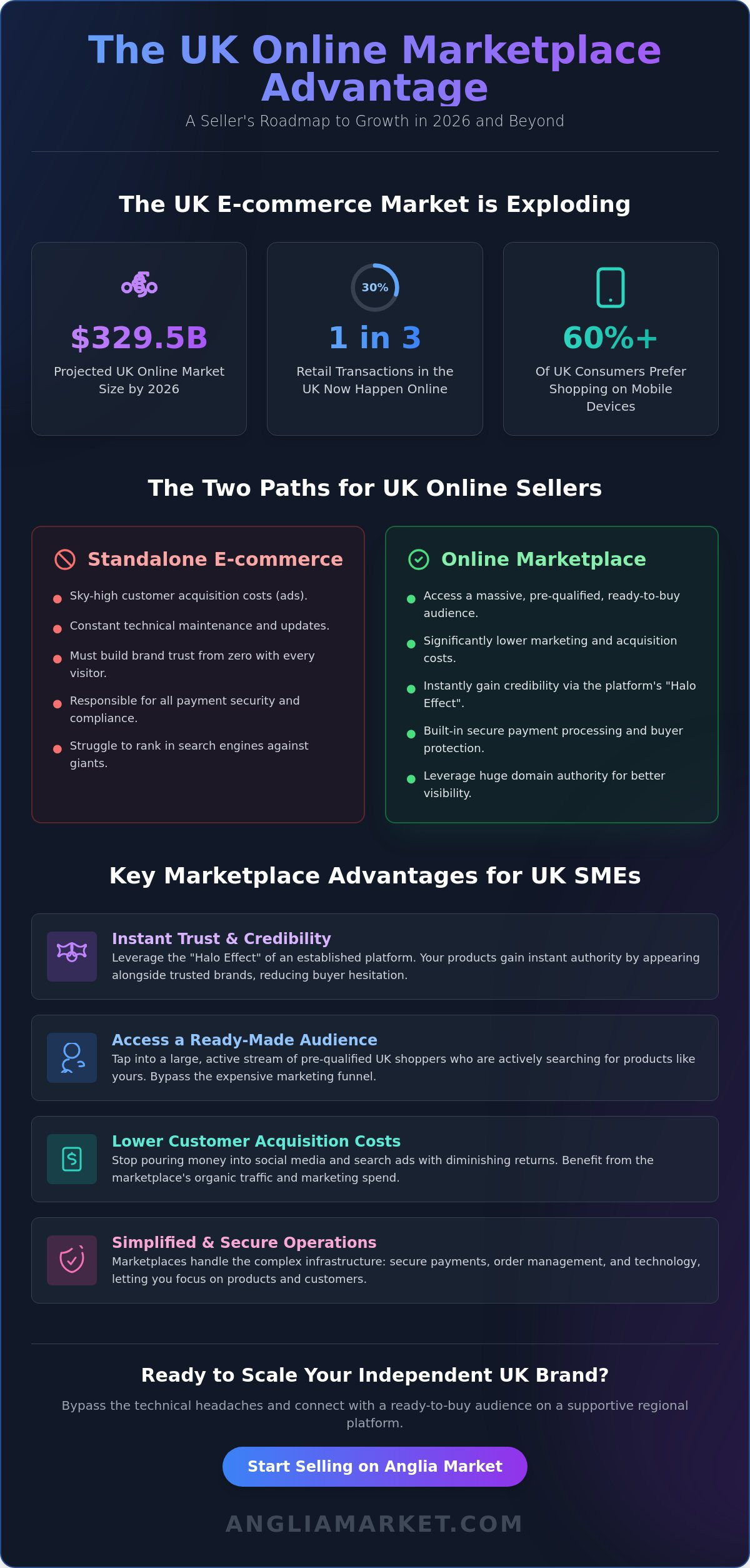
Did you know the UK online shopping market is projected to reach a massive $329.5 billion in 2026? With online sales now accounting for 30% of all retail transactions, understanding the strategic benefits of selling on an online marketplace uk is the most direct route to sustainable growth. It's frustrating to watch your margins disappear into expensive social media ads or spend your weekends troubleshooting website plugins. You want to focus on your products and your customers, not on debugging code or fighting for trust with every new visitor.
We agree that the technical and financial barriers to scaling a standalone site have never been higher. This guide shows you how to bypass those hurdles by using established platforms to reduce marketing costs and build instant credibility. You'll learn how to leverage a ready-made audience and simplify your daily order management. We'll also preview the critical 2026 fee updates and VAT rules you need to stay profitable while reaching more shoppers than ever before.
Key Takeaways
- Access a pre-qualified UK audience and leverage the "Halo Effect" of established platforms to build instant brand trust without the usual marketing struggle.
- Discover the core benefits of selling on an online marketplace uk, including significantly lower customer acquisition costs compared to expensive social media and search engine ads.
- Compare the true costs of marketplace commissions against the ongoing technical maintenance, hosting, and development fees of running a standalone e-commerce site.
- Learn how to optimize your product listings for internal search algorithms and use high-quality imagery to boost conversions in competitive categories like home and garden.
- Explore how independent UK vendors are scaling faster by joining supportive regional platforms that handle the complex infrastructure of online retail.
The Evolution of Selling on Online Marketplaces in the UK (2026)
The UK retail environment has undergone a massive transformation. High streets haven't vanished, but they've certainly evolved into hybrid digital storefronts for small and medium enterprises. By 2026, the online shopping market in the UK is projected to reach $329.5 billion. This growth isn't just about volume; it's about how people shop. Research shows that online sales now account for approximately 30% of all UK retail transactions. Success for a modern business means being present where the customers already spend their time.
A modern marketplace is more than a list of products. It's a collaborative ecosystem where independent vendors use shared technology to reach a national audience. What is an online marketplace? It is a centralized platform that facilitates transactions between multiple sellers and buyers, providing a level of security and convenience that standalone sites often struggle to match. One of the primary benefits of selling on an online marketplace uk is this instant access to a massive, ready-to-buy audience without the need for a huge technical budget.
Why Niche and Local Marketplaces are Rising
Shoppers are moving away from faceless global giants. There's a growing desire to support independent UK brands and regional economies. Specialized platforms that focus on specific categories like home and garden or pet supplies are seeing significant momentum. These marketplaces offer a curated experience. They connect buyers with vendors who actually understand the products they sell, fostering a sense of community that large-scale retailers can't replicate. Supporting local businesses through digital commerce has become a priority for the conscious 2026 consumer.
The 2026 UK E-commerce Landscape
Mobile-first commerce is the new standard. Over 60% of UK consumers now prefer to shop using their mobile devices. This shift has forced marketplaces to prioritize fast, responsive designs that make purchasing effortless. Success for SMEs now depends on being where the customers are, and that's usually on a smartphone screen.
Regulation has also played a part in this evolution. The implementation of the Digital Markets, Competition, and Consumers Act (DMCCA) throughout 2025 and 2026 has made the digital space safer. With the CMA's enhanced powers to tackle unfair practices, small businesses can compete on a fairer playing field. When you choose to sell online through a regulated marketplace, you're tapping into a system built on transparency and consumer trust. The integration of social commerce with these established platforms allows vendors to turn social media engagement into direct sales without leaving the marketplace environment.
Strategic Benefits: Why UK SMEs are Migrating to Marketplaces
For many small businesses, the dream of a standalone website often turns into a technical nightmare. Between rising customer acquisition costs on social media and the constant need for security updates, the overhead is exhausting. This is why we see a massive shift toward platform-based selling. One of the most immediate benefits of selling on an online marketplace uk is the ability to tap into a pre-qualified audience. These shoppers aren't just browsing; they're ready to buy. You bypass the expensive awareness phase of the marketing funnel because the platform has already done the heavy lifting for you.
Marketplaces also offer a "Halo Effect" that individual sites can't replicate. When your products appear alongside established brands, their credibility transfers to you. This is especially vital for high-value items. If you're selling electronics or furniture, the platform's reputation for delivery and dispute resolution gives buyers the confidence to click purchase. Additionally, marketplaces possess massive domain authority. They consistently outrank smaller, independent sites in search engine results, ensuring your inventory gets seen by a national audience.
Built-in Trust and Security
Buyer friction is the enemy of conversion. Unknown websites often suffer from high abandoned cart rates because shoppers are hesitant to share their credit card details. Marketplaces remove this barrier with standardized, secure payment gateways. Transactional safety is a core driver for UK consumer confidence in 2026. While there are various advantages and disadvantages of online marketplaces, the instant trust factor is a clear win. Impartial reviews also play a massive role. They provide the social proof needed to convert a first-time visitor into a loyal customer without you needing to manually collect and verify testimonials.
Infrastructure and Operational Efficiency
Managing the backend of an e-commerce site is a full-time job. By migrating to a marketplace, you outsource the technical headache. You don't need to worry about server uptime, SSL certificates, or complex cybersecurity measures. Instead, you get a streamlined dashboard designed for efficiency.
- Easy inventory management across diverse categories like pet supplies or home and garden.
- Built-in communication tools to handle customer enquiries in one place.
- Simplified order processing that scales as your business grows.
If you want to spend less time on code and more time on your craft, it's worth exploring how to sell online through an established partner. This move lets you focus on what actually drives profit: your products.
Comparing Marketplace Selling vs. Standalone E-commerce Sites
Running a standalone shop is often a battle against rising Customer Acquisition Costs (CAC). If you rely on Google or Meta ads, you're paying for every click, regardless of whether it leads to a sale. Marketplaces operate on a different logic. Most use a commission-based model where you only pay when a transaction occurs. This shift from "pay-per-click" to "pay-on-result" is one of the major benefits of selling on an online marketplace uk. It protects your cash flow and ensures your marketing spend is always tied to actual revenue.
Then there's the "fee vs. maintenance" reality. A custom site requires hosting, SSL certificates, developer retainers, and constant security patches. These costs are fixed and often high. Marketplaces bundle these operational requirements into their platform fees. You get a high-performance infrastructure that handles traffic spikes during peak UK shopping seasons like Black Friday or the January sales without your site crashing or slowing down. It's a level of technical stability that's difficult for a small business to achieve independently.
Speed to market is another critical factor. Building a custom e-commerce site can take weeks or months of design and development. You can launch a marketplace storefront in hours. This allows you to start generating revenue immediately while your competitors are still arguing over website templates. It's the most efficient way to get your inventory in front of a national audience quickly.
The Marketing ROI Breakdown
For a new standalone domain, SEO is a long and expensive game. It can take six to twelve months to rank for competitive UK keywords. Marketplaces already possess that search engine authority. They allow you to leverage platform-wide promotions to boost your visibility instantly. Instead of spending thousands on an SEO agency, you're using a platform that Google already trusts. This provides a much more predictable way to manage your marketing budget and see a faster return on investment.
Long-term Growth and Brand Stability
Many SMEs now use a hybrid model for growth. They use marketplaces as their primary sales engine while slowly building a niche brand identity. It's a low-risk strategy. A UK Parliament report on online platforms highlighted how these digital ecosystems allow smaller firms to reach national markets without the burden of heavy infrastructure.
Marketplaces are also the perfect testing ground for new inventory. Want to see if a new product line works? List it on a marketplace first. You'll get real-world data and customer feedback within days. It's much safer than investing in a dedicated marketing campaign for an unproven item. You get the ease of use and the traffic, allowing you to focus on product development rather than debugging code.
Maximising Your Success: A Roadmap for UK Vendors
Strategic growth requires more than just listing products. To truly capture the benefits of selling on an online marketplace uk, you need to master the platform's internal search logic. Marketplace algorithms prioritise listings that convert. This means your titles and descriptions must align perfectly with UK search intent. Use terminology your local customers use. A shopper looking for "garden benches" shouldn't be met with generic "outdoor seating" descriptions. Specificity drives visibility.
Visual presentation is your most powerful sales tool. In categories like furniture and kitchenware, high-quality imagery is non-negotiable. Shoppers can't touch your products, so your photos must do the work. Include lifestyle shots to show scale and close-ups to highlight material quality. Clear, professional images reduce buyer hesitation and lead to fewer returns. High standards in your visual assets directly correlate to higher conversion rates.
Customer service is the final pillar of success. Fast response times and helpful communication earn the 5-star testimonials that drive future sales. These reviews act as a permanent marketing asset for your business. When you consistently meet or exceed the platform's service standards, you're rewarded with better search rankings and increased buyer trust.
Optimising Your Marketplace Storefront
Your digital storefront is the face of your independent brand. Use your "About Us" section to tell your story. UK consumers value transparency and local roots. Highlighting your UK-based operations builds an immediate connection that global giants can't replicate. It's about being a person, not just a profile.
Data should guide every decision you make. Utilise available vendor tools to monitor which products are performing and where your traffic is coming from. Tracking these trends allows you to adjust your inventory before your competitors do. It's about staying agile in a fast-moving retail environment.
Building Loyalty and Repeat Sales
Acquiring a new customer is expensive. Keeping one is profitable. Encourage shoppers to join a loyalty program to keep your brand at the front of their minds. When customers feel rewarded for their repeat business, they're less likely to shop around. Retention is the key to long-term brand stability.
- Run seasonal sales to clear old inventory and attract bargain hunters.
- Ask for reviews promptly to build the social proof that converts future browsers.
- Offer exclusive promotions to your existing customer base.
If you're ready to scale your reach and simplify your operations, take the next step and apply to sell online with a platform that supports independent UK businesses.
Growing Your Independent Brand with Anglia Market
Anglia Market isn't just another sales channel. It's a platform specifically engineered to help UK small businesses thrive. While global giants focus on volume, we focus on the vendor experience. One of the unique benefits of selling on an online marketplace uk like ours is the exposure to a diverse, high-intent audience. Whether you specialize in home and garden, electronics, or pet supplies, you benefit from cross-category discovery. A customer buying a new pet bed might easily find your handmade garden furniture in the same session.
We empower you to sell online without the technical barriers that usually hold independent brands back. Our infrastructure is built to handle the heavy lifting, from secure transactions to mobile-optimized storefronts. This allows you to maintain your unique brand identity while enjoying the stability of a national platform. UK shoppers trust us because they know they're supporting regional commerce and finding items they can't get on the high street.
Tailored Support for UK Small Businesses
We don't believe in faceless help centers. Vendors have access to a dedicated support home for real technical and sales assistance. We understand the UK retail calendar. We know when bank holidays will affect your shipping and when seasonal peaks drive demand for specific categories. Getting started is simple. You can add your profile and begin listing products immediately. The barriers to entry are low because our goal is to grow alongside you.
Success Stories from the Community
The proof is in the results. Our testimonials highlight vendors who have successfully transitioned from local markets to national sales. Independent brands in the furniture and toy sectors have found particularly strong audiences here. They've leveraged the benefits of selling on an online marketplace uk to fund their expansion and reach customers from Cornwall to the Highlands.
Looking ahead, we're planning new innovations for our vendor community, including enhanced analytics and more integrated social commerce tools. We're committed to remaining the most supportive platform for independent UK enterprise. If you're ready to move beyond the limitations of a standalone site, join a marketplace that actually values your contribution to the local economy.
Scale Your Independent UK Business in 2026
Success in the modern retail environment requires a balance of technical stability and market reach. We've explored how shifting from a standalone site to a platform model reduces your marketing risk and eliminates the headache of website maintenance. By leveraging the benefits of selling on an online marketplace uk, you gain immediate access to a pre-qualified audience and the built-in trust needed to convert browsers into buyers. It's about working smarter, not harder, to reach your growth goals.
Anglia Market is already trusted by hundreds of UK independent businesses. We provide comprehensive support via our Freshdesk portal to ensure your transition is seamless. With dedicated categories for furniture, home goods, and electronics, your inventory is positioned exactly where shoppers are looking. Don't let technical barriers or high ad costs stall your progress. It's time to focus on your products while we handle the infrastructure.
Start your journey as an independent UK vendor today with Anglia Market. We're ready to help you reach a national audience and build a sustainable brand for the future.
Frequently Asked Questions
Is selling on an online marketplace profitable for small UK businesses?
Marketplace selling is highly profitable because it shifts the financial risk from the vendor to the platform. By leveraging the benefits of selling on an online marketplace uk, small businesses can avoid the massive upfront costs of driving traffic to a new, unknown website. You only pay for the sales you actually make, which keeps your profit margins predictable and protected.
How much does it cost to start selling on a UK marketplace?
Entry costs are significantly lower than building a standalone e-commerce site. Professional selling plans on major UK platforms typically involve a modest monthly subscription or a small fee per item sold. Referral fees generally range between 8% and 15% depending on the specific product category. This allows you to scale your operations without investing thousands in web development or cybersecurity.
Can I sell on a marketplace and my own website at the same time?
Yes, many successful vendors operate a hybrid model to maximize their reach. You can maintain your own brand domain while using the benefits of selling on an online marketplace uk to capture a larger share of national search traffic. Using centralized inventory tools ensures your stock levels remain accurate across both channels, preventing overselling and maintaining customer trust.
What are the best-selling categories on UK marketplaces in 2026?
High-demand sectors currently include home office equipment, pet supplies, and ethically sourced lifestyle goods. Consumers are increasingly looking for unique items from independent sellers that offer better value or more character than mass-produced alternatives. Categories like garden furniture and smart home electronics also continue to show strong growth as UK shopping habits lean further into digital convenience.
How do marketplace fees compare to the cost of Google Ads?
Marketplace fees are success-based, whereas search engine advertising is risk-based. With traditional ads, you pay for every click regardless of a purchase. On a marketplace, the commission is only deducted once a transaction is confirmed. This "pay-on-result" structure is much safer for SMEs who need to ensure every penny of their marketing budget generates a direct return.
What happens if a customer wants a return on a marketplace sale?
Returns are handled through an integrated dashboard that ensures compliance with the Digital Markets, Competition, and Consumers Act. Most platforms provide standardized communication tools and labels to make the process efficient for both the buyer and the seller. This professional infrastructure reduces the administrative burden on your business and helps maintain high customer satisfaction scores.
How do I protect my brand identity when selling on a third-party platform?
You can protect your brand by fully utilizing storefront customization tools and professional product photography. Focus on crafting a unique "About Us" section that highlights your UK-based operations and independent values. Consistent branding across your packaging and prompt, personal customer service will help shoppers remember your name even when they discover you through a larger platform.

Here to help — ask anything
For questions about this disclaimer or the site, contact us via the website’s Contact page.


