
Recent data from the Office for National Statistics (ONS) shows that 16% of UK businesses faced supply chain disruptions in early 2024. When a delivery fails to arrive, it's not just a logistical hiccup; it's a direct hit to your bottom line. You likely feel the immediate pressure of out-of-stock labels and the looming threat of negative feedback from customers who expect better. It's frustrating to lose revenue because someone else didn't keep their word, but you don't have to stay stuck in that uncertainty. Knowing exactly what to do when a supplier lets you down is the difference between a temporary dip and a total business crisis.
You know that customer trust takes years to build but only one failed delivery to lose. This guide shows you how to manage a supplier crisis effectively so you can protect your reputation and find reliable alternatives without losing your hard-earned customers. We'll walk through your legal rights in the UK, recovery tactics for lost funds, and how to establish a supply chain that actually delivers on its promises.
Key Takeaways
- Assess the immediate impact on your inventory and learn how to open effective communication channels to manage the crisis.
- Understand your legal protections in the UK, including how to review contract clauses like 'Force Majeure' and 'Breach of Contract'.
- Discover what to do when a supplier lets you down by sourcing high-quality alternatives from independent UK sellers on Anglia Market.
- Maintain your brand reputation using radical transparency and offering clear solutions like refunds or discounts to affected customers.
- Build a resilient supply chain for the future by transitioning to a 'Just-in-Case' model and diversifying your vendor base.
The First 24 Hours: Assessing the Damage and Opening Communication
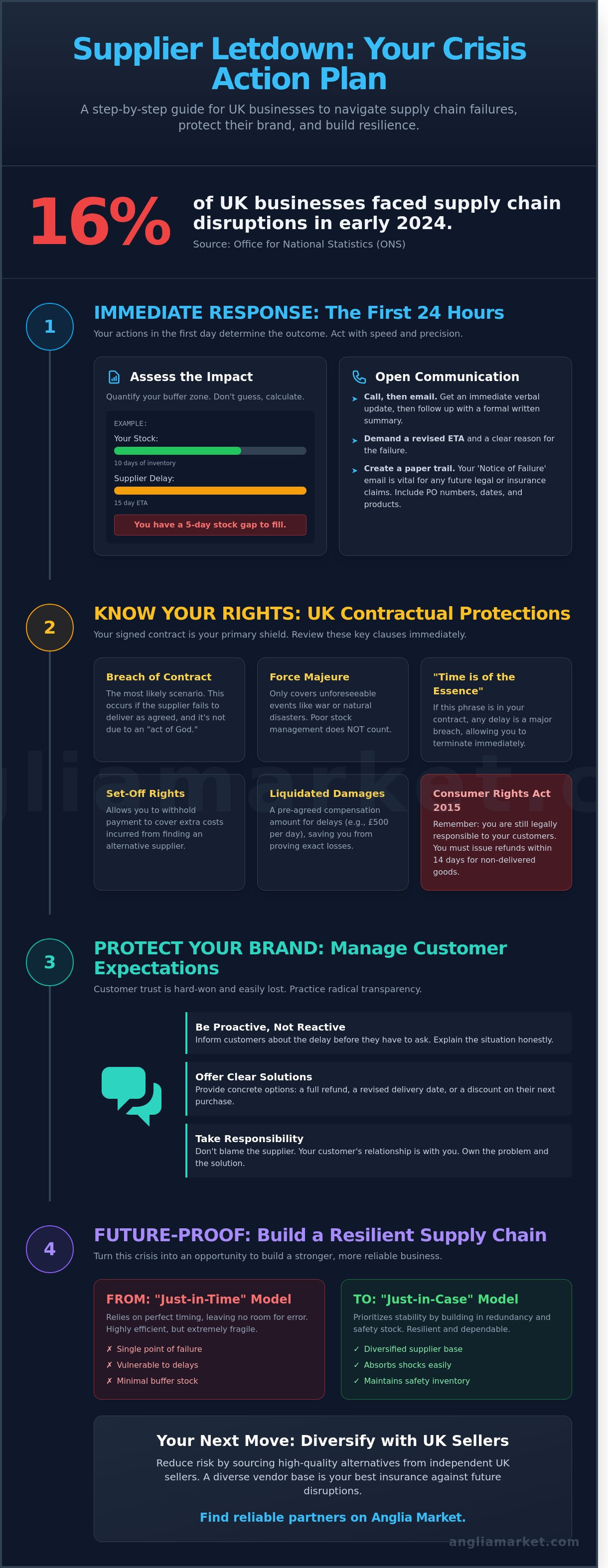
When a delivery doesn't arrive or quality drops, the first 24 hours determine if your business survives the week. You must identify the failure's nature immediately. A 48-hour transport delay requires a different response than a total factory shutdown. Check your warehouse levels to find your buffer zone. If you have 10 days of stock but the delay is 15 days, you have a 5-day gap to fill. Knowing what to do when a supplier lets you down starts with these hard numbers.
To better understand how to manage these relationships during a crisis, watch this helpful video:
Call your account manager right away. A phone call gets immediate answers that emails often miss. Ask for a revised Estimated Time of Arrival (ETA) and a written explanation for the failure. Once you hang up, send a formal summary. If the failure is significant, it might lead to a breach of contract, making your written record vital for any future legal or insurance claims. Knowing what to do when a supplier lets you down is about speed and accuracy.
Establishing a Professional Paper Trail
Documenting every interaction is essential from the minute a deadline passes. Your initial 'Notice of Failure' email should include the original purchase order number, the missed delivery date, and the specific products affected. Stay professional. Use clear, direct language to assert your business needs without being aggressive. This record protects your position if you need to claim compensation or terminate the agreement later.
Quantifying the Impact on Your Business
Calculate your daily loss of revenue. If a missing component halts production for a product that generates £850 in daily sales, that's your baseline cost. Prioritise your response by separating 'critical' orders from 'non-critical' ones. Supply chain impact is the measurable disruption to business operations and financial performance caused by a failure in the flow of goods or services. Focus your remaining stock on high-value clients or those with the oldest pending orders.
Understanding Your Legal Rights and Contractual Protections in the UK
When you're wondering what to do when a supplier lets you down, your first move is grabbing the signed contract. Don't rely on verbal promises; the written Terms and Conditions (T&Cs) are your primary shield. Check for a 'Force Majeure' clause. While many firms tried using this during the supply chain shocks of 2022, it usually only covers "acts of God" like floods or war. If your supplier simply failed to manage their stock or staff, they're likely in 'Breach of Contract'.
Look for the phrase "time is of the essence." If this exists, any delay is a major breach that lets you terminate the agreement immediately. Without it, you might have to give them a "reasonable" extension. You should also check for 'set-off' rights. This allows you to withhold payment for a failed delivery to cover the extra costs of finding a new source. If the financial hit exceeds £10,000 or threatens your business solvency, speak to a commercial solicitor before taking drastic action. You can find practical steps for supplier issues that help protect your cash flow during these disputes.
Common Contractual Clauses to Look For
Liquidated Damages clauses are vital. They set a fixed compensation amount, such as £500 per day of delay, saving you from proving exact losses in court. Check your Service Level Agreements (SLAs) too. If a supplier drops below a 98% fulfilment rate, they've breached their performance targets. Remember your duties under the Consumer Rights Act 2015. If you're a UK marketplace seller, you're still legally responsible to your customers even if your supplier failed you. You must refund your buyers within 14 days if goods don't arrive.
When to Negotiate vs. When to Walk Away
Decide if this is a one-off blip or a terminal decline. If the supplier's credit score has dropped recently or they've missed three consecutive deadlines, it's time to go. Offer a 'cure period' of 7 to 14 days to fix the issue. If they fail, issue a formal 'Letter Before Action'. This is a standard UK legal requirement before starting a court claim. It shows you're serious about recovering your £2,500 deposit or lost profits. Knowing what to do when a supplier lets you down keeps your business running while others wait for apologies that never come.
Sourcing Alternative Suppliers Rapidly and Safely
Knowing what to do when a supplier lets you down requires a shift from long-term strategy to tactical, rapid sourcing. Your first move should be to prioritise UK-based vendors. By focusing on local suppliers, you eliminate the 14-day lead times and customs complexities that often come with international shipping. Data from the Office for National Statistics in 2023 showed that 16% of UK businesses experienced supply chain disruptions, making local resilience a critical survival trait for modern SMEs.
Don't rush into a massive order with the first company you find. Request a small sample order first. This allows you to test the quality and delivery speed before you commit a large portion of your budget. If you need 1,000 units to fulfil your backlog, consider splitting the order between two different vendors. This diversification ensures that if one new partner fails, you still have 50% of your stock arriving to keep the business moving.
For instance, a home renovation business let down by their usual flooring provider could quickly find new options online and explore LVT from a different retailer to keep a project on schedule.
Similarly, a UK-based car garage facing a stockout from their primary parts distributor could look to specialized European suppliers to keep their service bays busy. For critical components, they might need to explore Brake Pads from an international vendor to fulfill customer repairs without delay.
Leveraging Marketplaces for Emergency Stock
Anglia Market is a powerful tool for finding independent UK sellers with ready-to-ship stock. Use the platform's search filters to identify businesses that can fulfil orders within 48 hours. Buying from established third-party vendors during a crisis provides a safety net because these sellers are often more agile than large corporations. You can compare prices and delivery estimates across multiple sellers in one place, ensuring you don't overpay for emergency supplies. It's a practical way to maintain business continuity while your primary supply chain is broken.
Vetting New Partners Under Pressure
Even when you're in a hurry, you must verify a new supplier's credentials to avoid further losses. Check their VAT registration and physical UK address to ensure they're a legitimate entity. Reviewing their consumer protection rights policies will tell you exactly where you stand if the goods arrive damaged or don't match the description. Use this quick-check list for every new candidate:
- Look for verified customer reviews from the last 90 days.
- Ask for a real-time stock count over the phone before paying.
- Confirm their returns policy in writing.
- Check for a responsive customer service team.
Negotiate short-term emergency contracts rather than long-term deals. A 30-day or 60-day agreement fills the immediate gap without locking you into a partnership that might not suit your business once the crisis passes. This straightforward approach protects your cash flow and gives you the flexibility to return to your original supplier or find a better permanent alternative later.
Managing Customer Expectations and Protecting Your Brand Reputation
Transparency is your most effective tool. Research from 2023 indicates that 81% of UK shoppers are more likely to buy again from a brand that is honest about delivery delays. When you realise a shipment is stuck, contact your customers within 12 hours. Don't wait for them to ask where their order is. This proactive approach shows you're in control, even if the logistics aren't. Knowing what to do when a supplier lets you down starts with owning the narrative before a customer feels ignored.
Update your website banners and marketplace listings immediately. If a standard 3-day delivery is now 10 days, reflect this on the product page. For existing orders, provide three clear choices:
- A full refund: Processed within 24 hours to show good faith.
- A similar replacement: Offer an alternative product at no extra cost.
- A discount for waiting: A 10% or 15% discount code often encourages patience.
Monitor your social media feeds and Trustpilot pages hourly. Reply to every comment with a calm, solution-oriented tone. Practicality beats excuses every time in the UK retail market.
The Art of the 'Apology Email'
Your message must take full responsibility. Avoid blaming "the factory" or "the courier" excessively; the customer's contract is with you. Use de-escalating phrases like "I understand this is frustrating" or "We've let you down." A small goodwill gesture, such as a £5 voucher for their next shop, can transform a one-star experience into a loyal relationship. Keep the layout simple and the call-to-action clear.
Preventing Negative Reviews on Marketplaces
Marketplace algorithms on prominent selling platforms are unforgiving regarding late shipments. Set your 'Expected Delivery Dates' to be conservative. If a supplier is struggling, add a 48-hour buffer to your lead times. Proactive communication can stop a buyer from hitting the "Report a Problem" button, which protects your seller rating and keeps your account healthy.
"Hi [Name], I'm very sorry your order was delayed. We had a sudden stock issue and didn't meet our usual high standards. I've just sent you a full refund and a discount code via email as a gesture of goodwill. We'd love the chance to make this right. Best, [Your Name]."
Maintaining a professional front ensures your business survives temporary supply shocks. If you need a reliable platform to reach new buyers, explore selling on Anglia Market to grow your UK customer base.
Future-proofing: Building a Resilient Supply Chain with Anglia Market
Recovery is only the first step. You need a permanent strategy to ensure you aren't left scrambling again. Since the 2021 supply chain disruptions, 60% of UK small businesses have shifted from a "Just-in-Time" to a "Just-in-Case" inventory model. This involves holding a 15% to 20% stock buffer for your top 10% most critical items. While this increases storage costs slightly, it prevents the total loss of revenue during a delivery failure. Knowing what to do when a supplier lets you down starts with having these safety nets in place months before a crisis occurs.
The Power of Supplier Diversification
Having a single point of failure is a risk that halts growth. You should aim for at least two suppliers for every core product line. Smart business owners balance cost-efficiency with security by splitting orders between a large-scale distributor and a local, UK-based vendor. Local sourcing often reduces lead times from 30 days to under 72 hours. Anglia Market helps you discover niche, independent vendors across the UK. These smaller partners are often more flexible and provide a personal level of service that larger corporations cannot match.
Implementing a Risk Management Strategy
Don't wait for a missed delivery to take action. Schedule quarterly "supplier health checks" to monitor performance and spot red flags. Use this checklist to identify potential failures early:
- Late invoices or sudden changes in credit terms.
- A 25% increase in communication response times over a one-month period.
- High staff turnover in their customer service or account management teams.
- Repeated quality control errors, even on low-value orders.
Use your data from marketplace sales to forecast inventory needs with higher precision. If your sales on Anglia Market grew by 12% last quarter, adjust your "Just-in-Case" levels immediately. This proactive data usage is the most effective way to manage what to do when a supplier lets you down, as it allows you to switch to a backup partner before your own shelves are empty.
Protect Your SME from Future Disruptions
A broken link in your supply chain doesn't have to mean a broken business. You've now got the tools to handle the first 24 hours of a crisis and understand your legal protections under UK law. Knowing exactly what to do when a supplier lets you down means you can pivot quickly without losing your reputation or your revenue. By diversifying your sources across different categories like electronics and furniture, you build the resilience needed to survive in the competitive UK market.
Anglia Market supports thousands of independent UK vendors; this gives you immediate access to reliable alternatives when your primary partner fails. We provide secure shopping and transparent seller reviews so you can verify a new partner's track record before you spend a single pound. Don't wait for the next delivery delay to act. Strengthening your network today ensures you're ready for whatever comes tomorrow. Your business deserves a backup plan that works as hard as you do.
Start selling or sourcing with Anglia Market - the UK marketplace for SMEs
Frequently Asked Questions
What are my legal rights if a supplier fails to deliver on time in the UK?
Your legal rights depend primarily on the terms of your written contract under the Sale of Goods Act 1979 or the Supply of Goods and Services Act 1982. If your agreement specifies that "time is of the essence," any delay is a material breach that allows you to terminate the contract immediately. Without this specific wording, the law implies that delivery must happen within a reasonable time, which UK courts typically define as 30 days for standard commercial orders.
Can I claim compensation for lost profits due to a supplier's error?
You can claim for lost profits, known as consequential loss, only if the supplier was aware of the specific risk when the contract was formed. Under the Hadley v Baxendale rule, you must prove the loss was a foreseeable result of the breach. Most UK suppliers limit their liability to 100% of the contract price, so check your terms for a liability cap before pursuing a claim for thousands of pounds in lost revenue.
How should I tell my customers that their order is delayed because of a supplier?
Contact your customers within 24 hours of learning about the delay to provide a new delivery date. Offer a 10% discount on their current order or a £5 voucher for their next purchase to maintain goodwill. This is a vital part of what to do when a supplier lets you down because 70% of UK shoppers say they'll shop again if a delivery issue is handled transparently.
Is it better to wait for an unreliable supplier or find a new one immediately?
Switch to a new supplier if your current partner misses two consecutive deadlines or fails to respond to emails within 4 working hours. Transitioning to a new vendor usually takes 14 to 21 days for standard retail stock. If the cost of your lost sales exceeds the £500 average cost of onboarding a new partner, you should move your business immediately to protect your cash flow.
How can I find reliable UK-based suppliers for my small business?
Search for vendors on UK marketplaces like Anglia Market or use the British Chambers of Commerce business directory. You can also attend trade events like the Autumn Fair at the NEC Birmingham to vet suppliers in person. Focus on partners who offer a 95% fulfilment rate. Using domestic suppliers reduces your shipping lead times from 6 weeks for international sea freight to just 3 days for UK road haulage.
What should be included in a supplier contract to protect against failure?
Include a Service Level Agreement (SLA) that mandates a 98% on-time delivery rate. Add a liquidated damages clause that requires the supplier to pay a £50 penalty for every day a shipment is late. Ensure you have a termination clause that allows you to cancel the contract with 7 days' notice if quality standards aren't met. Having these terms in place provides a clear plan for what to do when a supplier lets you down.
How do I conduct a 'supplier audit' to ensure they won't let me down?
Start by checking the supplier's credit score through Experian to ensure they aren't facing insolvency. Request three references from current UK clients and verify their ISO 9001 certification for quality management. A video tour of their warehouse or a physical site visit can confirm they actually hold the £10,000 of safety stock required to meet your peak season demands without delays.
Can a marketplace like Anglia Market help me manage supply chain risks?
Anglia Market helps you manage risk by providing access to a diverse network of over 500 UK-based small and medium businesses. Instead of relying on a single source, you can quickly find alternative vendors if your primary supplier has issues. This marketplace model allows you to compare prices and delivery times instantly. It ensures you always have a backup plan to keep your business running smoothly.

Here to help — ask anything
If you have any questions regarding this disclaimer or any of our policies, please contact Anglia Market through the contact page on our website, by email using the address provided on the site, or by phone at 0333 772 2593