
Did you know that 56% of UK consumers have stopped using a company's services because they didn't trust its data practices? It's a high price to pay for a confusing document. If you're feeling overwhelmed by the 2026 Data Act changes, you aren't alone. Most SME owners find legal jargon frustrating. You'd rather focus on sales than worry about a £17.5 million ICO fine. We understand that creating a privacy policy for a uk website feels like a daunting hurdle. However, it's actually your best tool for building long-term loyalty and proving your brand is reliable.
You're about to master the essentials of UK data compliance. This guide shows you how to build a robust, trust-earning policy that satisfies the latest requirements. We'll help you organise your data obligations by covering the new mandatory complaints-handling process, updated cookie rules, and efficient data request management. We'll provide a clear overview of your legal duties so you can get back to business with confidence. It's time to turn a legal requirement into a commercial advantage.
Key Takeaways
- Understand the essential elements your policy must contain, including business identity details and specific data collection categories.
- Learn how the Data (Use and Access) Act 2026 updates your obligations while maintaining UK GDPR standards.
- Master the practical steps for creating a privacy policy for a uk website using official tools to avoid expensive legal costs.
- Discover how a transparent policy acts as a vital trust signal that can boost sales and customer loyalty for your business.
Understanding the Essentials of a UK Privacy Policy in 2026
A privacy policy is a vital legal document that explains how your business collects, uses, and protects personal data. It isn't just a page of boring text; it's a public commitment to your customers. If you're looking for a foundational definition of what a privacy policy is, think of it as your roadmap for data handling. It tells users what information you need, why you need it, and how you'll keep it safe from hackers or misuse.
Every UK website must have one. It doesn't matter if you're a massive retailer or a local shop. If you collect even a single email address for a newsletter, the law applies to you. In 2026, the focus has shifted heavily towards transparency. The Data (Use and Access) Act requires businesses to give users more control than ever before. You can't hide your practices in tiny print. You must be clear, honest, and direct about your data habits. Creating a privacy policy for a uk website is now a primary step in building a legitimate online presence.
It's also helpful to distinguish between your internal policy and your public notice. Your "Privacy Policy" is often the detailed internal document that tells your staff how to handle data. Your "Privacy Notice" is the public-facing version that your customers actually read. For most small businesses, these terms are used interchangeably, but the goal is always the same: total clarity for the user.
Why Your Business Cannot Ignore Privacy Compliance
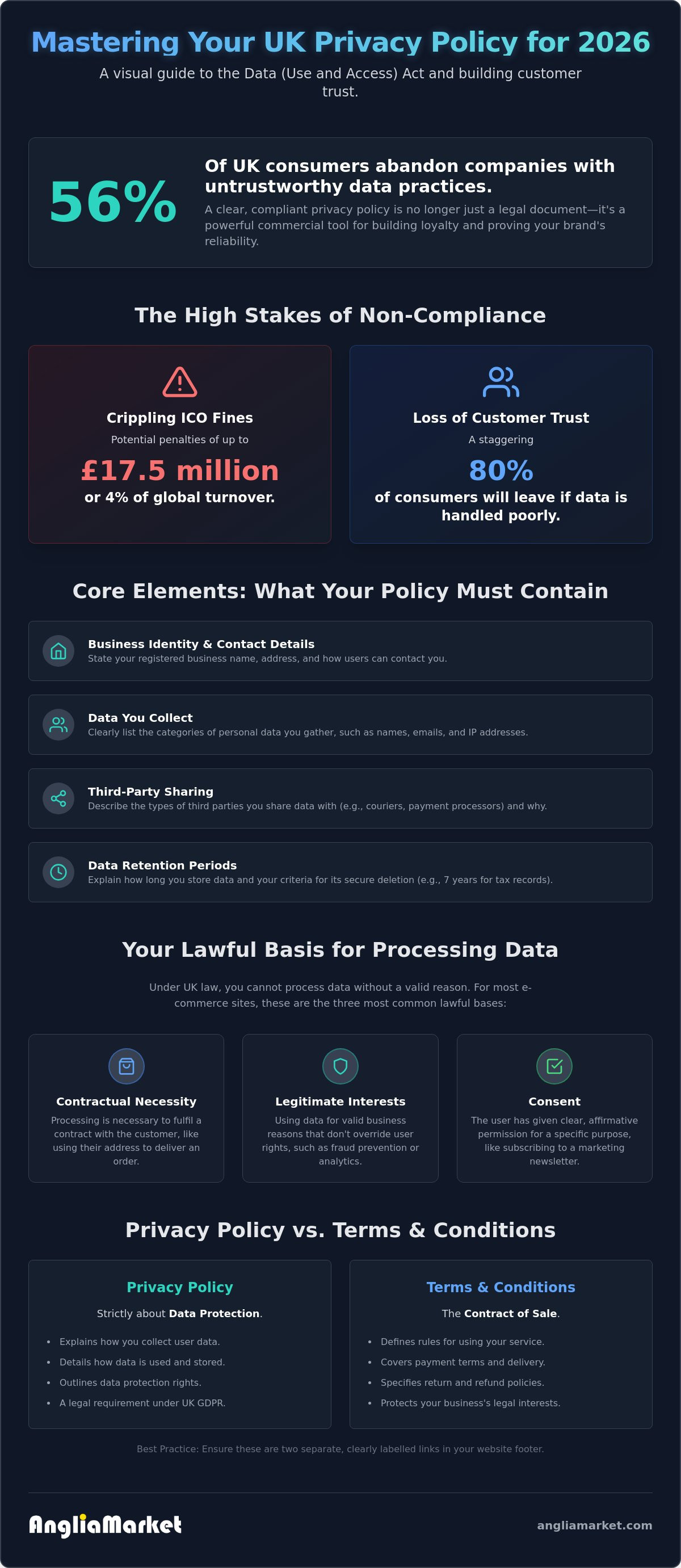
The stakes for non-compliance have never been higher. As of 2026, the Information Commissioner's Office (ICO) can issue fines of up to £17.5 million or 4% of your global turnover. Beyond the risk of fines, 80% of UK consumers say they'll stop using a service if they discover their data is being handled poorly. If you want to become a vendor on professional platforms, having a robust policy is a standard part of the due diligence process. It proves you're a reliable partner and reduces the number of security-related enquiries hitting your inbox.
Privacy Policy vs Terms and Conditions
Many owners confuse their privacy policy with their Terms and Conditions. They aren't the same. Your T&Cs are the contract of sale; they cover delivery, returns, and payment terms. Your privacy policy is strictly about data protection. When creating a privacy policy for a uk website, ensure it's a separate link in your footer. Use plain, non-legalistic British English. Avoid complex jargon that might confuse a shopper. Short, punchy sentences work best. This approach makes your site feel more accessible and trustworthy whilst ensuring you meet your legal obligations under the 2026 Act.
Core Elements: What Your Privacy Policy Must Contain
Your policy needs to be more than a generic template. It must accurately reflect your specific business operations. When creating a privacy policy for a uk website, you must start with your identity. Clearly state your registered business name, address, and contact details. If your SME is large enough to require a Data Protection Officer, their contact information must be included too. This transparency helps users know exactly who is responsible for their information.
You also need to be clear about third-party sharing. Most SMEs don't operate in a vacuum. You likely share data with couriers to deliver parcels or payment processors to handle transactions. List these categories clearly. You don't necessarily need to name every specific company, but you must describe their role. Finally, define your retention periods. You can't keep data forever. State how long you store customer info, such as seven years for tax records, and explain your process for securely deleting it afterwards.
Identifying the Personal Data You Collect
Data collection falls into two main categories. Direct data includes everything a customer types into a form, such as their name, shipping address, and phone number during checkout. Indirect data is often collected automatically. This includes IP addresses, device types, and browsing behaviour tracked via cookies. If you plan to sell online, you'll likely handle both. Be cautious with "special category" data. This includes sensitive info like health records or ethnic origin. Most retail SMEs should avoid collecting this unless it's absolutely essential for their service.
Defining Your Lawful Basis for Processing
Under UK law, you cannot process data just because you want to. You must have a "Lawful Basis." For most e-commerce sites, this usually falls under three headers:
- Contractual Necessity: You need the customer's address to send them the physical goods they bought.
- Legitimate Interests: This allows you to use data for tasks like fraud prevention or certain types of marketing, provided it doesn't outweigh the user's privacy rights.
- Consent: This is the gold standard for newsletters. You must use a clear "opt-in" tick box. Pre-ticked boxes are illegal.
When creating a privacy policy for a uk website, you must map each type of data you collect to one of these bases. This level of detail isn't just a legal requirement; it's a hallmark of a professional, trustworthy business. It shows your customers that you've thought about their rights and are committed to protecting their privacy in a competitive marketplace.
Navigating UK GDPR and the Data (Use and Access) Act 2026
The Data (Use and Access) Act 2025 has changed the landscape for small businesses, with its final provisions coming into full force in June 2026. It doesn't bin the UK GDPR; it refines it. For many, this makes creating a privacy policy for a uk website a slightly more logical task. The new law aims to cut red tape whilst keeping data standards high. You don't have to be a legal expert to see the benefits. It's about being practical and efficient.
Is it easier for SMEs now? Mostly, yes. The 2026 landscape introduces "simplified record-keeping" for businesses that don't handle high-risk data. You'll spend less time on spreadsheets and more time on sales. There's also a move towards "Smart Data." This helps businesses share data more easily between different platforms, boosting interoperability and competition. However, the stakes remain high. The ICO's power to fine for PECR breaches, such as cookie errors, now matches GDPR levels. You can't afford to be sloppy with your digital compliance.
Key Changes in the 2026 Data Landscape
Automated decision-making (ADM) is now more flexible. If you use AI-driven analytics to suggest products or manage inventory, the law is more permissive. You just need to tell customers and offer a way for them to challenge a significant decision. The definition of "identifiable" data has also been sharpened to account for modern tracking tech. For low-risk firms, the burden of proof for "reasonable and proportionate" data searches has eased. This means responding to Data Subject Access Requests (DSARs) is less of a drain on your resources. You can even "stop the clock" on response times if you need more info from the requester.
Maintaining Compliance Across Borders
Selling to the EU? You're still bound by the EU GDPR. This is a crucial distinction for any business looking to sell online to international markets. UK law has diverged to become more "pro-innovation," but European regulators haven't followed suit. If you have customers in France or Germany, your policy must reflect their stricter rules. Always use Standard Contractual Clauses (SCCs) for any international data transfers in 2026. Also, be transparent about your hardware. State where your data servers are physically located. Whether it's London or Dublin, your customers have a right to know. When creating a privacy policy for a uk website, being clear about these cross-border details proves your business is ready for global trade.
Steps to Create and Publish Your Policy Without a Solicitor
You don't need to spend thousands on legal fees to get your site compliant. In 2026, the tools available to SMEs are better than ever. Creating a privacy policy for a uk website starts with understanding your own workflow. By using free resources from the Information Commissioner's Office (ICO), you can build a solid foundation without a solicitor. It’s about being organised and methodical. You can save money whilst ensuring your document is perfectly tailored to your shop's needs.
The ICO’s official "Privacy Notice Generator" is your best starting point. Unlike paid tools that often use generic US-based templates, this tool is designed specifically for UK law. Once you have the baseline, customise it. Your policy should reflect your unique business operations and brand tone. It needs to be mobile-responsive too. In 2026, most shoppers use phones. If your policy is a giant, unreadable PDF, you aren't being transparent. Ensure the text is easy to read on any device.
Conducting a Simple Data Audit
Before you write a single word, you need a data audit. This sounds complex, but it’s just a map of how information moves through your business. Trace a customer's journey from the first click to the final delivery. Identify every touchpoint where data is collected, such as newsletter forms, cookies, and email enquiries. If you are a marketplace seller, check Anglia Market’s vendor support for platform-specific advice on how data flows between your shop and the main site. This helps you account for every bit of info you handle.
Where to Place Your Privacy Policy for Maximum Compliance
Where you put the policy is just as important as what it says. The standard is a clear link in your website footer. This makes it visible on every page. You should also include a "Point of Collection" notice. This is a short sentence and a link at the checkout stage or on sign-up forms. It ensures users can see your data practices at the exact moment they share their info. Always include a "Last Updated" date at the very top. It shows customers and regulators that you review your documents at least annually. If you're ready to start trading properly, apply to become a vendor and put your new policy into practice today.
A generic policy is easy to spot and offers less protection. If you use AI for product recommendations or specific analytics, you must mention this clearly. Mentioning specific categories of data you handle, such as preferences for furniture or garden supplies, makes the document feel authentic. Review this document every twelve months. Laws change, and your business will grow. An annual check ensures you never fall behind the latest 2026 standards.
Leveraging Privacy to Build Customer Trust on Anglia Market
Privacy is more than a legal obligation; it's a powerful commercial asset. For SMEs, it’s a way to prove you’re a safe pair of hands. When shoppers browse a marketplace, they look for signals that a vendor is professional. A clear, accessible policy is a major trust signal. It shows you respect their boundaries. In fact, 88% of UK consumers have taken steps to protect their data in the last six months. By being transparent, you align your business with their values. Creating a privacy policy for a uk website isn't just about avoiding fines. It's about winning the sale.
You can use your commitment to data security to stand out. In your Anglia Market vendor profile, mention your adherence to the 2026 Data Act. This positions you as a responsible "local" alternative to faceless global giants. Customers often prefer buying from UK-based businesses that they can hold accountable. Use this to your advantage. It builds a bridge of reliability between you and your audience. When they see you take their rights seriously, they're more likely to return for future purchases.
Privacy as a Competitive Advantage
Adopting a "privacy-first" marketing strategy appeals to security-conscious shoppers. It can directly boost your loyalty programme engagement. When users feel their data is safe, they're more likely to sign up for rewards and newsletters. This trust also helps reduce cart abandonment. Providing a quick link to your data reassurance at the final payment step gives shoppers peace of mind. They know their shipping address and payment details won't be sold or misused. It's a simple way to increase conversions without changing your product prices.
Communicating Privacy to Your Customers
Don't bury your policy in a footer and forget it. Write a short "Privacy Summary" in plain English for your about us page. This makes your brand feel more human and approachable. You should also highlight your commitment to UK data standards in your marketing emails. It tells your subscribers you value their inbox. By demonstrating a professional, compliant setup, you also encourage other vendors to sell online with confidence. Creating a privacy policy for a uk website shows you’re a leader in your niche. It proves that small businesses can be just as secure as the big players. Start using your data practices as a badge of honour today.
Future-Proof Your Business with Smart Data Privacy
A robust privacy notice is more than just a legal shield. It’s a commercial asset that proves your SME is reliable and professional. By mastering the core elements and navigating the latest 2026 legislative changes, you turn a complex task into a competitive edge. Transparency directly reduces cart abandonment and builds long-term loyalty amongst UK shoppers. Creating a privacy policy for a uk website doesn't have to be a solo struggle; it's a clear path to becoming a trusted brand in a crowded digital marketplace.
Now that you have the tools to stay compliant, it's time to scale your reach on a platform that values independent sellers. We've been supporting UK independent businesses since our launch, providing a secure UK-based marketplace platform for your growth. With our simple commission-based model for vendors, you can focus on your products whilst we provide the secure infrastructure you need. Join the Anglia Market community and start selling online with confidence today. Your journey to a successful, compliant online business starts right here.
Frequently Asked Questions
Do I really need a privacy policy if I don’t have a contact form?
Yes, you still need one because most websites collect data automatically. Even without a contact form, your site likely uses cookies or analytics tools that track IP addresses and user behaviour. Under the 2026 Act, this is still personal data. Creating a privacy policy for a uk website ensures you remain transparent about these background processes and background tracking.
What are the penalties for not having a UK GDPR compliant policy in 2026?
The Information Commissioner's Office (ICO) can impose fines of up to £17.5 million or 4% of your global annual turnover, whichever is higher. Since February 2026, PECR breaches also carry these same high penalties. Beyond the financial hit, you risk losing the trust of the 80% of UK consumers who say they'll stop using services that handle data poorly.
Can I just copy a privacy policy from another UK website?
No, you shouldn't copy a policy from another site. This is a breach of copyright and it likely won't accurately describe your specific business practices. Your data audit might reveal different third-party processors or retention periods. A mismatched policy is a major red flag for regulators and can lead to legal challenges if your actual practices don't match the text.
How does the Data (Use and Access) Act 2026 change my current policy?
The 2026 Act introduces more flexible rules for automated decision-making and reduces the administrative burden for low-risk SMEs. It also updates the rules for responding to Data Subject Access Requests (DSARs). You must update your policy to reflect these new "reasonable and proportionate" search requirements and the mandatory formal complaints-handling process that came into force in June 2026.
Do I need a separate policy for my mobile app and my website?
You don't necessarily need two separate documents, but your policy must cover the specific data collected by both platforms. Mobile apps often access unique information like location data or device IDs. If you're creating a privacy policy for a uk website and a companion app, ensure you clearly distinguish which practices apply to each to remain fully compliant.
Does a UK privacy policy need to mention cookies?
Yes, your policy must address how you use cookies and similar tracking technologies. Whilst the 2026 Act relaxed consent rules for statistical cookies, you must still provide an opt-out. You can include this within your main privacy notice or link to a dedicated cookie policy. This ensures you meet the latest transparency requirements for UK retail sites.
How often should I ask my customers to re-read my privacy policy?
You only need to notify customers when you make significant or "material" changes to how you process their data. If you're simply fixing a typo or updating a contact address, a quiet update is sufficient. For major changes, such as sharing data with new categories of third parties, an email notification is a professional way to maintain customer trust.
Is a "Free Privacy Policy Generator" safe for a UK business to use?
Only use generators that are specifically tailored to UK law. Many free tools are designed for the US market and miss critical UK GDPR and PECR requirements. The official ICO Privacy Notice Generator is the safest free option for SMEs. It provides a compliant baseline that you can then customise to reflect your unique business operations and brand voice.

Here to help — ask anything
If you have any questions regarding this disclaimer or any of our policies, please contact Anglia Market through the contact page on our website, by email using the address provided on the site, or by phone at 0333 772 2593