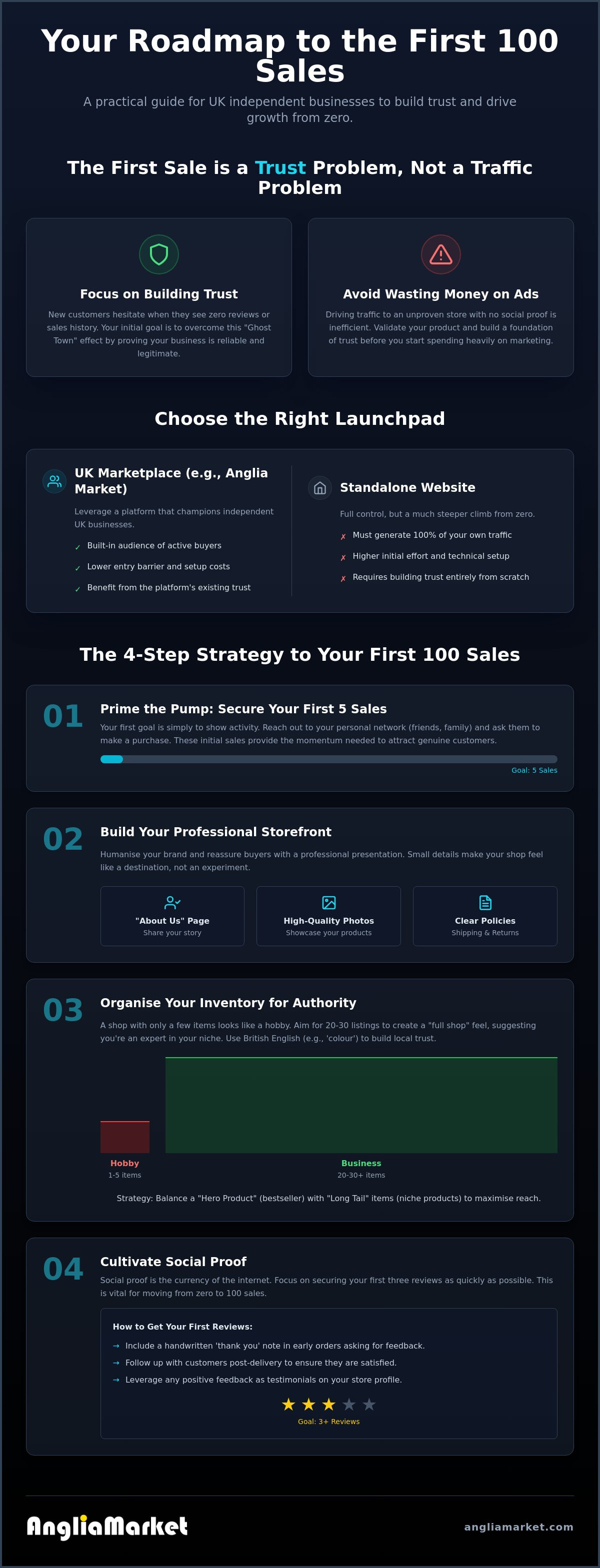
The first 100 sales aren't a traffic problem; they're a trust problem. Many UK sellers waste hundreds on ads before they've even validated their product idea or built a shred of social proof. In a crowded digital market, shouting louder isn't the answer. Learning how to get your first 100 sales online requires a shift from chasing clicks to building a repeatable sales process on a platform that actually champions independent businesses. It's about being discovered in the right place at the right price.
It's frustrating to see your dashboard stuck at zero while global platforms favour massive brands with endless budgets. You want consistent daily orders and a validated product without needing a five-figure bank balance. This guide provides the practical, straightforward steps to move from your very first sale to a steady stream of 100. We'll explore how to leverage a UK-focused marketplace like Anglia Market to reach a broader audience, build essential trust with verified feedback, and organise a strategy that turns a single product into a growing brand. Let's get your business moving.
Key Takeaways
- Overcome the "Ghost Town" effect by building essential social proof to validate your business model early on.
- Organise your product range to move beyond a hobbyist appearance and create a professional, trustworthy storefront.
- Master how to get your first 100 sales online by leveraging the built-in traffic and lower entry barriers of a UK marketplace.
- Identify exactly where your core audience spends time to create a marketing calendar that balances value with product promotion.
- Transition from testing to scaling amongst a community of independent UK sellers once your product idea is proven.
Overcoming the Ghost Town Effect: Why the First 100 Sales are the Hardest
Opening an online shop can feel like hosting a party in an empty room. This "Ghost Town" effect is the biggest hurdle for new vendors. Customers are naturally cautious. When they see a listing with zero reviews and no sales history, they often hesitate. They worry about product quality or delivery reliability. Understanding how to get your first 100 sales online is less about marketing and more about overcoming this initial wall of silence. These first transactions represent the validation phase of your business. They prove that people actually want what you're selling.
British shoppers value reliability and transparency. They want to know they're buying from a legitimate source. To build this foundation, you must first define your space. What is e-commerce? At its core, it's a digital transaction based on trust. You can "prime the pump" by reaching out to your personal network. Ask friends or family to make the first five purchases. These initial sales provide the momentum needed to attract strangers. It's a simple, practical way to show the marketplace that your shop is active and reliable.
To better understand this concept, watch this helpful video:
The Psychology of the First Purchase
A lack of sales history is the primary conversion killer. It signals a lack of experience. To counter this, humanise your brand. Create a professional "About Us" page that explains who you are and why you're selling. This builds a connection. Use high-quality, clean photography. Grainy or dark images look amateur. Crisp, bright photos signal established business standards. They show you've put effort into your presentation, which reassures the buyer. Small details like these make your shop feel like a destination rather than a temporary experiment.
Building Immediate Social Proof
Social proof is the currency of the internet. Focus on securing your first three reviews as quickly as possible. You might include a handwritten note in your first few orders asking for feedback. You can also leverage testimonials to show that other buyers had a positive experience. Be transparent about your shipping and return policies. Clear information reduces buyer anxiety. If a customer knows exactly when their item will arrive and how to return it, they're much more likely to click the buy button. This transparency is vital for moving from zero to 100 sales.
The Selection Strategy: Organising Your Inventory for Maximum Reach
A shop with only three items isn't a business; it's a hobby. When a buyer lands on your profile, they want to feel they are in a professional environment. Diversifying your range creates a "full shop" feel that builds immediate authority. It suggests you're an expert in your niche rather than someone testing the waters. This perceived scale is a vital component in how to get your first 100 sales online. It encourages customers to browse, often leading to multi-item orders that increase your average transaction value.
Balance your stock using a "Hero Product" and "Long Tail" strategy. Your hero product is the bestseller that drives the majority of your traffic. Your long tail inventory consists of niche items that sell less frequently but capture highly specific searches. This mix is essential for long-term growth. It ensures you have a consistent revenue driver whilst capturing a wide net of search terms. Expert advice on launching your first online business often highlights that a broad selection reduces the risk of relying on a single trend. You can set up your vendor profile to start testing which items in your range resonate most with UK buyers.
Quantity Meets Quality
Aim for at least 20-30 active listings to build shop authority. This isn't just about appearances; it's about your digital footprint. Use variations like different colours, sizes, or styles to expand your presence without needing entirely new products. Every listing must use British English spelling. Using "colour" instead of "color" or "organise" instead of "organize" builds immediate trust. It signals that you are a local vendor who understands the domestic market. These small linguistic cues are powerful trust signals for British shoppers.
Optimising for Internal Search
Marketplace algorithms rely heavily on metadata to connect buyers with sellers. Your titles must be keyword-rich and match how UK buyers actually search. They don't just search for a "lamp". They search for a "brushed brass table lamp for office". Detailed descriptions are crucial, especially in busy categories like Home and Garden. Search relevance is the match between buyer intent and product metadata. If your tags and titles don't align with what the customer types into the search bar, your items will remain invisible. Focus on specific attributes like material, dimensions, and intended use to maximise your reach.
Choosing Your Launchpad: Marketplace vs. Standalone Website
The biggest mistake new vendors make is spending months building a beautiful, standalone website that no one visits. Whilst owning your own domain offers total control, it starts with zero authority and zero traffic. For those figuring out how to get your first 100 sales online, the built-in audience of a marketplace is an unbeatable advantage. Marketplaces act as a search engine for products. They already have the shoppers you need. This allows you to focus on your products rather than worrying about web hosting, security patches, or complex design layouts.
Standalone stores often require a significant upfront investment in both time and money. Beyond the monthly subscription fees, which can range from £5 for basic starters to over £344 for advanced setups, there is the massive challenge of discovery. Marketplaces reduce this technical friction. They provide a ready-made framework that makes it easy to sell online almost immediately. Whilst multi-channel selling is the ultimate long-term goal, starting with a focused marketplace presence allows you to validate your idea without the technical overhead.
Why UK Marketplaces Win for Beginners
UK-based marketplaces offer a level of regional trust that global platforms sometimes lack. They provide access to domestic shipping optimisations and customer support that understands the local market. Platforms like Anglia Market specifically champion independent vendors through dedicated seller profiles. This community-focused approach helps small businesses stand out rather than getting lost amongst thousands of international dropshippers. You benefit from the platform's established reputation, which is essential for making those first 100 sales when your own brand is still unknown.
The Hidden Costs of Standalone Stores
The true cost of a standalone store isn't the software; it's the traffic. In 2026, the digital advertising space is more competitive than ever. Average Google Ads costs in the UK typically range from £0.80 to £4.50 per click for most industries. Facebook advertising adds another layer of expense, with average costs between £0.40 and £1.50 per click. For a new site with low conversion rates, these costs can quickly wipe out your profit margins. New domains also face a significant SEO lag, often taking months to rank for even basic keywords. A marketplace listing can appear in search results within days, giving you immediate visibility and a faster path to your sales targets.
Driving Targeted Traffic: Marketing Your Way to the 100-Sale Mark
Identifying your core audience is the first strategic step in how to get your first 100 sales online. You cannot be everywhere at once. In 2025, social commerce accounted for nearly £6.5 billion in UK retail sales; this figure is only growing throughout 2026. Successful sellers find exactly where their specific buyers gather. If you sell electronics, your audience might be on tech forums or specific subreddits. If you sell handmade furniture, Pinterest and Instagram are your best friends. Focusing your energy where it matters saves both time and money.
Start with low-hanging fruit. Your personal network and local community groups are perfect testing grounds. Share your shop's journey on local Facebook groups or neighbourhood apps. These communities often prioritise supporting independent UK businesses and provide honest, immediate feedback. This early traffic is essentially free. It helps you build momentum toward that 100-sale mark without needing a massive advertising budget. It also allows you to refine your customer service before the volume increases.
Timing your marketing to coincide with sales events can create a significant surge in visibility. Buyers are much more likely to take a chance on a new vendor when there is a clear financial incentive or a time-sensitive offer. A well-structured promotion can push a hesitant browser into making their first purchase. View our current sales events to see how top-performing UK vendors drive volume through strategic pricing.
Social Media for E-commerce
Focus on one platform rather than spreading yourself too thin. Trying to manage TikTok, Instagram, and Facebook simultaneously often leads to inconsistent content. Pick the one that aligns best with your product's visual appeal. Share "Behind the Scenes" content to build a brand personality. Show the packing process or how you source your materials. Use micro-campaigns to highlight specific promotions. This transparency makes your brand feel active and trustworthy to a British audience that values authenticity.
Retention and Loyalty
Your 10th sale is significantly easier and cheaper than your 1st. If your first customer returns, you have effectively eliminated the cost of acquisition for that second transaction. Implementing a loyalty program from the start encourages this repeat behaviour. Simple email marketing also keeps your first 50 customers engaged. Send a thank-you note or a small discount for their next order. Retention is the secret to moving from a one-off seller to a consistent, daily business.
Scaling Your Success with Anglia Market
Reaching your hundredth sale is a significant milestone. It marks the moment your business moves from a trial phase into a scalable venture. You've successfully navigated how to get your first 100 sales online by building trust and choosing a platform that supports your growth. Now, the focus shifts to efficiency. Scaling requires a deep dive into your marketplace analytics. Look at which items had the highest conversion rates and which categories saw the most engagement. This data allows you to invest your time and budget into products with proven demand rather than guessing what might sell next.
Being amongst a community of UK-based independent sellers provides a unique advantage. You aren't just a number on a global spreadsheet. You're part of a regional ecosystem that values quality and service. This support network is vital when preparing for major UK retail peaks like Black Friday and Christmas. These periods require advanced inventory planning and sharpened marketing strategies. Successful scaling means having the stock ready and your operations streamlined before the seasonal rush begins. It's about being prepared for the volume before it arrives.
Becoming a Professional Vendor
Scaling requires a shift from a hobbyist mindset to a commercial business structure. This means treating every transaction with professional rigour. Consistent branding across your shopfront, packaging, and customer communication builds long-term equity. It turns one-time buyers into brand advocates. To take the next step in your journey, you can join our vendor community. This gives you access to the professional tools and visibility needed to turn your initial success into a sustainable, full-time enterprise.
Expanding Your Product Categories
Use the insights from your first 100 sales to inform your next product launch. If your home goods are flying off the shelves, consider adjacent gaps in the market. You might expand into Electronics or explore the growing demand in Pet Supplies. Diversifying your range based on actual buyer behaviour reduces risk. Remember that the first 100 sales are always the hardest because you're building trust from scratch. Once you have that foundation, reaching the next 1,000 is simply a matter of repeating and refining a proven process. Keep your focus on quality, and the orders will follow.
Launch Your UK Business Today
Moving from zero to your first 100 sales is a major milestone for any entrepreneur. It proves your product has genuine value and your business model is sustainable. By building trust through verified social proof, organising a diverse inventory, and choosing a marketplace with a built-in audience, you've set a professional foundation. Learning how to get your first 100 sales online is about more than just traffic; it's about establishing a reliable brand amongst British shoppers who value quality and service.
You don't have to navigate this growth alone. Anglia Market provides the essential tools and visibility to help you scale your operations quickly. There are no hidden setup fees to worry about, and you'll receive dedicated support designed specifically for UK SMEs. You'll gain immediate access to thousands of active UK shoppers looking for independent vendors just like you. Start your journey and sell online with Anglia Market today. The hardest phase of validation is now behind you. It's time to turn those first orders into a thriving, long-term enterprise.
Frequently Asked Questions
How long does it typically take to get the first 100 sales online?
It typically takes between three to six months for a dedicated seller to reach this milestone. The timeline depends heavily on your niche and how much time you spend refining your listings. Some high-demand categories move faster, whilst specialised items may take longer to find their audience. Consistency in your daily operations is the most important factor for success.
Do I need a large marketing budget to reach my first 100 sales?
You don't need a massive budget to start. Many independent vendors reach their initial targets through organic social media and local community groups. Whilst paid ads can speed up the process, average CPC rates in the UK can reach £4.50 on Google, which is often too high for beginners. Focus on free traffic sources until your product idea is fully validated.
Which platform is best for UK small businesses starting out in 2026?
UK-based marketplaces like Anglia Market are often the best starting point for small businesses. They offer lower barriers to entry compared to standalone sites and provide immediate access to active UK shoppers. This platform-first approach is a proven strategy for how to get your first 100 sales online without the technical headache of managing your own server or security.
How many products should I list to look professional to buyers?
Aiming for 20 to 30 active listings is the standard for looking like a professional business. A shop with only a few items looks like a hobby, which can discourage cautious buyers. Diversifying your range with variations in colour or size helps fill your digital shopfront and increases your visibility in internal search results.
What is the best way to get reviews when I have zero sales?
The most effective way to secure early reviews is through your personal network and exceptional customer service. Ask friends or family to make the first few purchases and leave honest feedback. Including a handwritten note in your packages can also encourage strangers to leave a review. These initial testimonials are the currency you need to build trust with future customers.
Should I offer free shipping to reach my first 100 sales faster?
Offering free shipping is a powerful conversion tool but it must be balanced against your profit margins. Many UK shoppers see delivery costs as a deal-breaker at checkout. If you can't afford to offer it on every item, consider a minimum spend threshold. This encourages larger orders whilst still providing the incentive that buyers expect in a competitive market.
Can I sell on a marketplace and my own website at the same time?
You can certainly sell on multiple platforms simultaneously. Multi-channel selling is a great way to diversify your risk and reach different audience segments. However, for those learning how to get your first 100 sales online, it's often better to master one marketplace first. Once your process is repeatable and your inventory management is solid, you can expand to a standalone website.
What are the most popular categories for new sellers in the UK?
Apparel, footwear, and accessories currently account for nearly one-third of total UK e-commerce revenue. Identifying niche trends within these categories, such as the bold silver ring styles featured on thomas-jewellery.com, can help your shop stand out to style-conscious buyers. Other high-performing areas for new vendors include home furniture, electronics, and pet supplies. Choosing a category with high demand but room for independent sellers is a smart move. Focus on niches where you can offer a unique selection or better value than mass-market retailers.

Here to help — ask anything
If you have any questions regarding this disclaimer or any of our policies, please contact Anglia Market through the contact page on our website, by email using the address provided on the site, or by phone on 0333 772 2593