
UK shoppers are projected to return items worth £27 billion in 2026. For many independent sellers, dealing with serial returners feels like a constant drain on resources. It's a logistical nightmare that keeps your best inventory off the shelves during your busiest periods.
You've likely noticed your profit margins shrinking due to rising shipping and restocking costs. It's frustrating to see stock tied up, especially when it's hard to tell if a customer is truly unhappy or just 'wardrobing' for a single event. You need a way to protect your business without losing your most loyal shoppers.
We'll show you how to distinguish between abusive returners and high-value customers whilst protecting your margins. It is possible to balance great service with financial sustainability. It's about using the right data to make informed decisions.
This guide provides a clear strategy to reduce returns. We'll look at improving product descriptions to prevent 'bracketing' and how to identify profitable customers in a crowded marketplace. You'll gain the practical tools to stay competitive and compliant in the 2026 retail climate.
Key Takeaways
- Identify the shift in 2026 consumer behaviour and how 'TikTok haul' culture is driving a rise in habitual returns.
- Recognise the 'Serial Returner Paradox' where high-frequency returners are often your most profitable, high-spending customers.
- Implement 7 practical strategies for dealing with serial returners, such as using 360-degree video to eliminate product 'surprises'.
- Uncover the hidden operational drain on margins, including non-refundable processing fees and intensive restocking labour.
- Optimise your marketplace vendor profile and messaging tools to clarify product details before a single item is shipped.
What are Serial Returners and Why Are They on the Rise in 2026?
Serial returners are customers who habitually purchase multiple items with the intent of returning some or all of them. By July 2026, this behaviour has become a defining challenge for UK SMEs. Dealing with serial returners requires a firm grasp of why the 'buy to return' mindset has shifted from a niche habit to a mainstream expectation. It's no longer just a fashion problem; it's affecting every category from electronics to home decor.
The current UK landscape is a contradiction. Shoppers face a persistent cost-of-living crisis, yet 'TikTok haul' culture continues to thrive. This creates a clash where consumers want the high of a new purchase without the long-term financial commitment. Whilst environmental awareness is rising, it hasn't yet slowed the volume of returns. Consequently, many retailers are ditching free returns. Data from 2026 shows that 35% of the UK's top 100 fashion retailers now charge return fees, a significant jump from just 23% in 2023.
To better understand this concept and its impact on your marketplace presence, watch this helpful video:
The 'Bracketing' Phenomenon Amongst UK Shoppers
Why does this happen so frequently? Sizing inconsistency amongst British brands is the primary culprit. Without standardisation, shoppers treat their bedrooms as the new fitting room. They buy three sizes of the same item, knowing at least two will go back. For independent sellers of clothing or bulky furniture, this ties up valuable inventory for weeks. During peak seasons, having your best-selling stock stuck in a transit loop can be the difference between a profitable month and a loss. It's a logistical drain that forces small businesses to over-order just to keep items in stock.
Abusive Behaviours: Wardrobing and Staging
Not all returns are honest mistakes. Some customers engage in what is effectively return fraud. Wardrobing involves wearing an item for a special event and returning it for a full refund. A newer trend is 'staging', where users buy high-end items solely for a social media photo before sending them back. The UK Consumer Rights Act 2015 provides a 14-day window to cancel most online orders, but it's designed for 'fair use' to inspect goods. It was never intended as a free rental service. Identifying these patterns is the first step in protecting your bottom line whilst maintaining a fair policy for genuine customers.
The Serial Returner Paradox: Are They Actually Your Best Customers?
It's easy to see a return notification and feel a sense of dread. Many UK SMEs view returns as a pure drain on resources. However, data often tells a different story. Dealing with serial returners requires looking past the initial shipping cost to see the full picture of customer lifetime value. Shoppers with high return rates often have the highest gross spend and the deepest brand loyalty. They treat the online marketplace as their personal fitting room; whilst they send items back, they often keep more stock in total than the average shopper.
The cost of returns for UK retailers is a significant burden, but aggressive blanket bans are risky. Blocking a customer based solely on a high return percentage can alienate your most active buyers. If a shopper has a 50% return rate but spends £3,000 a year, they are far more valuable than a customer who buys one £20 item and never returns it. You must pivot your focus from 'Return Rate' to 'Net Profit Per Customer'. This metric accounts for total revenue minus the outbound shipping, return logistics, and restocking labour.
Identifying the 'High-Value' Serial Returner
High-value returners are easy to spot if you look for net retention. These customers buy frequently and keep a significant volume of goods over time. They often act as brand advocates; they might refer friends or share their purchases on social media despite their high return frequency. One British boutique recently found that by embracing 'fit-conscious' returners, they increased overall revenue by 15%. By allowing these customers to find their perfect match through trial and error, the brand secured long-term loyalty that outweighed the logistical costs. You might even consider rewarding these frequent shoppers through a loyalty program to encourage even higher net spend.
When to Cut Ties: Spotting the Net-Loss Customer
Not every frequent returner is worth keeping. You must calculate the 'Cost to Serve' for your most problematic accounts. This includes administrative time, cleaning, and the potential for stock to become 'dead' if it stays in the return loop too long. Warning signs include customers who return 100% of their orders over a sustained six-month period. These individuals aren't shopping; they are using your business as a free rental service. When a customer consistently creates a negative feedback loop and costs more in logistics than they ever generate in kept sales, it's time to adjust their access to free shipping or restricted return windows.
The True Cost of Returns for UK SMEs
The financial impact of a return goes far beyond the simple act of refunding a customer's money. When dealing with serial returners, you are often losing money on every transaction before the item even reaches your warehouse. Direct costs include outbound shipping and return postage, which have both seen significant price hikes from Royal Mail and major couriers in early 2026. Additionally, most payment processors don't refund their transaction fees when you issue a refund. You are essentially paying for the privilege of a lost sale.
Operational labour is another invisible margin killer. Inefficient returns handling can account for 20-65% of the original item's price. This covers the time your team spends unboxing, inspecting for damage, steaming garments, and re-tagging stock. There is also the environmental burden to consider. Under the EU Ecodesign for Sustainable Products Regulation (ESPR) effective as of July 2026, businesses selling into the EU must ensure returned goods aren't destroyed. This necessitates a robust, and often costly, recycling or resale process for any UK vendor with international reach.
Logistics and Restocking in the UK
Small businesses are particularly vulnerable to courier price volatility. For those selling electronics or home goods, the question of restocking fees often arises. Whilst legal in the UK if clearly stated in your terms, these fees must be fair to avoid scrutiny from the Competition and Markets Authority (CMA). The CMA now has enhanced powers to issue fines of up to 10% of global turnover for consumer law violations. Beyond the physical post, your customer support team likely spends hours managing return enquiries and disputes, further driving up your 'cost to serve'.
Inventory Management Challenges
Inventory depreciation is a silent threat to your bottom line. During "Returnuary" in January 2026, UK shoppers returned an estimated £1.55 billion worth of goods. If a seasonal item is tied up in the return loop for three weeks, it might come back when the demand has vanished. This 'dead time' prevents you from selling that stock to a profitable customer. Items also frequently arrive in unsellable condition, requiring deep cleaning or being written off entirely. To ensure items are refurbished to a professional standard, you can check out Carpet Cleaner In Manchester for expert upholstery care. Return Logistics is the circular movement of goods from the end consumer back to the seller, requiring dedicated SME warehouse space for inspection and refurbishment before stock can be reintegrated.
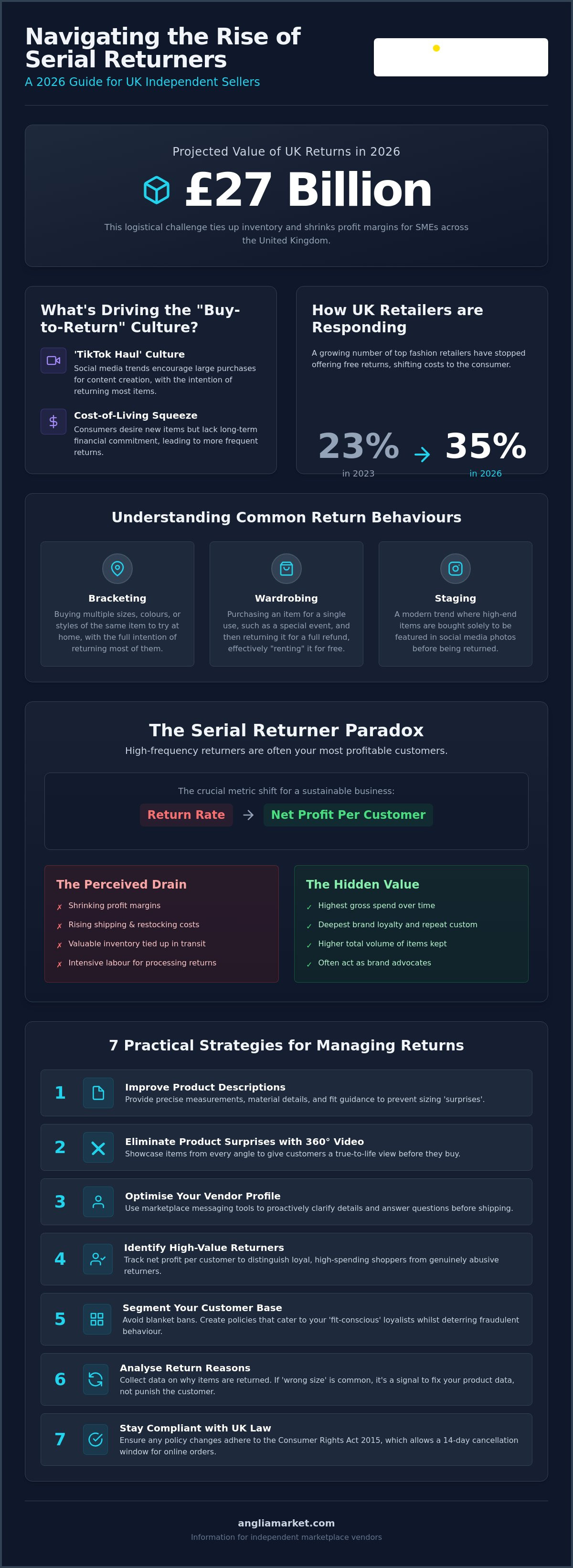
7 Practical Strategies for Dealing with Serial Returners
Dealing with serial returners requires a proactive strategy that balances customer satisfaction with financial reality. You don't have to rely on aggressive bans to protect your margins. Instead, focus on reducing the 'expectation gap' that leads to returns in the first place. By providing better information upfront, you help customers make the right choice before they ever hit the 'buy' button.
High-quality visuals are your first line of defence. Use 360-degree video to show products from every angle. This is particularly effective for high-ticket items where texture and scale are hard to judge from a static photo. Combine this with 'real-person' sizing. Seeing a product on various body types or in actual living spaces helps shoppers visualise the item more accurately. This transparency builds trust and significantly cuts down on 'surprise' returns.
Leveraging Content to Reduce Returns
Content is a powerful tool for prevention. User-Generated Content (UGC) provides social proof and a realistic view of your products. Encourage customers to upload photos of their purchases. Detailed descriptions are equally vital. Don't just list dimensions; describe the fabric 'feel', the weight of the material, and provide clear 'true-to-size' indicators. Pre-purchase FAQs can address common concerns about fit or assembly. If you provide these answers early, you reduce the likelihood of a customer buying multiple versions just to 'test' them out.
Policy Adjustments for Profitability
Your returns policy should be dynamic, not static. Consider implementing a 'Loyalty-Based' system. You can offer free returns as an exclusive benefit for members of your loyalty programme whilst charging a nominal fee for guest checkouts. This encourages repeat business whilst covering your logistical costs for casual shoppers. Other effective policy tweaks include:
- Offering free returns only if the refund is taken as store credit for future home and garden purchases.
- Shortening return windows for high-risk categories like 'occasion wear' to prevent wardrobing.
- Charging a flat 'processing fee' for returns to discourage the habit of 'bracketing' multiple sizes.
- Using personalised 'gentle nudge' emails for customers whose return behaviour is approaching an unprofitable threshold.
Moving beyond generic 'Small/Medium/Large' labels is essential for UK clothing and furniture brands. Provide actual measurements and consider using fit-finder tools. These small adjustments help shoppers find the perfect match on their first attempt. To start implementing these changes today, ensure you update your vendor profile with the most accurate and detailed product information possible.
Managing Returns on a Marketplace: Tips for Anglia Market Vendors
Selling on a marketplace requires a different mindset than running a standalone site. You have less control over the core platform rules, but you have powerful tools to protect your business. Dealing with serial returners starts with a professional and transparent vendor profile. When buyers see a detailed "About" section and clear shop-specific policies, they are less likely to treat your shop as a faceless corporation. Trust reduces the urge to make 'test' purchases.
Don't wait for a return to happen. Use the marketplace's messaging tools to clarify product details before you ship. If you notice a customer has ordered the same item in three different colours or sizes, send a quick, helpful note. Confirming their measurements or explaining a specific shade can prevent a return before the parcel leaves your hands. This proactive communication shows you care about their experience whilst protecting your own stock levels.
Handling disputes is a delicate balance. You must protect your margins without damaging your seller rating. Always respond to return requests promptly and professionally. Clear, honest communication in your individual shop policies is vital. If a return is inevitable, ensure the process is smooth. A high seller rating is a valuable asset; it attracts better customers who are often less likely to engage in abusive return behaviour.
Success as an Independent Seller
Building a strong brand identity is your best defence. Customers are less likely to 'wardrobe' an item when they feel a personal connection to an independent label. Encourage testimonials that specifically mention accurate sizing and product quality. These reviews act as a guide for future shoppers, helping them make better decisions. You can also utilise marketplace data to spot repeat offenders. If a buyer consistently returns items across different product lines, you can adjust your engagement with them accordingly.
Conclusion: Balancing Growth and Protection
A nuanced approach to serial returners is the key to sustainable e-commerce in 2026. The goal is not to achieve zero returns. That is unrealistic in a digital world. Instead, focus on achieving profitable returns. By segmenting your customers and providing exceptional product information, you can protect your margins whilst maintaining the loyalty of your best shoppers. It's about being a helpful and efficient facilitator of great commerce.
Ready to put these strategies into practice? Start selling online with Anglia Market and grow your business today. Our platform is designed to support UK SMEs as they navigate the complexities of modern retail.
Maximising Profitability in the 2026 Retail Climate
Dealing with serial returners isn't about shutting doors; it's about opening the right ones. By shifting your focus from return rates to net profitability, you can protect your margins whilst rewarding your most active buyers. High-quality product descriptions and immersive visuals remain your best tools for preventing returns before they happen. Your success depends on a strategy that balances customer experience with operational efficiency.
Whether you are adjusting your return windows or incentivising store credit, the goal is sustainable growth. A data-driven approach allows you to identify high-value shoppers and separate them from net-loss accounts. This nuance is what keeps independent businesses competitive in an increasingly complex marketplace.
Anglia Market is here to support UK-based SMEs with a platform designed for regional independent commerce. You get access to thousands of active UK shoppers and a simple fee structure built for independent vendors. Open your seller account on Anglia Market today and take control of your e-commerce future. You have the tools to thrive in 2026. Start building a more resilient business today.
Frequently Asked Questions
Is it legal to ban a serial returner in the UK?
Yes, it's legal for UK businesses to stop serving a customer as long as you aren't discriminating based on protected characteristics like age or disability. You must still honour your legal obligations for any orders already placed. If a shopper's behaviour is consistently unprofitable, you can choose to block their future access to your shop by updating your terms of service.
How can I identify a serial returner without expensive software?
You can track problematic behaviour manually by auditing your order history and looking for recurring email addresses or postcodes. Use a basic spreadsheet to calculate the net spend versus the return rate for your top customers. This simple data analysis helps you identify who is keeping stock and who is just using your warehouse as a revolving door for their wardrobe.
What is the average return rate for UK e-commerce businesses in 2026?
The average e-commerce return rate in the UK currently sits at 18%. For fashion-specific retailers, this figure is much higher, often reaching between 25% and 40%. These 2026 statistics highlight why dealing with serial returners has become a critical priority for small businesses trying to protect their margins from rising logistical costs and inventory depreciation.
Should I charge for returns to discourage bracketing?
Charging for returns is an effective way to recover costs and discourage the habit of bracketing multiple sizes. No major UK retailer that has introduced return fees in the last three years has reversed that decision. It forces customers to be more intentional with their purchases whilst helping you cover the labour of unboxing, inspecting, and restocking your inventory.
How do I write a returns policy that protects my business but stays fair?
Start by clearly stating the statutory 14-day cancellation window required by UK law. Use plain English to explain what condition items must be in to qualify for a full refund. A fair policy should offer a longer window for exchanges or store credit, which protects your cash flow whilst keeping the customer happy and encouraging future sales.
Does 'free shipping' encourage more serial returns?
Free shipping often leads to higher return rates because it removes the financial friction for the shopper. When customers don't pay for delivery, they feel less pressure to get the order right the first time. It's a common challenge when dealing with serial returners who view the lack of shipping costs as an invitation to over-order without intent to keep.
What is 'wardrobing' and how can I prove a customer is doing it?
Wardrobing is the practice of wearing an item for a special event and returning it as "new". You can prove this by using large, visible security tags that must remain attached for a refund. Inspect returns for signs of wear, such as perfume scents or makeup marks, which render the item unsellable under the Consumer Rights Act's fair use guidelines.
How do I handle a customer who claims an item is faulty just to get a free return?
Always ask for clear photos of the reported fault before approving a return label. Under UK law, faulty goods can have an extended returns period of up to 180 days. If the item arrives and the fault is non-existent, your policy should allow you to deduct the return shipping cost from the refund. Honest communication about your inspection process often discourages false claims.

Here to help — ask anything
If you have any questions regarding this disclaimer or any of our policies, please contact Anglia Market through the contact page on our website, by email using the address provided on the site, or by phone at 0333 772 2593