
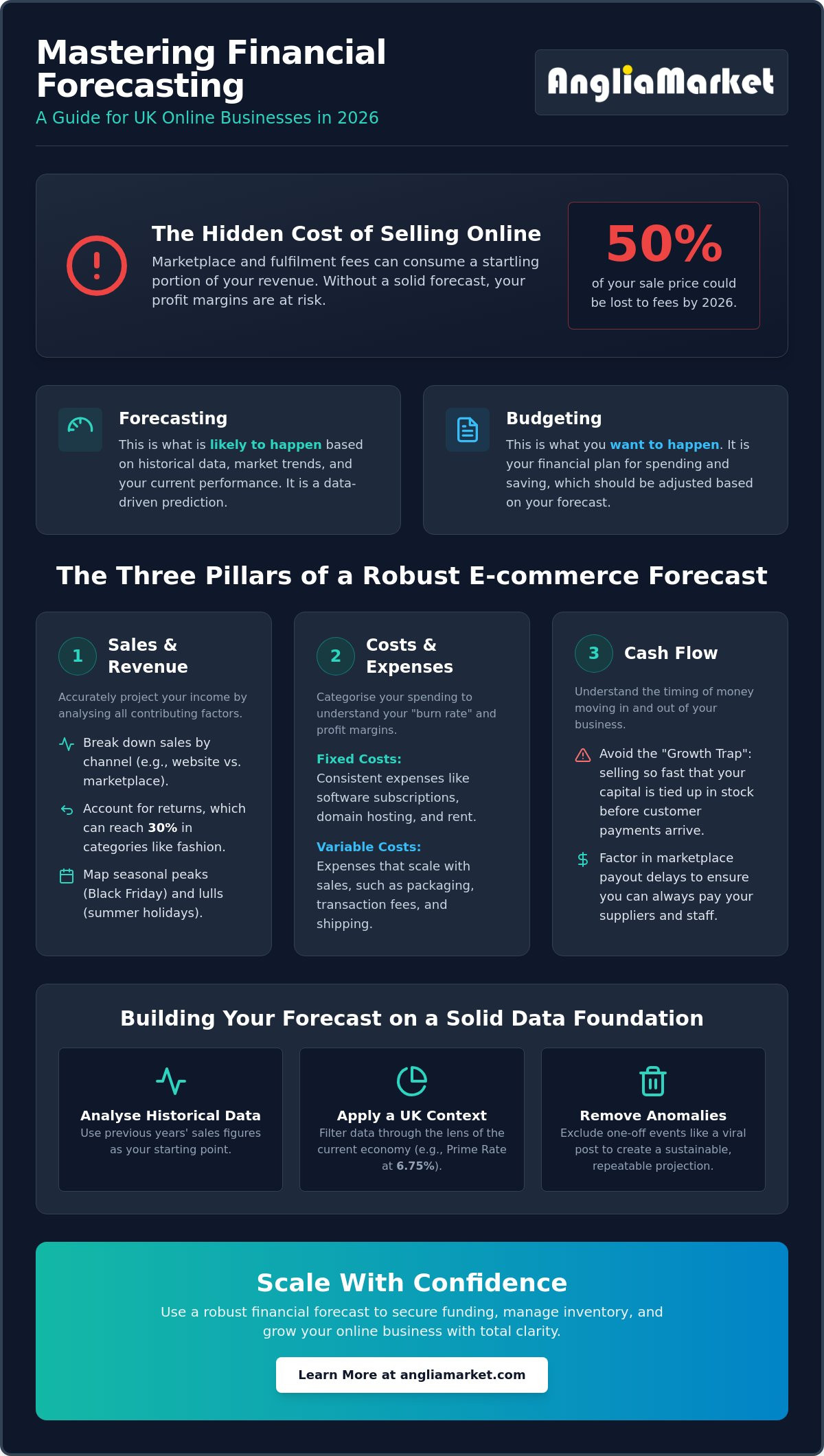
Did you know that the total cost of selling on global marketplace platforms with fulfilment services can swallow up to 50% of your sale price in 2026? It's a startling figure that catches many independent sellers off guard. You've likely felt the frustration of hidden marketplace fees eating your margins or the stress of unpredictable cash flow spikes. Mastering financial forecasting for a small online business isn't just about spreadsheets; it's about survival and growth in a competitive digital market.
You deserve a clear roadmap for inventory purchasing and the confidence to hire new staff or expand your product lines. We'll show you how to build a practical, UK-focused framework that tracks digital marketing ROI and accounts for the latest marketplace fee structures. We're looking at everything from basic cash flow management to creating professional forecasts that satisfy lenders and partners alike—a step that is especially vital for medical professionals who may consult Mortgages for Doctors when seeking property finance. We'll also help you organise your tax obligations and plan for future growth with total clarity.
Key Takeaways
- Understand why digital forecasting requires more agility than traditional retail due to faster feedback loops and shifting online customer behaviour.
- Master the core pillars of financial forecasting for a small online business by accurately predicting sales volumes across organic and paid channels.
- Learn how to build marketplace commissions and digital marketing acquisition costs directly into your pricing to protect your bottom line.
- Implement a practical five-step framework to map out your monthly "burn rate" and establish a secure minimum operating budget.
- Gain the confidence to scale your operations and invest in new inventory by leveraging the stability of established UK vendor communities.
What is Financial Forecasting for Small Online Businesses?
Effective financial forecasting for a small online business is your strategic estimate of future revenue and expenses over a set period, typically the next 12 months. Unlike traditional bookkeeping, which focuses on past transactions, forecasting looks through the windscreen at the road ahead. It allows you to anticipate cash flow needs before they become emergencies. A precise financial forecast serves as the navigational chart for e-commerce survival in 2026.
Operating in a digital environment differs significantly from high-street retail. You deal with much faster feedback loops; a change in a search algorithm or a sudden shift in social media trends can impact your sales within hours. Customer behaviour is more volatile online, making your projections vital for staying agile. Shifting your mindset from recording the past to predicting the future helps you organise your growth with purpose rather than reacting to every market ripple.
Forecasting vs. Budgeting: Knowing the Difference
Budgeting is essentially what you want to happen. It's your plan for spending and saving. A Financial forecast is what is likely to happen based on current data and reality. Online businesses need both to manage stock levels effectively whilst avoiding the dreaded "cash crunch" where your money is tied up in inventory you can't move. You should use your forecast to adjust your budget in real-time. If your forecast shows a dip in marketplace traffic for next month, you can proactively trim your marketing spend or delay a new product launch to protect your margins.
The Role of Historical Data in 2026
Successful financial forecasting for a small online business relies on high-quality data. You should utilise your sales figures from the previous year, but you must filter them through the lens of the current UK economic climate. For instance, with the current Prime Rate at 6.75%, your cost of borrowing or servicing debt might be higher than it was eighteen months ago. If you're a brand-new startup with zero sales history, look at UK e-commerce benchmarks for your specific niche to build your initial model.
Data cleaning is a vital step in this process. You must identify and remove one-off anomalies that won't necessarily repeat. A single viral social media post might have caused a massive sales spike last July, but you shouldn't bank on that happening again in your 2026 projections. Removing these "outliers" ensures your forecast remains grounded in repeatable, sustainable growth patterns rather than temporary luck.
The Three Pillars of a Robust E-commerce Forecast
Building a reliable model for financial forecasting for a small online business requires looking beyond simple profit and loss. You need to understand the mechanics of how money actually moves through your digital shopfront. For small vendors, profit is an idea, but cash is reality. To stay solvent and ready for growth, you must focus on three core areas: sales revenue, operating expenses, and the precise timing of your cash flow.
Predicting Sales Volume and Revenue
Revenue isn't just a single headline figure; it's the result of your various traffic sources working together. You should break down your projections by channel, comparing your direct website sales against performance on marketplaces like Anglia Market. It's vital to account for returns and refunds. In the UK e-commerce sector, return rates can vary wildly by category, often reaching 30% in fashion. If you don't deduct these from your forecast, you'll significantly overestimate your actual income. You also need to map out seasonal peaks like Black Friday and Christmas, whilst preparing for the inevitable summer lulls when UK shoppers are often away on holiday.
Managing Fixed and Variable Costs
Your costs fall into two distinct buckets. Fixed costs are the "burn rate" required to keep the digital lights on, such as domain hosting, software subscriptions, and small office rent. Variable costs fluctuate directly with your order volume. These include packaging materials, transaction fees, and shipping rates. In 2026, you must keep a close eye on inflation affecting raw materials and delivery charges. Utilising established financial forecasting methods can help you model how a small increase in courier fees might impact your overall margins over a twelve month period.
The Cash Flow Statement: Preventing the "Growth Trap"
The "growth trap" occurs when an online business sells too much too fast. If you've spent all your capital on inventory but haven't yet received the funds from your latest sales due to marketplace payout delays, you can't pay your bills. You must manage the gap between buying stock and receiving customer money. To make these predictions more accurate, integrate data from your loyalty program. Knowing your repeat purchase behaviour helps you predict future income without relying solely on expensive new customer acquisition. If you're looking to expand your reach whilst managing these costs, you might consider how to sell online amongst a community of local vendors to simplify your logistical planning.
Factoring in Online-Specific Variables and Marketplace Fees
Predicting your bottom line requires a deep dive into the specific variables of the digital marketplace. High-street retailers don't have to worry about algorithm shifts or click-through rates, but these are the lifeblood of your operation. To build realistic financial projections, you must account for commission structures that vary significantly by platform. This level of detail is what separates a vague guess from professional financial forecasting for a small online business.
Marketplace commissions are often your largest variable expense. Whilst some platforms charge a flat percentage, others include per-order fees and payment processing costs. For instance, TikTok Shop fees in 2026 are set at 8% plus a £0.30 per order fee. Total fulfilment costs on large global platforms can even swallow 35% to 50% of your sale price once storage and shipping are included. You must build these baseline fees directly into your price-point forecast to ensure your margins remain healthy even after the platform takes its cut.
Marketplace vs. Direct-to-Consumer (DTC) Margins
A common mistake is fearing the commission fee. A 15% fee on a marketplace might seem high compared to your own site's 3% transaction fee. However, the marketplace provides the traffic. You don't have to pay for every click to get a pair of eyes on your product. Selling via Anglia Market allows you to test new product lines without the heavy upfront marketing costs of a DTC launch. This visibility often creates a "Halo Effect," where customers discover you on a marketplace and later visit your direct site to join a loyalty programme or browse your full catalogue.
Ad Spend and Customer Acquisition Costs
Your "Marketing Ceiling" is the maximum amount you can spend to acquire a customer whilst remaining profitable. If your Cost Per Acquisition (CPA) exceeds your gross margin, your business is shrinking with every sale. You should also factor in seasonal ad-rate hikes. In the final quarter of the year, competition for digital ad space intensifies, often doubling the cost of social media advertising. Professional financial forecasting for a small online business accounts for these spikes, ensuring you have the cash reserves to compete when traffic is at its peak.
Shipping, Logistics, and Inventory Turnover
Logistics costs are rarely static. Royal Mail rates and private courier fuel surcharges fluctuate, particularly in the UK market where peak surcharges often apply between October and January. Your forecast must also track inventory turnover. If your capital is locked in a warehouse or a spare room for six months, you cannot reinvest that money into new stock or marketing. Aim for a lean turnover rate to keep your cash flow fluid. Managing this balance is essential for maintaining a steady "burn rate" whilst scaling your operations.
A 5-Step Practical Framework for Your 2026 Forecast
Creating a reliable model for financial forecasting for a small online business doesn't require a degree in accounting. It requires a logical, repeatable process. In 2026, agility is your greatest asset. Follow these five steps to build a framework that protects your cash flow whilst allowing for rapid expansion.
- Step 1: Collate your data. Gather your sales and expense figures from the last 12 months. If you're a new startup, use UK e-commerce benchmarks to estimate your initial traffic and conversion rates.
- Step 2: Map your burn rate. Identify the absolute minimum cost to stay in business each month; this includes hosting, basic software, and any essential storage fees.
- Step 3: Create three scenarios. Model "Conservative," "Expected," and "Aggressive" outcomes. This 2026 Agility Model ensures you aren't blindsided by a slow month or a sudden surge.
- Step 4: Layer in promotions. Add your marketing calendar and planned promotions. Ensure you have the capital to buy stock before these peaks occur.
- Step 5: Review monthly. Your forecast is a living document, not a one-time task. Spend 30 minutes every four weeks comparing your actual performance against your projections to organise your next steps.
Scenario Planning: Preparing for the Unexpected
The "Worst Case" scenario is often the most useful. What happens if a key supplier raises prices by 15%? By modelling this now, you can decide whether to absorb the cost or adjust your pricing. Conversely, you must prepare for viral success. Many small businesses fail because they lack the cash to restock after an unexpected sales spike. A conservative forecast ensures you can still pay yourself even during the quietest UK retail months.
Leveraging AI and Modern Tools
Modern spreadsheet plugins now use AI to spot seasonal trends you might miss with the naked eye. Leveraging these tools makes financial forecasting for a small online business significantly more accurate. You can automate data imports directly from your seller account to keep your models updated in real-time. Keep your model simple. A complex spreadsheet you don't understand is useless. Focus on the core pillars of revenue and expenses to maintain clarity. If you're ready to grow your reach, register as a vendor to start gathering the real-time data you need for accurate forecasting.
Scaling with Confidence: Leveraging Marketplaces for Growth
A robust model for financial forecasting for a small online business does more than just track numbers; it provides the "green light" for your next big move. When your projections show a consistent surplus and a healthy inventory turnover rate, you can invest in more stock with total certainty. You no longer have to guess if you can afford a bulk order. You have the data to prove it. This clarity is essential for any vendor looking to move from a part-time side-hustle to a full-time commercial enterprise.
Reducing risk is a major benefit of accurate forecasting. By selling amongst a community of established UK vendors, you gain stability that a standalone site often lacks. You can use your forecast to identify which products are driving your growth and which are simply taking up space. Financial forecasting for a small online business is ultimately your best tool for peace of mind. It turns the "what ifs" of e-commerce into a manageable, professional roadmap for success.
Why Anglia Market is the Ideal Partner for Small Businesses
Scaling your business requires reach, but traditional advertising costs can be prohibitive for independent sellers. Joining our platform gives you immediate access to a broader customer base without those high upfront fees. We handle the technical infrastructure and transactional security, allowing you to focus entirely on your product quality and customer service. You can also check out our current promotions to see how we actively drive traffic to our sellers. This collaborative environment helps you maintain the margins you've carefully projected in your forecast.
Taking the Next Step as a Professional Vendor
You can start selling online today and begin building your first sustainable revenue stream. Joining a network of UK SMEs focused on quality and value provides the support you need to scale safely. As your sales data grows, your forecasts will become even more precise, allowing you to refine your inventory and marketing spend. Ready to grow? Register as an Anglia Market vendor and start your journey toward a professional, data-driven e-commerce business. Your future growth is waiting for its first forecast.
Take Control of Your 2026 Growth
You now have the tools to move beyond basic bookkeeping and master the art of prediction. By identifying your monthly "burn rate" and building marketplace commissions into your price points, you ensure your business remains profitable during every season. Effective financial forecasting for a small online business provides the clarity you need to invest in new inventory and expand your reach with total confidence. It's about turning "what ifs" into actionable data.
Scaling doesn't have to be a solo journey. We provide dedicated UK-based support for independent SMEs and a simple commission structure that makes your future forecasting straightforward. You'll also reach thousands of active UK shoppers through a platform designed to facilitate your commercial success. Join Anglia Market as a vendor and scale your business today to start turning your projections into reality.
Join Anglia Market as a vendor and scale your business today. We're ready to help you build a resilient, data-driven future.
Frequently Asked Questions
How far ahead should a small online business forecast?
You should aim to forecast 12 months ahead to capture a full cycle of seasonal peaks and troughs. This timeframe allows you to plan for major UK retail events like Black Friday whilst maintaining a buffer for quieter summer periods. Whilst three-year plans are useful for long-term vision, the volatility of digital markets makes a rolling 12-month model the most practical choice for daily operations and inventory management.
Can I do financial forecasting in a simple spreadsheet?
Yes, a simple spreadsheet is often more effective than complex software for financial forecasting for a small online business. It allows you to maintain total control over your variables without getting lost in automated features you don't need. Focus on clear columns for revenue, fixed costs, and variable marketplace fees. As long as your data is clean, a basic file provides all the visibility required for professional growth.
What is the most common mistake in e-commerce forecasting?
The most frequent error is projecting gross sales without deducting marketplace commissions and high UK return rates. If you forget that fashion returns can often reach 30%, your cash flow projections will be fundamentally flawed. You must also account for the lag between a sale occurring and the funds actually landing in your bank account. Ignoring these hidden deductions often leads to a preventable cash crunch during scaling.
How do I forecast sales for a brand-new product with no history?
You should utilise industry benchmarks for UK e-commerce conversion rates within your specific niche. Look at competitor price points and average traffic volumes for similar keywords to build a conservative estimate. If you are launching on a marketplace, use category-wide performance data to gauge potential demand. Testing small batches of inventory first provides the real-world data needed to refine your forecast before committing to larger orders.
Should I include my own salary in the financial forecast?
How often should I update my business forecast in 2026?
You should review and update your projections at the end of every month. This rolling forecast approach allows you to compare your actual performance against your estimates and adjust for the next period. In the fast-paced 2026 digital landscape, quarterly reviews are often too slow to catch shifting ad-rate spikes or logistical price changes. Monthly updates keep your strategy agile and your cash flow secure.
What is a "burn rate" and why does it matter for online shops?
Your burn rate is the total sum of fixed costs required to keep your digital shopfront active before making a single sale. This includes software subscriptions, storage, and domain hosting. Knowing this figure is critical because it tells you exactly how much "runway" you have in the bank. If sales slow down, your burn rate dictates how long you can survive whilst you organise a new marketing strategy or promotional push.

Here to help — ask anything
If you have any questions regarding this disclaimer or any of our policies, please contact Anglia Market through the contact page on our website, by email using the address provided on the site, or by phone at 0333 772 2593