
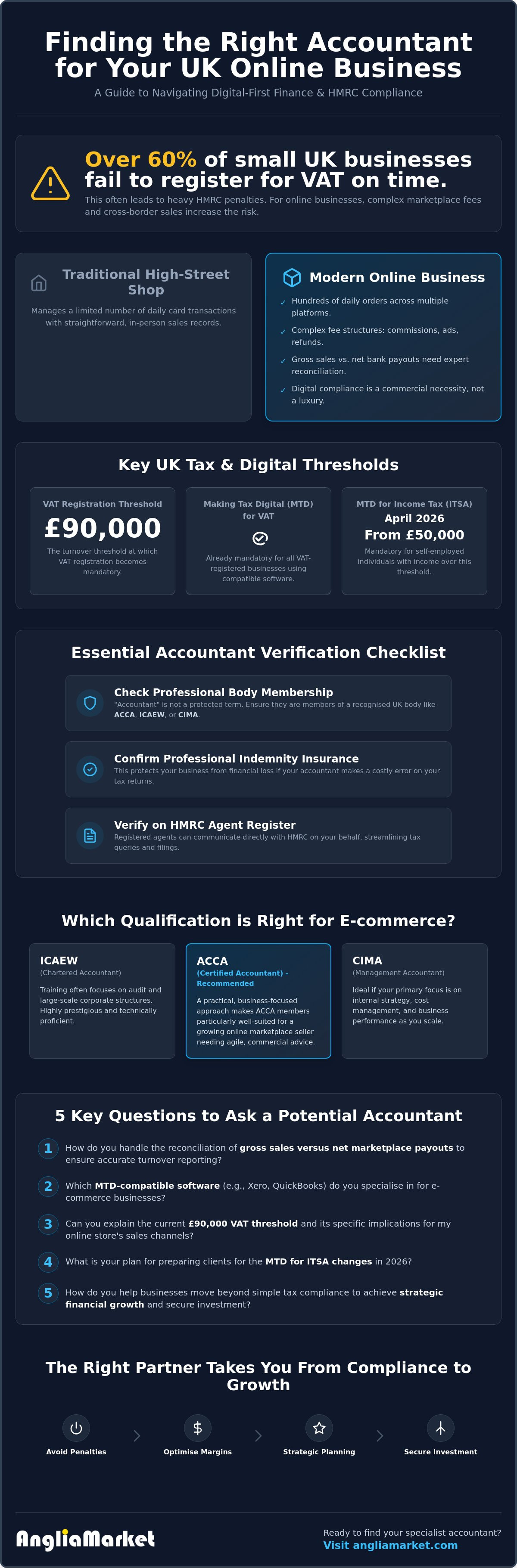
Over 60% of small UK businesses fail to register for VAT on time, according to recent industry estimates. This often leads to heavy HMRC penalties that could have been avoided with the right professional support. If you feel overwhelmed by marketplace fee structures or the complexity of cross-border sales, you aren't alone. With the VAT registration threshold now at £90,000 and the rollout of Making Tax Digital (MTD) for Income Tax Self Assessment in April 2026, the stakes for compliance are higher than ever. Finding a good accountant for your online business is no longer just a luxury. It's a commercial necessity to ensure you don't overpay for generic services that don't fit your digital model.
You deserve a partner who understands that your business doesn't operate like a local high-street shop. We'll show you exactly how to identify and hire a specialist who masters digital inventory and MTD-compatible software like Xero or QuickBooks. This guide covers the essential vetting process, from checking their technical knowledge of marketplace APIs to ensuring they can handle the £50,000 MTD for ITSA threshold. Discover how to protect your margins and stay on the right side of the taxman while focusing on what you do best: selling.
Key Takeaways
- Understand why a digital-first specialist is vital if you don't want to struggle with complex marketplace fee structures and inventory tracking.
- Identify the essential UK qualifications to look for, such as ACCA or ICAEW, ensuring your enterprise stays protected from uncertified risks.
- Streamline the process of finding a good accountant for your online business by testing their specific knowledge on the £90,000 VAT threshold.
- Prepare for consultations with five targeted questions designed to expose common red flags and digital proficiency gaps.
- Discover how a strategic financial partner helps you move from simple compliance to securing the investment needed for long-term growth.
Why Your Online Business Needs a Specialist E-commerce Accountant
A traditional high-street shop handles a few dozen card transactions a day. Your online business might process hundreds of orders across three different platforms and two continents before lunch. This scale changes everything. Traditional accounting methods often fail to capture the reality of digital trade. This is why finding a good accountant for your online business is the most important hire you'll make this year. You need someone who understands that your bank balance doesn't always reflect your true turnover.
An e-commerce specialist acts as a digital-first partner. They don't just file your year-end accounts; they help you transition from basic bookkeeping to strategic financial management. DIY accounting is a high-risk gamble. HMRC penalties for incorrect VAT filings or missed deadlines can wipe out your monthly profits. Working with British qualified accountants ensures your business remains compliant whilst you focus on scaling your inventory. They bridge the gap between your sales platform and the taxman.
The Complexity of Marketplace Transactions
Marketplaces don't make it easy. They send you a net payout, but HMRC wants to see your gross sales. If you only record the cash hitting your bank account, you're under-reporting turnover and over-paying tax. You must account for platform commission fees, advertising spend deducted at source, and refunded items. Generalist accountants often struggle with these high-volume, low-value data sets. A specialist uses automated tools to reconcile every penny, protecting your true margins and ensuring you don't pay tax on money you never actually received.
HMRC and Making Tax Digital (MTD) Requirements
The tax landscape in 2026 is strictly digital. As of 6 April 2026, MTD for Income Tax Self Assessment (ITSA) is mandatory for self-employed sellers with a gross qualifying income exceeding £50,000. This is a major shift from annual filings to quarterly updates. Making Tax Digital is a mandatory HMRC programme for all VAT-registered businesses. Failing to use MTD-compatible software like Xero or QuickBooks leads to points-based penalties and financial fines. A specialist ensures your systems are ready for these rules, keeping your digital record-keeping accurate and your filings on time.
Essential Qualifications: How to Verify a UK Accountant
Anyone in the UK can print a business card and call themselves an accountant. It's a surprising reality. Unlike law or medicine, "accountant" isn't a protected legal term. This makes the task of finding a good accountant for your online business more than just a search; it's a verification mission. You shouldn't trust your marketplace turnover to someone without professional oversight. Without a qualified professional, you risk receiving advice that doesn't comply with current HMRC standards.
The gold standard involves looking for members of the main UK bodies: the Association of Chartered Certified Accountants (ACCA), the Institute of Chartered Accountants in England and Wales (ICAEW), or the Chartered Institute of Management Accountants (CIMA). These organisations require rigorous training and adherence to strict ethical codes. When Choosing an Accountant, always check they hold Professional Indemnity Insurance. This protects you if they make a costly error on your tax return. You should also confirm they are registered on the HMRC agent register for added security. This ensures they can communicate directly with the tax office on your behalf.
Chartered vs. Certified: What is the Difference?
Chartered Accountants (ICAEW) often undergo training focused on audit and large-scale corporate structures. They are highly prestigious and technically proficient. Certified Accountants (ACCA) take a more practical, business-focused approach. This often makes ACCA members particularly well-suited for a growing online marketplace seller who needs agile, commercial advice. If you're focusing on internal strategy and cost management as you scale, a CIMA-qualified professional might be your best bet. Each path provides a solid foundation, but the practical nature of the ACCA syllabus often aligns well with the fast-paced retail sector.
Checking Credentials and References
Don't take a candidate's word for it. Use the official member directories provided by the professional bodies to verify their status. It only takes a few minutes to search a name or firm. Once you've confirmed their qualifications, look for e-commerce experience. Ask for client testimonials from other marketplace vendors. Seeing how they helped a peer manage inventory or VAT across borders is invaluable. For instance, the Anglia Market testimonials show how important vendor trust and platform reliability are in the digital space. If you're ready to expand your reach, you can sell online with a platform that supports independent UK businesses. Finding the right financial partner ensures that as your sales grow, your compliance stays rock-solid.
Evaluating E-commerce Expertise: VAT, Inventory, and Marketplaces
Generalist accountants often see a marketplace payout as a single transaction. A specialist sees a puzzle of fees, refunds, and taxes. When you're finding a good accountant for your online business, you must move beyond basic qualifications. You need to test their technical niche knowledge. Start with the basics of the 2026/27 tax year. They should immediately know the UK VAT registration threshold is £90,000 on a rolling 12-month basis. If they can't explain why a rolling 12-month period differs from a fixed tax year, they'll likely miss your registration deadline.
Inventory valuation is another critical area. Ask them about FIFO (First-In-First-Out) versus the Weighted Average Cost method. The way you value your stock directly affects your profit margins and your Corporation Tax liability. An expert will help you choose the method that best suits your product turnover and pricing strategy. They should also be comfortable with "Place of Supply" rules. These rules determine whether you charge UK VAT on a sale or follow international tax regulations. Getting this wrong leads to expensive back-dated tax bills from HMRC.
VAT for Online Sellers: A Critical Knowledge Test
A good candidate must distinguish between zero-rated and exempt goods. This isn't just semantics; it determines which expenses you can reclaim. Ask them about Postponed VAT Accounting (PVA). This scheme is essential for importers as it allows you to account for import VAT on your periodic VAT return rather than paying it upfront at the border. They should also be able to advise whether the Flat Rate Scheme or Standard VAT is more cost-effective for your specific marketplace volumes.
Integrating with Your Sales Platform
Manual data entry is a recipe for disaster. When selling online, your financial data must flow seamlessly from your marketplace shop to your ledger. Ask potential accountants about their preferred tech stack. Most e-commerce experts rely on Xero or QuickBooks integrated with tools like A2X. This setup automates the reconciliation of payouts, ensuring your books reflect your gross sales and platform fees accurately. Real-time data flow allows for proactive tax planning rather than reactive damage control at the end of the year.
Interviewing Candidates and Comparing Fee Structures
Choosing a financial partner is a commercial decision that directly affects your bottom line. You shouldn't simply settle for the first firm you find. Finding a good accountant for your online business involves a rigorous vetting process that prioritises digital competence over geographic proximity. In 2026, the cheapest option is often the most expensive in the long run. Low-cost generalists frequently miss specific e-commerce deductions or fail to set up MTD-compliant systems correctly, leading to avoidable HMRC penalties and interest charges.
Watch out for red flags during your first interaction. Slow response times are a major warning sign; a firm that takes days to answer a simple query will likely struggle during a time-sensitive VAT audit. Lack of digital proficiency is another deal-breaker. If an accountant suggests manual spreadsheets or paper-based record-keeping, they aren't equipped for the high-volume environment of modern marketplace selling. They must be comfortable with cloud-based automation and API integrations to provide real-time value.
Fixed Fee vs. Hourly Rates: Which is Better?
Hourly billing is increasingly outdated for the e-commerce sector. It creates a conflict of interest where you pay more for a firm's inefficiency. Fixed-fee retainers are far superior because they offer price certainty and encourage your accountant to use time-saving automation. A fixed-fee retainer is the gold standard for predictable business cash flow. A standard e-commerce monthly package should include:
- Quarterly VAT return preparation and MTD filing.
- Monthly reconciliation of marketplace payouts, commissions, and advertising fees.
- Annual statutory accounts and Corporation Tax returns.
- Ongoing subscription costs for MTD-compatible software.
- Proactive advice on the £50,000 MTD for ITSA threshold.
Questions to Ask During the Initial Call
Prepare to lead the conversation during your consultation. You need to determine if the candidate actually understands the mechanics of your business model. Use these five essential questions to gauge their expertise:
- "How many other marketplace sellers do you currently represent?" You want a firm that handles e-commerce clients daily, not one that is learning on the job with your data.
- "How do you handle the reconciliation of Anglia Market fees and other platform charges?" Listen for mentions of automated tools like A2X or Link My Books that bridge the gap between your shop and your ledger.
- "What is your typical turnaround time for VAT returns and year-end accounts?" Clear service level agreements prevent last-minute stress and late-filing fees.
- "Which MTD-compatible software do you recommend for high-volume inventory?" They should have a clear preference for platforms like Xero or QuickBooks.
- "How do you stay updated on HMRC's specific rules for cross-border sales?" This tests their commitment to ongoing professional development in a changing regulatory landscape.
Once you have your financial house in order, you can focus on expanding your reach. If you are ready to find more UK customers, you can sell online with a platform that supports independent regional businesses.
Scaling Your Business with the Right Financial Support
Scaling an online venture requires more than just increasing your ad spend. It demands a shift in how you view your finances. Finding a good accountant for your online business means moving beyond basic compliance and into the territory of strategic advisory. Once your MTD filings and marketplace reconciliations are automated, your accountant should provide the data-driven insights needed for expansion. They become a key partner in your long-term strategy, helping you interpret cash flow patterns and identify which product categories offer the best return on investment.
Professional financial support is also vital when you need to secure external funding. Whether you're applying for a business loan to increase inventory or seeking private investment to launch a new brand, lenders require clean, professional accounts. An e-commerce specialist understands how to present your digital assets and recurring revenue in a way that builds trust with creditors. They ensure your balance sheet reflects the true value of your enterprise, making the path to capital much smoother.
Strategic Tax Planning for Growth
As your turnover climbs towards the £90,000 VAT threshold, your business structure deserves a second look. Your accountant will help you decide when to transition from a sole trader to a limited company. This decision is particularly pressing given the MTD for ITSA rules starting in April 2026 for those with gross income over £50,000. Operating as a limited company allows for more sophisticated tax planning, such as balancing a smaller salary with dividends. Keep in mind that the tax-free dividend allowance for the 2026/27 year is £500; your partner will help you navigate these limits to maximise your take-home pay.
Growth also brings more overheads. A specialist ensures you claim every available relief, including capital allowances on equipment and office supplies. They can also investigate if your bespoke software integrations qualify for R&D tax credits. These savings provide additional liquidity that you can reinvest directly back into your stock or marketing efforts.
Joining a Supportive Marketplace Community
Success in e-commerce isn't just about the numbers; it's about the platform you choose. High-volume sellers thrive when they're part of a community that values independent enterprise and regional growth. By choosing a marketplace that prioritises local vendors, you gain access to a customer base that appreciates quality and reliability. We invite you to become a vendor on a platform designed to facilitate your success without the predatory fee structures often found on global giants.
Focus on your products whilst your accountant handles the numbers—get started with Anglia Market today. By pairing expert financial advice with a supportive selling environment, you create a resilient business ready for whatever the 2026 retail landscape brings.
Take Control of Your E-commerce Growth
Success in the UK's 2026 e-commerce landscape depends on your ability to balance high-volume sales with strict HMRC compliance. You've learned that finding a good accountant for your online business requires more than just a quick search. It involves verifying professional credentials like ACCA or ICAEW and testing for specific marketplace technical knowledge. By prioritising specialists who understand automated reconciliation and the £90,000 VAT threshold, you protect your margins and avoid the stress of manual record-keeping.
A strategic financial partner moves you beyond simple tax filings. They provide the insights needed to reinvest in your inventory and navigate the complexities of Making Tax Digital. With your finances in safe hands, you can focus on reaching new customers and growing your brand.
Join a community that understands the needs of independent enterprises. Join Anglia Market and start selling to a wider UK audience today. Our platform is trusted by hundreds of independent vendors and uses a simple commission-based model designed specifically to support UK-based small and medium enterprises. Take the next step in your retail journey with confidence.
Frequently Asked Questions
Do I really need an accountant if I use Xero or QuickBooks?
Software is simply a recording tool; it doesn't provide professional tax advice or strategic growth planning. An accountant ensures your ledger is MTD-compliant and reconciles your gross sales against platform fees correctly. Finding a good accountant for your online business prevents "garbage in, garbage out" data errors that lead to HMRC investigations. Their expertise helps you claim all eligible reliefs that automated software might overlook.
What is the average cost of an accountant for a UK online business?
Accounting fees vary based on your transaction volume and the complexity of your marketplace integrations. Most specialists move away from hourly billing in favour of monthly retainers to offer better price certainty. You'll likely pay for the specific value of the expertise provided, especially regarding international VAT and MTD compliance. Always ask for a clear breakdown of what your monthly fee covers to avoid unexpected charges for year-end filings.
Can I use a local high-street accountant for my marketplace shop?
You can use a local firm, but they often lack the technical knowledge required for digital-first retail. High-street generalists frequently struggle with the sheer volume of marketplace data and the nuances of platform-specific fee structures. A specialist e-commerce accountant uses automated tools to sync your shop directly with your ledger, providing a level of efficiency that traditional firms rarely match. They understand the specific digital challenges your business faces daily.
When should I register for VAT as an online seller?
Registration is mandatory if your taxable turnover exceeds £90,000 in any rolling 12-month period. This is a rolling limit, not a fixed tax year calculation. You must also register if you expect to exceed this threshold in the next 30 days. For overseas businesses storing goods in the UK, there's a nil threshold, which means registration is required from the very first sale made to UK customers.
How do I switch accountants if I am unhappy with my current one?
Switching is a straightforward administrative task that your new firm will largely manage for you. Once you've appointed a new partner, they'll send a "professional clearance" request to your old accountant to transfer your records. This process is common and professional firms are used to handling these transitions smoothly. It's best to switch after a VAT quarter to keep your records clean and avoid mid-period complications.
What documents do I need to provide to my new accountant?
You must provide your most recent statutory accounts, tax returns, and current trial balance. Access to your MTD-compatible software is essential so they can review your digital records. You should also have your VAT registration certificate and any recent correspondence from HMRC ready. Providing a clear list of your marketplace platforms and integrated apps helps them understand your technical setup quickly, ensuring a smooth transition for your business.
Is it better to be a sole trader or a limited company for e-commerce?
Limited companies often become more tax-efficient as your profits grow, though they require more formal record-keeping. Being a sole trader is simpler for new vendors. However, with MTD for ITSA becoming mandatory in April 2026 for those with a gross income over £50,000, the gap in administrative effort is narrowing. Your accountant will help you weigh the benefits of limited liability against the increased Corporation Tax and filing requirements.
How does an accountant help with cross-border sales after Brexit?
Finding a good accountant for your online business is essential for handling the complexities of IOSS and Import VAT. They manage your Postponed VAT Accounting (PVA) entries and ensure you have the correct EORI numbers for smooth customs clearance. By handling these technical details, they prevent your international orders from being held at the border. This expertise is vital for maintaining a positive customer experience whilst selling to an international audience.

Here to help — ask anything
If you have any questions regarding this disclaimer or any of our policies, please contact Anglia Market through the contact page on our website, by email using the address provided on the site, or by phone at 0333 772 2593