
What if your record-breaking sales month is actually pushing your business closer to insolvency? It's a harsh reality for many UK sellers who focus on turnover whilst ignoring silent margin killers. Understanding how to calculate profit margin for online store UK success is no longer optional in 2026. It's the difference between a thriving enterprise and a hobby that costs you money.
We agree that the confusion between markup and margin is frustrating. Hidden marketplace fees. The latest 2% Digital Services Tax surcharges. These factors eat your profits fast. You want to price items competitively without sacrificing your own salary. This guide promises to clear the fog. You'll master the exact formulas needed to stay profitable and sustainable in the current British market.
We'll preview the essential UK-specific costs you must track. Everything from the £90,000 VAT threshold to shifting shipping rates. You'll walk away with a repeatable pricing strategy that lowers your overheads and gives you a crystal-clear view of your business health.
Key Takeaways
- Understand why revenue is a vanity metric and how focusing on margins provides a realistic view of your business health.
- Master the step-by-step formulas for how to calculate profit margin for online store UK success, covering both gross and net percentages.
- Identify hidden UK-specific costs, including payment processing fees and marketplace commissions, that can quietly erode your profitability.
- Compare your store's performance against 2026 industry benchmarks across sectors such as fashion, furniture, and electronics.
- Discover how to scale your reach whilst maintaining healthy margins by leveraging a supportive UK marketplace like Anglia Market.
Understanding Profit Margins for UK E-commerce Businesses
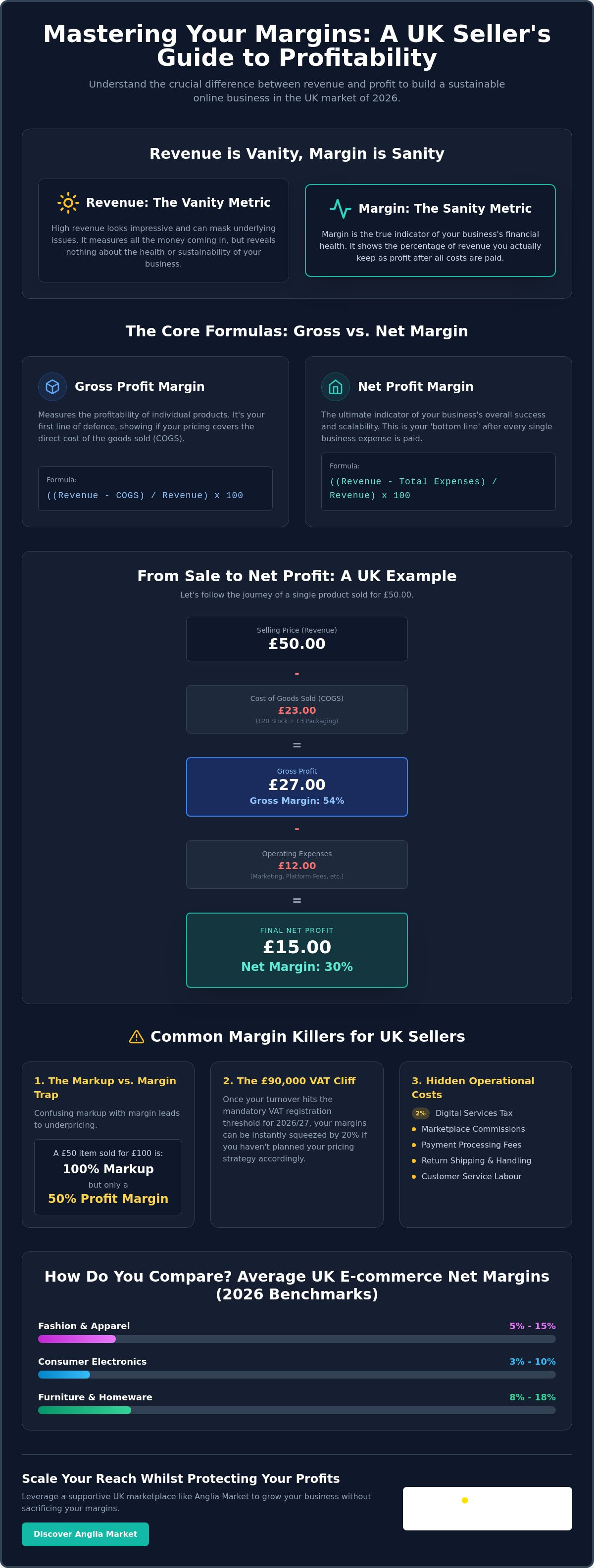
Revenue is exciting, but it doesn't pay the bills. You can generate millions in sales and still go bust if your costs are too high. A Profit margin is the percentage of your sales revenue that remains after you've paid all your business expenses. We call revenue a "vanity metric" whilst margin is your "sanity metric". High revenue looks great on a spreadsheet, but margin tells you if your business is actually healthy.
Learning how to calculate profit margin for online store UK success is vital in 2026. British consumer behaviour has shifted. Shoppers now demand more sustainable products and flexible payment options. These preferences often lead to higher transaction fees for the seller. If you don't perform regular margin audits, these small shifts in consumer preference can quietly destroy your take-home pay. When you sell online, your choice of platform directly impacts these figures.
Gross Margin vs Net Margin: What is the Difference?
Gross margin focuses on the individual product level. It's the profit you make on a single item after subtracting the cost of goods sold (COGS). This includes the purchase price from your supplier and any direct packaging costs. It is the first line of defence for your profitability.
Net margin is your "bottom line". This is the percentage left over after every single expense is paid. You must include rent, staff wages, marketing spend, and marketplace commissions. For a growing online store, net margin is the ultimate indicator of success. It shows if your business model can scale without running out of cash.
When cash flow becomes a challenge during expansion, some entrepreneurs look towards financial assistance, such as homeowner loans UK, to help manage business debt and maintain a healthy balance sheet.
Why UK Sellers Often Get the Calculation Wrong
Many new entrepreneurs fall into the "markup trap". Markup is the percentage added to the cost price to reach a selling price. Margin is the percentage of the final selling price that is profit. They aren't the same. If you buy an item for £50 and sell it for £100, your markup is 100%, but your margin is only 50%.
VAT is another common pitfall. With the mandatory VAT registration threshold at £90,000 for the 2026/27 tax year, many small businesses find their margins squeezed by 20% when they hit that limit. You must also account for the "invisible" costs of the UK market. This includes the cost of customer service time for enquiries and return shipping fees. Platform-specific regulatory operating fees also eat into your profit. Failing to track these ensures your pricing strategy is built on guesswork rather than data.
The Core Formulas: How to Calculate Your Profit Percentages
Mastering the mathematics of your business is the only way to ensure long-term growth. You need to know exactly how to calculate profit margin for online store UK operations to avoid pricing yourself out of the market. While revenue tells you how much money is coming in, these formulas tell you how much of it you actually get to keep. Let's look at the two numbers that define your commercial success.
The first step is identifying your Cost of Goods Sold (COGS). This represents the direct costs of producing or purchasing the products you sell. For a reseller, COGS is the wholesale price paid for stock plus delivery to your warehouse; for a manufacturer, it's the total cost of raw materials and direct labour used to create the item. Getting this number right is essential for setting your 2026 retail prices.
Calculating Gross Profit Margin
Your gross margin measures the efficiency of your production or sourcing. Use this formula: ((Revenue - COGS) / Revenue) x 100. When calculating COGS, you must include raw materials, manufacturing costs, and the initial shipping fees paid to get the stock to your door. This percentage shows if your individual products are priced high enough to cover their own creation.
Calculating Net Profit Margin for UK SMEs
Net margin is the ultimate indicator of long-term business survival. It accounts for every single penny that leaves your business. Use this formula: ((Total Revenue - Total Expenses) / Total Revenue) x 100. Unlike gross margin, this calculation includes operating expenses such as website hosting, business insurance, and marketing spend. If your net margin is negative, you're losing money on every sale, regardless of how high your gross margin looks.
Let's look at a worked example for a product sold for £50.00 in the UK:
- Selling Price: £50.00
- COGS: £20.00 (Stock) + £3.00 (Packaging and inbound shipping) = £23.00
- Gross Profit: £27.00
- Gross Margin: 54%
- Operating Expenses: £12.00 (Marketing, insurance, and platform fees)
- Net Profit: £15.00
- Net Margin: 30%
In this scenario, you keep 30p for every £1.00 of sales. This is a healthy position for most UK e-commerce sectors. If you're looking for a platform that helps you reach customers without the complex fee structures of global giants, you can explore how to become one of our independent UK vendors. Keeping your expenses predictable makes these calculations much easier to manage as you scale.
Hidden Costs for UK Sellers: Marketplace Fees and Logistics
Calculating your base costs is only half the battle. Many entrepreneurs overlook the silent killers that drain bank accounts after the sale is finalised. If you want to know how to calculate profit margin for online store UK operations accurately, you must look beyond the wholesale price. Marketplace commissions and logistics are where most margins vanish. These costs are often variable, making them difficult to track without a rigorous system.
Marketplace Commissions and Listing Fees
Commissions aren't just a single percentage. In 2026, UK sellers face multi-layered fees that vary wildly between platforms. Some global giants apply a 2% Digital Services Tax surcharge on top of referral fees that already range from 8% to 15%. Others include specific regulatory operating fees alongside transaction and payment processing costs. These micro-costs add up quickly. When you are selling online with Anglia Market, you benefit from a transparent fee structure designed to support independent SMEs rather than penalise them with hidden layers.
Packaging and Last-Mile Delivery Costs
Sustainable packaging is no longer a luxury; it's a 2026 consumer expectation. However, eco-friendly mailers and recycled void fill often cost significantly more than traditional plastic alternatives. You must also account for the "Free Shipping" trap. This is always a marketing expense, never a zero-sum game. If a courier charges £4.50 for a tracked delivery, that £4.50 must be baked into your item price. If you don't, your net margin will collapse as soon as you hit a high volume of orders.
The "Return Factor" is another critical element. In the UK e-commerce market, a 10% return rate is common for general goods, and even higher for fashion. If you sell ten items and one comes back, you haven't just lost that sale. You've paid for the original outbound shipping, the return postage, and the payment processing fees, which are rarely refunded by providers like Stripe or PayPal. You also lose the labour cost required to inspect and restock the item.
A single return can wipe out the profit from three or four other successful sales. Smart vendors factor a "return allowance" into their initial margin calculations. This ensures that your business remains sustainable even when a small percentage of customers change their minds. Without this buffer, you're essentially gambling with your take-home pay.
Benchmarking and Improving Your Online Store Margins
Knowing how to calculate profit margin for online store UK success is only the first step. You then need to know if your numbers are actually "good". In 2026, a healthy net profit margin for UK e-commerce typically sits between 10% and 20%. However, this isn't a universal rule. Your target figure depends entirely on your specific industry and how much you spend on customer acquisition. High-volume sellers often survive on much thinner slices, whilst boutique brands require a larger buffer to remain sustainable.
Sector-Specific Margin Benchmarks for 2026
Different categories demand different strategies. For instance, electronics often see razor-thin gross margins of 5% to 10% because of intense price competition and standardised products. Success here relies on high turnover and efficient logistics. Conversely, the home and garden sector often enjoys gross margins between 30% and 50%. These higher margins are necessary to cover the increased storage and delivery costs associated with bulkier items.
Luxury goods require even higher margins, often exceeding 60%. This isn't just about profit; it covers the high cost of premium marketing and the 10% to 15% conversion boost often required from AI-driven personalisation tools. Small businesses can compete with high-volume giants by focusing on these niche, high-margin categories where personalised service adds genuine value.
Strategic Ways to Boost Your Profitability
You don't always have to raise prices to increase your take-home pay. Product bundling is a powerful tactic for 2026. By grouping related items, you increase your Average Order Value (AOV). This dilutes the impact of fixed shipping costs across multiple products. If it costs £4.50 to ship one item or three, the margin on the three-item bundle is significantly higher.
Use your data to identify "zombie" products. These are items that sell consistently but have margins so low they actually drain your resources once you factor in storage and labour. Culling these products allows you to reinvest your capital into high-performing stock. You should also regularly negotiate with your UK suppliers. Even a 2% reduction in wholesale costs or a better rate from a courier can drastically shift your net profit over a financial year.
If you're looking to improve your visibility without the high advertising overheads of other platforms, you can list your products as an independent vendor. Reaching a pre-built audience of UK shoppers is often more cost-effective than trying to drive cold traffic to a standalone site.
Scaling Your UK Business with Anglia Market
Scaling a business requires more than just knowing your numbers; it requires the right environment to grow. Once you've mastered how to calculate profit margin for online store UK success, you need to find ways to lower your customer acquisition costs (CAC). High marketing spend is often the primary reason why net margins fail to meet 2026 benchmarks. By leveraging a trusted marketplace, you can reach a broader audience without the constant financial drain of pay-per-click advertising.
Anglia Market provides that space. We focus on supporting local vendors, allowing you to tap into established traffic. This shift from "hunting" for customers to "serving" an existing marketplace community can significantly improve your bottom line. Our loyalty program is a key part of this strategy. It's much cheaper to sell to a returning customer than to find a new one. Repeat buyers increase your overall margin because you've already paid the initial cost to acquire them.
A Platform Built for Independent Sellers
Our mission is simple: we provide practical tools for UK SMEs. Whether you are selling large items in Furniture or high-turnover goods in Pet Supplies, our platform is designed for ease of use. You don't need a massive technical budget to get started. By keeping your storefront creation and maintenance costs low, you ensure that a higher percentage of every sale stays in your pocket. We handle the platform-wide promotions, so you can focus on inventory and fulfillment.
Next Steps for Your Online Store
Profitable growth isn't about luck; it's about consistent review. Use this actionable checklist to secure your future:
- Audit your COGS and operating expenses every quarter to spot margin erosion.
- Review your return rates to identify problematic products that eat your profit.
- Calculate your net margin for every category, not just your overall store.
- Apply for a vendor account to join our community of independent sellers.
Focusing on sustainable, profitable growth is the only way to survive the competitive 2026 landscape. By understanding how to calculate profit margin for online store UK metrics and choosing a platform that prioritises your success, you can build a business that lasts. We're here to facilitate that journey, providing a reliable home for your brand whilst you focus on what you do best: sourcing and selling great products to a loyal British customer base.
Build a Sustainable and Profitable UK Brand
Building a successful e-commerce brand in 2026 requires more than just great products. It demands a deep, daily understanding of your numbers. You've now mastered the difference between markup and margin. You know how to account for hidden costs like the Digital Services Tax and rising sustainable packaging prices. Most importantly, you have the tools to audit your store's health and identify the "zombie" products that drain your capital.
Mastering how to calculate profit margin for online store UK operations ensures you stay ahead of the competition. By focusing on net profit rather than just vanity revenue, you protect your take-home pay and ensure your business can scale. Choosing a platform that prioritises your growth is the final piece of the puzzle. We already support thousands of UK small businesses with a simple, transparent fee structure that removes the guesswork from your accounting.
Ready to scale your reach? Start selling on Anglia Market and grow your UK business today. Gain access to a nationwide customer base whilst keeping your overheads predictable. Your path to a sustainable online store starts with these data-driven decisions. We're excited to help you succeed.
Frequently Asked Questions
What is a healthy profit margin for an online store in the UK?
A healthy net profit margin for a UK e-commerce business in 2026 typically sits between 10% and 20%. Whilst high-volume giants might survive on margins as low as 5%, smaller independent brands often require a buffer of 20% or more. This higher percentage provides the necessary safety net to cover fluctuating marketing costs and unexpected logistics surcharges that often impact smaller enterprises.
How do I account for VAT when calculating my profit margin?
You must calculate your margins using net-of-VAT figures if you're registered. Subtract the 20% VAT from your gross selling price before you start your calculation. If you calculate your margin based on the full price paid by the customer, you're overestimating your profit by a fifth. This mistake can lead to severe cash flow problems when your quarterly VAT bill eventually arrives.
Is it better to have a high margin or high volume?
For most small to medium enterprises, a high-margin strategy is more sustainable than chasing high volume. High-volume models require significant investment in automation, warehouse space, and complex logistics to remain profitable on thin slices. High margins allow you to focus on quality and customer service whilst providing a financial cushion against rising supplier costs or changes in marketplace commission structures.
How do marketplace fees affect my net profit?
Marketplace fees act as a direct deduction from your revenue. When you're learning how to calculate profit margin for online store uk success, you must subtract referral fees, payment processing costs, and any regulatory operating surcharges. These combined costs can often reach 15% to 25% of the total sale price. Monitoring these figures ensures you don't lose your entire profit to platform commissions.
Can a profit margin be too high for an online store?
Yes, a margin can be too high if it prevents your business from growing. If your prices are significantly higher than the 2026 industry average, you're likely losing customers to more competitively priced rivals. Additionally, an excessively high margin might suggest you aren't reinvesting enough into marketing, staff, or product development to ensure the long-term health of your online store.
How often should I recalculate my store margins?
You should recalculate your store margins at least once every quarter. The UK e-commerce landscape changes fast; supplier prices, courier surcharges, and marketplace fees can all shift within a few months. A quarterly review helps you identify "margin creep" early. This allows you to adjust your pricing or negotiate better rates with your suppliers before your take-home pay is significantly affected.
What is the difference between markup and margin in simple terms?
Markup is the percentage you add to your cost price; margin is the percentage of the final selling price that you keep. For example, if you buy a product for £50 and sell it for £100, your markup is 100%. However, your profit margin is 50% because half of that final £100 is profit. It's a vital distinction that prevents you from underpricing your inventory.
Should I include my own salary in the net profit calculation?
You should always include a fair salary for yourself as an operating expense. Treating your own pay as "profit" gives a false sense of your business's financial health. By including your wage as a cost, you can see if the business is actually sustainable. If the store can't afford to pay you a market-rate salary and still show a profit, the business model needs adjusting.

Here to help — ask anything
If you have any questions regarding this disclaimer or any of our policies, please contact Anglia Market through the contact page on our website, by email using the address provided on the site, or by phone at 0333 772 2593