
Last Tuesday, a UK-based craft seller spent forty-five minutes answering twelve detailed questions about a £20 handmade cushion, only for the "buyer" to disappear without a trace. You've probably felt that same frustration while wondering how to deal with time-wasting enquiries more effectively. It's exhausting when your inbox is overflowing with messages but your sales notifications are silent. Repetitive messaging leads to genuine burnout, and it's easy to lose hours of productivity on tasks that don't actually grow your business. You want to provide great service, but you also need to protect your most valuable asset: your time.
This guide will help you identify tire-kickers before they drain your energy. We'll show you how to streamline your process for qualifying leads and provide pre-written scripts for common questions. By the end of this article, you'll have a clear plan to automate your responses. This gives you more freedom to focus on order fulfilment and the long-term growth of your brand. You'll learn to handle every message with professional efficiency, ensuring you never miss a real sale while ignoring the noise.
Key Takeaways
- Learn to spot "tire-kickers" early by identifying low-intent messages that demand high effort for zero conversion.
- Implement a three-step qualification filter to master how to deal with time-wasting enquiries and protect your most valuable asset—your time.
- Master the "Polite Pivot" and set firm office hours to maintain professional boundaries while keeping your communication efficient.
- Use automated "Welcome" and "Out of Office" messages to streamline your responses and provide instant support to potential customers.
- Discover how a structured vendor profile on a professional marketplace like Anglia Market helps reduce random enquiries and builds trust with serious UK buyers.
Spotting the Signs: Common Types of Time-Wasting Enquiries
Managing an online shop takes significant energy. Understanding how to deal with time-wasting enquiries is a key skill for any UK seller. These messages are low-intent interactions. They require high effort from you but result in zero conversion. Sellers often find themselves stuck in loops with users who aren't a Qualified Prospect. This drains your productivity and slows down your shipping schedule.
To better understand this concept, watch this helpful video:
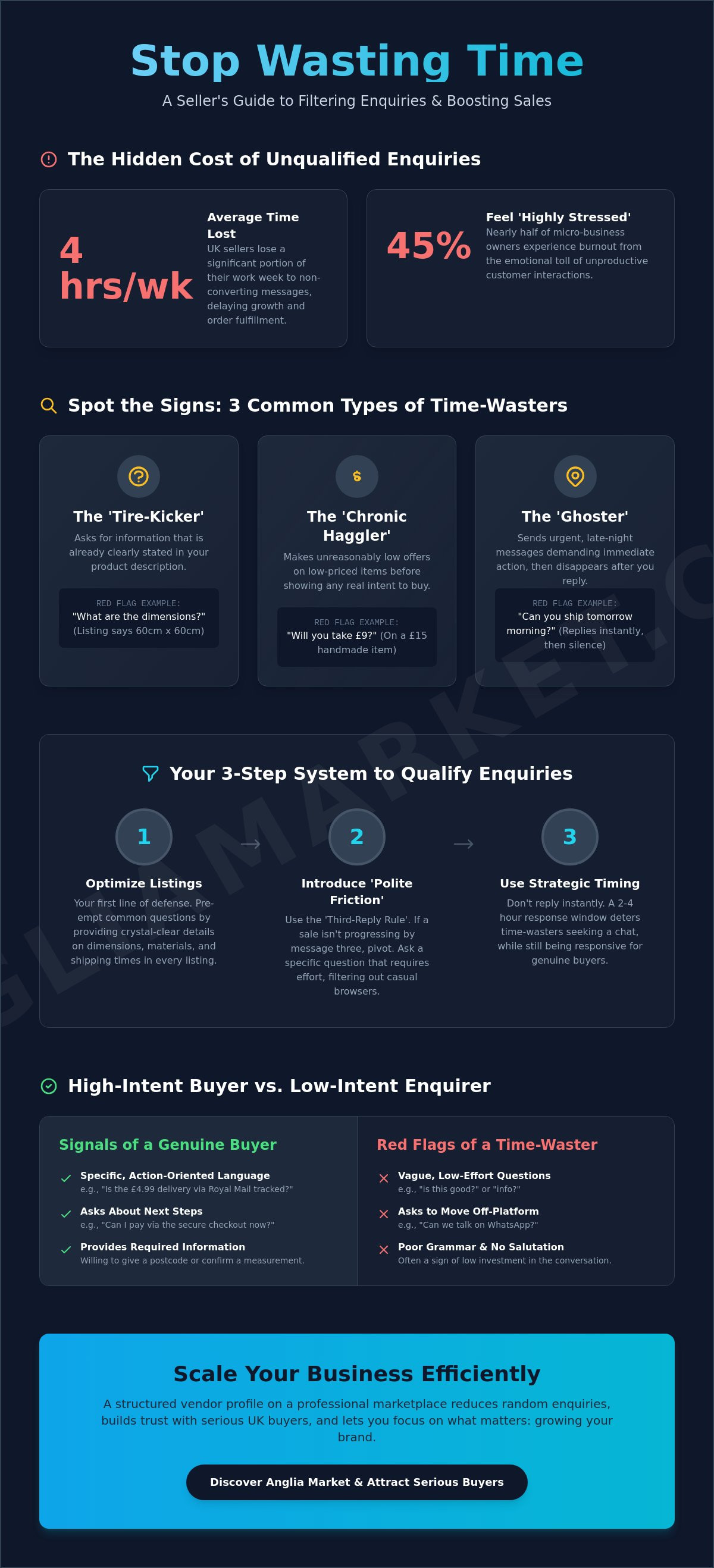
Time-wasters usually fall into three main categories. First is the 'Tire-Kicker'. They ask for the dimensions of a coffee table even though the listing clearly says '60cm x 60cm'. Second is the 'Chronic Haggler'. They demand a 40% discount on a £15 item before they even confirm they want it. Third is the 'Ghoster'. They send urgent messages at 11pm asking if you can ship tomorrow. You reply instantly; they never message back. These interactions carry a heavy emotional toll. A 2023 survey of 500 UK micro-businesses found that 45% of owners feel 'highly stressed' by non-productive customer interactions. Learning how to deal with time-wasting enquiries ensures you focus on genuine customers who value your time.
The 'Information Seeker' vs. The 'Buyer'
You must distinguish between technical queries and bored browsers. A genuine buyer asks specific questions about compatibility or shipping. A bored browser asks vague questions like "is this good?". High-intent language consists of specific, action-oriented phrases such as "can I pay via the secure checkout now" or "is the £4.99 delivery via Royal Mail tracked" that signal a readiness to purchase. Watch for red flags. Vague questions, poor grammar, or requests to move the conversation to WhatsApp are signs of a low-quality lead.
Pattern Recognition: When to Stop Replying
Successful sellers use the 'third-reply' rule. If a conversation hasn't moved toward a sale by the third message, it likely won't. If you find yourself answering the same question twice, it's a signal to update your product description immediately. This prevents future confusion. Trust your gut. A customer who is difficult during the enquiry stage often becomes a 'return' headache later. A 2023 retail study reported that UK sellers lose an average of 4 hours per week to non-converting messages. Protect your time by identifying these patterns early.
Building a Qualification System to Filter Your Inbox
Stop viewing every message notification as a customer service emergency. Most online sellers feel pressured to reply instantly, but this often backfires. To master how to deal with time-wasting enquiries, you must shift your mindset from "support" to "lead qualification." If you treat every "is this still available" message with the same urgency as a paid order, you'll burn out quickly. Your goal is to create a system that lets serious buyers through while making it slightly harder for casual browsers to take up your time.
A 3-step filter is the most effective way to protect your schedule. This includes listing clarity, pre-set questions, and strategic response timing. While it sounds counterintuitive, responding in under 60 seconds can actually attract more time-wasters. It signals that you're available for a long, real-time chat. Professional sellers often wait 2 to 4 hours to reply. This small delay filters out people looking for an instant dopamine hit from "window shopping" through messages. Genuine buyers will still be there a few hours later.
Friction is a powerful tool. By requiring the enquirer to perform a small task, you separate the wheat from the chaff. A serious buyer won't mind providing a postcode or a specific measurement requirement. A person just "bored browsing" will usually disappear when asked to do even a tiny amount of work.
Optimising Product Listings to Pre-empt Questions
Detailed listings are your first line of defence. Ensure dimensions, materials, and shipping times are prominent. You can see how detailed descriptions should look by browsing the Home and Garden or Electronics categories. When you provide every technical detail upfront, you eliminate the need for "basic" questions. Use the "FAQ at the bottom" trick. Adding a "Common Questions" section directly to your listing can reduce repetitive messages by as much as 30% based on 2023 seller data. If someone asks a question already answered in the FAQ, you know they haven't read the listing, which is a major red flag for a time-waster.
Using Pre-Qualification Questions
Use specific questions to force the buyer to prove their intent. Start by asking, "When do you need this by?" to filter out non-urgent browsers. If their timeline is "sometime next year," they don't need your immediate attention. You should also request specific details like a SKU or model number to force the buyer to look closely at the item. Use "if/then" logic in your initial responses to save time. For example: "If you need delivery to a UK business address, the cost is £6.50; if it's a residential address, please provide a postcode for a quote." This puts the effort back on them. To reach more serious buyers who value quality, you can sell online with a platform built for independent vendors.
Communication Tactics: How to Respond Without Losing Your Day
Protecting your schedule is vital for commercial success. Learning how to deal with time-wasting enquiries ensures you focus on genuine buyers rather than endless chats. Every minute spent explaining a detail already written in your listing is a minute lost on order fulfilment or sourcing new stock. Efficiency is the hallmark of a professional seller.
The 'Polite Pivot' is your best tool for redirection. If a user asks for dimensions or shipping costs clearly stated in your text, don't re-type the information. Direct them back to the source. A quick "You can find the full technical specifications and delivery breakdown in the listing description below" is enough. This saves time and encourages buyers to be more self-sufficient.
Set firm professional boundaries by defining your messaging hours. A 2023 study of 1,200 UK micro-businesses found that 68% of sellers lose over five hours a week to unproductive messaging. Stick to a 09:00 to 17:30 window. You don't owe every enquiry a 500-word essay. Your brand voice should be helpful but firm. Short, factual responses project confidence and show that your time is valuable. If you want to grow your business, you must sell online with a strategy that prioritises productivity.
The Power of Canned Responses and Templates
Creating a 'Snippet Library' allows you to answer common questions in seconds. Store these templates in a notes app or your keyboard shortcuts. This maintains a consistent brand voice while removing the emotional labour of repetitive typing. Use these scripts to stay professional:
- Declining a low-ball offer: "Thank you for your interest. We've priced this item competitively at £[Price] to reflect its quality and current market value. We aren't accepting lower offers at this stage."
- Handling availability checks: "Yes, this item is currently in stock and ready for dispatch. You can complete your purchase directly through the listing to secure it."
Managing Expectations and Response Times
Instant replies set a dangerous precedent. If you respond within thirty seconds, the buyer expects a live chat experience. This leads to a back-and-forth rhythm that consumes your afternoon. Instead, use batch-processing. Answer all enquiries twice a day, perhaps at 10:00 and 16:00. This keeps your workflow focused and uninterrupted.
There is a psychological benefit to a deliberate 2-hour delay for non-urgent queries. It signals that you're a busy, established vendor rather than someone desperate for a sale. This subtle shift in power often discourages 'tyre-kickers' who are only looking for a quick distraction. By controlling the pace of the conversation, you remain the professional lead in every transaction.
Leveraging Automation and Marketplace Tools
Automation is the most effective way to protect your schedule. When you understand how to deal with time-wasting enquiries, you realize that you don't need to be the one answering every "Is this available?" message manually. By 2026, industry data from Gartner suggests that AI-driven support tools will manage 80% of initial retail enquiries. Small businesses can now access this technology to filter low-intent messages. Use built-in marketplace features to create a functional barrier between your time and the tyre-kickers.
Setting up automated "Welcome" messages or "Out of Office" replies sets clear boundaries. If a buyer knows you only respond between 9:00 and 17:00, they're less likely to send three follow-up messages on a Sunday evening. For multi-channel sellers, a centralised support system is vital. Managing eBay, Amazon, and your own site from one dashboard prevents messages from slipping through the cracks. It also reduces the time spent switching tabs, which can save a busy seller up to 5 hours per week.
Implementing an FAQ Strategy
A proactive approach stops questions before they're asked. Learning how to deal with time-wasting enquiries often involves looking at your own data to see where buyers get confused. Build a living FAQ document and update it every Friday based on that week's messages. If a specific question about product dimensions keeps appearing, move that information to the top of your listing. You can model your help section on the Anglia Market Support Portal to see how structured information reduces support tickets. Turning a common query into a marketing asset, like a "How-to" guide, can even boost your conversion rates.
Marketplace Messaging Features
Use the "Quick Replies" function on your mobile app. This allows you to send a pre-written, professional response in two taps. It's perfect for those "What's your best price?" messages that don't deserve a custom reply. Tagging and categorising enquiries is another powerful tactic. Mark messages as "Ready to Buy" or "General Info" to ensure you're prioritising £150 orders over £5 questions. Don't be afraid of the archive button. If a conversation hasn't moved toward a sale after three exchanges, archive it to keep your workspace clean and focused on high-value tasks.
Scaling Your Business Efficiently with Anglia Market
Moving your sales operations from social media to a dedicated marketplace is the most effective way to filter out low-quality leads. While platforms like Facebook or Instagram are great for visibility, they often attract casual browsers who aren't ready to buy. This leads to a constant stream of "Is this still available?" messages that lead nowhere. Anglia Market changes that dynamic. We provide a professional environment where customers come specifically to purchase, not just to browse.
A structured vendor profile acts as your digital storefront. It builds immediate trust by displaying your reviews, shipping policies, and business details in one place. When a buyer sees a professional layout, their "buyer's doubt" vanishes. They don't need to ask basic questions because the information is already there. Learning how to deal with time-wasting enquiries becomes much simpler when your platform does the heavy lifting for you.
We focus on supporting UK-based SMEs by providing tools that save hours of administrative work. Recent industry data suggests that UK small business owners spend roughly 20% of their working week on manual admin and customer filtering. Our system reduces this burden by automating the order process and providing clear communication channels. We handle the technical maintenance and platform security so you can focus on sourcing and shipping products.
Why Selling on Anglia Market Protects Your Time
Our platform architecture is designed for clarity. Every product listing includes specific fields for dimensions, weight, and delivery times. This structure encourages buyers to read the fine print before they ever hit the "message" button. It's a proactive way to manage expectations and reduce the volume of repetitive questions.
- Professional listings reduce "random" social media spam.
- Clear delivery specs prevent "When will it arrive?" messages.
- Integrated payment systems ensure only serious buyers proceed.
If you're tired of chasing dead-end leads, it's time to upgrade your setup. You can Sell with us to access a suite of vendor tools specifically built to streamline your workflow. We help you scale by removing the friction often found in peer-to-peer selling apps.
Joining a Community of Professional Vendors
Growth doesn't happen in a vacuum. When you join the Anglia Market Vendor Network, you're part of a professional community of UK sellers. This network allows for the sharing of best practices and logistical tips that help everyone succeed. It's about moving away from the "lone wolf" mentality of social media selling and into a supportive marketplace ecosystem.
As you scale your operations, you can also access our Loyalty Program. We believe in rewarding vendors who provide consistent, high-quality service to UK shoppers. This program offers tangible benefits that help lower your overheads as your order volume increases.
Protecting your time is the first step to increasing your profit. By using a platform that filters out the noise, you can dedicate your energy to growth. This structured approach is the ultimate answer to how to deal with time-wasting enquiries. Start selling on a platform designed for efficiency and watch your business thrive.
Take Control of Your Inbox and Grow Your Sales
Managing your time effectively is the difference between a struggling shop and a scalable business. You've learned to spot red flags early and implement qualification filters that keep your focus on genuine buyers. By using automated tools and clear communication templates, you'll stop losing hours to dead-end conversations. Knowing how to deal with time-wasting enquiries ensures you're investing your energy where it yields the best return. A 2023 report from Small Business Britain found that 44% of UK small business owners identify time management as their primary challenge; don't let an unmanaged inbox hold your growth back.
Ready to move to a platform that values your efficiency? Anglia Market is a fast-growing UK marketplace built specifically to support small and medium businesses. We provide secure shopping environments and dedicated vendor tools to help you manage your shop without the usual headaches. It's time to focus on the customers who actually hit the checkout button.
Start selling efficiently and support UK SMEs on Anglia Market today
Your business deserves your full attention, so start reclaiming your schedule and boosting your productivity right now.
Frequently Asked Questions
Is it rude to not respond to a customer enquiry?
It isn't rude to ignore messages that are clearly spam or nonsensical. Professional sellers prioritize serious buyers to maintain efficiency and save time. If a message is a genuine question, a short template response is better than silence. For marketplaces like Anglia Market, keeping a high response rate helps your shop's visibility. Aim to reply to legitimate leads within 24 hours to stay professional and helpful.
How do I politely tell a customer I can't offer a discount?
State clearly that your prices are fixed to ensure the best value for all customers. You can say, "I'm afraid the price is firm as it reflects the quality and current market value." This approach stops further negotiation immediately. Mentioning that your £20 item is already discounted by 15% compared to high street prices provides a factual reason for the refusal. It keeps the transaction straightforward.
What are the biggest red flags of a time-wasting buyer?
Common red flags include asking for information already in the description and making low-ball offers under 50% of the asking price. Buyers who send 5 or more messages without asking about payment or collection are often "tyre-kickers." Learning how to deal with time-wasting enquiries involves spotting these patterns early. If a user asks for "more photos" of a well-documented £10 item, they're likely not a serious buyer.
Should I use automated replies for my small business?
Yes, automated replies save time and set clear expectations for your customers. Use them to provide instant answers to common questions like delivery times or postage costs. Setting an "Away" message during evenings ensures buyers know you'll reply during your 9 am to 5 pm business hours. This tool helps manage your workload while maintaining a 100% response rate on most UK selling platforms like Anglia Market.
How can I reduce the number of 'Is this still available?' messages?
Include a prominent note in your description stating that the item is available if the listing is live. You can also use specific keywords in your title like "In Stock" or "Ready for Dispatch." Data shows that adding "Please don't ask if this is available" can reduce these messages by 30%. Updating your listings every 7 days also signals to buyers that the stock is current and ready for sale.
What should I do if a customer becomes aggressive after I set a boundary?
Stop the conversation immediately and report the user to the platform's support team. You don't have to tolerate abuse while learning how to deal with time-wasting enquiries. Most UK marketplaces have strict 24/7 moderation policies against harassment. Keep a record of the messages as evidence for any potential disputes. Your safety is more important than a single £50 sale. Blocking the user is a standard professional response.
How much time should I spend on customer service every day?
Allocate 30 to 60 minutes daily to handle all incoming messages and enquiries. Successful small businesses often split this into two 30-minute sessions at the start and end of the day. This structure prevents constant interruptions to your packing or sourcing tasks. Sticking to a schedule ensures you remain a helpful facilitator without letting admin tasks take over your entire 8-hour workday. Consistency builds trust with buyers.
Can I block users who consistently waste my time on marketplaces?
Yes, you have the right to block any user who disrupts your business operations. Blocking is a practical tool for maintaining a stress-free selling environment. If a user has failed to show up for a collection twice, blocking them prevents further lost time. Most UK platforms provide a simple "Block User" button in the chat interface to stop them from messaging or buying your products again. It protects your commercial interests.

Here to help — ask anything
If you have any questions regarding this disclaimer or any of our policies, please contact Anglia Market through the contact page on our website, by email using the address provided on the site, or by phone at 0333 772 2593