
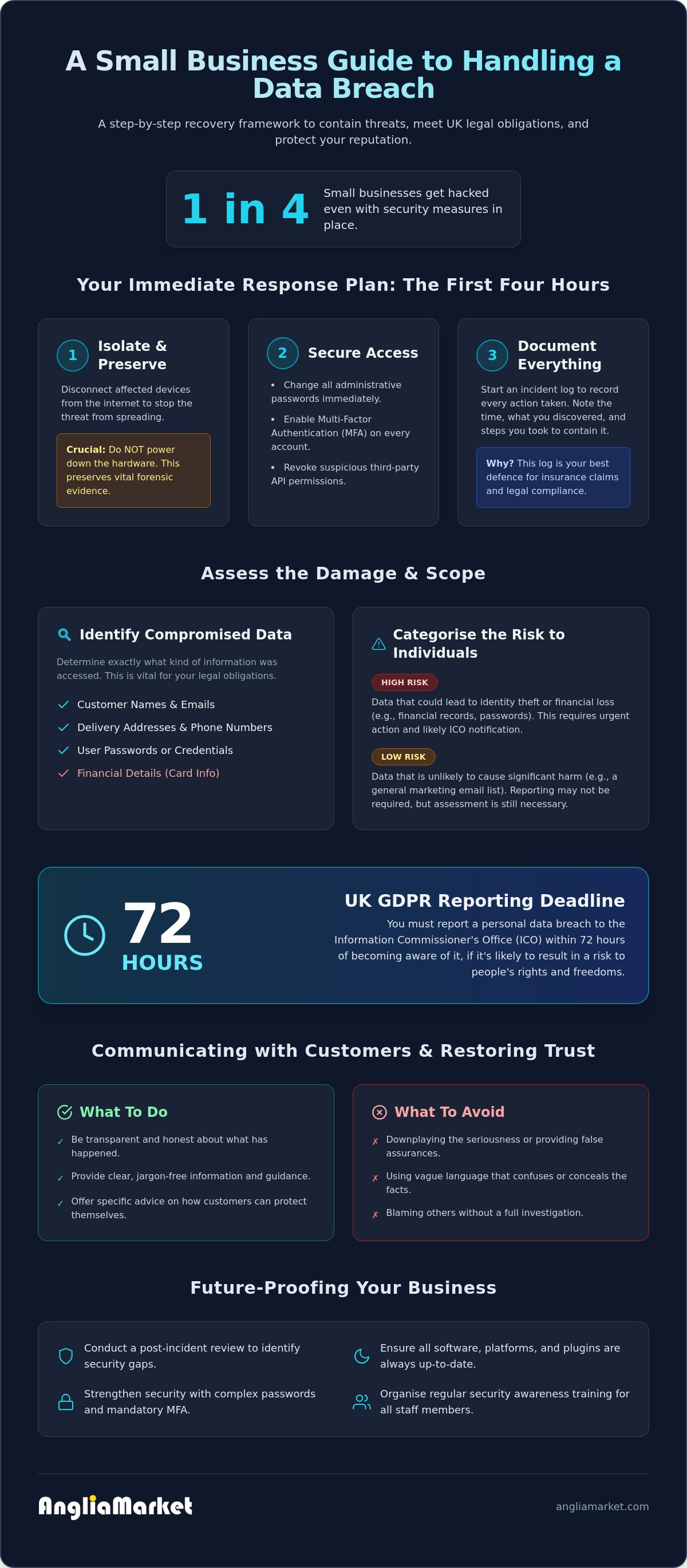
One in four small businesses get hacked even with security measures in place. It's a sobering fact. If you've just found a security gap, your first instinct is likely panic. You're worried about heavy ICO fines and losing the hard-earned trust of your customers. You're probably asking how to handle a data breach small business owners can realistically manage without a dedicated IT team.
It's a stressful moment, but this is a manageable commercial event. You don't need to let a leak end your enterprise. This guide provides a step-by-step recovery framework to contain threats, meet UK legal obligations, and protect your reputation. We'll show you how to stop the leak immediately and comply with UK GDPR rules. You'll learn to keep your business running whilst managing the crisis and meeting that critical 72-hour ICO reporting deadline.
Key Takeaways
- Contain threats instantly by disconnecting compromised hardware whilst preserving vital forensic evidence for later analysis.
- Navigate your legal obligations with a clear guide to the reporting window and your specific UK GDPR requirements.
- Discover how to handle a data breach small business customers will respect through transparent, jargon-free communication.
- Secure your commercial future by using post-incident reviews to identify and fix organisational security gaps.
Immediate Containment: The First Four Hours of a Breach
Discovery is a shock. You need to act fast but precisely. Knowing what is a data breach is the first step, but containment is what saves your business. The first four hours are critical. Disconnect affected devices from the internet immediately. Don't turn them off. Keeping them powered on preserves volatile memory that forensic experts need to trace the attacker's steps. If you pull the plug, you might destroy the only evidence of how the intruder got in.
Next, change every administrative password. This includes your e-commerce platform accounts, email systems, and server logins. If you use a shared password across multiple sites, you're at high risk. You must identify how they got in. Was it a dodgy phishing email? A weak password on an old staff account? Or perhaps a vulnerable third-party app? Understanding how to handle a data breach small business owners face starts with closing these doors. Don't just reset the obvious ones. Check your cloud storage and any integrated marketing tools too. Document every single action you take for insurance and legal purposes.
Securing Your Digital Perimeter
Enable Multi-Factor Authentication (MFA) on every account right now. It's the single most effective way to stop unauthorised access. Review your marketplace settings and revoke any suspicious third-party API permissions. These often act as hidden backdoors for hackers. If you operate from a physical warehouse or office, isolate your local networks to prevent the threat from spreading to your shipping or inventory systems. This prevents a small leak from becoming a total system blackout. It's about building walls around the infection whilst you work on a cure.
The "Golden Hour" Documentation
Documentation is your best defence for insurance and legal claims. Start a simple log immediately. Note the exact time you discovered the issue and what you've done since. Take screenshots of ransom notes or weird system behaviour before you fix them. It's vital to identify what data was compromised. Check if it was customer names, delivery addresses, or payment details. This information determines your reporting duties to the ICO later. Understanding how to handle a data breach small business owners encounter begins with this meticulous record-keeping. Keeping an accurate record shows regulators you've acted responsibly and with due diligence.
Assessing the Damage and Preserving Evidence
Once you've contained the immediate threat, you must pivot to a thorough assessment. You need to know exactly what was taken. This isn't just about counting lost files; it's about understanding your UK legal and regulatory obligations. If the breach involved "Personal Data" as defined by the UK GDPR, the clock is ticking on your reporting requirements. Personal data includes anything that can identify a living person, such as names, email addresses, or even IP addresses. Identifying the scope early is vital.
Don't rush to restore your systems yet. You must verify that the threat is fully eradicated. If you restore from a backup that was already compromised, you'll simply be inviting the attacker back in. Verify the integrity of your backups. Ensure they haven't been corrupted by the same ransomware or malware that caused the initial breach. Analyse the behaviour of the intruder. Are they still lurking in your network? Professional hackers often leave persistence mechanisms, like new admin accounts or hidden scripts, that allow them back in later. Understanding how to handle a data breach small business owners often find overwhelming requires a calm, methodical look at the digital evidence.
Data Categorisation and Risk Levels
Not all data loss carries the same weight. Distinguish between low-risk data, such as a general email newsletter list, and high-risk data like financial records, home addresses, or passwords. You must assess the "likely risk to individuals" involved. If the leak could lead to identity theft or financial loss, your reporting duties are much stricter. Check if the accessed data was encrypted. If the encryption keys remained secure and the data is unreadable to the attacker, the legal risk to your business may be significantly lower. This assessment helps you prioritise your next moves.
Working with Forensic Experts
Avoid the temptation to "clean" or wipe your systems before an expert has looked at the evidence. You might delete the digital fingerprints needed to identify the culprit or claim on insurance. Many small businesses worry about the cost, but affordable cyber-incident response teams exist specifically for the UK SME market. If you have cyber insurance, it often covers the cost of professional investigation. This helps you get back to business safely. If you're looking to build a more resilient online presence, consider using a platform that prioritises security for its independent vendors.
Meeting Your UK Legal and Regulatory Obligations
The 72-hour clock is the most stressful part of the process. In the UK, you have three days from the moment you discover a breach to report it to the Information Commissioner’s Office (ICO). This isn't optional for serious incidents. If the breach puts the rights and freedoms of individuals at risk, you must speak up. Failing to do so can lead to massive fines. Serious infringements of UK GDPR can cost up to £17.5 million or 4% of your total worldwide annual turnover, whichever is higher. Even less serious mistakes can result in fines of £8.7 million. Since 2018, over 2,500 GDPR fines have been issued, totalling over 7 billion euros. This is why knowing how to handle a data breach small business owners can survive is vital for your commercial future.
You also need to define your role. Are you a "Data Controller" or a "Data Processor"? Most small businesses selling products are controllers because they decide what data to collect and why. If you use third-party tools, check your contracts. You might have a legal duty to notify your software vendors or logistics partners. If financial data or credit card numbers were involved, notify your bank and payment processors immediately. They can help monitor for fraudulent activity and might even reissue cards to protect your customers. This step is a key part of assessing the damage and limiting your liability.
When and How to Notify the ICO
A reportable breach is one likely to result in a risk to people. This might mean identity theft, financial loss, or damage to reputation. The ICO provides an online self-assessment tool. Use it to decide if your specific situation requires a formal report. If it does, your report must include the nature of the breach and the categories of data involved. You'll also need to state how many people were affected and what your mitigation plan looks like. Being honest and proactive here can significantly reduce the severity of any regulatory action.
Legal Liability and Small Business Protections
You can mitigate potential fines by demonstrating "Accountability" under GDPR. This means showing you took data protection seriously before the attack happened. Having a written Incident Response Plan is a major part of this defence. It proves you weren't negligent. If the situation is complex, seek legal advice to manage your correspondence with affected parties. This helps ensure your how to handle a data breach small business strategy remains within the law whilst you work to restore normal operations.
Communicating with Customers and Restoring Trust
Trust is the hardest thing to rebuild once it's broken. When a leak occurs, your customers feel vulnerable and exposed. They want to know two things: what happened to their data and what you are doing to fix it. Understanding how to handle a data breach small business customers will actually forgive starts with clear, jargon-free communication. Avoid corporate speak. Be direct. If you try to hide the scale of the problem, you'll lose your reputation along with your data. Over 93% of UK businesses were targeted by phishing in 2025, so your customers likely understand the risks. They just need to know you're on their side.
Draft a notification that explains the situation simply. Be honest about what you don't know yet. Saying "we are still investigating" is far better than a false "everything is fine" that you have to retract later. Provide specific advice to help them protect themselves. This might include changing passwords or enabling Multi-Factor Authentication. Set up a dedicated communication channel immediately. A specific email address or a help centre page for breach enquiries shows you're taking the matter seriously. It keeps the panic off your main sales lines and gives customers a central place for updates.
The Anatomy of a Breach Notification
Your email subject line must be direct and urgent without being alarmist. Use something like "Important Security Update regarding your account." In the body, state clearly what data was involved. Crucially, tell them what was NOT involved. If payment info is safe, say so early. End with a clear call to action. Tell the customer exactly what they need to do next, such as "Reset your password here" or "Monitor your bank statements." This clarity prevents further frustration.
Managing Public Relations for Small Brands
Social media will be your biggest challenge during a crisis. Don't ignore comments or delete them; this looks like a cover-up. Acknowledge enquiries and point people to your dedicated help page. Proactive transparency is your best tool for maintaining long-term loyalty. Once the crisis is managed, focus on rebuilding your image. You can showcase your commitment to reliability by highlighting positive customer testimonials and reviews that speak to your service quality. This helps shift the narrative back to your products and community focus. Learning how to handle a data breach small business owners can recover from means turning a disaster into a demonstration of your integrity.
Future-Proofing Your Business Against the Next Attack
Recovery is only the first half of the battle. Once the immediate crisis subsides, you must ensure your enterprise is more resilient than before. Conduct a thorough post-mortem review to identify the specific organisational or technical failures that allowed the incident to occur. Was it an unpatched server or a staff member clicking a suspicious link? Over 93% of UK businesses were targeted by phishing attacks in 2025, so human error is a likely culprit. Understanding how to handle a data breach small business owners face means learning from these mistakes to close every possible gap.
Implement a "Least Privilege" access model across your business software and marketplace accounts. This means staff only have access to the specific data and tools they need for their daily tasks. If a single account is compromised, the damage is restricted to a small area rather than your entire system. Update your staff training regularly to focus on the latest social engineering tactics. Hackers change their methods constantly, so your team's knowledge must stay current. Schedule quarterly security drills to ensure everyone knows exactly how to react to a suspected incident without hesitation.
Strengthening Your Marketplace Presence
Selling on a secure, established platform can significantly reduce your direct data handling risks. By leveraging the infrastructure of a professional marketplace, you benefit from their advanced security protocols. If you need technical assistance with your vendor account settings, visit Anglia Market Support for expert guidance. You can also encourage customers to join the Anglia Market Loyalty Program. This uses secure, centralised data management, which reduces the amount of sensitive information you need to store on your local systems. It's a practical way to protect your customers whilst streamlining your operations.
The Small Business Cybersecurity Checklist for 2026
Demonstrate your commitment to security by applying for the Cyber Essentials certification. It's a government-backed scheme that proves you take data protection seriously. For micro-organisations with up to nine employees, the cost is £320 + VAT. Small businesses with 10 to 49 employees can expect to pay £440 + VAT. This certification is often a prerequisite for certain contracts and can even help with cyber insurance premiums. Use this checklist to stay on track:
- Audit Hardware: Regularly check your office supplies and tech stack for outdated software that no longer receives security patches.
- Enforce MFA: Ensure Multi-Factor Authentication is mandatory for every business account.
- Review Permissions: Conduct monthly reviews of who has administrative access to your systems.
- Backup Data: Maintain encrypted, offline backups that are tested at least once a month.
Building a secure business is an ongoing process. By following these steps, you ensure that your how to handle a data breach small business strategy evolves into a robust defence system that protects your reputation and your bottom line. As you look towards 2026, staying informed about secure digital identification is a key part of your long-term resilience; to find out more, check out BTCME.com.
Take Control of Your Digital Security
Managing a security incident is about precision and transparency. You've learned to isolate threats immediately whilst preserving vital evidence for regulatory review. Meeting the 72-hour reporting window is critical for avoiding heavy UK GDPR fines and maintaining your professional standing. By implementing staff training and the "Least Privilege" access model, you turn a past crisis into a long-term commercial strength. Understanding how to handle a data breach small business owners can realistically survive is the first step toward a more resilient future.
Don't let security fears hold your growth back. You can protect your business and reach more customers by becoming a verified vendor on Anglia Market today. Our platform is trusted by independent UK businesses and provides a secure transactional environment. With our dedicated vendor support centre, you have the tools to trade safely and confidently. You've done the hard work of securing your systems; now it's time to focus on growing your enterprise with a partner that values your security as much as you do.
Frequently Asked Questions
Do I really need to report a breach if only a few email addresses were leaked?
Yes, you must report the incident if there is a likely risk to the individuals' rights and freedoms. Even a small leak of names and email addresses can lead to highly targeted phishing attacks or identity theft. If you're unsure how to handle a data breach small business owners should use the ICO self-assessment tool. You must document every breach internally, even if you decide it doesn't meet the threshold for a formal report.
How much does the ICO fine small businesses for a data breach?
The ICO can issue fines up to £17.5 million or 4% of total worldwide annual turnover for the most serious infringements. For less severe mistakes, the cap is £8.7 million or 2% of turnover. While the ICO often issues reprimands or smaller penalties to SMEs, they prioritise businesses that show negligence. Having a clear response plan and staff training records can help reduce the severity of any potential fine.
What is the difference between a cyber attack and a data breach?
A cyber attack is the actual attempt by a hacker to gain unauthorised access to your network or systems. A data breach is the successful result of an attack where sensitive or confidential information is viewed, stolen, or used by an unauthorised party. Not every attack results in a breach. However, most breaches are the direct consequence of an attack, such as a phishing campaign or a malware infection.
Can my business be held liable if a third-party app I use is breached?
Yes, your business remains responsible if you are the "Data Controller" for the compromised information. Under UK GDPR, you have a legal duty to ensure any third-party "Data Processors" you hire maintain high security standards. You should check your service contracts to see if they include indemnity clauses. This liability is why choosing secure, established platforms for your commercial activities is a vital part of your risk management.
How long do I have to notify my customers after discovering a breach?
You must notify affected individuals "without undue delay" if the breach is likely to result in a high risk to their rights and freedoms. Unlike the strict 72-hour window for reporting to the ICO, there is no fixed hourly deadline for customer notification. However, speed is essential to help your clients protect themselves from fraud. Delaying this communication can lead to a significant loss of trust and potential legal claims.
What should I do if a hacker demands a ransom for my business data?
Do not pay the ransom demand. Paying doesn't guarantee you'll get your data back and it often makes you a target for future extortion attempts. Contact Action Fraud or the National Cyber Security Centre (NCSC) immediately to report the crime. Focus your energy on your recovery framework. Use your secure, offline backups to restore your systems whilst your forensic team identifies and closes the original point of entry.
Does my business insurance cover the costs of a data breach?
Standard business insurance policies rarely cover the specific costs associated with a data leak. You usually need a dedicated cyber insurance policy to cover forensic investigations, legal fees, and the costs of notifying customers. Many insurers now require you to hold a Cyber Essentials certification before they will offer coverage. Check your current policy wording to see if you have protection for digital business interruption and regulatory fines.
Is it better to announce a breach on social media or via email?
Direct email is the most effective way to notify the specific people affected by the incident. It allows you to provide personalised security advice and keeps the conversation professional. Social media should only be used as a secondary tool if the breach is so widespread that you cannot contact everyone individually. Managing the initial message privately helps you maintain control whilst you figure out how to handle a data breach small business customers will find alarming.

Here to help — ask anything
If you have any questions regarding this disclaimer or any of our policies, please contact Anglia Market through the contact page on our website, by email using the address provided on the site, or by phone on 0333 772 2593