
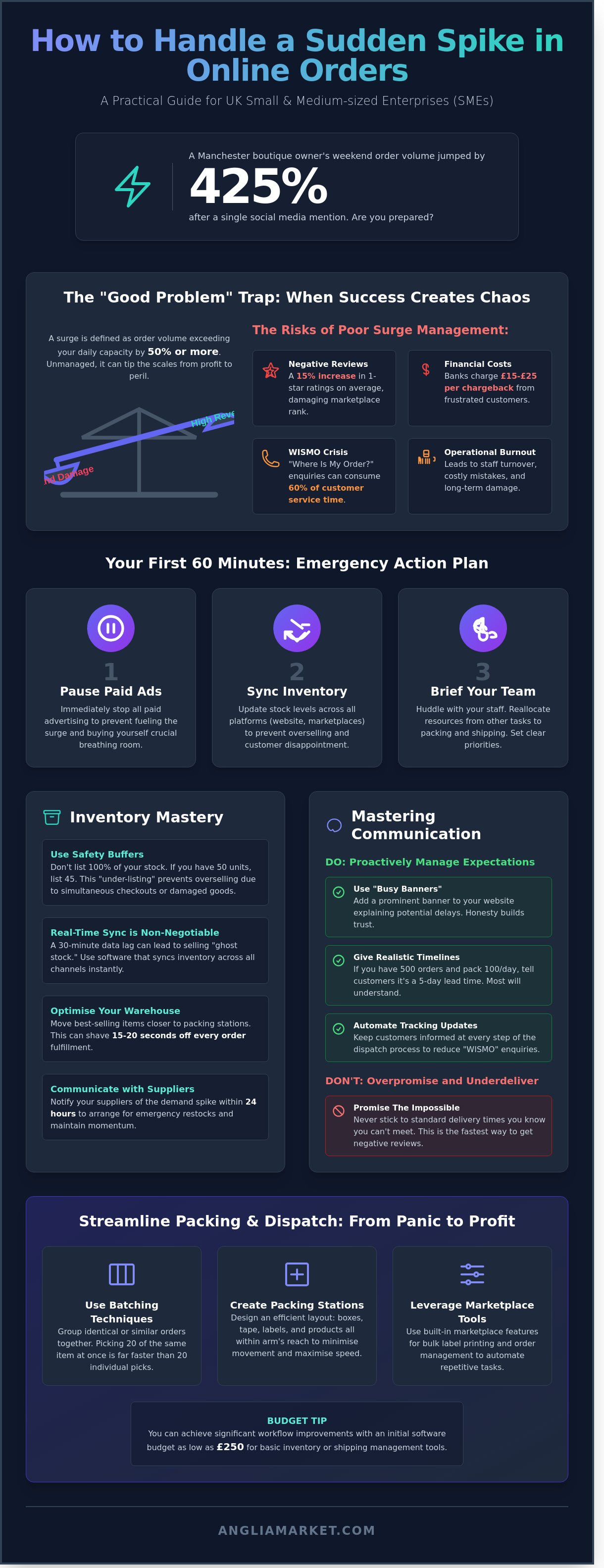
Last Tuesday, a boutique owner named Sarah in Manchester discovered her weekend order volume had jumped by 425% after a single social media mention. Every UK SME dreams of this level of growth. However, the immediate reality often involves frantic packing and the threat of one-star reviews. Learning how to handle a sudden spike in online orders is the difference between scaling your business and watching your reputation slip away during a logistical crisis.
You've likely felt that sinking feeling when your inventory doesn't sync or you're stuck doing manual data entry at 2am. It's exhausting. You aren't alone in worrying about stockouts or delivery delays. We've created this guide to help you move from panic to profit. You'll discover practical, scalable strategies to manage order surges without compromising your customer experience. This guide provides a clear plan to clear your current backlog and outlines the essential systems you need to prevent future chaos, even if you only have a small budget of £250 for initial software upgrades.
Key Takeaways
- Protect your brand reputation by using safety buffers and real-time tracking to prevent the nightmare of overselling during busy periods.
- Maintain customer loyalty through transparent communication, including the effective use of "busy banners" and automated tracking updates.
- Streamline your dispatch process with batching techniques and high-speed packing station layouts designed for maximum efficiency.
- Discover how to handle a sudden spike in online orders by leveraging marketplace tools and promotions to manage demand effectively.
- Identify the "Good Problem" trap to ensure your UK business scales sustainably without compromising on your long-term service quality.
Understanding the Impact of a Sudden Spike in Online Orders
An order surge is a temporary misalignment between demand and operational capacity. For most UK small businesses, a true spike occurs when order volume exceeds your standard daily processing capacity by 50% or more. While seeing sales climb is the goal of every vendor, rapid growth often acts as a "good problem" trap. If you don't know how to handle a sudden spike in online orders, you risk permanent brand damage that far outweighs a single day of high revenue.
Before scaling up, understanding the order fulfillment process is vital for maintaining your reputation. You must quickly identify the source of the surge. This might be a mention from a UK influencer, a seasonal promotion, or an organic trend on social media. Identifying the "why" helps you predict how long the surge will last and whether you need to sustain high output for days or just a few hours.
For businesses looking to generate this kind of growth, working with an Influencer marketing platform can be a powerful strategy to connect with the right voices for your brand.
For instance, a business selling seasonal products like camping gear anticipates massive surges before festival season. To see an example of such a specialized online shop, click here.
The challenge of managing seasonal demand isn't limited to consumer retail. In specialized B2B industries like agriculture, suppliers face immense logistical pressure during peak planting seasons. For those curious about how such a niche market operates online, you can explore Semănători de păioase to see an example of a specialized equipment catalog.
To better understand how to manage these workflows efficiently, watch this helpful video:
Within the first 60 minutes of noticing a surge, perform immediate triage. First, pause any active paid advertising to prevent further volume. Second, update your inventory across all platforms to avoid overselling products you don't have. Third, brief your team to reallocate resources immediately. Acting fast prevents a manageable rush from becoming an operational collapse.
The Risks of Poor Surge Management
Mismanaging a spike leads to a 15% increase in negative reviews on average. These 1-star ratings can drop your marketplace ranking within a week. Financial costs add up quickly too. Banks often charge £15 to £25 for every chargeback filed by a frustrated customer. You also face the "Where Is My Order" (WISMO) crisis. These enquiries can take up 60% of your customer service time, pulling staff away from packing and shipping. Operational burnout is the final risk. A 12-hour packing shift might solve today's problem, but it risks staff turnover and errors that cost even more in the long run.
Setting Realistic Expectations Early
Honesty about lead times is always better than promising the impossible. If your current throughput is 100 orders per day and you have 500 orders in the queue, tell the customer their delivery will take five days. Most UK shoppers are understanding if they're told the truth at the point of purchase. Analyse your data to determine a realistic "new" delivery date. If you're a vendor looking to grow, check our sell online page for more tips on managing your shop profile. Maintaining trust is how you turn a one-time spike into long-term loyalty programme success.
Optimising Your Inventory and Stock Management
Managing a rush requires more than just energy; it needs precise stock control. When learning how to handle a sudden spike in online orders, your first priority is visibility. Real-time inventory tracking ensures your digital storefront matches your physical shelf. Overselling a product leads to disappointed customers and potential marketplace penalties, which can be costly for UK SMEs. If your data lags by even 30 minutes, you risk selling items that aren't there.
Smart retailers use safety buffers. If your warehouse has 50 units of a trending item, consider listing only 42 or 45. This "under-listing" strategy provides a vital cushion for damaged goods or simultaneous checkouts during high-traffic periods. Efficient storage also plays a role. Move your most popular items to the front of your packing station to shave 15 to 20 seconds off every order. According to IMRG, managing unexpected spikes in demand requires clear communication with your supply chain. Keep an open line with manufacturers; they need to know within 24 hours if you require an emergency restock to maintain your sales momentum.
Desync Prevention Strategies
Manual stock counting is a recipe for disaster during a peak period. If you're processing 40 orders an hour, a spreadsheet simply can't keep up. Use inventory management software that integrates directly with your shop. This allows you to sell online across multiple platforms while keeping a single record of stock. When a unit sells on one channel, it should instantly update everywhere else. This prevents the "ghost stock" problem where items appear available but are actually gone, a mistake that 60% of small retailers struggle with during their first major spike.
Contingency Planning for Stockouts
Stockouts are sometimes inevitable during a 300% traffic surge. Prepare for this by drafting "out of stock" templates in advance. Offer customers an immediate alternative or the option to join a pre-order queue. Automated alerts are essential. Set your system to notify you when stock hits a 15% threshold. This gives you a head start on reordering before the "sold out" sign appears. Focus your energy on your top five "hero products." Ensure they have dedicated fulfilment lanes to keep the most popular items moving without any delay. Knowing how to handle a sudden spike in online orders means being ready for the moment the shelves go bare.
Mastering Customer Communication During High Volume
Transparency builds trust during busy periods. Use a "We are Busy" banner on your homepage to manage expectations immediately. It's a simple tool that reduces customer anxiety and prevents your support inbox from overflowing. Learning how to handle a sudden spike in online orders requires you to be proactive rather than reactive. Automate your order confirmations and tracking updates. These automated touchpoints reassure the buyer that their money is safe and their order is moving through your system. It's about keeping the customer informed without needing to touch every single email manually.
Transparent Lead Times and Shipping Updates
Update your shipping policy page to reflect current processing times. If a standard 48-hour dispatch becomes a 5-day window, tell your customers before they reach the checkout. Use email templates to notify buyers of delays before they feel the need to ask. Clear communication is a vital part of scaling your e-commerce business without damaging your reputation. Offer a small gesture of goodwill, like an invitation to join your loyalty program, as a thank you for their patience. This turns a shipping delay into a chance to build long-term retention and shows you value their business.
Managing the Influx of Support Tickets
The "Where Is My Order" (WISMO) surge can be relentless. Statistics show that up to 75% of support queries during peak times are delivery-related. Create a self-service FAQ page that addresses these specific concerns to filter out basic questions. Set up "Quick Replies" for common questions to save your team hours of typing. You must prioritise tickets carefully; look for high-risk keywords to spot an angry customer before they leave a negative review. Using professional tools like Anglia Market Support helps you keep track of every message. It ensures no buyer is left waiting, which is essential when you are figuring out how to handle a sudden spike in online orders during the UK's busiest shopping seasons.
Turning a delay into a loyalty opportunity is about the "surprise and delight" factor. Consider these small gestures to keep customers happy:
- Include a handwritten note in the parcel for orders over £50 to add a personal touch.
- Send a £5 discount code via email for their next purchase as an apology for the wait.
- Extend your return window by 14 days to give buyers extra peace of mind.
For businesses with a family-focused audience, including a small, free printable activity sheet can be a low-cost way to create a memorable experience. To see an example of this kind of resource, click here.
Streamlining Packing and Dispatch Processes
Speed is everything. When your order volume triples overnight, every extra second spent finding tape or choosing a box adds up to hours of lost productivity. Knowing how to handle a sudden spike in online orders requires a shift from individual attention to industrial speed. Efficiency in the warehouse is the difference between a satisfied customer and a backlog of complaints.
Batching orders is your first line of defence. You should never pack one order at a time. Grouping orders by SKU or shipping method allows your team to stay in a "flow state," reducing the mental tax of switching between different products. Data from UK warehouse audits shows that batch picking can increase output by 30% compared to single-order processing.
Designing a high-speed packing station is equally vital. Keep every essential item within a 60cm reach. This "golden zone" should include your tape dispenser, labels, and void fill. If a staff member has to walk even three steps for a box, they're wasting time. Standardising your packaging to just three core box sizes also helps. It eliminates "decision fatigue," where workers spend too long trying to find the perfect fit for a specific item.
For businesses shipping fragile or uniquely shaped items, this process is even more critical. Online retailers like Modern Memory Design, which specialize in custom picture frames, rely on such streamlined systems to protect their products and manage order surges effectively.
Local courier services are your best allies during a rush. Don't waste time driving to the Post Office. Royal Mail offers free business collections if your annual spend exceeds £17,000, while couriers like DPD or Evri can arrange daily bulk pick-ups. This keeps your floors clear and ensures parcels enter the delivery network as soon as they're labelled.
Creating a Lean Fulfilment Workflow
This lean approach is the most effective way to learn how to handle a sudden spike in online orders without compromising on quality. Follow these four steps to keep the line moving:
- Step 1: Print all labels and packing slips in one go to avoid frequent trips to the printer.
- Step 2: "Pick" all items for the entire batch using a consolidated list rather than individual slips.
- Step 3: Pack items using a standardised method to ensure every box looks professional and secure.
- This professionalism extends to your printed materials; for businesses needing high-quality packing slips or promotional inserts at scale, a commercial printing service like Linemark can be a valuable partner.
- Step 4: Sort parcels by courier or shipping class immediately to make the handover to drivers seamless.
This level of professionalism should extend to all your materials. Even for niche products like specialized paper goods, the quality of the item itself is a key part of the customer experience. For an interesting example of a company focused on this, you can learn more.
Scaling Your Labour Force Quickly
Scaling up doesn't always mean hiring. Cross-training staff from other departments, such as marketing or admin, allows you to move people to the packing line the moment orders surge. For massive spikes, compare the cost of temporary staff against a 3PL (Third-Party Logistics) provider. While a 3PL might charge a premium, they handle the entire storage and dispatch process, which is often cheaper than renting extra space and managing new hires.
As your business grows, you might even need to move to a larger warehouse or office. For businesses planning a commercial relocation, it's wise to explore Moving with a professional service to handle the complex logistics and ensure a smooth transition.
Keeping morale high is the secret to sustained productivity. The "Pizza and Productivity" rule works. A £60 investment in hot food for a late-night shift can prevent the 15% drop in accuracy usually seen when teams are tired. Happy workers make fewer mistakes, which means fewer costly returns for your business.
Ready to grow your business and reach more customers across the UK? Start selling with us today and take advantage of our marketplace platform.
Leveraging Marketplaces to Scale Your Business
Selling on a managed platform is a smart move for UK SMEs facing rapid growth. It stops your private website from crashing when traffic hits unexpectedly. A 2023 report from Retail Economics showed that 40% of UK shoppers now start their product searches directly on marketplaces. This infrastructure handles the technical stress of learning how to handle a sudden spike in online orders. You won't have to worry about server bandwidth or checkout glitches during a 300% traffic surge because the platform manages the heavy lifting for you.
Strategic use of marketplace promotions allows you to control demand flows with precision. If your warehouse team is struggling, you can pause active deals to catch up. If you have excess stock after a rush, you can trigger a new campaign to keep the momentum going. It acts as a volume dial for your business operations. Being part of a larger ecosystem also means you benefit from collective marketing spend, bringing eyes to your products that you might not reach alone.
As your business grows to include multiple marketplaces, distributors, or other sales partners, managing these different channels effectively becomes the next big challenge. For a look at how technology can streamline this complexity, you can discover Computer Market Research and its suite of cloud-based solutions.
Why SMEs Thrive on Anglia Market
Anglia Market provides a robust framework that supports small businesses during volatile periods. You're listed alongside other vendors, which builds immediate consumer trust. UK shoppers feel more secure buying from an independent seller when the transaction is backed by a reliable platform. This collective environment helps you maintain a professional image even when you're busy behind the scenes. Use the data from your recent surge to plan for the next big sale event. If 75% of your orders arrived between 6pm and 9pm on a Sunday, you can schedule your future staff rotas to match that specific pattern.
From Accidental Spike to Sustainable Growth
Don't let the momentum fade once the initial rush ends. Analyse your customer data to find repeat buyers and offer them a reason to return. A spike is only a success if it leads to long term stability. Invest your profits into better hardware to prepare for the next time you need to know how to handle a sudden spike in online orders. Spending £300 on a high speed thermal label printer or £150 on a wireless barcode scanner can cut your packing time by 25% per order. These small upgrades prevent bottlenecks during future peaks.
As you transition from managing daily spikes to planning for long-term expansion, understanding your funding and investment options becomes vital. For UK business owners considering the next level of growth, BGS Capital provides a detailed guide on how private equity can support business development.
- Courier Performance: Did your delivery partners meet their 24 or 48-hour windows?
- Stock Accuracy: Does your physical inventory match your digital records exactly?
- Customer Feedback: Check reviews for mentions of slow shipping or damaged packaging.
- Packaging Durability: Did your boxes hold up under the pressure of rapid handling?
- Staff Feedback: Ask your team where the biggest "pain points" occurred during the surge.
Scale Your SME with Confidence
Scaling a UK business effectively means staying ahead of demand before it arrives. Focus on real-time stock management to prevent overselling; industry data suggests 70% of shoppers won't return after a poor delivery experience. Streamline your packing bench to shave seconds off every order. These small gains add up when volume triples overnight. Mastering how to handle a sudden spike in online orders is about building a resilient foundation that supports your brand's reputation during peak seasons.
Anglia Market provides the infrastructure you need to thrive in a competitive retail landscape. We're dedicated to supporting small and medium UK businesses by providing practical tools for independent vendors. Our secure and trusted marketplace environment handles the technical heavy lifting so you can focus on your products. It's time to take your retail operations to the next level and reach more customers across the country.
Start selling with Anglia Market today and grow your business with confidence
Your next big sales milestone is just around the corner, and we're here to help you reach it.
Frequently Asked Questions
How do I tell customers their order is delayed without losing their trust?
Be honest and proactive by sending an automated email within 4 hours of identifying the delay. Offer a concrete new delivery date or a small incentive like a 5% discount code for their next purchase. Clear communication prevents 85% of negative reviews according to UK retail surveys. Don't wait for them to ask you. Explain that high demand means quality checks are taking longer to ensure their parcel arrives in perfect condition.
What is the fastest way to pack 100+ orders in a single day?
Use a batch-picking system and set up a dedicated packing station with all materials within arm's reach. Grouping 20 identical items at a time reduces movement by 40% compared to picking individual orders. Use pre-assembled boxes and thermal label printers to save 30 seconds per parcel. This streamlined approach is essential when learning how to handle a sudden spike in online orders efficiently.
Should I stop taking new orders if I have a massive backlog?
Don't stop orders entirely; instead, extend your expected delivery times on product pages by 3 to 5 working days. This manages expectations while keeping your cash flow moving. If your backlog exceeds 500 orders or your lead time hits 14 days, consider a temporary pause banner. This protects your seller rating on platforms like Anglia Market and prevents customer frustration during peak times.
How can I prevent my website from crashing during an order spike?
Use a Content Delivery Network like Cloudflare and ensure your hosting can scale up to 5,000 simultaneous visitors. 40% of users abandon a site that takes more than 3 seconds to load. Compress all product images to under 100KB to reduce server strain. Regular load testing before peak seasons like Black Friday helps identify bottlenecks before they cost you valuable sales.
What UK courier is best for handling sudden high volumes of parcels?
Royal Mail and DPD are the most reliable for UK SMEs during surges due to their extensive local networks. Royal Mail's Click and Drop service handles up to 1,000 labels at once, while DPD's 1-hour delivery slots maintain high customer satisfaction. Diversify by using a multi-carrier platform like ShipStation. This ensures you have a backup if one provider reaches their daily 50-parcel collection limit.
How do I handle returns and refunds during a busy period?
Automate the process by using a dedicated returns portal that generates labels instantly for the customer. Set a clear 30-day return window to spread out the administrative load. Processing refunds within 48 hours of receiving the item keeps trust high. Since 30% of online fashion orders are returned, having a pre-printed return slip in every box saves hours of customer service emails.
Can I change my shipping prices during a surge to cover extra labour?
Yes, you can adjust your shipping rates, but it's better to increase the free delivery threshold from £50 to £75. 60% of UK shoppers abandon carts due to unexpected shipping costs. If you must raise prices to cover a £11.44 per hour temporary packer, be transparent. Mention peak season surcharges clearly at checkout so there are no surprises at the final payment step.
Is it worth hiring temporary staff for a one-week spike?
It's worth it if your order volume increases by more than 200% above your normal daily average. Use local agencies to find staff for a flat rate of £11.44 per hour, the 2024 National Living Wage. Training takes roughly 2 hours for basic packing tasks. This investment prevents burnout for your core team and ensures you know how to handle a sudden spike in online orders without damaging your long-term reputation.

Here to help — ask anything
If you have any questions regarding this disclaimer or any of our policies, please contact Anglia Market through the contact page on our website, by email using the address provided on the site, or by phone at 0333 772 2593