
Did you know that failed deliveries cost UK retailers roughly £1.6 billion every year? For an independent seller, a single missing parcel isn't just a lost sale; it's a direct threat to your hard-earned marketplace rating. Learning how to handle shipping delays and communicate with customers is no longer just a basic requirement. With 2026 regulations like the mandatory ICS2 declarations for road freight and frequent structural logistics disruptions, your response to a late package defines your brand's integrity.
You're likely tired of the constant "where is my order?" enquiries and the anxiety that comes with every courier delay. We understand that your time is better spent growing your business than chasing parcels. This guide will show you how to turn delivery disruptions into loyalty-building moments with proactive communication and practical logistical fixes. We'll explore how to reduce your support ticket volume, maintain high satisfaction scores, and build long-term trust even when the post is slow.
Key Takeaways
- Implement the 'Golden 24-Hour' rule to proactively notify buyers of issues before they feel the need to send an enquiry.
- Discover why a multi-carrier strategy is essential for reducing reliance on a single courier and avoiding regional delivery bottlenecks.
- Master how to handle shipping delays and communicate with customers by using the 'Service Recovery Paradox' to build deeper brand loyalty.
- Learn how to adjust dispatch time settings during peak periods to manage buyer expectations and protect your marketplace seller ratings.
- Utilise direct communication channels on UK-focused platforms like Anglia Market to facilitate transparent, trustworthy transactions with your local customer base.
Why Shipping Delays Occur and Why Your Response Matters
In 2026, a shipping delay is more than a missed deadline; it's a critical test of your business operations. With the full implementation of the Import Control System 2 (ICS2) for road freight as of 3 February 2026, the logistics landscape has become structurally more complex. A delay occurs whenever a parcel fails to meet the delivery window promised at checkout. Whilst modern shoppers have been conditioned to expect extreme speed, they value honesty and transparency far more when disruptions arise. Understanding how to handle shipping delays and communicate with customers allows you to bridge the gap between high expectations and logistical reality.
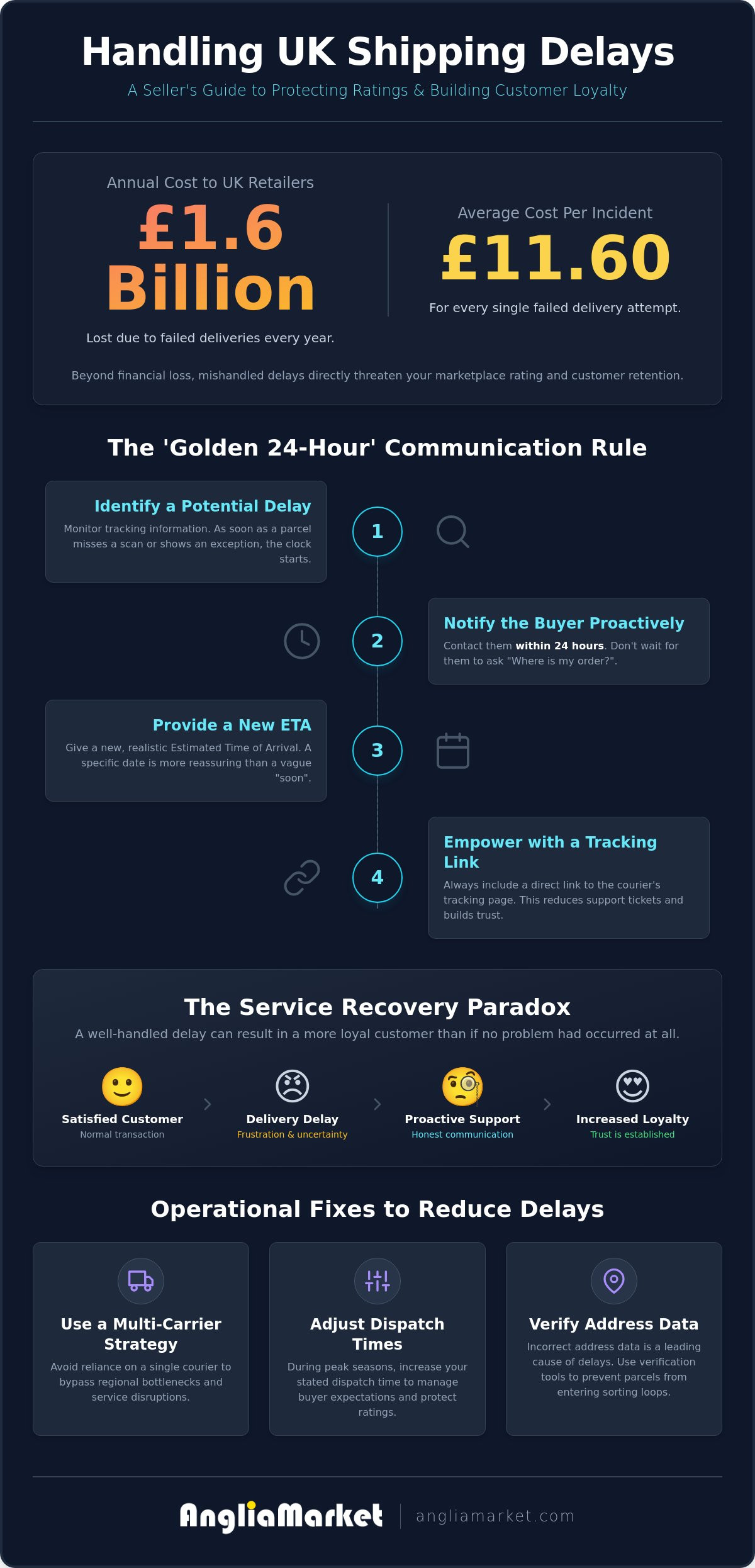
The financial consequences of poor delay management are severe. Beyond the immediate loss of a sale, mishandled disruptions lead to chargebacks and a significant dip in customer retention. Every failed delivery attempt costs UK retailers an average of £11.60, contributing to a staggering £1.6 billion annual loss across the industry. By prioritising clear updates, you protect the long-term value of your customers and avoid the cycle of costly refunds. Factors such as local courier capacity, extreme weather, and global supply chain ripples mean that delays are often outside your direct control, making your response the only variable you can truly manage.
To better understand this concept, watch this helpful video:
Common Causes for UK Delivery Disruptions
Peak season surges remain a primary cause of bottlenecks at regional distribution centres. During these times, volume often exceeds the processing capacity of even the most efficient hubs. Last-mile challenges amongst UK couriers like Royal Mail, DPD, and Evri are also frequent, particularly in areas with driver shortages. Additionally, incorrect address data is a leading cause of 'failed delivery' statuses. Even a minor typo in a postcode can send a parcel into a time-consuming manual sorting loop, highlighting why how to handle shipping delays and communicate with customers effectively is a skill every vendor must master.
The Psychology of the Waiting Customer
Frustration rarely stems from the delay itself; it stems from the silence that follows. The 'Peak-End Rule' suggests that a customer's memory of an experience is defined by its most intense point and its conclusion. If you resolve a delivery issue with transparency, that positive final interaction can outweigh the initial annoyance. Proactive communication is the act of informing a customer about a potential issue before they feel the need to ask. By removing uncertainty, you maintain the professional trust required to scale your business on platforms like Anglia Market.
Mastering Customer Communication: What to Say and When
Timing is everything when logistics go wrong. You should adopt the 'Golden 24-Hour' rule. This means notifying your buyer within one day of you identifying a potential delay. Don't wait for the customer to message you first. Proactive updates reduce anxiety and prevent the dreaded "where is my order?" enquiry. Learning how to handle shipping delays and communicate with customers effectively starts with this immediate acknowledgement. Your customers don't expect perfection, but they do demand information.
Professionalism in the UK market requires a local touch. Always use British English in your correspondence. Terms like 'centre', 'organise', and 'favourite' signal that you are a legitimate local seller. This builds trust amongst UK buyers who may be wary of faceless international dropshippers. When you send that first update, include a new Estimated Time of Arrival (ETA) immediately. Even if it's an educated guess based on courier data, a specific date is far more comforting than a vague "soon".
Tracking links are your most powerful self-service tool. Ensure every communication includes a direct link to the courier's tracking page. This empowers the customer to check progress themselves without needing to contact you. If you need inspiration on managing these interactions, you can find helpful customer support resources to streamline your workflow.
A Step-by-Step Communication Framework
Follow these four steps to maintain control of the narrative:
- Step 1: Identify the delay early through automated courier tracking alerts.
- Step 2: Draft a personalised message. Mention the specific item so the buyer knows it isn't a generic template.
- Step 3: State the cause clearly. Whether it's a surge at a regional sorting centre or a temporary courier issue, be brief. Avoid long-winded excuses.
- Step 4: Provide the solution. Tell them the new ETA or offer a discount on a future purchase to show goodwill.
British English Templates for Delay Notifications
Use these templates to save time whilst maintaining a professional tone. They are designed to fit the how to handle shipping delays and communicate with customers strategy perfectly.
Minor Delay (1-2 days): "Hello [Name], I'm just getting in touch to let you know your favourite [Product] is facing a slight delay at the local distribution centre. It's now expected to arrive by [Date]. You can track the progress here: [Link]. Thanks for your patience."
Major Disruption (5+ days): "Hello [Name], I'm writing to apologise for a significant delay with your order. Due to [Reason], we've had to reorganise our logistics. Your parcel is now estimated for [Date]. If this is too late, I'm happy to offer a full refund or a [Percentage]% discount for the trouble. Please let me know how you'd like to proceed."
Operational Fixes: Reducing the Impact of Late Deliveries
Fixing the physical side of your business is just as vital as knowing how to handle shipping delays and communicate with customers. A robust operational setup acts as a safety net when external factors, like the new 2026 ICS2 road freight requirements, slow down the network. You should start by diversifying your courier portfolio. Relying on a single provider is a significant risk. If one network faces a localised strike or a technical failure at a sorting centre, your entire business grinds to a halt. Multi-carrier strategies allow you to pivot instantly to a functional service.
Adjusting your 'Dispatch Time' settings is another quick win. During peak periods, you should increase your stated handling time by 24 to 48 hours. This manages expectations before the purchase is even made. For high-demand categories such as electronics or furniture, maintaining a buffer of "safety stock" is essential. Don't list your very last unit if there's a chance the inventory count is slightly off. This prevents the awkward "out of stock" delay that frustrates buyers.
Diversifying Your Courier Portfolio
DPD often leads for reliability and precise tracking, whilst Royal Mail offers unrivalled reach into remote UK postcodes. Having accounts with both allows you to switch mid-stream if one network becomes congested. You should also consider integrating Pick-Up Drop-Off (PUDO) points or locker networks. These options grew by 33% in 2024 because they virtually eliminate the 'failed delivery' attempt. Since a failed delivery currently costs UK retailers an average of £11.60 per parcel, moving towards out-of-home delivery is a smart financial move.
Optimising Internal Fulfilment Processes
Accuracy starts at the packing station. You should organise your warehouse to follow a logical flow, reducing the time spent searching for items. High accuracy prevents the delay caused by sending the wrong product, which requires a lengthy return and reship cycle. Using automated address validation tools at the checkout also stops delays before they start by catching typos in postcodes or house numbers. Sellers who choose to sell online through structured marketplaces often find these integrated tools essential for maintaining high performance ratings and avoiding manual data entry errors.
Protecting Your Reputation: Turning Delays into Loyalty
A shipping delay doesn't have to result in a lost customer. In fact, the 'Service Recovery Paradox' suggests that your relationship with a buyer can actually become stronger after a successfully resolved error. When you master how to handle shipping delays and communicate with customers, you prove that your business is reliable even when things go wrong. Since 83% of UK consumers experience at least one issue during home delivery, they don't necessarily expect perfection. They expect accountability. A customer who sees you working hard to fix a courier blunder often feels more valued than one who had a standard, forgettable transaction.
Your job isn't finished once the parcel finally leaves the sorting centre. You should always follow up 48 hours after the tracking confirms delivery. A simple note asking if the item arrived in good condition and offering a final apology for the wait goes a long way. This small gesture often prevents a frustrated buyer from leaving a negative review days later. It shows you haven't forgotten them just because you've already taken their money.
Effective Compensation Strategies
Knowing when to offer a peace offering is a delicate balance. If a parcel is only a day late, a sincere apology is usually enough. For longer delays, you should offer a discount code for a future purchase. This keeps the customer within your ecosystem and encourages repeat business. You can also use the Anglia Market loyalty program to reward patient buyers with extra points or exclusive perks as a token of goodwill. If the delay is significant, consider upgrading their next order to 'Express' shipping for free. This is a low-cost way for you to honour their patience whilst demonstrating your commitment to faster service in the future.
Managing Marketplace Seller Ratings
Negative feedback is an opportunity to show your professionalism to the public. When responding to a public complaint, stay calm and factual. Acknowledge the courier disruption but highlight the steps you took to keep the buyer informed. This signals to future shoppers that you are a supportive and transparent vendor. If you have clear evidence of timely dispatch, you can often appeal 'Late Delivery' strikes on marketplace platforms to protect your standing. Proactive transparency regarding logistics hurdles provides the documented evidence needed to protect your seller rating from unreasonable or malicious complaints.
If you're looking for a partner that understands the importance of vendor reputation and provides the tools to manage these relationships, you should register as a vendor to grow your business with confidence.
Scaling Your Small Business with Anglia Market’s Support
Growing a small business in the UK requires more than just great products; it requires a platform that understands the local landscape. Anglia Market facilitates better vendor-buyer relationships by providing the direct communication channels you need to succeed. When you are learning how to handle shipping delays and communicate with customers, having a supportive marketplace makes the process significantly smoother. You aren't just a number in a global database. You're part of a community focused on regional UK commerce.
Being on a UK-focused platform means the infrastructure is designed for our specific courier networks. Whether you are dealing with seasonal surges at regional sorting centres or the latest 2026 border regulations, you have a partner that understands the context. This local expertise allows you to stay agile whilst maintaining transactional security. By using direct messaging tools, you can resolve issues quickly, ensuring that a single late parcel doesn't damage your long-term reputation.
Support Resources for Anglia Market Vendors
We provide practical tools to help you manage disruptions effectively. If you hit a logistical snag or need help with a transaction, you can access the Anglia Market support home for direct assistance. One of the best ways to manage expectations is through your vendor profile. Use this space to post shop-wide announcements if you know a specific courier is struggling. This prevents individual enquiries before they start. You can also view our current vendors to see how other successful businesses organise their profiles and handle customer interactions.
The Future of Independent UK E-commerce
Building a resilient brand today is the best way to prepare for 2027 and beyond. Logistics will always have challenges, but your ability to maintain transparency is a massive competitive advantage. By mastering how to handle shipping delays and communicate with customers now, you build a foundation of trust that survives any courier issue. Focus on customer-centricity to stand out amongst larger, faceless retailers; for example, Leuchtnatur leverages handmade craftsmanship and natural materials to create a distinctive brand that resonates with discerning buyers. It's about being a reliable facilitator for your buyers. Ready to take the next step in your journey? Register to sell on Anglia Market today and join a marketplace that values your growth as much as you do.
Future-Proof Your UK Business Through Radical Transparency
Shipping delays are an inevitable part of the 2026 retail landscape. They don't have to break your business. By implementing the 'Golden 24-Hour' rule and diversifying your courier portfolio, you turn logistical hurdles into opportunities for growth. Mastering how to handle shipping delays and communicate with customers ensures your marketplace ratings remain high and your buyers stay loyal.
Success in e-commerce depends on being a reliable facilitator. Anglia Market is a supportive platform for UK SMEs that prioritises direct vendor-to-buyer communication. Trusted by thousands of independent businesses, we provide the tools you need to manage your reputation and scale securely. Don't let a late parcel define your brand; let your professional response prove your integrity instead.
Start selling on Anglia Market and grow your UK business today. We're ready to help you navigate the complexities of modern logistics with confidence.
Frequently Asked Questions
How do I apologise to a customer for a shipping delay?
You should apologise directly by acknowledging the delay as soon as you identify it. Be honest about the cause without being defensive. Always provide a new estimated arrival date to reduce uncertainty. Providing a specific solution, such as a small discount on their next purchase, shows you value their patience whilst maintaining a professional brand image.
What is a reasonable compensation for a late delivery in the UK?
Reasonable compensation depends on the length of the disruption. For minor delays of one or two days, a sincere apology is often sufficient. If the delay exceeds five days, offering a 10% discount code or free delivery on their next order is a standard professional gesture. This keeps the customer within your sales funnel whilst acknowledging the inconvenience caused by the courier.
Should I refund the shipping cost if the order is late?
Refunding the shipping cost is a standard practice if a customer paid for an express service that wasn't delivered on time. If you promised next-day delivery and it took three days, returning that specific fee is a fair way of how to handle shipping delays and communicate with customers. It demonstrates that you take your delivery promises seriously and helps preserve your seller rating.
How do I handle a customer who is being aggressive about a delay?
Stay calm and factual when dealing with an aggressive customer. Don't take their frustration personally; they're usually reacting to the situation rather than you. Acknowledge their frustration, state what you're doing to resolve it, and provide a clear timeline for the next update. If the behaviour becomes abusive, refer them to the marketplace's official support channels to protect your own wellbeing.
Can I ask a customer to remove a negative review about a shipping delay?
You can ask a customer to update their review once the issue is fully resolved. It's best to wait until they've confirmed they have the parcel and are happy with the product. Frame the request politely, asking if they'd consider reflecting the resolution in their feedback. Most buyers are reasonable if they see you've worked hard to fix a courier error.
How long is a 'reasonable' delay before I should offer a full refund?
A delay becomes unreasonable if the parcel hasn't moved for 10 to 14 days without a tracking update. At this point, the item is likely lost, and you should offer a full refund or a replacement. Under UK Consumer Contracts Regulations, buyers have a 14-day cooling-off period, so staying within this timeframe helps you remain legally compliant and maintains customer trust.
What are the most common causes of shipping delays in 2026?
In 2026, the primary causes are new regulatory requirements like the ICS2 mandatory declarations for road freight starting 3 February 2026. The French Smart Border ELOs, introduced on 1 January 2026, also impact transit times. Locally, UK distribution centres often face capacity issues during peak surges, whilst incorrect address data remains a persistent cause for failed last-mile delivery attempts.
How can I track multiple shipments across different UK couriers efficiently?
The most efficient way to track multiple shipments is by using a multi-carrier management dashboard. These tools consolidate data from Royal Mail, DPD, and Evri into a single view, allowing you to spot potential delays before the customer does. This proactive approach is essential for scaling your business whilst keeping your support ticket volume manageable during busy trading periods.

Here to help – ask anything
Should you have any questions regarding this disclaimer or any of our policies, please contact Anglia Market via the contact page on our website, by email using the address provided on the site, or by phone on 0333 772 2593