
Most UK giveaways are technically illegal lotteries, and the Gambling Commission doesn't take "I didn't know" as an excuse. You've likely felt that hesitation before hitting 'publish' on a prize draw. It's frustrating to watch your competitors gain thousands of followers while you worry about the legal fine print or attracting "professional" compers who'll never spend a single pound. You want real growth, but you need it to be secure and profitable for your small business. We understand that your time is valuable and your reputation is everything.
Learning how to run a successful online competition uk doesn't have to be a legal minefield. This 2026 guide shows you how to navigate the Gambling Act 2005 and CAP Code requirements while building a high-converting campaign. You'll master the strategic marketing tactics needed to filter out prize hunters and fill your email list with genuine potential customers. We'll cover everything from setting your entry mechanics to boosting sales on your marketplace storefront. By the end of this guide, you'll have a clear, practical roadmap to launch a promotion that delivers a measurable return on investment.
Key Takeaways
- Understand why online competitions are a high-impact, low-cost marketing tool for UK SMEs looking to build rapid brand trust in 2026.
- Ensure your brand stays compliant with the Gambling Act 2005 by learning how to run a successful online competition uk without falling into the "illegal lottery" trap.
- Design a high-performance launch by selecting "magnetic" prizes and entry mechanisms that balance customer friction with valuable data collection.
- Drive massive traffic to your contest by engaging with UK-specific "comping" communities and leveraging viral giveaway trends on TikTok and Instagram.
- Scale your business growth by integrating competitions with your Anglia Market seller profile and using "runner-up" discounts to convert non-winners.
Why Online Competitions are a Power Move for UK SMEs in 2026
Traditional UK advertising costs hit record highs in late 2025, forcing many small businesses to rethink their marketing spend. Learning how to run a successful online competition uk is no longer just an option; it's a vital strategy for 2026. This year, the UK market has shifted toward "interactive retail." Shoppers expect engagement rather than just static product listings. For new marketplace sellers, a well-run contest builds immediate trust. It proves you're a legitimate business invested in your community. If you're looking to sell online, competitions provide the social proof needed to compete with established giants.
Every campaign must operate within the framework of UK Competition Law to ensure fairness and transparency. When SMEs follow these rules, they can achieve three primary goals:
- Brand Awareness: Contests typically generate 30% more organic reach than standard promotional posts.
- Data Collection: You can build a high-quality email list for a fraction of the cost of paid leads.
- Direct Sales: Offering a "consolation" discount code to non-winners can convert entrants into customers instantly.
The Psychology of the Win
Gamification is a massive driver of consumer behavior in 2026. Interactive elements drive 40% higher engagement levels compared to standard "buy now" ads. The "Near-Miss" effect is particularly powerful. When a participant feels they were close to winning, it triggers a psychological response that improves brand recall for months. The Value Exchange is the mutual agreement where a participant trades their contact data or social engagement for a fair chance to win a high-value prize. This simple transaction feels rewarding rather than intrusive.
Competitions vs. Standard Discounts
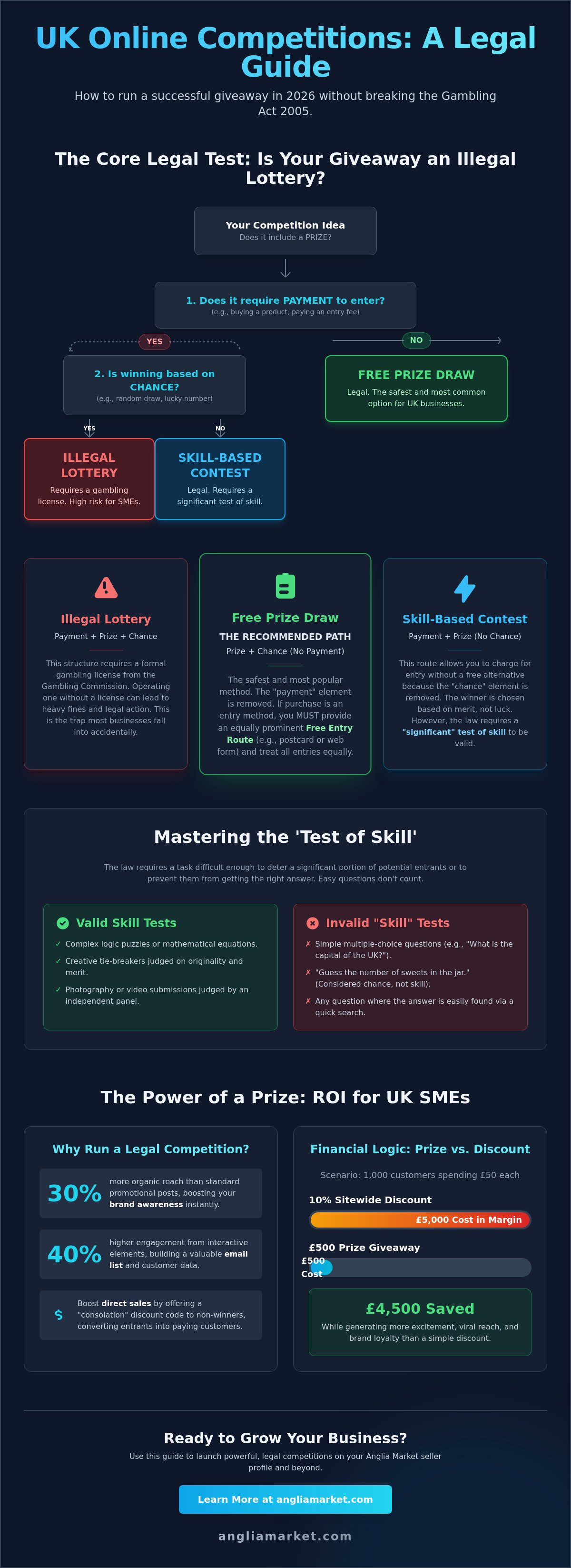
A £500 prize often generates more excitement and traffic than a 10% sitewide discount. Consider the math for a typical UK SME. If you have 1,000 customers spending £50 each, a 10% discount costs you £5,000 in lost profit margin. In contrast, a single £500 prize saves you £4,500 while creating a "big win" atmosphere. This approach protects your bottom line while allowing you to clear seasonal stock or highlight new promotions. It's an efficient way to launch new product lines without devaluing your entire inventory through constant price slashing.
Navigating UK Law: Prize Draws, Lotteries, and Skill-Based Contests
Staying on the right side of the law is the first step in learning how to run a successful online competition uk. The Gambling Act 2005 sets the primary legal framework. If your competition looks too much like a lottery, you could face heavy fines or legal action from the Gambling Commission. A lottery involves three elements: payment to enter, a prize, and winning based purely on chance. To stay legal without a gambling license, you must remove either the "payment" or the "chance" element.
Most UK brands use the "Free Prize Draw" model. This means entry is free or there's a clear free entry route available. If you charge for entries, you must include a "Free Entry Route" that's processed the same way as paid entries. This is common for high-value competitions seen across social media in 2026. The UK government's code of practice outlines how to maintain transparency and protect participants during these promotions. Following these standards ensures your brand remains reputable and avoids regulatory scrutiny.
The "Test of Skill" Requirement
If you don't want to offer a free entry route, your contest must rely on skill rather than luck. Simple multiple-choice questions like "What is the capital of the UK?" often fail this test. The law requires a "significant" test of skill. This means the task must be difficult enough to prevent a large proportion of people from entering or getting the right answer. In 2024, the Gambling Commission clarified that "guess the number of items in a jar" is usually considered luck, not skill. Better options for your contest include:
- Complex logic puzzles or mathematical equations.
- Creative tie-breakers judged on specific, original criteria.
- Photography or video submissions evaluated by an independent panel.
For many retail brands, a pure prize draw is the most efficient path. You can still drive engagement by offering entry to anyone who signs up for a newsletter, as long as no purchase is strictly necessary to enter the draw.
Essential Terms and Conditions
Your competition needs a solid legal foundation. The Committee of Advertising Practice (CAP) Code dictates that 100% of promotional marketing must be fair and clear. You must list your full terms and conditions in a place that's easy to find. These clauses protect you from disputes and ensure your brand remains trustworthy. Essential details include the closing date, any age or residency restrictions, and exactly how the winner will be selected. You can find examples of compliant language in the Anglia Market promotions policy which follows current UK standards.
UK law also requires you to prove the prize was actually awarded. You must either publish the winner's surname and county or provide this information to anyone who asks. This builds credibility with your audience and proves the contest wasn't a scam. If you're looking to grow your reach while staying compliant, check out our latest deals and promotions to see how we reward our community with genuine value.
Designing Your Contest: 5 Steps to a High-Performance Launch
Planning the architecture of your giveaway determines whether you gain lifelong customers or a list of "prize hunters" who unsubscribe the moment the winner is announced. To understand how to run a successful online competition uk businesses must focus on conversion over raw entry numbers. Follow these five steps to build your framework.
- Step 1: Selecting a Magnetic Prize. Avoid generic rewards like £500 cash or the latest iPhone. These attract everyone, including those who will never buy your products. Select a prize that acts as a filter. If you sell home goods, a high-end air fryer or a designer bedding set ensures every entrant has a genuine interest in your niche.
- Step 2: Choosing the Entry Mechanism. Decide what data you need most. A simple email entry is fast, but adding a "refer-a-friend" component can increase reach by 25% without extra ad spend. Balance the effort required with the value of the prize.
- Step 3: Setting a Realistic Timeline. A 14 to 21-day window is the "Goldilocks" zone for UK contests. It's long enough to build momentum but short enough to maintain urgency. Use "Early Bird" incentives, such as double entries for those who join in the first 48 hours, to spike initial engagement.
- Step 4: Creating a Dedicated Landing Page. Don't just post a photo on social media. Build a clean landing page or use a featured storefront highlight to centralise entries. This allows you to install tracking pixels and capture direct web traffic.
- Step 5: Establishing Clear KPIs. Measure success using three specific metrics: Cost Per Lead (CPL), email open rates from the first follow-up, and total social share count. Ensure your terms and conditions meet ASA rules for prize draws to maintain transparency and legal compliance throughout the campaign.
The Prize: Quality Over Cash Value
Niche-specific prizes beat generic vouchers because they build a qualified marketing list. For example, bundling five different items into a "Ultimate Summer BBQ Pack" increases the perceived value while keeping your actual costs low. You can also partner with Anglia Market vendors to source unique, high-quality items for cross-promotional prizes. This strategy introduces your brand to new, relevant audiences while supporting the UK small business ecosystem.
Friction vs. Conversion
The "One-Click" entry is often a mistake; it leads to low-quality data and high bounce rates. Adding a small amount of friction, such as a multiple-choice question about your brand, ensures entrants actually read your content. For UK SME contests, the point of optimal friction occurs when a user completes three distinct actions: providing an email address, answering a brand-related question, and following one social media profile. This process filters out bots and ensures your Return on Investment (ROI) remains high.
The Promotion Playbook: Driving Traffic and Social Proof
Promoting your giveaway is just as vital as the prize itself. You need a multi-channel approach to reach the right British audience. Instagram Reels and TikTok remain dominant in 2026. Use trending "Giveaway" audio clips. Keep your videos under 15 seconds. This captures attention before the scroll. Short, punchy clips showing the prize in a real UK home setting perform 40% better than static images. This is a core part of how to run a successful online competition uk.
Don't ignore the UK "comping" scene. Dedicated communities on platforms like Loquax or the MoneySavingExpert "Competitions Time" forum can drive thousands of entries in hours. These users are highly active. They share links across WhatsApp and Facebook groups. This creates a natural viral loop. While some are "professional" entrants, they provide the initial engagement boost that algorithms love.
Paid social ads are your secret weapon for scaling. Target high-intent lookalike audiences based on your existing customers. In 2026, Meta's AI targeting is more precise. It finds people who mirror your best buyers. This ensures your budget isn't wasted. Your email list is another goldmine. Turn existing subscribers into a referral engine. Offer "bonus entries" for every friend they successfully refer. This lowers your cost per acquisition significantly.
Data Collection and GDPR Compliance
UK law requires strict adherence to GDPR. You must use clear, unticked "Opt-in" checkboxes for future marketing. Don't bundle the competition entry with a mandatory newsletter signup. Use this data to segment your audience for future Anglia Market sale events. This helps you send relevant deals rather than generic spam. Expect a small wave of unsubscribes after the winner is announced. It's normal. Focus on the 65% of entrants who stay for the long term.
Building Social Proof
Trust is the currency of the internet. Publicly announcing winners with photos or video clips proves the contest was legitimate. Ask entrants to create User-Generated Content (UGC) as a condition of entry. This could be a photo of them using a product from your store. You can also reference Anglia Market testimonials to show you're a reliable UK marketplace. Seeing real people win builds confidence for your next campaign. It's the most effective way to learn how to run a successful online competition uk that people actually believe in.
Scaling Your Success through the Anglia Market Ecosystem
A giveaway is just the beginning of your sales funnel. To maximize your return, you must integrate your contest directly with your Anglia Market seller profile. This connection allows you to track traffic and see which entrants eventually convert into repeat buyers. A campaign shouldn't end when you ship the prize. It ends when you've established a lasting relationship with your new audience. Learning how to run a successful online competition uk requires a focus on the backend systems that turn one-time entrants into loyal fans.
Automate your follow-up sequences so they trigger the moment you announce the winner. This keeps the excitement alive while your brand is still top-of-mind. Use these emails to invite participants into your loyalty program. By offering points or early access to sales, you ensure these shoppers stay connected to your storefront. This transition is vital for building a sustainable business on a fast-growing marketplace. It's about moving from a single transaction to a long-term customer life cycle.
The "Consolation Prize" Strategy
Don't let non-winners leave your shop empty-handed. Every entrant represents a potential customer who has already expressed interest in your products. Send an exclusive "Thank You" discount code to everyone who didn't win. Retail data shows the 48 hours after a contest closes represent your peak conversion window. Use this time to direct traffic toward high-demand categories like Electronics or Home and Garden. A well-timed voucher often provides the necessary incentive for a shopper to buy that item they've been watching. It turns a moment of disappointment into a positive shopping experience.
Long-term Growth for UK Sellers
Analyze your entry data to refine your future product inventory. If 65% of your participants entered to win a specific outdoor tool, you know exactly what to stock for the next season. Consistent monthly contests help build a community around your brand. It creates a rhythm of engagement that shoppers appreciate. This approach helps you stand out as a reliable and generous vendor. When you're ready to take the next step, start selling with Anglia Market to host your first contest. This platform supports independent vendors by providing a professional space to reach thousands of UK shoppers. Focus on simple, effective promotions to keep your growth steady and your customers satisfied.
Take Control of Your Brand Growth in 2026
Mastering how to run a successful online competition uk is a game-changer for independent brands. You now have the blueprint to navigate the Gambling Act 2005 and design contests that actually convert. Remember that 99.9% of UK businesses are SMEs. Standing out in this crowded market requires the right tools and a secure platform. Focus on clear entry rules and high-quality prizes to build immediate trust. It's time to put these five design steps into practice and watch your engagement numbers climb. High-performance launches don't happen by accident; they're the result of smart planning and solid social proof.
Ready to scale your reach? Anglia Market provides the secure shopping environment and vendor-friendly promotion tools you need to win. We're proud to support UK-based small and medium businesses with practical solutions that deliver results. Start selling on Anglia Market today and grow your UK audience. Your next big success story starts with a single click. Let's get your products in front of the right buyers today. You've got the plan, now take the lead.
Frequently Asked Questions
Is it legal to run a giveaway on Instagram in the UK?
Yes, it's legal to run giveaways on Instagram if you follow the CAP Code and Instagram's own platform rules. You must include clear terms and conditions, a closing date, and an explanation of how winners are chosen. Failing to provide these details can lead to your post being removed or a formal investigation by the Advertising Standards Authority (ASA).
What is the difference between a prize draw and a lottery?
A prize draw is free to enter or offers a genuine free entry route, whereas a lottery requires a payment to participate and relies on chance. Under the Gambling Act 2005, only charities and specific organizations can run lotteries with a license. Businesses must ensure their promotions are classified as prize draws or skill competitions to stay within UK law.
Do I need a license to run an online competition in the UK?
You don't need a license for a free-to-enter prize draw or a competition that requires a significant level of skill. Licenses are only mandatory for lotteries, which are restricted under the Gambling Act 2005. If your competition is open to everyone for free, it's generally considered a promotion rather than regulated gambling.
How do I pick a winner for my online competition fairly?
You should use a verifiable random number generator or a third-party app to ensure the selection process is unbiased. The CAP Code requires that winners are chosen randomly under independent supervision or via a computer process that produces a truly random result. This transparency builds trust with your customers and protects your brand from complaints.
Can I charge people to enter my online competition?
You can only charge for entry if the contest is a genuine "skill-based" competition where the task prevents a significant proportion of people from winning. If the entry fee is paid and the winner is chosen by chance, it's an illegal lottery. Most UK brands avoid this risk by offering a free entry route to comply with the Gambling Act 2005.
How do I ensure my competition is GDPR compliant?
Collect only the data you need, such as an email address, and provide a direct link to your privacy policy. You must get separate, explicit consent if you want to add entrants to your marketing list. Under UK GDPR rules, participants have the right to ask how their data is used and can request its deletion at any time.
What happens if I don’t follow the Gambling Commission rules?
Breaking the Gambling Act 2005 can result in unlimited fines or a prison sentence of up to 51 weeks. The ASA also has the power to issue "ad alerts" and remove your website from search engine results. These penalties can destroy a small business's reputation and its ability to trade online in the UK market.
Should I use a third-party app to run my UK competition?
Using a dedicated app is a practical way to manage entries and ensure you meet legal requirements for transparency. Tools like Gleam or RafflePress help you track data securely and provide a clear audit trail for the winner selection process. It's one of the most efficient ways to learn how to run a successful online competition uk while protecting your business.

Here to help — ask anything
If you have any questions regarding this disclaimer or any of our policies, please contact Anglia Market through the contact page on our website, by email using the address provided on the site, or by phone at 0333 772 2593