
Did you know that 60% of UK consumers feel more positive about a brand after reading custom content on its site? For a busy small business owner, finding the time to create that content often feels impossible. You likely worry about what to say or fear that your hard work won't reach the first page of Google. It's a common hurdle, but learning how to write an effective business blog post is the most affordable way to grow your online shop in 2026 without spending a fortune on ads.
We agree that your time is your most valuable asset, and you shouldn't waste it on writing that doesn't convert. This guide promises to give you a practical, step-by-step framework designed to drive consistent traffic and increase your sales. We'll walk through a repeatable writing process that clears up technical SEO confusion and helps you rank higher, so you can spend less time staring at a blank screen and more time supporting your customers.
Key Takeaways
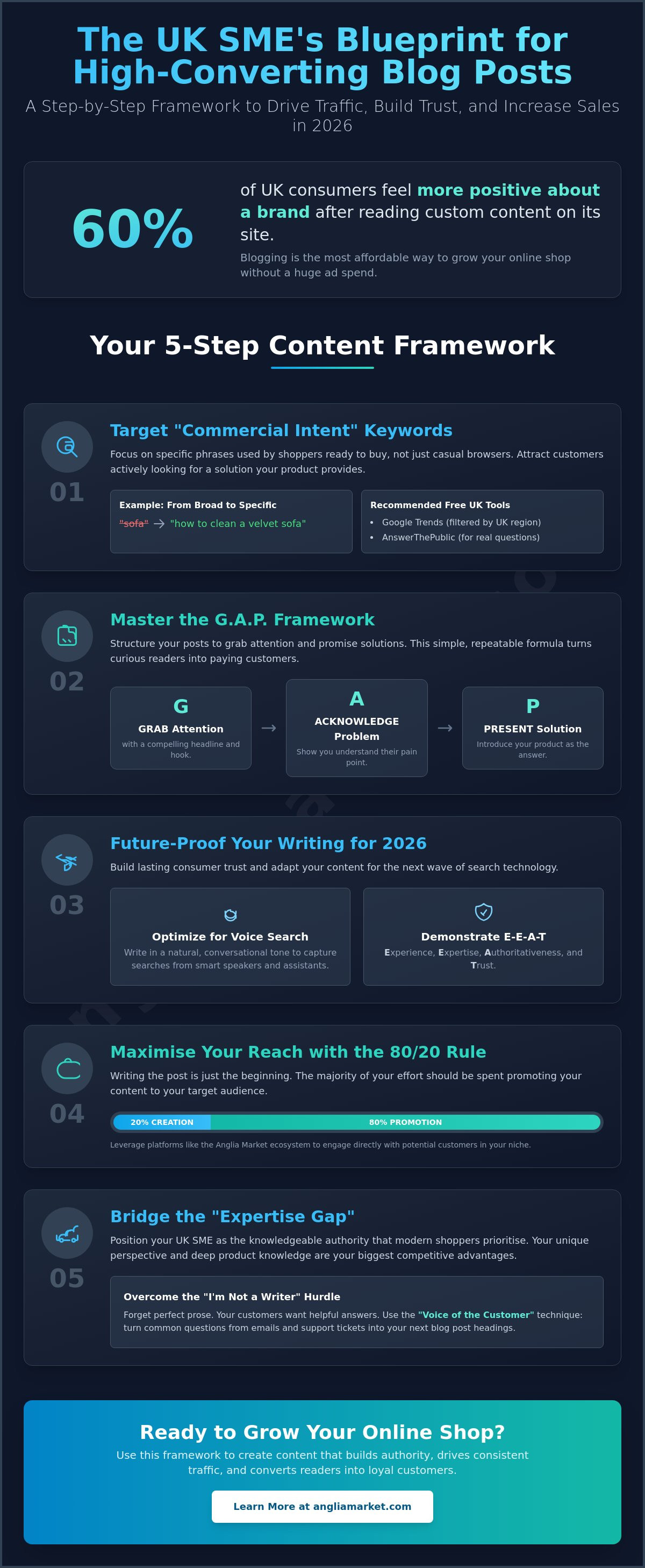
- Identify "Commercial Intent" keywords using free tools to ensure your content attracts ready-to-buy UK shoppers instead of just casual browsers.
- Master the G.A.P. framework on how to write an effective business blog post to grab attention and promise solutions that convert readers into customers.
- Future-proof your writing for 2026 by optimizing for conversational voice search and demonstrating the E-E-A-T factors that build consumer trust.
- Maximise your reach by applying the 80/20 promotion rule and leveraging the Anglia Market ecosystem to engage with your target audience effectively.
- Bridge the "Expertise Gap" to position your UK SME as the knowledgeable authority that modern independent shoppers prioritise.
Why Every UK SME Needs a Business Blog in 2026
Business blogging is a strategic engine for growth. It moves beyond simple updates to become a tool for building authority and capturing organic traffic. For UK sellers, understanding what is a corporate blog helps clarify its role as a public-facing asset that drives commercial results. Learning how to write an effective business blog post is no longer optional for UK sellers. It's the primary way to close the "Expertise Gap" that exists between large corporations and independent vendors.
In 2026, UK consumers prioritise transparency and knowledge. They want to know who they're buying from. A blog allows you to demonstrate your deep product knowledge directly. While social media platforms offer reach, they're "rented land." Algorithms change and accounts can be restricted. Your blog is an asset you own and control entirely. It provides a stable home for your brand's voice and a direct line to your marketplace customers.
To better understand this concept, watch this helpful video:
The Commercial Benefits of Content
Blogging increases your visibility for specific product categories. If you sell Furniture, writing about "How to choose a durable oak dining table" attracts buyers who are ready to purchase. This "educational selling" reduces buyer hesitation by answering questions before they're asked. It builds trust through helpfulness rather than hard sales tactics. Every post you publish adds to the compound effect of your digital presence. Each article serves as a permanent, 24/7 lead generation tool that gains value as it ages and attracts more search engine authority.
Overcoming the "I am not a writer" Hurdle
Many SME owners avoid blogging because they fear their writing isn't professional enough. Forget perfect prose. Your customers want helpful answers, not a literary masterpiece. Your unique perspective as a small business owner is your biggest competitive advantage; you know your products better than any AI or corporate copywriter. Use the "Voice of the Customer" technique to find topics. Look at your recent emails or support tickets. Turn common questions like "How do I maintain this product?" into your blog headings. This ensures your content is always relevant to your audience. Mastering how to write an effective business blog post starts with simply being useful to the people you serve.
Planning Your Strategy: Topic Selection and Keyword Research
Learning how to write an effective business blog post requires a shift from vanity metrics to commercial reality. High traffic numbers look good on a report, but they don't pay the bills. You need "Commercial Intent" keywords. These are specific phrases used by people who are ready to spend £ GBP, not just those browsing for fun. Focus on terms that signal a problem your business can solve immediately.
Start your research with free tools tailored for the UK market. Google Trends allows you to filter by region, showing you what's trending in London versus Manchester. AnswerThePublic is excellent for finding the exact questions Brits ask search engines. For instance, if you see a spike in "how to insulate a garden office," and you sell DIY supplies, you've found a high-value topic. Use these insights to build a "Problem-Solution" Matrix. List five common customer headaches and match them directly to your inventory. This ensures every post acts as a soft sales tool.
Finding Your Niche in the Marketplace
Success often lies in the details. High-demand sectors like Home and Garden or Pet Supplies are competitive, so you must find "Content Gaps." These are specific questions your competitors haven't answered yet. Use the "Local Advantage" by targeting UK-specific seasons. Search volume for "hosepipe ban tips" or "Bank Holiday BBQ prep" follows a predictable pattern in Britain. Capitalise on these windows to capture local traffic before the big brands react.
Keyword Research for Beginners
Long-tail keywords are your best friend. A broad term like "sofa" is nearly impossible to rank for. However, "how to clean a velvet sofa" targets a user with a specific need. Understanding "Search Intent" is the secret to knowing how to write an effective business blog post that actually converts. Users generally fall into three categories: those wanting to learn, those comparing options, or those ready to buy.
- Informational: "How to season a cast iron skillet" (Builds trust)
- Commercial: "Best eco-friendly lunch boxes UK" (Captures researchers)
- Transactional: "Buy stainless steel cookware sets" (Leads to sales)
Consistency is the final piece of the puzzle. You don't need to post every day. A 2025 industry report found that UK SMEs posting just twice a month saw 45% better lead growth than those with irregular schedules. Use a simple spreadsheet to plan your topics four weeks in advance. This prevents burnout and keeps your content focused on your business goals. If you're ready to scale your reach, consider selling online through a dedicated marketplace to put your products in front of a wider audience.
The Anatomy of a High-Converting Business Blog Post
Success starts with a structure that respects your reader's time. To master how to write an effective business blog post, you must use the G.A.P. Headline Framework. First, you grab attention with a bold claim. Second, you articulate a specific issue your customer faces. Third, you promise a solution that's easy to implement. This framework ensures your title isn't just clickbait; it's a professional commitment to providing value.
Your blog's layout acts as a map for the reader. Use H2 and H3 headings as a skeleton to support your main points. Research from the Nielsen Norman Group shows that 79% of users scan a new page they come across; only 16% read word-for-word. By placing the most vital information at the top, following the Inverted Pyramid style, you capture the 80% of readers who might otherwise bounce. If you're ready to scale your reach, consider setting up an Online Marketplace Storefront to turn that traffic into transactions.
Crafting the Perfect Introduction
You have roughly eight seconds to convince a visitor to stay. Use the Hook-Relate-Reward method. Start with a punchy fact, show you understand the reader's struggle, and tell them exactly what they'll gain. You must establish your Vendor Authority within the first 100 words to build trust quickly. Here is how that looks for a Sporting Goods retailer:
"Finding the right gear shouldn't feel like a marathon before the race even starts. We've tested over 50 types of running trainers to ensure our collection meets professional standards for UK athletes. This guide helps you select the perfect equipment to hit your fitness goals without overspending."
Body Content and Visuals
Keep your communication rhythm fast. Use bullet points and short paragraphs to prevent walls of text that discourage mobile users. In a post-AI search environment, original photography is non-negotiable. Google's 2025 algorithm updates place a higher premium on Helpful Content that features unique, high-quality images rather than stock photos or generic graphics. To drive immediate revenue, naturally integrate internal links to your current Promotions. This turns an educational moment into a commercial opportunity without feeling forced. Direct, value-driven writing is the most reliable way to learn how to write an effective business blog post that actually sells.
Writing and Optimizing for 2026 Search Trends
Search is different now. By 2026, over 50% of UK households own a smart speaker, making conversational language a requirement for visibility. Learning how to write an effective business blog post involves more than just picking a topic; it requires understanding how AI and voice assistants like Alexa or Siri process your words. People don't type "best office chairs UK" as often as they ask, "Siri, what is the most affordable ergonomic chair for a small home office?"
Google's 2024 core updates solidified the "E-E-A-T" framework as the gold standard. To rank in 2026, you must prove Experience, Expertise, Authoritativeness, and Trustworthiness. Don't just summarize a product. Share a specific case study or a lesson learned from your time in the UK retail market. If you are discussing office supplies, mention how a specific desk setup improved your team's productivity by 15% last quarter. Real world data wins.
Readability is your secret weapon. Data from the National Literacy Trust suggests that writing for a 12-year-old reading level ensures your message reaches the widest possible audience. Busy SME owners don't have time for academic jargon. They want fast answers. Use a technical SEO checklist to keep the backend clean:
- Meta descriptions: Keep these under 155 characters and include a clear call to action.
- Alt-text: Describe images clearly to support the 2 million people in the UK living with sight loss.
- URL structures: Use short, descriptive slugs like /blog/how-to-sell-online rather than random strings of numbers.
Writing for AI Search Engines
AI search engines look for direct answers. You can win featured snippets by structuring "Question and Answer" blocks near the top of your posts. Use an H3 tag for a common customer question, then answer it in the very next sentence. Avoid keyword stuffing. Natural language is the priority for modern SEO. Remember that factual accuracy is non-negotiable. In 2026, AI filters are aggressive at flagging unverified claims. Always cite UK-based sources or official government data to maintain your site's integrity.
Refining Your Brand Voice
Your voice should be a "Helpful Facilitator." At Anglia Market, we focus on being practical and straightforward. We don't use flowery language to hide a lack of value. When you master how to write an effective business blog post, you balance this helpfulness with commercial urgency. Use phrases like "Limited Time Sale" or "Big Savings" to drive action without sounding desperate.
The best way to check your flow is the "Read Aloud" test. If you run out of breath before finishing a sentence, it's too long. Short, punchy sentences create a fast-paced rhythm that keeps readers moving toward your checkout page. Keep it simple. Keep it commercial. Keep it honest.
Ready to put these trends into practice and grow your reach? Start selling with Anglia Market today and connect with thousands of UK shoppers.
Promoting Your Content and Measuring Success
Writing the content is only the start. You've mastered how to write an effective business blog post, but it won't work if no one sees it. Stick to the 80/20 rule. This means 20% of your effort goes into writing, while 80% goes into promotion. UK SMEs often make the mistake of hitting publish and hoping for the best. Instead, use the Anglia Market ecosystem. Sharing your latest insights with Loyalty Program members gives you an immediate, warm audience of shoppers who already trust the platform.
Multi-channel distribution is essential for reaching different demographics. If you sell Home Decor, your visual content needs to live where shoppers look for inspiration. If you're in the Beauty sector, short-form video and high-quality imagery are your primary tools. Don't let your hard work sit on a single page. Spread it across the web to capture traffic from every possible angle.
Social Media Strategy for UK Vendors
Direct traffic comes from active engagement. Use Facebook and Instagram to showcase the lifestyle benefits of your products. Visual platforms like Pinterest are particularly powerful for physical goods. A single pin can drive evergreen traffic for over 12 months, far outlasting the 24-hour lifespan of a standard social post.
Efficiency is key for busy business owners. Create micro-content by turning one blog post into five distinct updates:
- A "Top Tip" graphic for Instagram stories.
- A short video demonstration of a product mentioned in the post.
- A poll on Facebook asking for customer opinions on the topic.
- A high-quality photo pinned to a relevant Pinterest board.
- A direct link shared with your email subscriber list.
Analyzing What Works
Stop obsessing over page views. High traffic numbers look good, but they don't pay the bills. Knowing how to write an effective business blog post is only half the battle; the rest is tracking data. Focus on "Add to Cart" conversions. This metric tells you if your content is actually persuading people to buy. Use simple tools to see which posts result in positive Testimonials from satisfied customers.
Implement a "Refresh" strategy every six months. Search engine algorithms change, and information becomes outdated. Update your stats, fix broken links, and add new product recommendations to keep your rankings high. It's much faster to update an old post than to write a new one from scratch. Once your readers are engaged and informed, give them a reason to act. Direct them to your latest deals on the Anglia Market Sale page to turn that reader into a loyal customer.
Boost Your UK Sales Results Now
Mastering how to write an effective business blog post is a vital skill for any UK SME aiming to lead the market in 2026. Your strategy must prioritize high-converting structures and align with current UK search trends to capture attention. Industry data shows that 70% of customers prefer learning about brands through articles rather than traditional adverts. Focus on providing clear value, track your metrics monthly, and keep your advice straightforward for your local audience.
Once your content is driving traffic, you need a reliable platform to convert those visitors into sales. Anglia Market is a fast-growing online marketplace supporting UK small and medium businesses with a focus on local growth. We offer secure shopping trusted by thousands of UK customers and provide direct support for independent vendors. It's the perfect time to join our community of successful British sellers. Start selling on Anglia Market today and grow your business with our community!
Take these steps today and watch your business reach new heights.
Frequently Asked Questions
How long should a business blog post be in 2026?
Aim for 1,500 to 2,500 words to achieve the best search engine rankings. Short posts under 500 words rarely provide enough depth to satisfy modern search algorithms or user intent. Backlinko data shows that long-form content generates 77.2% more backlinks than short articles. Focus on providing comprehensive answers rather than just hitting a specific word count target.
How often should I publish new content on my business blog?
Publish 2 to 4 times per week to see the most significant traffic growth. Consistency matters more than volume for UK SMEs. HubSpot research shows companies that blog 11 or more times a month get 3 times more traffic than those blogging only once. Start with one quality post weekly and scale up as your resources and budget allow.
Do I need to be a professional writer to have a successful business blog?
You don't need a journalism degree to write a successful blog. Customers value your industry expertise and practical advice more than perfect prose. Use a tool like Grammarly to catch errors and keep your language simple. Focusing on solving specific problems for your UK customers makes learning how to write an effective business blog post much easier for busy owners.
Can I use AI to write my business blog posts?
Use AI tools like ChatGPT or Claude as assistants for outlining and brainstorming. Never publish raw AI output without human editing. Google's Search Quality Rater Guidelines require first-hand experience that AI cannot replicate. 75% of readers can spot AI-generated content quickly. Add your own case studies and UK-specific examples to maintain trust and authority with your audience.
How long does it take for a blog post to start showing up in Google search results?
Expect to wait 3 to 6 months for a post to reach its peak position in search results. While Google might index your page within 24 hours, ranking for competitive terms takes time. Ahrefs found that only 5.7% of newly published pages reach the top 10 within a year. Be patient and keep updating your content to improve its performance over time.
What is the best way to come up with blog post ideas if I am stuck?
Look at your sent emails to find questions customers ask every day. These real-world problems make the best topics. Tools like AnswerThePublic show exactly what people search for in the UK. You can also check the "People Also Ask" sections on Google. Solving a customer's £50 problem with free advice builds long-term loyalty and establishes your brand as a helpful facilitator.
How do I know if my blog is actually helping my business make money?
Track your conversion rate using Google Analytics 4 to see which posts lead to sales or enquiries. Assign a monetary value to actions like newsletter sign-ups or contact form submissions. If a post costs £200 to produce and generates £1,000 in leads, it's a success. Understanding these metrics is key when learning how to write an effective business blog post that delivers ROI.
Should I focus on my products or on general industry news in my blog?
Follow the 80/20 rule by making 80% of your posts helpful advice and only 20% product-focused. Readers visit blogs to solve problems, not to see constant adverts. Share industry news only if it affects your customers directly. For example, a 2025 change in UK trade regulations is more relevant than a general press release about your company's new office paint.

Here to help — ask anything
If you have any questions regarding this disclaimer or any of our policies, please contact Anglia Market through the contact page on our website, by email using the address provided on the site, or by phone at 0333 772 2593