
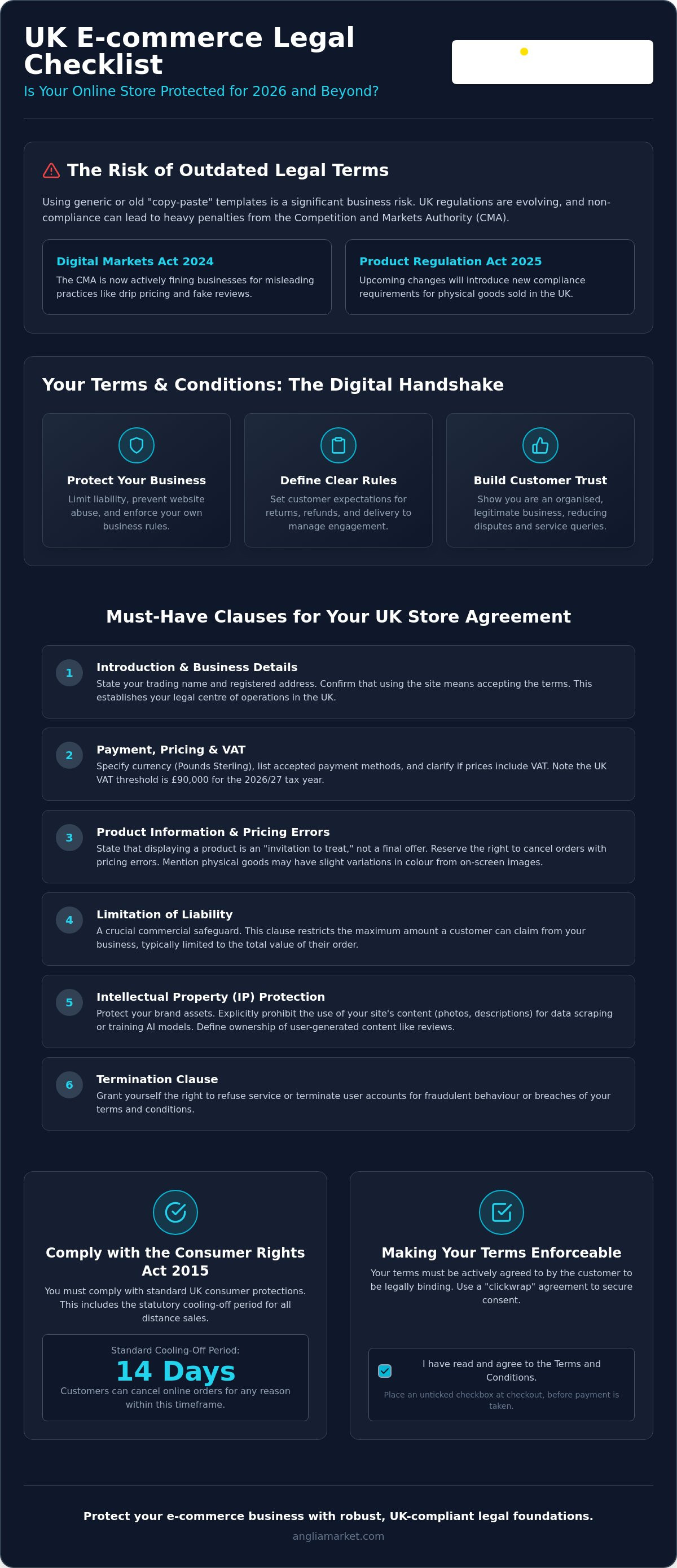
Would you risk your entire business on a "copy-paste" legal template that hasn't been updated since 2023? With the Competition and Markets Authority (CMA) now issuing heavy fines for drip pricing and fake reviews under the Digital Markets, Competition and Consumers Act 2024, your legal fine print has never been more important. Learning how to write terms and conditions for your online store is no longer just a "nice to have" task. It is a commercial necessity for any platform selling physical goods in the UK today.
We understand that managing returns and disputes feels like a major headache. It is easy to feel confused by UK consumer rights or the new Product Regulation and Metrology Act 2025. This guide will help you master the essentials of drafting robust, UK-compliant Terms and Conditions that protect your business whilst building customer trust. We will provide a clear checklist of must-have clauses and a simple breakdown of how to reduce your liability and stay compliant in 2026.
Key Takeaways
- Define the "rules of engagement" by establishing a clear legal contract that protects your business and clarifies customer expectations.
- Master how to write terms and conditions for your online store by identifying the specific clauses needed for pricing, VAT, and currency.
- Ensure full compliance with the Consumer Rights Act 2015 and the standard 14-day cooling-off period for all distance sales.
- Secure your shop with "clickwrap" agreements to make your terms legally binding during the checkout process.
- Learn how selling via an established marketplace platform can significantly lower your regulatory workload through shared policies.
What are Terms and Conditions and Why Does Your UK Store Need Them?
Think of your Terms and Conditions as the digital handshake between you and your customer. This document is a binding legal contract that dictates how you do business. It is the rulebook for your shop. When you research how to write terms and conditions for your online store, you'll see it's about more than just legal safety. It provides the "rules of engagement" for every single transaction. These rules cover everything from who can use your site to what happens if a parcel goes missing during transit.
Without these rules, your store is vulnerable. T&Cs prevent website abuse by setting clear boundaries for user behaviour. They also protect your original content. Your product descriptions, brand photos, and logo are all intellectual property. Your terms should clearly state that this content belongs to you. Beyond protection, there is massive commercial value here. Clear, accessible rules reduce the number of customer service enquiries. When shoppers know exactly where they stand, they are less likely to raise disputes or flood your inbox with questions about returns.
The Legal Reality for UK E-commerce
Technically, T&Cs aren't strictly mandatory under UK law in the same way a Privacy Policy is. However, without them, you have no way to enforce your own business rules. A Privacy Policy handles data and GDPR compliance; your Terms of service handle the transaction and the usage of the site itself. For UK businesses, it is vital to specify your "centre" of operations. This confirms which legal jurisdiction applies if a dispute ever reaches a court. It also clarifies your position regarding UK tax obligations, such as VAT.
Building Trust Through Transparency
Professional T&Cs show you are a legitimate, organised business. They aren't just fine print. They are a trust signal. Clear terms often lead to glowing customer testimonials because there are no nasty surprises at the checkout. You should use this section to manage expectations about product availability and delivery times. If an item is out of stock, your terms should explain how you will handle the refund or replacement. This level of transparency keeps customers happy and helps you maintain a professional reputation whilst you grow.
Essential Clauses for Your Online Store Agreement
Every contract needs a solid foundation. When researching how to write terms and conditions for your online store, start with a clear Introduction clause. This identifies your trading name, registered office address, and the scope of the agreement. It confirms that the customer accepts these terms the moment they browse or buy. This simple step sets the legal boundary for your entire relationship with the shopper.
Payment and Pricing clauses are next. You must state that all transactions are in Pounds Sterling. If your turnover exceeds the £90,000 VAT threshold for the 2026/27 tax year, your terms must clearly state if prices include VAT. List your accepted payment methods to avoid confusion at the checkout. Being transparent about costs up front helps prevent abandoned baskets and reduces the risk of payment disputes later on.
Limitation of Liability is your commercial safeguard. It restricts the amount a customer can claim from you to the value of the order they placed. This protects your business from excessive or unforeseen claims. Pair this with a Termination clause. This gives you the right to refuse service or close user accounts if a person breaches your rules or behaves fraudulently. If you want to simplify your setup, you can sell online via a professional marketplace that provides a structured environment for these rules.
Product Descriptions and Pricing Accuracy
In UK law, displaying a product is usually an "invitation to treat", not a binding offer. This distinction is vital. It means a contract is only formed when you accept the order, not when the customer clicks buy. We recommend a specific Pricing Error clause: "We reserve the right to cancel any order and provide a full refund if a product was displayed at an incorrect price due to a typographical or technical error." Also, mention that physical goods may have slight variations in colour or finish compared to on-screen images.
Modern IP Protection in the Age of AI
By 2026, protecting your data from automated bots is essential. Your Intellectual Property clause must explicitly prohibit the use of site content for AI training, machine learning, or data scraping. You should also define the ownership of user-generated content. State that whilst customers own their reviews, they grant you a perpetual licence to use that feedback for marketing purposes. Ensure your logos and brand assets remain your exclusive property at all times. This prevents competitors from using AI to harvest your hard-earned product descriptions or brand imagery.
Navigating UK Consumer Rights and Distance Selling
Understanding the Consumer Rights Act 2015 is a non-negotiable part of learning how to write terms and conditions for your online store. This legislation dictates that every product you sell must be of satisfactory quality, fit for purpose, and exactly as described. If a customer receives a product that fails these tests, they have a legal right to a refund, repair, or replacement. Your terms must reflect these statutory rights without trying to limit them, as any clause that attempts to override these rights will be legally void and could attract attention from the CMA.
Distance selling regulations provide online shoppers with extra protection compared to high-street buyers. The most significant of these is the 14-day "cooling-off" period. Customers have the right to cancel their order for any reason within 14 days of receiving the goods. You don't have to like it, but you do have to honour it. Once they notify you of the cancellation, they have another 14 days to return the item. However, not every product is eligible for this window. You should clearly list exceptions in your T&Cs, such as personalised gifts, perishable items, or sealed hygiene goods that have been opened.
Data protection also plays a role in your contractual relationship. Whilst your Privacy Policy handles the technical details of data processing, your T&Cs should acknowledge your compliance with the UK GDPR. This ensures that the customer understands how their information is used to facilitate the contract of sale. Transparency is the goal here. Clear language helps you avoid the "unfair trading" traps recently tightened by the Digital Markets, Competition and Consumers Act 2024.
Managing Returns and Refunds
Your terms must state who pays for return postage. If you don't specify that the customer bears this cost for "change of mind" returns, you might end up footed with the bill. For faulty goods, you are legally required to cover the return costs. To keep things organised, link your T&Cs to a practical support centre. This gives customers a clear path to resolve disputes and helps you manage refund timelines effectively, usually within 14 days of receiving the returned goods.
Delivery and Risk
Legally, the "risk" for the goods remains with you until the moment they are delivered to the customer. Your T&Cs should define this clearly to avoid arguments over items left in "safe places" without permission. UK law sets a default 30-day delivery window unless you agree otherwise with the buyer. This is particularly important when shipping bulky items like furniture or large home and garden equipment. Always state that delivery dates are estimates to protect yourself against claims for delayed arrivals caused by third-party couriers.
Implementation: Making Your Terms Enforceable
Writing a brilliant legal document is pointless if you cannot prove your customers agreed to it. When you master how to write terms and conditions for your online store, you must also master how to make them stick. You should use a "Clickwrap" agreement at the checkout. This requires shoppers to actively tick a box confirming they have read and accepted your terms before they can complete a purchase. Relying on a simple link in the footer, known as "Browsewrap", is risky and often fails to hold up in UK courts if a dispute arises.
Visibility is your best defence. Place your terms in the website footer for general browsing, but ensure they are prominent at the point of sale. You should also maintain a strict version history of your documents. If a dispute occurs six months after a purchase, you need to show exactly which rules were active on that specific date. If you update your policies significantly, send a quick email to your database to keep things transparent. If you want to reach more customers on a platform that handles the technical side of policy visibility, you can sell online with a professional marketplace today.
The Importance of Language and Layout
UK courts have little patience for "unintelligible" terms. If your contract is a wall of dense legalese, it may be struck down as an unfair term under the Consumer Rights Act 2015. Use clear headings and a table of contents to make the document scannable. You must highlight any "onerous" or unusual clauses. Use bold text or a separate call-out box to ensure these points are prominent. If a customer cannot find a restrictive rule easily, a judge might decide it simply doesn't apply to the contract.
Applicable Law and Jurisdiction
You must state which law governs your contract. For most businesses in Britain, this will be the laws of England and Wales. You can also specify Scotland or Northern Ireland if that is where your business is registered. This clause determines which courts will settle any legal fights. Even if you sell to international shoppers, staying rooted in UK jurisdiction protects you from the cost and complexity of defending your business in a foreign legal system. This keeps your legal costs predictable and your business operations secure.
Simplifying Compliance: The Marketplace Advantage
Starting a standalone site means every legal clause rests entirely on your shoulders. When you learn how to write terms and conditions for your online store, you quickly realise the sheer volume of UK regulations involved. From the Digital Markets, Competition and Consumers Act 2024 to specific product safety laws, the checklist is long. Selling through an established marketplace changes this dynamic. The platform provides a set of overarching policies that govern the entire shopping environment. This reduces the legal burden on individual vendors. You aren't just selling in a vacuum; you are operating within a secure, managed ecosystem.
Marketplace-wide policies protect both the buyer and the seller. They create a consistent standard for returns, payments, and dispute resolution. This shared trust is a massive commercial asset. Customers feel safer buying from a platform with a known reputation for reliability. Transactional security is handled by the marketplace, ensuring that payment data is processed according to high industry standards. Instead of spending weeks drafting dense legalese, you can focus on inventory and customer service. It is a more efficient way to trade whilst staying on the right side of UK law.
How Anglia Market Supports Small Businesses
We specialise in empowering SMEs and third-party vendors across the UK. Our platform is designed to help you get up and running without the stress of starting from legal zero. We provide the structure you need to stay compliant whilst reaching a wider audience. You can also participate in our established loyalty programs and site-wide promotions. This gives your small business the marketing power of a much larger retailer without the associated overheads or legal complexity.
Focusing on Growth Over Paperwork
If you are a new business, selling online via a marketplace is the best way to test your products. You can gauge demand without the upfront cost of building a bespoke website and hiring legal counsel. We provide the support structures that make compliance straightforward. This allows you to scale at your own pace. Your time is better spent perfecting your products than wrestling with paperwork. Start your journey today by adding your profile to our growing community of independent sellers.
Future-Proof Your Shop with Confident Trading
Mastering how to write terms and conditions for your online store is about more than just avoiding lawsuits. It's about building a transparent relationship with your customers. Clear clauses on pricing, returns, and modern AI protection are the foundations of a successful e-commerce business. By implementing clickwrap agreements and staying updated on the latest UK consumer rights, you protect your revenue whilst growing your brand reputation.
Navigating the complex legal landscape of 2026 doesn't have to be a solo effort. Many independent sellers find that the most efficient path to growth is leveraging a secure and transparent marketplace environment. This allows you to focus on sourcing great products whilst the platform handles the heavy lifting of transactional security and policy frameworks. We are trusted by UK small and medium-sized businesses and offer comprehensive support for third-party vendors.
Join Anglia Market today and start selling to a wider audience with ease. You've got the tools. Now it's time to trade with confidence.
Frequently Asked Questions
Can I just copy Terms and Conditions from another website?
No, you shouldn't copy terms from another site because it's a breach of copyright and often leaves you with irrelevant clauses. Every business has unique risks. A generic template might not cover your specific shipping methods or product types. When researching how to write terms and conditions for your online store, focus on bespoke rules that reflect your actual operations to ensure they are legally enforceable.
Do I need a lawyer to write my online store Terms and Conditions?
You don't strictly need a lawyer, but professional advice is helpful for high-risk industries. Many UK small businesses use reputable templates or sell through marketplaces to manage their legal burden. If you decide to draft them yourself, ensure you follow the Consumer Rights Act 2015. This keeps your costs low whilst providing the basic protection your business needs to trade safely and professionally.
What is the difference between Terms of Use and Terms and Conditions?
Terms of Use generally govern how people browse your website and interact with content. Terms and Conditions, often called Terms of Sale, focus on the contract created when a customer buys a product. Whilst they often sit in the same document, the sale terms are the most critical for protecting your revenue and managing physical returns, delivery disputes, and payment processing rules.
How often should I update my e-commerce Terms and Conditions?
You should review your terms at least once a year or whenever significant legal changes occur. For example, the Digital Markets, Competition and Consumers Act 2024 introduced new rules that required many stores to update their pricing and review policies. Keeping a version history is also vital. This proves which rules applied to a specific order if a dispute arises several months after the purchase.
Are digital "tick-box" agreements legally binding in the UK?
Yes, "clickwrap" agreements where a user must tick a box are legally binding and highly effective. UK courts prefer this method because it proves the customer had a clear opportunity to review the contract before purchasing. It's much stronger than "browsewrap" links hidden in a footer. Using this method is a key step in how to write terms and conditions for your online store that actually hold up in court.
What happens if I don’t have Terms and Conditions on my website?
Without T&Cs, you have very little control over how disputes are handled. You won't be able to limit your liability or set specific rules for return postage costs. Instead, you'll be forced to follow default statutory laws, which are often more favourable to the consumer than the business. This leaves your shop vulnerable to excessive claims, fraudulent behaviour, and expensive administrative headaches during the returns process.
Do I need different terms for selling to businesses (B2B) vs consumers (B2C)?
You definitely need distinct clauses for B2B and B2C sales. Consumer law is very strict regarding returns and "cooling-off" periods, whereas business contracts allow for more flexibility. For instance, you can limit or exclude the right to change-of-mind returns in a B2B contract. Mixing these up can lead to legal confusion and lost revenue if a business customer claims consumer protections they aren't entitled to receive.
How do I handle international customers in my UK terms?
You should specify that your contracts are governed by the laws of England and Wales. It's also important to state that international customers are responsible for their own local taxes and import duties. This prevents surprises at the border. Clearly defining the jurisdiction ensures that any legal disputes are settled in UK courts, which saves you from the massive expense of defending your business in a foreign legal system.

Here to help — ask anything
If you have any questions regarding this disclaimer or any of our policies, please contact Anglia Market through the contact page on our website, by email using the address provided on the site, or by phone on 0333 772 2593