
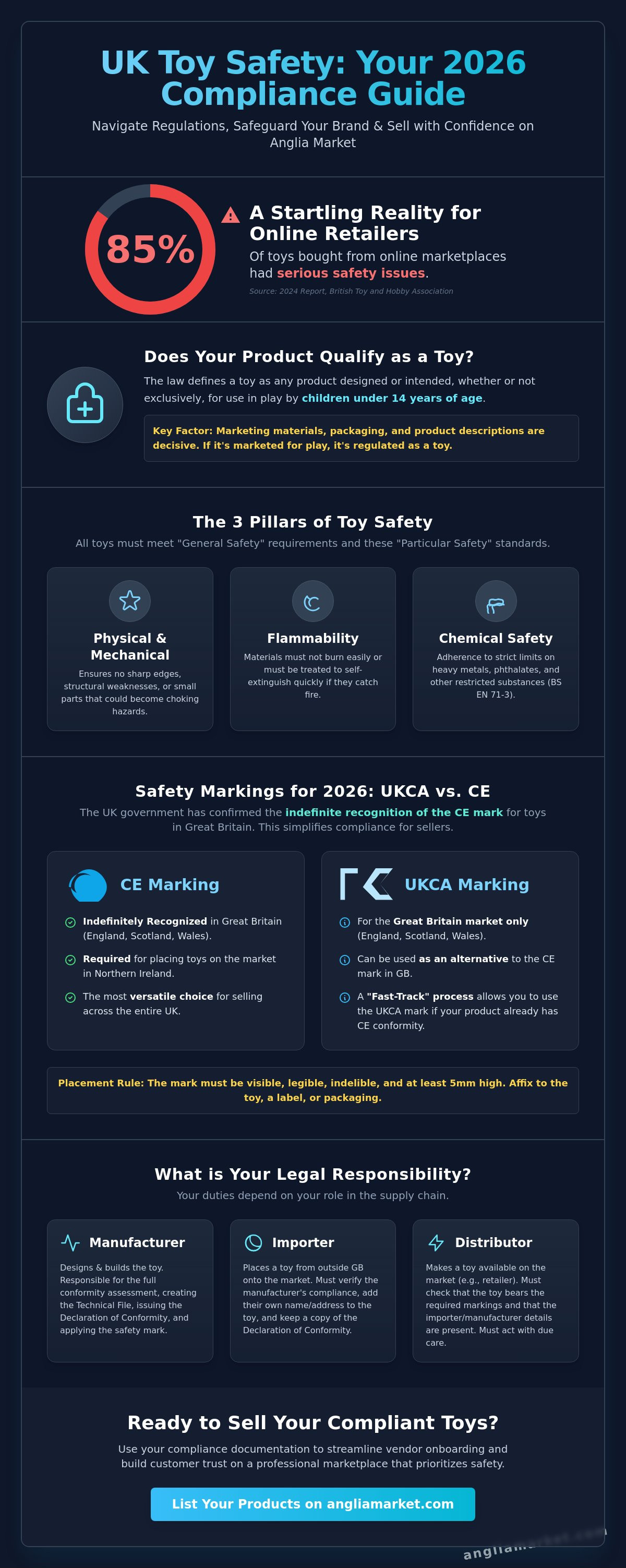
Did you know that a 2024 report by the British Toy and Hobby Association found that 85% of toys bought from online marketplaces had serious safety issues? It's a startling figure that highlights why regulators are watching closer than ever. You want to build a successful retail brand, but the complex legal requirements for selling children's toys uk often feel like a massive barrier. It's natural to worry about the high cost of testing or the confusion between UKCA and CE markings.
We understand that technical jargon and shifting dates make compliance feel like a moving target. This guide changes that. You'll learn how to master essential safety regulations to protect your business and ensure your products are market-ready for 2026. We'll simplify the latest government updates on indefinite CE marking recognition and the recent February 2026 updates to BS EN 71 standards. You'll get a clear step by step compliance checklist and the confidence to list your inventory on a professional marketplace like Anglia Market. Let's make safety your competitive advantage.
Key Takeaways
- Identify exactly what qualifies as a "toy" under the Toys (Safety) Regulations 2011 to ensure your products meet current UK standards.
- Navigate the indefinite extension of CE mark recognition alongside UKCA requirements to keep your product labeling accurate for 2026.
- Pinpoint your specific legal requirements for selling children's toys uk based on whether you manufacture, import, or distribute goods.
- Build a robust Technical File and master the EN71 safety standards to safeguard your brand against costly legal penalties or product recalls.
- Use your compliance documentation to streamline vendor onboarding and build customer trust on the Anglia Market platform.
Understanding the UK Toy Safety Landscape in 2026
Selling toys in the UK requires more than just a great product. It requires strict adherence to the Toys (Safety) Regulations 2011. This law remains the primary framework for every seller in 2026. If you want your brand to grow on Anglia Market, you must understand these rules inside out. The Office for Product Safety and Standards (OPSS) oversees enforcement across the country. They ensure every item on the shelf is safe for its intended user. Compliance builds consumer trust. It also protects your business from expensive recalls and legal penalties. Meeting the legal requirements for selling children's toys uk is the first step toward a sustainable retail business.
The 14-Year Rule: Does Your Product Qualify?
The law defines a toy as any product designed or intended for play by children under 14 years of age. This definition is broad. It covers everything from plush bears to complex electronics. Some products fall into "grey areas" that often confuse new sellers. For example, highly detailed collectibles or gym equipment aren't usually classified as toys. Decorative items for the home often get misclassified too. Your marketing materials are the deciding factor. If your packaging, website descriptions, or ads suggest a child should play with it, the law treats it as a toy. You must meet all legal requirements for selling children's toys uk to stay active on any reputable marketplace.
General vs. Particular Safety Requirements
Every toy must meet the "General Safety" mandate. This means the product cannot jeopardize the health or safety of users or third parties when used as intended. It also applies when a child uses the toy in a way that is "foreseeable," even if it wasn't intended. Beyond this general rule, you must also consider "Particular Safety" requirements. These focus on specific hazards that could harm a child. These pillars include:
- Physical and mechanical properties: Ensuring there are no sharp edges or small parts that could cause choking.
- Flammability: Materials must not burn easily or must be treated to self-extinguish quickly.
- Chemical safety: Adhering to strict limits on heavy metals, phthalates, and other restricted substances.
These rules align with global Toy Safety Standards, but the UK maintains its own specific list of "designated standards." Following these pillars is non-negotiable for your brand. It's the only way to ensure your business is ready for the 2026 market. If you are ready to reach more customers and showcase your compliant products, learn how to become one of our vendors today. We prioritize safety and quality for all our shoppers.
Essential Safety Markings: UKCA vs. CE Marks in 2026
The most visible part of meeting legal requirements for selling children's toys uk is the safety mark on your product. For several years, sellers faced a looming deadline to switch entirely from the European CE mark to the UKCA (UK Conformity Assessed) mark. However, recent government policy shifts have simplified this process. As of April 7, 2026, the UK government has confirmed the indefinite recognition of the CE marking for toys placed on the market in Great Britain. This means you can choose the mark that best fits your supply chain without the pressure of a forced transition.
The 2024 Indefinite Recognition Rule Explained
The decision to allow both marks indefinitely is a major win for independent sellers. It reduces the need for double-testing and separate inventory for different regions. If your toys already meet the UK Toy Safety Regulations 2011 via the CE route, you don't need to apply a UKCA mark to sell in England, Scotland, or Wales.
There's a critical geographic distinction to remember. Under the Windsor Framework, Northern Ireland still requires the CE marking for all toys. If you plan to sell across the entire UK, the CE mark remains the most versatile choice. For those choosing to use the UKCA mark, a "Fast-Track" process exists. This allows you to use the UKCA mark if your product already meets EU requirements and has passed the relevant conformity assessments. It's a practical way to future-proof your brand while keeping costs low.
Placement and Visibility Rules
Correct marking isn't just about the symbol; it's about where you put it. The mark must be visible, legible, and indelible. Usually, you must affix it directly to the toy or a permanent label. If the toy is too small or consists of tiny parts, you can place the mark on the packaging or an accompanying leaflet.
- Size: The mark must be at least 5mm in height unless the specific safety standard allows otherwise.
- Proportions: You cannot distort the logo; it must maintain its standard proportions.
- Transitional Provision: Until 11 pm on December 31, 2027, you have the option to place the UKCA marking on a sticky label or an accompanying document rather than directly on the toy itself.
Missing or incorrect markings can lead to immediate product recalls or bans from digital platforms. Regulators take these shortcuts seriously because they signal a lack of safety testing. Once you've secured your markings and documentation, you're ready to scale. If you're looking for a reliable platform to reach local customers, consider the benefits when you sell online with a trusted marketplace that values compliance. Proper markings don't just satisfy the law; they tell your customers that your toys are safe for their children.
Your Legal Role: Manufacturer, Importer, or Distributor?
Your legal obligations depend entirely on your position in the supply chain. The law categorizes sellers into three main roles: manufacturers, importers, and distributors. Each role carries a different level of responsibility. If you design or make the toy yourself, you are the manufacturer. This role carries the heaviest burden. You must ensure the toy is designed safely and undergoes all necessary testing before it reaches a customer. Even if you don't physically make the item, you might still be a manufacturer in the eyes of the law. This happens through "white-labeling." If you place your brand name or trademark on a toy produced by someone else, you inherit every one of the legal requirements for selling children's toys uk that a factory would face.
Distributors have the lightest set of duties, but they aren't exempt. A distributor is anyone in the supply chain, like a shop owner or a vendor on Anglia Market, who isn't the manufacturer or importer. You must verify that the toy bears the correct safety markings and is accompanied by the required instructions. You also have a legal duty to act with due care. If you have reason to believe a toy isn't compliant, you cannot legally sell it. For a deep dive into these specific definitions, you can consult the Full Text of the Toys (Safety) Regulations.
Obligations for Handmade and Small-Batch Makers
Many independent creators believe safety laws only apply to big corporations. This is a dangerous misconception. Whether you sell one toy a month or one thousand, the safety standards remain the same. Home-based makers must maintain a Technical File. This document tracks your materials, such as non-toxic paints or EN71-3 compliant fabrics. While you might not need a third-party lab for every small batch, you must prove your toy is safe through "self-declaration" and careful material sourcing. Safety is your best marketing tool for building a loyal following.
Importing Toys: The Added Risks
Importers bring toys into the UK from overseas. This role is high-risk because you are legally responsible for the manufacturer's mistakes. You must verify that the overseas factory has completed all safety assessments. You are also required to provide a UK-based address on the product or packaging. This makes you the "Responsible Person" for the authorities. Before your first shipment arrives, you must ensure the technical documentation is complete and available. Meeting the legal requirements for selling children's toys uk as an importer means doing your due diligence long before the product hits the warehouse.
Technical Documentation and Physical Safety Testing
Documentation is the evidence that your business respects the legal requirements for selling children's toys uk. It isn't enough to simply believe a toy is safe. You must prove it through a Technical File. This is a comprehensive folder that details every aspect of your product's design and manufacture. You are legally required to keep this file for 10 years after the last toy of that model is sold. If the Office for Product Safety and Standards (OPSS) requests it, you must be able to provide it quickly. A missing file is a major compliance failure that can lead to immediate product removal.
The core of your Technical File is the Declaration of Conformity (DoC). This is a single-page document where you, as the manufacturer or importer, state that the toy meets all relevant safety laws. You don't always need a third-party laboratory to sign this. For most low-risk toys, you can use "self-declaration" if you have conducted the necessary tests yourself or verified the materials from your suppliers. However, if your toy uses complex electronics or unique mechanisms, you might need to involve an "Approved Body" for a formal type-examination. This ensures that expert eyes have verified the safety of your design.
The EN71 Standards Breakdown
The UK uses the BS EN 71 series as the "designated standards" for toy safety. These standards are updated frequently to address new risks. As of February 13, 2026, several key updates have taken effect that you must follow. The main pillars include:
- EN 71-1 (Physical and Mechanical): This covers sharp edges, small parts, and tension tests. A new restriction for "wave rollers" was added to this standard in February 2026.
- EN 71-2 (Flammability): This ensures toys don't burn too quickly. It is especially critical for soft toys, dolls, and dressing-up costumes.
- EN 71-3 (Chemical Safety): This tests for the migration of heavy metals. The newest version, EN 71-3:2019+A2:2024, is now the required standard for compliance.
- EN 71-13 (Specialty Kits): If you sell olfactory board games or cosmetic kits, you must now meet the updated EN 71-13:2021+A2:2024 standard.
Age Labelling and Warnings
Correct labelling is a vital part of your safety documentation. Any toy that is dangerous for children under 36 months must carry the specific "not suitable" warning symbol or text. This is often due to small parts that present a choking hazard. You must also include warnings for specific risks like long cords, magnets, or functional sharp edges on craft tools. For the UK market, all warnings must be written in English. They must be clearly visible on the packaging or the toy itself. If you're ready to reach more customers with your safe, tested products, learn how to sell online with us today. Clear safety labelling builds immediate trust with shoppers and keeps your brand compliant with UK law.
Scaling Your Toy Business on Anglia Market
Compliance is a powerful growth engine for your brand. When you master the legal requirements for selling children's toys uk, you move through the onboarding process faster. Being an Anglia Market vendor means joining a platform that values quality and safety. We make it simple to list your products and reach a wide audience. Having your Declaration of Conformity and Technical File ready ensures your account stays in good standing. This preparation prevents sudden listing removals. It also stops buyer disputes before they start. Safety is a major selling point. Use your compliance as a badge of honor in your product descriptions. It sets you apart from low-quality, non-compliant competitors. Our marketplace tools help you manage these details effectively across all your listings.
A professional approach to safety protects your profit margins. Non-compliant products often face high return rates and negative feedback. By following the 2026 standards, you minimize these risks. You also protect your brand from the legal penalties mentioned earlier in this guide. We support independent enterprises by providing a reliable platform for their safe, tested goods. This commitment to safety builds a loyal customer base that returns to shop with confidence. Your success is our priority.
Best Practices for Marketplace Product Listings
Transparency wins customers. Include clear photos of your safety markings and warnings in your product image gallery. This builds immediate trust with parents. When they see the "not suitable for under 3s" logo clearly displayed, they feel confident in their purchase. This transparency often leads to glowing customer testimonials. Positive reviews are vital for your search visibility on the platform. Keep your listings updated as regulations evolve. If safety standards change, like the February 2026 updates to chemical migration rules, update your product descriptions immediately. It shows you are a responsible professional who cares about child safety.
Joining a Community of Responsible Sellers
Anglia Market is built for independent businesses. We focus on regional commerce and empowering small enterprises. Our toys and games category is a vibrant space for compliant, high-quality products. You aren't just a number here. You're part of a community that prioritizes transactional security and customer satisfaction. We provide the tools you need to manage your inventory and reach local buyers effectively. Meeting the legal requirements for selling children's toys uk is your ticket to this growing market. Ready to grow? Start selling online with Anglia Market today. We are here to facilitate your success and help your business thrive.
Ready to Build a Compliant Toy Brand?
Selling toys in 2026 doesn't have to be overwhelming. You've learned how to identify your specific role in the supply chain. You know why maintaining a Technical File is non-negotiable for long term success. Mastering the legal requirements for selling children's toys uk protects your brand and builds immediate buyer trust. Whether you're using the indefinite CE mark recognition or the UKCA mark, your documentation is your best defense against product recalls. Compliance isn't just a legal hurdle; it's your competitive advantage.
Now it's time to turn that compliance into sales. We're a supportive platform for UK SMEs and trusted by independent vendors across the country. Our simple commission-based model makes it easy to start without huge upfront costs. Join a community that values safety and quality. Become an Anglia Market Vendor and Reach UK Families Safely. Your safe, high-quality products deserve a place in every UK home. We're ready to help you get there.
Frequently Asked Questions
Do I need to pay for expensive lab tests for every toy I sell?
No, third-party lab testing isn't always a mandatory part of the legal requirements for selling children's toys uk. For many low-risk products, you can use "self-declaration" if you can prove safety through technical documentation and material batch certificates. You only need a formal type-examination from an Approved Body if the toy is complex or doesn't follow a designated standard. This helps independent sellers keep costs manageable while staying safe.
Can I still use the CE mark in the UK in 2026?
Yes, you can use the CE mark indefinitely for toys sold in Great Britain. The UK government updated this policy on April 7, 2026, to allow both the CE and UKCA marks for most goods. This means you don't have to re-label existing inventory that already meets EU safety standards. It's a practical way to manage stock across different regions without extra manufacturing costs.
What happens if I sell a toy that doesn't meet safety requirements?
Selling non-compliant toys can lead to heavy fines, product recalls, or even criminal prosecution. Enforcement authorities like the OPSS have the power to seize your stock and ban you from selling across the UK. Beyond legal penalties, your brand will likely face immediate removal from professional marketplaces. This loss of reputation is often harder to recover from than the initial fine.
Is a 'Technical File' the same as a user manual?
No, these documents serve completely different purposes. A user manual provides instructions and safety warnings for the customer to read. A Technical File is a deep-dive internal document for regulators that proves how the toy was designed and tested. You must keep this file for 10 years after you stop selling that specific toy model to remain compliant with the law.
Do second-hand or vintage toys need to meet the 2011 Regulations?
Yes, any item sold as a toy must be safe regardless of its age. While the 2011 Regulations primarily target "new" products being placed on the market, General Product Safety Regulations still apply to second-hand goods. If a vintage item doesn't meet modern safety pillars, it should be sold as a "collector's item" rather than a toy for play to avoid liability.
How do I know if my product is a 'toy' or a 'decorative object'?
The law looks at the "intended use" and the age of the likely user. If a product has "play value" for a child under 14, regulators will likely classify it as a toy. Your marketing, packaging, and even the price point help determine this. If you list it in the toys section of a marketplace, it must meet all legal requirements for selling children's toys uk.
What is a 'Declaration of Conformity' and do I need one for each product?
A Declaration of Conformity (DoC) is a formal statement that your product meets UK safety laws. You must create a unique DoC for every toy model or product line you sell. This document identifies the toy, lists the relevant safety standards it meets, and is signed by the manufacturer or importer. It's a critical piece of paperwork that proves you've done your due diligence.
Does Brexit affect how I sell toys to customers in Northern Ireland?
Yes, Northern Ireland continues to follow EU toy safety rules under the Windsor Framework. This means the CE mark is mandatory for toys sold in NI, whereas Great Britain accepts both CE and UKCA marks. If you sell across the whole UK, using the CE mark is often the simplest way to ensure compliance in all regions without managing two different sets of inventory.

Here to help — ask anything
If you have any questions regarding this disclaimer or any of our policies, please contact Anglia Market through the contact page on our website, by email using the address provided on the site, or by phone at 0333 772 2593