

What if 12% of your total revenue was disappearing before you even had the chance to reinvest it? For many UK independent sellers, the combined weight of marketplace fees + Stripe UK processing costs creates a "margin gap" that's incredibly difficult to close without the right data. You know the feeling of checking your dashboard after a busy weekend only to find that your £100 in sales has dwindled significantly after platform commissions and transaction fees are deducted. It's a common struggle that leaves small business owners feeling like they're working for the payment processor rather than themselves.
This guide provides the exact breakdown you need to reclaim control over your profits in 2026. We'll show you how to calculate the true cost of every transaction, including those hidden 1.5% to 2.5% fees for international cards that often go unnoticed. By the end of this article, you'll have a clear framework to lower your overheads and find a supportive UK marketplace that actually wants your business to thrive.
Key Takeaways
- Learn how to distinguish between platform commissions and payment gateway costs to master your marketplace fees + Stripe UK calculations for 2026.
- Get a clear breakdown of standard UK card processing rates and discover why international transactions can significantly impact your bottom line.
- Understand how commissions interact with shipping and VAT to ensure your pricing strategy covers every penny of your overheads.
- Master the "Margin-First" approach to pricing, using psychological price points to maintain high conversion rates without sacrificing profit.
- Discover why a transparent fee structure makes Anglia Market the practical choice for independent UK vendors looking to stay competitive.
Understanding Marketplace Fees and Stripe UK in 2026
Selling online involves more than just a listing price. You need to account for the total cost of doing business. This usually means balancing platform commissions with payment processing. Understanding what is an online marketplace helps clarify this. These platforms act as digital facilitators. They invest in marketing and SEO to drive shoppers to your products. In return, they charge a fee for the traffic they organise.
While this guide focuses on marketplaces for consumer goods, the core principles of valuation and transaction costs are universal. For example, even in specialized marketplaces for assets like vacant land, understanding the initial value is the critical first step. You can learn more about how this works in a different context.
In 2026, the combination of marketplace fees + Stripe UK is the most common financial structure for British sellers. Stripe provides the infrastructure for the money, while the marketplace provides the shop window. This setup ensures every transaction follows the latest Financial Conduct Authority (FCA) security rules. It keeps your business compliant and your customers safe.
To better understand this concept, watch this helpful video:
The Two Pillars of Marketplace Costs
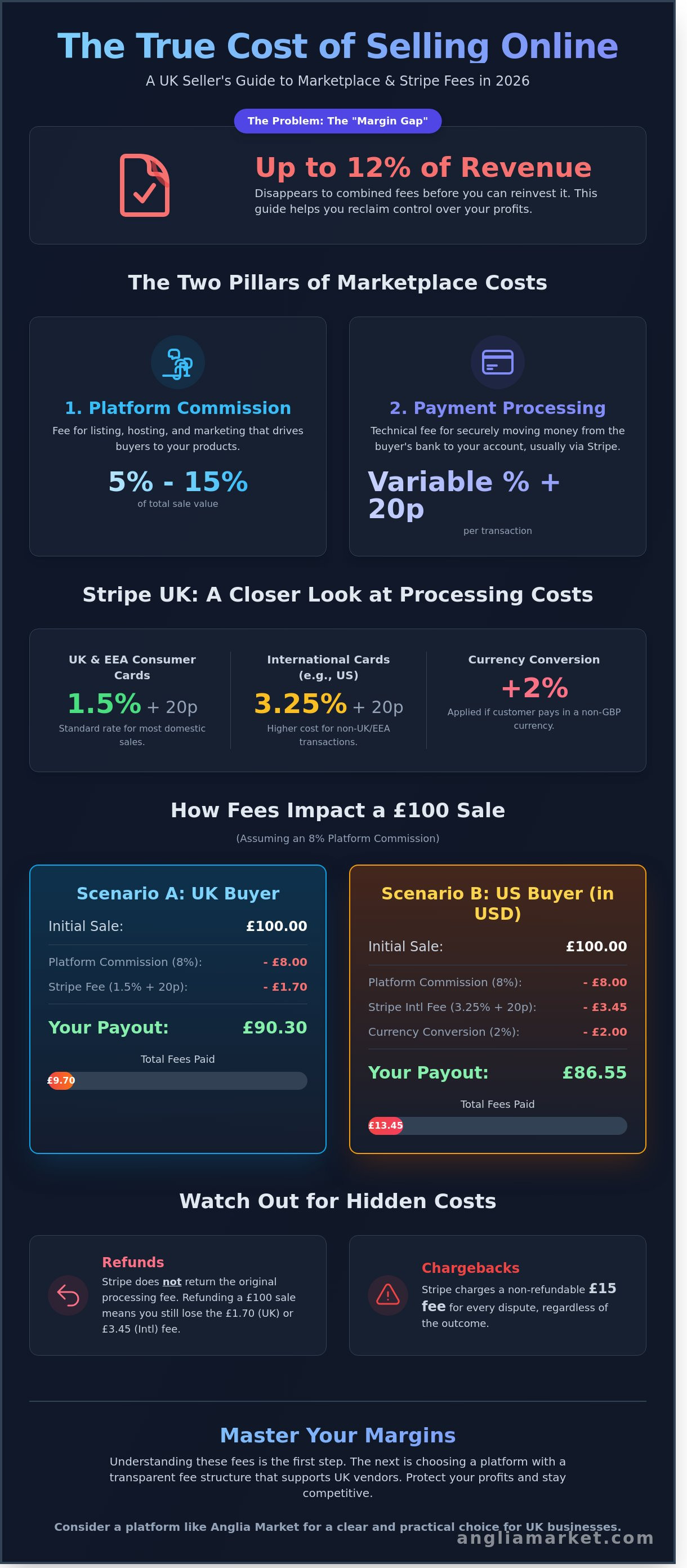
Your monthly statement usually splits costs into two distinct categories. The first is the Platform Commission. This fee covers the cost of listing, hosting, and the marketing efforts that bring buyers to the site. In 2026, most UK marketplaces charge between 5% and 15% of the total sale value for this service.
The second pillar is Payment Processing. This is the technical fee for moving money from the buyer's bank to your account. Even if a marketplace provides the storefront, they use Stripe to handle the actual cash. These costs are billed separately because they serve different functions. One pays for the audience; the other pays for the secure transfer of £ GBP.
Why Stripe is the Standard for UK Sellers
Stripe dominates the UK market in 2026 because it's built for speed and trust. For small businesses, the Stripe Connect system allows for instant onboarding. You can often start accepting payments in under 10 minutes without waiting days for manual bank approvals. This efficiency is a core reason why marketplace fees + Stripe UK are often bundled together in seller guides.
- High Security: Tools like Stripe Radar now block 99% of fraudulent attempts automatically.
- Local Payments: Stripe fully supports Apple Pay and Google Pay. These methods now account for over 60% of all UK mobile e-commerce transactions.
- Reliability: Stripe maintains a 99.9% uptime, ensuring you never miss a sale during peak shopping periods like Black Friday.
By using this infrastructure, UK marketplaces provide a professional checkout experience that buyers trust. This reliability helps independent vendors compete with global retail giants on a level playing field.
Breaking Down Stripe UK Processing Costs for Sellers
Stripe remains the primary payment processor for British platforms. Most sellers pay a standard rate of 1.5% plus 20p for every successful transaction using a UK consumer card. These marketplace fees + Stripe UK costs directly impact your profit margins. If you sell a £50 item, you will see £0.95 deducted before the funds even reach your Stripe dashboard. Understanding this breakdown helps you price products effectively to ensure your business stays profitable in 2026.
Domestic vs. International Transaction Fees
For transactions involving UK or EEA cards, the cost is consistently lower. However, selling to customers in the US or Australia changes the maths. International cards typically carry a fee of 3.25% plus 20p. If the customer pays in a currency other than GBP, Stripe applies an additional 2% currency conversion fee. The interchange fee is the baseline cost set by card networks for each transaction. Sellers must also stay compliant with UK VAT regulations for online marketplaces when handling these global transactions to avoid unexpected tax liabilities.
Hidden Costs: Refunds and Chargebacks
Refunds can be surprisingly expensive for small businesses. Stripe doesn't return the original processing fee when you issue a refund to a customer. If you refund a £100 sale, you're still out of pocket for the initial £1.70 fee. Formal chargebacks are even more costly, with Stripe charging a £15 fee per dispute. You can reduce "friendly fraud" by using clear product descriptions and tracked shipping methods. Providing high-quality photos and accurate dimensions prevents the "item not as described" claims that often lead to bank disputes.
Payouts for UK-based sellers usually follow a 3-day rolling schedule. This means funds from a Monday sale typically hit your bank account by Thursday. While some accounts qualify for instant payouts for an extra 1% fee, most businesses find the standard cycle sufficient for cash flow. If you're looking to scale your reach without complex setups, you can start selling with us to connect with a dedicated UK audience.
- Standard UK Fee: 1.5% + 20p per transaction.
- International Fee: 3.25% + 20p for non-UK/EEA cards.
- Dispute Fee: £15 per chargeback.
- Conversion Fee: 2% for multi-currency sales.
The Interaction Between Marketplace Commissions and Payment Processing
Most platforms, including Anglia Market, calculate their commission based on the total transaction value. This means if you sell a vintage clock for £60 plus £10 shipping, the commission applies to the full £70. Many sellers worry about this "double dip" effect where they pay fees on the VAT and delivery costs they pass on to the customer. It's a standard industry practice. You must price your items with this 10% to 15% deduction in mind to protect your margins.
Clarity in pricing is now more than just good practice. The new UK laws on hidden fees mean consumers must see total costs early in the shopping journey. This legal shift helps sellers by normalising "all-in" prices that include shipping. When you understand how marketplace fees + Stripe UK processing work together, you can set prices that remain competitive while covering every cost layer.
The Split-Payment Mechanism
Stripe Connect manages the flow of funds automatically at the point of sale. When a customer pays, the software splits the money instantly. The marketplace commission goes to the platform, while the remaining balance lands in your seller account. This setup removes the administrative burden of manual monthly invoicing. You won't ever "owe" the platform money at the end of the month because the system settles everything in real-time. Your dashboard provides a live view of net earnings, making cash flow management simple for small business owners.
VAT and Marketplace Invoicing
Marketplace fees are a service, so they attract VAT at the standard 20% rate in the UK. If you're a VAT-registered business, you can reclaim this tax as an input cost on your quarterly return. For sellers under the £90,000 turnover threshold, this fee is a standard business expense. Always download your monthly VAT invoices from your seller portal. These documents are essential for your annual tax return. They prove exactly how much you paid in marketplace fees + Stripe UK costs, ensuring you don't overpay HMRC on your final profits.
Strategic Pricing: How to Protect Your Margins from Fee Erosion
Profitability starts with a Margin-First mindset. You can't just guess your prices. Every listing must account for your break-even point. This includes the cost of goods, VAT, and the combined marketplace fees + Stripe UK charges. As of January 2026, successful sellers track their Effective Fee Rate across every category. This metric shows the true percentage lost to transaction costs. If your effective rate climbs above 18%, your pricing needs an immediate update.
Psychological pricing remains a powerful tool for UK vendors. Setting a price at £19.99 rather than £20.00 often yields higher conversion rates. It doesn't significantly impact the final payout either. Bundling products is another essential tactic. By grouping three £5 items into a single £15 bundle, you only pay the fixed transaction fee once. This simple shift can boost your net margin by 4% on every sale. Understanding how marketplace fees + Stripe UK costs impact these bundles helps you choose the right items to group.
Beyond pricing tactics, the most fundamental way to protect your margins is to create products that are inherently profitable. For those looking to master the art of creating and selling digital goods, the online platform Living the Hustle offers comprehensive guides and courses on this very topic.
The Fixed Fee Trap
The 20p fixed fee is a silent profit killer for low-cost inventory. On a £5 accessory, that 20p represents 4% of the total price. On a £50 item, it's only 0.4%. Micro-transactions require a different pricing logic than high-ticket items. To protect your earnings, set a minimum order value of £10 or move low-margin items into multi-pack listings. This spreads the fixed cost across a larger basket size, saving your bottom line.
Adjusting Prices for International Growth
Selling abroad adds complexity to your fee structure. International cards often incur a 2% or 3% surcharge compared to domestic UK cards. Use your marketplace dashboard to automate regional pricing. This ensures customers in France or the USA pay a slightly higher base price to cover the extra processing and currency conversion costs. Always evaluate if the 2.5% international fee is worth the added shipping risk for items under £20. Focus your global efforts on high-margin products that can absorb these costs comfortably.
Ready to scale? Start selling with Anglia Market today to access a platform built for UK business growth.
Why Anglia Market is the Practical Choice for UK Small Businesses
Anglia Market focuses on the 5.5 million small businesses currently operating across the UK. We keep things simple. While global giants often hide costs in complex tiers, our structure is built for clarity. You won't find yourself guessing about marketplace fees + Stripe UK costs at the end of the month. We handle the technical heavy lifting of the Stripe integration; this means your shop is ready to accept secure payments from day one without you writing a single line of code.
Our commitment to independent UK vendors is about more than just hosting a shopfront. We provide a platform where local favourites can become national brands. By 2026, the digital marketplace has become crowded, yet we maintain a competitive edge for our sellers by keeping overheads predictable. You get the benefit of a professional payment gateway and a high-traffic site for a fraction of the cost of building a bespoke e-commerce solution.
Support Beyond the Transaction
We don't just host your products; we promote them. Your marketplace fee includes inclusion in our seasonal marketing campaigns and social media spotlights. We've seen local sellers expand to nationwide shipping within their first 90 days on the platform. If a payment fails or a technical glitch occurs, our UK-based support team responds within 24 hours. You aren't just a ticket number in a global queue; you're a partner in our community-focused ecosystem. We provide the tools to manage marketplace fees + Stripe UK reporting so your accounting stays organised.
Getting Started with Us
The onboarding process is designed for speed. You can set up your vendor profile and list your first ten products in less than 15 minutes. We've removed the barriers to entry that stall many entrepreneurs. There are no hidden £30 monthly "pro" subscriptions. We only win when you sell. This pay-as-you-grow model ensures your business remains profitable even during quieter trading months. It's a low-risk way to test new product lines or scale a side hustle into a full-time career.
Ready to join a marketplace that puts British small businesses first? Start selling with Anglia Market today and take control of your commercial future.
Future-Proof Your Business Margins in 2026
Success in 2026 requires a firm grip on your overheads. You now understand how to balance marketplace fees + Stripe UK processing costs against your retail prices. By accounting for those 1.5% to 3% transaction bites early, you protect your bottom line from fee erosion. It's clear that transparency is the best tool for any independent seller looking to scale. You've seen how even small adjustments to your pricing strategy can offset the impact of platform commissions while keeping your offers competitive for British shoppers.
Anglia Market offers the practical solution UK small businesses need. We're already trusted by hundreds of independent UK vendors who value our straightforward, commercial approach. You get secure payments powered by Stripe UK and absolutely no hidden monthly costs or surprise subscriptions. This helps you focus on what you do best: selling quality products to a growing audience across the country. We're here to help you navigate the retail landscape with confidence and clarity.
Join the UK’s fastest-growing marketplace for SMEs. Let's get your shop live and start growing your brand today.
Frequently Asked Questions
What are the standard Stripe fees for UK businesses in 2026?
In 2026, standard Stripe UK fees for domestic cards are 1.5% plus a 20p fixed fee per transaction. Premium cards like American Express or corporate cards typically carry a higher rate of 1.9% plus 20p. These costs are deducted automatically before your funds reach your balance. It's a transparent system that ensures you only pay for the sales you actually make without facing hidden monthly costs.
Does Anglia Market charge a monthly subscription fee in addition to sales commission?
Anglia Market doesn't charge a monthly subscription fee to its sellers in 2026. You only pay a flat 10% sales commission on the total order value when a customer makes a purchase. This model reduces your upfront risk and helps small businesses grow without fixed overheads. There aren't any hidden listing fees, so you can add your entire product range to the shop at no initial cost.
How do marketplace fees affect my VAT returns?
Marketplace fees and Stripe UK charges are classed as business expenses for your VAT returns. If you're VAT-registered, you can usually reclaim the VAT paid on these services or deduct the gross fee from your taxable turnover. Always keep your monthly tax invoices from Anglia Market to ensure accurate reporting to HMRC. This helps maintain a clear audit trail for your annual accounts and simplifies your tax season.
Can I use my own Stripe account on Anglia Market?
You must link your own Stripe account to Anglia Market to receive payments directly. Our platform uses Stripe Connect to facilitate secure, instant transactions between the buyer and your business bank account. Setting this up takes less than five minutes through your seller dashboard. It ensures you maintain full control over your financial data and payout history. You'll see every transaction land in your own account in real time.
What happens to the fees if a customer requests a refund?
Stripe doesn't refund the original processing fees when you issue a refund to a customer. While Anglia Market may credit back the 10% commission fee, the 1.5% plus 20p Stripe charge is retained by the payment provider. This is a standard industry practice across all UK payment gateways in 2026. You should factor these potential costs into your overall pricing strategy and returns policy to protect your bottom line.
Are international payment fees higher for UK marketplace sellers?
International payment fees are higher than domestic rates, typically costing 2.5% for EEA cards and 3.25% for cards issued outside Europe. You'll also encounter a 2% currency conversion fee if the buyer pays in a currency other than GBP. These additional marketplace fees + Stripe UK costs are automatically calculated during checkout. Selling globally expands your reach but requires careful margin management to stay profitable in the competitive UK market.
How often are payouts processed from the marketplace to my bank account?
Payouts are processed on a 7-day rolling basis for most new UK sellers on the platform. Once your account establishes a consistent sales history over 30 days, you can often switch to daily payouts through your Stripe dashboard. Funds typically take 2 to 3 business days to clear into your linked bank account after Stripe initiates the transfer. This schedule provides a predictable cash flow for managing your inventory and daily operations.
Is there a minimum sale price required to cover the marketplace and Stripe fees?
We recommend a minimum sale price of £5.00 to ensure your margins remain healthy after marketplace fees + Stripe UK deductions. On a £5.00 item, total fees amount to approximately 78p, leaving you with £4.22 before your product and shipping costs. Items priced below this threshold often struggle to generate profit due to the 20p fixed transaction fee. Higher-value items naturally see a lower percentage impact from these fixed costs.

Here to help — ask anything
For questions about this disclaimer or the site, contact us via the website’s Contact page.


