What if your creative weekend project is actually a legal liability waiting to happen? Most creators start for the love of restoration, but the transition to a professional seller often comes with a fear of HMRC penalties and confusing safety jargon. Understanding the regulations for selling upcycled furniture uk is the only way to build a business that is both sustainable and safe. You want to focus on your craft, not on decoding government white papers.
It's time to turn that uncertainty into a clear plan for growth. This guide simplifies the 2026 fire safety reforms, outlines your consumer rights under the latest legislation, and breaks down the tax thresholds you need to know today. You'll learn exactly how to handle labelling, insurance, and tax obligations without the headache. We also show you how to leverage a dedicated UK marketplace to reach local customers who value quality and compliance.
Key Takeaways
- Identify the exact point where your hobby becomes a professional trade and how profit intent triggers specific legal duties under UK law.
- Navigate the latest 2026 fire safety reforms and understand which regulations for selling upcycled furniture uk apply to upholstered items like sofas and bed bases.
- Master the "Satisfactory Quality" benchmarks of the Consumer Rights Act 2015 to ensure your bespoke creations meet professional standards.
- Learn how to protect your business with essential public liability insurance and calculate true profit after tool and workshop expenses.
- Discover why a dedicated UK marketplace provides a more supportive, transparent platform for independent furniture sellers than social media.
Understanding Your Legal Status: Hobbyist vs. Professional Trader
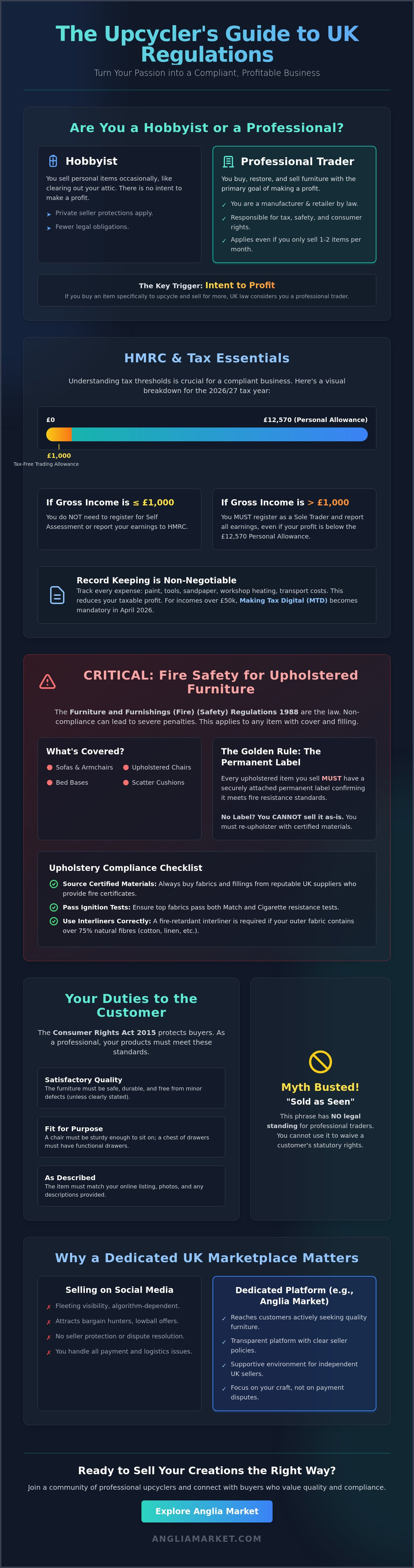
Deciding to sell your first piece of restored furniture is an exciting milestone. However, the UK government draws a sharp line between a casual hobby and a commercial enterprise. The primary regulations for selling upcycled furniture uk depend on your intent. If you buy a chest of drawers specifically to renovate and sell it for more than you paid, you are legally trading. This is different from clearing out your own attic. Upcycling for profit triggers immediate responsibilities toward three main bodies: HM Revenue and Customs (HMRC) for tax, Trading Standards for consumer safety, and the Office for Product Safety and Standards (OPSS) for general compliance.
The distinction matters because professional traders must provide goods that are of satisfactory quality and fit for purpose. When you act as a business, you lose the "private seller" protections that allow for more casual transactions. If you plan to sell online, you must accept that you are now a manufacturer and retailer in the eyes of the law. This status applies even if you only sell one or two items a month from your garage.
The HMRC Trading Allowance and Tax Obligations
For the 2026/27 tax year, the UK government maintains a £1,000 tax-free trading allowance. If your gross annual income from upcycling is £1,000 or less, you don't need to register for Self Assessment. Once you cross this threshold, you must register as a Sole Trader. Keep in mind that the personal allowance for the 2026/27 year is £12,570. You only pay income tax on profits above this amount, but you still need to report your earnings to HMRC if you exceed the trading allowance.
Meticulous record-keeping is your best defense against penalties. You must track every expense, including paint pots, sandpaper packs, upholstery tacks, and even a portion of your heating or transport costs. For those with a qualifying income over £50,000, Making Tax Digital (MTD) becomes mandatory in April 2026. This requires digital record-keeping and quarterly updates to HMRC via compatible software.
Trading Standards and Your Local Authority
Trading Standards officers monitor the safety of goods sold in your region. Many new sellers mistakenly believe that "sold as seen" protects them from complaints. This is a myth for professional traders. You cannot waive a customer's legal rights through a simple disclaimer. Every piece of furniture you sell must meet modern safety expectations, regardless of its age or original condition.
You can contact your local Trading Standards office for a business compliance review. They provide guidance on specific regulations for selling upcycled furniture uk, helping you avoid costly mistakes before they happen. Being proactive with your local authority builds a foundation of trust and ensures your business remains compliant as you scale.
Fire Safety Regulations for Upholstered Upcycled Furniture
Safety is the most critical part of your business. If you sell upholstered items in Great Britain, you must follow the Furniture and Furnishings (Fire) (Safety) Regulations 1988. These rules ensure that furniture is resistant to ignition from cigarettes and matches. As of May 2026, the government is consulting on reforms to these standards, but the 1988 requirements remain the active legal benchmark. These regulations for selling upcycled furniture uk apply to sofas, armchairs, dining chairs with upholstered seats, bed bases, and even scatter cushions. If it has a filling and a cover, it likely falls under these rules.
The Permanent Label is your proof of compliance. Every piece of upholstered furniture must have one. It must be securely attached, usually under a seat cushion or on the base of the item. This label identifies the manufacturer or importer and confirms that the materials meet specific ignition resistance levels. If you find a vintage piece with a missing or illegible label, you cannot legally resell it in its current state. You must re-upholster it using modern, certified materials to ensure it meets the Fire Safety Regulations for Upholstered Upcycled Furniture before it reaches a customer.
Compliance Checklist for Upholstery
Don't guess when it comes to materials. Always source your fabrics and fillings from reputable UK suppliers who provide fire certificates. Your checklist should include:
- Match and Cigarette Tests: Ensure top fabrics are treated or naturally resistant to flame.
- Interliners: Use a fire-retardant interliner (Schedule 3) if your outer fabric contains more than 75% natural fibers like cotton or linen.
- CMHR Foam: Only use Combustion Modified High Resilience foam for any replacements.
The Danger of Vintage and Second-hand Fillings
Pre-1988 foam is a major fire hazard. It often contains materials that release toxic fumes when ignited. It's almost always illegal to resell furniture containing this old foam if it has been "upcycled" or altered. When you strip back a piece, dispose of old fillings as hazardous waste. Document the replacement process with photos and keep your receipts for new fire-retardant materials. This creates a paper trail that protects your business. A seller who ignores fire safety labels or uses non-compliant fillings faces strict liability, which can lead to unlimited fines or criminal prosecution regardless of their intent. If you've mastered these safety steps, you can confidently list your compliant upcycled furniture for sale to a national audience.
General Product Safety and Consumer Rights Act 2015
Selling a beautiful piece of furniture involves more than just aesthetics. The Consumer Rights Act 2015 (CRA) is the legal backbone for every transaction you make as a professional seller. While you might be working with vintage materials, the law is clear. Goods must be of satisfactory quality, fit for a particular purpose, and exactly as described. This creates a unique challenge for upcyclers. You must be honest about the age and condition of the piece while ensuring it functions as intended. The General Product Safety and Consumer Rights Act 2015 guide outlines how these standards protect the buyer. If a drawer sticks or a leg wobbles, it likely fails the satisfactory quality test unless you explicitly described those flaws before the sale.
Managing returns is another area where regulations for selling upcycled furniture uk become strict. For online sales, the Consumer Contracts Regulations give buyers a 14-day window to cancel their order for any reason. You must provide a clear returns policy. If you don't, the cancellation period could legally extend to a full year. This applies to most furniture items, though truly bespoke pieces made to a customer's specific measurements may be exempt.
Structural Integrity and Stability
A beautiful finish cannot hide a dangerous structure. You have a duty under the General Product Safety Regulations to sell only safe goods. Test every tall cabinet or wardrobe for stability. If an item is top-heavy, you must provide wall-mounting hardware or clear warning labels. Repairs to joints or frames should be permanent and safe. A quick fix with wood glue is rarely enough for a professional sale. Ensure every hinge is secure and every shelf can support its expected load without bowing.
Paint, Finishes, and Chemical Safety
Chemical safety is paramount, especially for items intended for children. If you're upcycling a nursery chest or items often found in toys and games categories, use paints certified to EN71-3 (Toy Safe) standards. These finishes are tested for heavy metal migration. Older furniture often carries layers of lead-based paint. Never dry-sand these pieces. Use chemical strippers or wet-sanding techniques to keep dust contained. Providing a care leaflet with your furniture helps buyers maintain the finish safely. It also shows you've considered the product's entire lifecycle.
Business Admin: HMRC, Insurance, and Intellectual Property
Managing the back-end of your business is just as important as the finish on a sideboard. One area often overlooked by new sellers is Intellectual Property (IP). If you upcycle a piece from a famous brand like G-Plan or Ercol, you must be careful with how you use their trademarks. While the principle of "exhaustion of rights" generally allows you to resell branded items, the original owner can object if your work negatively impacts their brand reputation. High-quality work is your best defense. Always be transparent in your listings that the item is a modified vintage piece rather than a new product from the original brand. This clarity helps you stay on the right side of the regulations for selling upcycled furniture uk while building a trustworthy brand.
Accurate profit calculation is the next step in professionalizing your trade. Many beginners only track the cost of the furniture and the paint. To see your true earnings, you must deduct every allowable expense. This includes sandpaper, wax, new hardware, workshop rent, and even a portion of your utility bills. Don't forget to account for the depreciation of expensive tools like sanders or spray guns. Tracking these figures ensures you don't end up with a surprise tax bill that wipes out your hard work.
Tax Deadlines and Self-Assessment
The UK tax year runs from 6 April to 5 April. If your upcycling income exceeds the £1,000 trading allowance mentioned earlier, you must register as a sole trader via the Gov.uk portal. Turnover is the total amount of money your business receives from sales, whereas profit is the amount left over after you have deducted all your allowable business expenses. For the 2026/27 tax year, remember that if your qualifying income exceeds £50,000, you will need to follow Making Tax Digital rules for your records.
Insurance: Protecting Your Livelihood
Standard home insurance policies usually exclude business activities. If a customer is injured by a splinter or a chair you sold collapses, you could be personally liable for significant damages. The average public liability claim for furniture professionals between April 2025 and March 2026 was £8,160. Public Liability Insurance (PLI) covers these third-party risks, while Product Liability Insurance specifically covers faults in the items you have modified. In 2026, indicative prices for PLI start from around £5.76 to £7.50 per month. This small monthly cost is a vital part of following the regulations for selling upcycled furniture uk and protecting your personal assets.
If you have your insurance and tax status in order, you are ready to reach a wider audience. To start showcasing your work to a dedicated community, register as a vendor on our platform today.
Selling Your Upcycled Furniture on Anglia Market
Moving from a hobby to a professional business requires more than just technical skill. It requires a platform that understands the specific needs of the UK market. While social media is useful for finding inspiration, it often lacks the secure infrastructure needed to manage a compliant business. A dedicated marketplace provides a professional storefront that signals reliability to your customers. By listing on a platform focused on quality, you demonstrate that your work meets the necessary regulations for selling upcycled furniture uk. This professional setting helps you stand out from casual sellers who might ignore safety standards.
Customer retention is the key to long-term success. Our platform allows you to integrate your business with a loyalty program designed to drive repeat sales. When buyers know they are purchasing safe, legally compliant items from a trusted vendor, they are more likely to return for future home projects. This structured approach to selling allows you to focus on your craft while the platform handles the commercial heavy lifting.
Creating a Compliant Product Listing
Your product listing is your digital handshake. When photographing your furniture, include a clear shot of the permanent fire safety label mentioned in earlier sections. This provides immediate proof of compliance. In your descriptions, be explicit about the materials used. State clearly that the item is a professionally finished upcycled piece. Mentioning that you use EN71-3 certified paints or CMHR foam reassures buyers that you take their safety seriously. Clear, honest communication reduces the risk of returns and builds a positive reputation through verified customer feedback.
Scaling Your Side Hustle
Transitioning from local porch pickups to a national brand is a major step for any upcycler. Our seller platform is built to help you manage this growth efficiently. You can reach customers across the country who are specifically looking for unique, sustainable pieces. To keep your inventory moving, you can utilize targeted promotions to clear older stock or launch new collections. This visibility is difficult to achieve on general marketplaces where your items can get lost in a sea of mass-produced goods. If you are ready to turn your passion into a fully compliant UK business, you can become a vendor and start listing your work today. Taking this final step ensures your business is as solid as the furniture you create.
Secure Your Future as a Professional Upcycler
Success in the upcycling industry depends on balancing creative restoration with strict legal compliance. By mastering fire safety standards, registering with HMRC, and securing the right insurance, you protect both your customers and your livelihood. Following the regulations for selling upcycled furniture uk isn't just about avoiding penalties; it's about building a brand that customers can trust for years to come. You've learned how to navigate tax thresholds and safety labels; now it's time to put that knowledge into practice and reach a wider audience.
Ready to turn your upcycling hobby into a business? Sell on Anglia Market today! We provide a trusted platform for home and garden goods with a simple fee structure designed specifically for SMEs. You'll benefit from dedicated UK-based support for independent sellers and a marketplace that prioritizes high-quality, local craftsmanship. Take the next step and join a community that empowers your enterprise and connects you with buyers who value your work. Your compliant business starts here.
Frequently Asked Questions
Do I need a special licence to sell upcycled furniture in the UK?
No special licence is required to sell upcycled furniture, but you must register as a sole trader with HMRC if your gross income exceeds £1,000. While there is no "upcycler's permit," you are legally bound by general regulations for selling upcycled furniture uk and consumer protection laws. These rules require you to ensure every item is safe, durable, and accurately described before it reaches a buyer.
Is it illegal to sell a chair without a fire safety label?
Yes, it is illegal to sell upholstered furniture that does not carry a permanent fire safety label. This is a requirement of the 1988 Regulations that still applies in 2026. If a vintage chair has lost its label, you must re-upholster it using compliant materials and attach a new, permanent label. Selling non-compliant upholstered goods can lead to unlimited fines or criminal prosecution.
Do I have to pay tax if I only sell one or two upcycled items a month?
You only pay income tax if your total yearly profits exceed the personal allowance of £12,570 for the 2026/27 tax year. However, you must register for Self Assessment if your gross trading income is more than the £1,000 trading allowance. Even for a few sales, you must keep digital records of your expenses. This ensures you can accurately report your earnings to HMRC if you exceed the threshold.
What happens if a customer is injured by furniture I upcycled?
You are personally liable for injuries or property damage caused by products you have modified and sold. If a structural repair fails and a customer is hurt, they can claim damages against your business. Between April 2025 and March 2026, the average public liability claim for furniture professionals was £8,160. Having Public and Product Liability Insurance is the only way to protect your personal assets from these claims.
Can I use any type of paint on furniture I plan to sell?
You must use paints that are safe for the consumer, especially for items intended for children. Finishes certified to EN71-3 (Toy Safe) standards are the professional choice because they don't contain harmful heavy metals. Using high-quality, low-VOC paints also helps you meet the "satisfactory quality" standards of the Consumer Rights Act. Always provide care instructions to help the buyer maintain the finish safely over time.
Do I need to register for VAT as an upcycling business?
You only need to register for VAT if your taxable turnover exceeds £90,000 in a 12-month period for the 2026/27 tax year. Most independent upcyclers stay below this threshold and don't need to charge VAT. If your business grows rapidly and you cross this limit, you must register with HMRC and submit digital returns. Some sellers register voluntarily to reclaim VAT on expensive tools or workshop equipment.
Can I sell upcycled furniture that was originally made before 1988?
You can sell pre-1988 furniture, but upholstered pieces must be stripped and re-filled with modern, fire-retardant materials. Original foam from that era is almost always illegal to resell because it doesn't meet modern safety benchmarks. For wooden items, you must ensure any old lead-based paint is safely handled. Documenting your restoration process provides proof that the item now complies with the latest regulations for selling upcycled furniture uk.
What information must be included on my furniture fire safety label?
A permanent fire safety label must include the name and postcode of the UK supplier and the date of manufacture. It must clearly state that the item meets the specific ignition resistance requirements for both fillings and covers. This label must be securely attached to the item, typically in a place that is not visible during normal use. It serves as your legal declaration that the furniture is safe for the home.

Here to help — ask anything
If you have any questions regarding this disclaimer or any of our policies, please contact Anglia Market through the contact page on our website, by email using the address provided on the site, or by phone at 0333 772 2593