
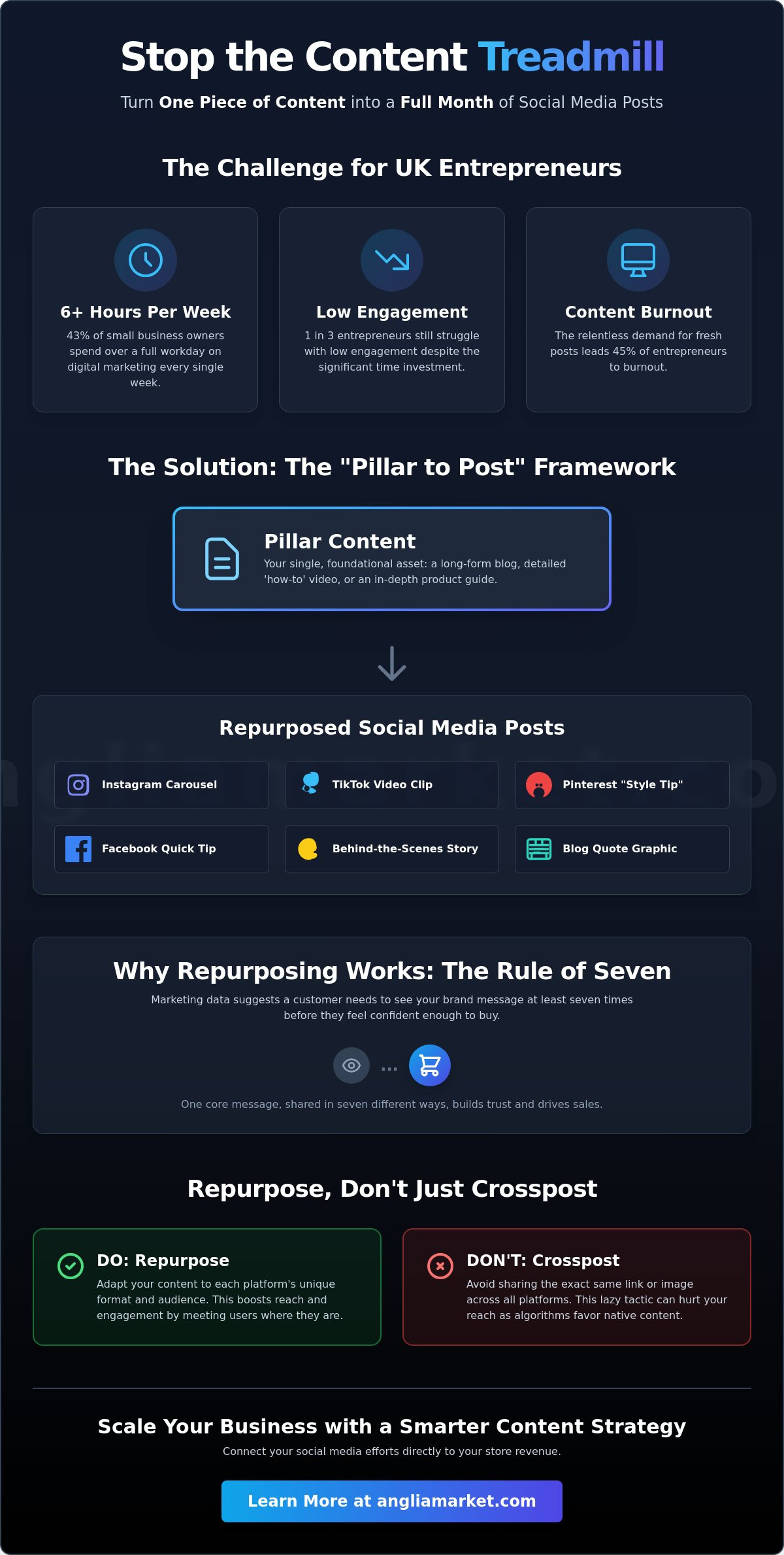
According to a 2023 report by Social Media Examiner, 43% of small business owners spend over 6 hours every week on digital marketing, yet 1 in 3 still struggle with low engagement. For a busy UK entrepreneur, spending a full workday every week on posts that vanish in hours isn't just frustrating; it's bad for business. Mastering the art of repurposing content for social media is the only way to break this cycle without hiring an expensive agency. It's about working smarter to ensure your quality products get the visibility they deserve.
You likely agree that creating brand-new content every single day is the fastest route to burnout. We've seen many independent sellers lose steam because the demand for fresh posts across Instagram, Facebook, and TikTok is relentless. This guide promises to change that by showing you how to turn one single piece of content into a full month of social media updates. You'll learn a repeatable workflow that saves time, clears up platform confusion, and boosts your storefront sales. We'll walk through specific strategies to help your UK business grow its reach across every major platform.
Key Takeaways
- Stop the daily "content treadmill" and avoid burnout by learning to work smarter with the assets you already own.
- Master repurposing content for social media to transform a single pillar blog or video into a full month of engaging posts.
- Learn to adapt your best-performing content into high-impact formats like Instagram carousels and TikTok clips for maximum reach.
- Follow a practical workflow to audit your "greatest hits" and extract key insights that build trust and drive conversions.
- Connect your social media efforts directly to your Anglia Market revenue to highlight your latest promotions and boost sales.
Why Repurposing Content for Social Media is the Ultimate SME Growth Hack
Many UK small business owners feel like they're stuck on a content treadmill. You spend hours crafting the perfect post, only for it to vanish from feeds in less than 24 hours. It's a cycle that leads to burnout for 45% of entrepreneurs who manage their own digital marketing. Repurposing content for social media breaks this cycle. It allows you to squeeze every drop of value from your hard work while saving precious time.
Success in the digital marketplace relies on the "rule of seven." Marketing data suggests a customer needs to see your brand message at least seven times before they feel confident enough to buy. You don't need seven unique ideas to make this happen. You need one great idea shared in seven different ways. This approach is a fundamental part of a professional Content Strategy. It helps you maintain a consistent brand voice across Instagram, Facebook, and Pinterest without doubling your workload or your budget.
To better understand this concept, watch this helpful video:
Moving Beyond the 'One-and-Done' Mindset
High-quality content deserves a lifespan longer than a single day. Algorithms move fast, and your target audience isn't always online when you hit "publish." Repurposing helps you reach different segments of your audience on their preferred platforms. A long-form guide can become a series of quick tips for those who prefer scannable content. This message reinforcement builds psychological trust. It turns a passing glance into a lasting brand connection by meeting customers where they are.
The Strategic Advantage for UK Marketplace Sellers
UK SMEs often compete against big-box retailers with massive advertising budgets. You can level the playing field by appearing "everywhere" at once through smart distribution. Supporting your Anglia Market vendor profile with a multi-channel presence makes your business look larger and more established.
- Turn product descriptions into stories: Don't just list features; show the product in use through a short video.
- Educate your buyers: Use your expertise to create "how-to" graphics that link back to your shop.
- Maximise ROI: Spend one hour creating a great blog post and turn it into a week of social updates.
This strategy turns simple features into engaging narratives. If you sell home goods, a single product update can become a "style tip" on Pinterest or a "behind-the-scenes" story on Instagram. It drives traffic back to your shop and increases your sales potential without requiring a 24/7 filming schedule.
The Content Repurposing Framework: From Pillar to Post
Repurposing content for social media is the process of taking one large 'pillar' asset and adapting it into several smaller formats. It's about efficiency for UK vendors who don't have 40 hours a week to spend on marketing. Instead of starting from scratch every Monday, you use what you already have. This framework saves time while keeping your brand message consistent across different channels. You aren't just repeating yourself; you're making your best ideas accessible to different types of scrollers.
What Qualifies as Pillar Content?
Pillar content is the foundational asset from which all sub-content flows. You might choose a long-form blog post, a 10-minute 'how-to' video, or a detailed product guide. Comprehensive customer case studies that highlight a specific problem and solution also work well. For a UK small business, a guide on "How to Style Your Living Room for Under £200" serves as a goldmine of information. These assets are deep, informative, and provide enough substance to feed your social channels for weeks. They represent your expertise and give you the raw material needed for smaller, punchy posts.
Crossposting vs. Repurposing: Knowing the Difference
Crossposting is the act of sharing the exact same link or image across every platform simultaneously. It's a lazy automation tactic that often hurts your reach. By 2026, major platform algorithms are likely to penalize posts that push users away to external websites through simple link previews. True repurposing means you tailor the 'hook' for each specific audience. You might create a sleek visual for Pinterest but use a conversational, question-based approach for Facebook. As noted by Forbes, successful Repurposing Content For Social Media requires matching the content to the user's intent on that specific app. Avoid using tools that automatically blast the same caption everywhere, as this ignores the unique culture of each platform.
The 'Atomisation' technique is your best tool for efficiency. It involves breaking a large concept into its smallest possible parts. For instance, a single guide on "Winter Proofing Your Garden" can be split into a 15-second video on salt-spreading, a Facebook poll about favorite winter plants, and an Instagram carousel showing three types of outdoor covers. This ensures you provide value in bite-sized chunks. Identify your evergreen assets early. These are the pieces of content that don't expire, such as a guide on how to assemble flat-pack furniture or a list of essential office supplies. These posts remain useful for 18 to 24 months. If you're looking to scale your business and reach more customers, you can sell online with our platform and start putting these strategies into practice today.
5 Practical Ways to Repurpose Your Existing Assets in 2026
Small businesses in the UK need to work smarter to stay visible. Content creation costs can easily consume 25% of your marketing budget if you aren't careful. Using repurposing content for social media as a core strategy helps you stretch every pound. You don't need a massive team to stay active on every platform. You just need to transform what you already have.
Turn your long-form blogs into educational Instagram carousels. If you've written a 1,000-word guide on energy-efficient home upgrades, break it into five or seven simple slides. It's an effective way to Grow Your Customer Base by reaching users who prefer quick, visual information over long articles. Do the same with product demonstration videos. Cut a three-minute demo into three 15-second TikTok or Reel clips. Short-form video engagement increased by 40% in 2025, making these snippets vital for reaching younger demographics.
Your email newsletter is another goldmine. Take the most clicked link or the top-performing insight from your last mailer and turn it into a LinkedIn post or an X thread. It keeps your professional profiles updated without requiring new research. Finally, repackage your 'Frequently Asked Questions' into a 'Tip of the Week' series. This provides consistent value and positions your brand as a helpful expert in your niche.
Leveraging Social Proof and Testimonials
Trust is your best sales tool. Take a glowing review from our testimonials page and drop the text into a clean Canva-designed quote graphic. Use your brand colours to keep it consistent. Create 'Before and After' stories based on customer feedback to show real-world results. User-generated content (UGC) is 8.7 times more impactful than traditional brand photos. Encourage your customers to share their purchases. Reposting their content is the ultimate form of repurposing that builds massive credibility.
Adapting Product Guides for Visual Platforms
Visual guides drive direct traffic to your store. Turn a 'How to Style Your Living Room' blog post into a curated Pinterest board or an Instagram Guide. You can link these visual assets directly to our furniture or home and garden listings to shorten the customer journey. Don't let static product photos sit idle. Use three or four images to create 'stop-motion' style video clips. These simple animations catch the eye of 65% more scrollers than still images alone, making repurposing content for social media a high-ROI activity for any UK vendor.
A Step-by-Step Workflow for Repurposing Social Media Content
Efficiency is the engine of a successful UK small business. You don't need to create something new every day to stay visible. By following a structured workflow for repurposing content for social media, you can turn one high-quality blog post or guide into weeks of engagement. This process ensures your best ideas reach customers who might have missed the original version. Data from 2023 suggests that 52% of content creators see better engagement when they refresh and redistribute old posts rather than starting from scratch.
- Step 1: Audit your library. Open your analytics and find your 'Greatest Hits'. Look for posts with the highest click-through rates from the last 12 months.
- Step 2: Extract knowledge bombs. Pull out 5 to 10 specific tips, statistics, or visual highlights. These are your bite-sized assets ready for sharing.
- Step 3: Target your platforms. Don't post everywhere. Choose where your UK customers spend their time, whether that's Instagram for visual products or LinkedIn for B2B services.
- Step 4: Leverage AI tools. Use tools like ChatGPT to rewrite captions in different tones or Canva to resize images instantly for different formats.
- Step 5: Schedule the rollout. Spread your repurposed pieces over a 4 to 6 week window to keep your feed active without looking repetitive.
Auditing Your Library for Evergreen Potential
Success starts with identifying content that has staying power. Evergreen content refers to pieces that stay relevant and fresh for your audience regardless of the current date. These are your foundational guides that solve common problems. Use your platform insights to see which topics consistently attract views months after publication. You can also identify seasonal content, such as gift guides or DIY tips, and refresh them for the current sale season. Updating 20% of an old post with new prices or trends can boost its performance significantly.
The 1:10 Ratio: One Pillar, Ten Posts
The 1:10 ratio is a powerful framework for repurposing content for social media. It turns one 'pillar' piece, like a 1,000-word blog, into ten distinct social updates. Here is a sample breakdown for a UK retailer:
- 1 Instagram Reel summarizing the top 3 tips from the article.
- 3 X (formerly Twitter) posts featuring key quotes or statistics.
- 2 Facebook posts designed to start a conversation with your local community.
- 4 Instagram Stories using polls or 'This or That' questions based on the content.
Manage your content calendar carefully to avoid over-saturation. Tools like Buffer or Hootsuite make scheduling easy for small teams, allowing you to visualize your month at a glance. This modular approach saves roughly 15 hours of creative work per month for the average business owner. It keeps your brand consistent while reducing the pressure to constantly invent new concepts.
Ready to get your products in front of more UK shoppers? Become a vendor on Anglia Market today and start growing your reach.
Scaling Your Anglia Market Store with a Smarter Content Strategy
Your social media activity must drive your bottom line. Repurposing content for social media ensures your message reaches a wider audience without doubling your workload. Every repurposed post is a fresh opportunity to showcase promotions and exclusive deals that move stock quickly. Don't just post product photos; share the value behind them. This approach builds a community that follows your brand journey, not just your latest listing. Once you have their attention, invite these followers to join your loyalty program. Statistics from 2023 show that UK shoppers are 64% more likely to repeat purchase when they feel part of a brand community.
Driving Traffic from Social Posts to Your Seller Profile
Every repurposed post needs a specific job. That job is usually a click. Use a clear Call to Action (CTA) in every caption, such as "Shop this look on Anglia Market" or "Check the latest price here." Since platforms like Instagram limit links in captions, use your "Link in Bio" effectively. Create a landing page that mirrors your Anglia Market seller profile so the transition is seamless. Track your traffic sources using platform analytics. You might find that 35% of your sales originate from Pinterest while Facebook drives more direct enquiries. Use this data to double down on the platforms that actually generate revenue for your shop.
The Long-Term Value of Content Repurposing
Consistency builds authority. If you regularly share expert tips on Pet Supplies or Electronics, customers start to see you as a specialist. This organic reach reduces your cost of customer acquisition. Industry reports indicate that businesses using organic content strategies can see a 30% lower acquisition cost compared to those relying solely on paid ads. Staying active keeps your brand top-of-mind. When a customer needs a replacement item, they won't just search a generic engine; they'll head straight to Anglia Market to find your specific store because they recognize your helpful, repurposed content.
- Direct Revenue: Link your posts to high-converting product pages.
- Community Growth: Use polls and questions to engage your audience.
- Brand Retention: Use the loyalty program to turn one-time buyers into fans.
- Efficiency: Turn one long-form blog into a week of social media updates.
The UK social commerce market is projected to grow significantly by the end of 2024. By mastering the art of repurposing, you position your Anglia Market store to capture this growth. It's about working smarter, not harder, to ensure your products are seen by the right people at the right time.
Scale Your UK Business with Smart Content
Mastering repurposing content for social media transforms a single blog post into weeks of high-performing engagement. It's the most efficient way to maintain a professional presence without spending 40 hours every week on creation. By following the Pillar to Post framework, you ensure your brand stays visible to the 53 million active social media users across the UK. This strategy isn't just about saving time; it's about maximizing every asset you own to drive consistent traffic back to your digital storefront.
When you're ready to turn that digital traffic into real revenue, choose a platform built for your growth. Anglia Market provides a streamlined way to reach a nationwide customer base instantly. You'll join thousands of successful UK independent vendors who already benefit from secure shopping and dedicated seller support. It's time to stop overworking your creative process and start scaling your actual results with a marketplace that understands your needs.
Start selling your products on Anglia Market today and grow your UK business
Your next big sale is just one smart, repurposed post away. We're excited to see your business thrive.
Frequently Asked Questions
What is the best type of content to repurpose for social media?
Long-form blog posts and detailed guides are the most effective assets for repurposing content for social media. These pieces contain multiple data points, tips, and quotes that you can break into 10 or 15 smaller updates. For example, a single 1,500-word article can provide enough material for five LinkedIn posts and three Instagram Reels. UK businesses find that turning product tutorials into short video clips often yields higher engagement on TikTok.
How often should I repurpose the same piece of content?
You should wait at least 12 weeks before sharing the exact same information again on the same platform. This gap ensures your feed stays fresh while catching followers who missed the original post. A 2023 study by Sprout Social found that only 10% of an audience sees any given post. You can share the same core message four times a year by changing the visual style or the headline each time.
Will I be penalised by Google or social media algorithms for duplicate content?
You won't face penalties from Google or social media algorithms for repurposing content for social media. Google's duplicate content rules apply to identical pages on your website, not to cross-platform sharing. Social algorithms actually reward consistent posting schedules. As long as you adapt the format to fit the specific platform, your reach will likely improve. Focus on adding fresh value to each version to keep your audience engaged.
Do I need expensive software to repurpose my content?
You don't need expensive software to start this process. Free versions of tools like Canva or CapCut provide professional templates for UK small businesses on a budget. Many successful brands use basic smartphone apps to edit videos and design graphics. You can manage your entire strategy without spending a single pound on premium subscriptions. Start with the free tools and only upgrade once your revenue justifies the extra cost.
How do I repurpose content for platforms I’m not active on yet?
Start by selecting your three most popular blog posts from the last 12 months. Use these proven topics to create your first few posts on the new platform. This strategy reduces the risk of low engagement since the subject matter is already validated by your current audience. It's an efficient way to build a presence without the stress of creating entirely new concepts from scratch. Focus on one new platform at a time.
Is repurposing content the same as crossposting?
Repurposing isn't the same as crossposting. Crossposting is the act of sharing the exact same file and caption across multiple platforms at once. Repurposing involves changing the format or message to suit each specific audience. For instance, you might turn a detailed LinkedIn article into a punchy 15-second video. This tailored approach typically results in 50% more engagement than generic crossposting because it respects the norms of each social network.
Can I repurpose my competitors' content legally?
You cannot legally repurpose a competitor's content without their express permission. Doing so violates the UK Copyright, Designs and Patents Act 1988. You can use their popular topics as inspiration for your own original work. If a competitor's post about "Small Business Tax Tips" performs well, write your own unique guide based on your professional expertise. Always ensure every word and image you publish is your own to maintain your brand's reputation.
How do I know if my repurposed content is actually working?
Check your analytics for a 10% to 15% increase in engagement compared to your original posts. Monitor the click-through rate to see if the repurposed content still drives traffic back to your website. Use the built-in insights on platforms like Instagram and LinkedIn to compare performance. If your recycled posts reach 500 new users, your strategy is effectively expanding your brand's visibility without the high cost of producing entirely new assets.

Here to help — ask anything
If you have any questions regarding this disclaimer or any of our policies, please contact Anglia Market through the contact page on our website, by email using the address provided on the site, or by phone at 0333 772 2593