
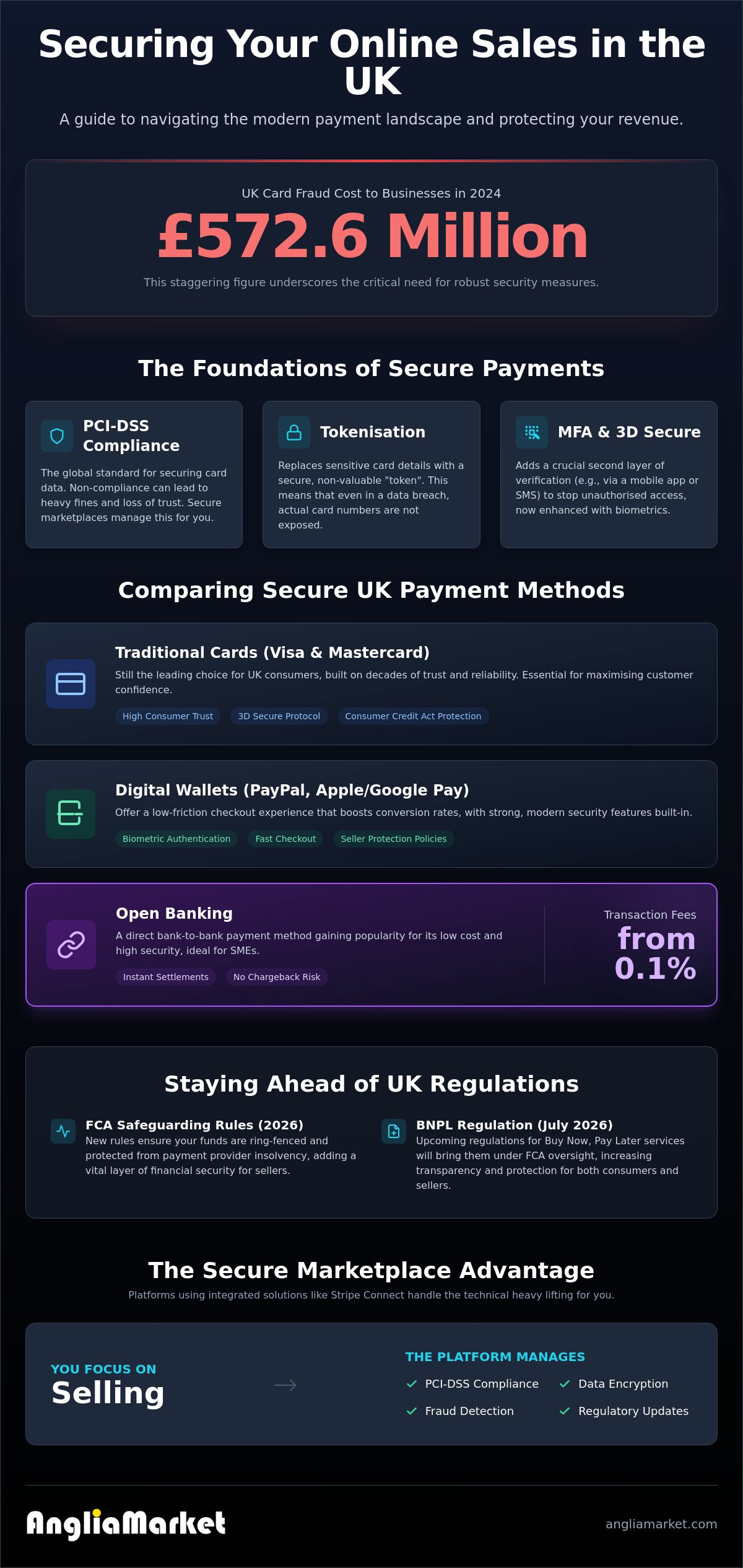
Did you know that UK card fraud cost businesses a staggering £572.6 million in 2024? It's a massive figure that highlights why many sellers ask how do online marketplaces handle payments securely uk before choosing where to trade. You've likely felt the sting of "friendly fraud" chargebacks or the confusion of navigating complex FCA regulations. It's exhausting to balance business growth with the constant anxiety of PCI-DSS compliance.
We understand that you need a solution that just works. Our guide promises to show you the most secure payment methods available to protect your UK business whilst ensuring a smooth checkout for your customers. You don't have to build these defences alone; the right platform does the heavy lifting for you to keep your revenue safe.
We'll preview the latest 2026 standards, including the new payment safeguarding rules that arrived in May. You will discover how platforms use tools like Stripe Connect to manage risks effectively. From the July 2026 BNPL regulations to low-cost Open Banking options starting at 0.1%, we provide the straightforward facts you need to stay safe and profitable in the current market.
Key Takeaways
- Understand how the latest FCA regulations and 2026 safeguarding rules protect your business funds from provider insolvency.
- Discover why Open Banking is becoming a favourite for UK SMEs looking for instant settlements and transaction fees as low as 0.1%.
- Gain insights into how do online marketplaces handle payments securely uk by using robust infrastructure like Stripe Connect to manage PCI-DSS compliance for you.
- Identify the essential evidence you must collect to successfully challenge "friendly fraud" and protect your hard-earned revenue from unfair chargebacks.
- Learn how to simplify your operations by joining a secure marketplace that handles the technical heavy lifting, allowing you to focus on selling.
Understanding the Secure Payment Landscape for UK Sellers
In 2026, a safe payment option isn't just about a green padlock in the browser. It's defined by strict adherence to Financial Conduct Authority (FCA) guidelines. The robust safeguarding requirements that arrived in May 2026 are a game changer. These rules ensure that even if a payment firm faces financial trouble, your business funds are ring-fenced and protected. This regulatory oversight is what separates legitimate UK providers from risky, unregulated alternatives.
For many independent vendors, a primary concern is ensuring online marketplaces handle payments securely to prevent revenue loss. Security involves a multi-layered approach. It starts with PCI-DSS compliance. This is a global standard ensuring any business accepting card payments maintains a secure environment. Without this, you risk heavy fines and a total loss of customer trust. Understanding the underlying online payment systems is the first step toward building a resilient business. Seller protection is just as critical as buyer protection for your long-term success. If your platform doesn't have your back during a dispute, your business longevity is at risk.
The Role of Payment Service Providers (PSPs)
A PSP acts as a facilitator that encrypts sensitive data during the transaction. By using a "full-stack" provider, you reduce security gaps. One entity handles everything from the checkout interface to the final settlement in your bank account. This modular approach is common in modern marketplaces. It helps you organise your business finances whilst technical experts manage encryption and regulatory updates. This is a core aspect of how online marketplaces handle payments securely in the UK today. If you want to sell online with confidence, choosing a platform with an integrated PSP is the most efficient path.
Why Traditional Card Payments Still Lead in the UK
British consumers still show a massive preference for Visa and Mastercard. This trust is built on decades of reliability. The 2026 evolution of the "3D Secure" protocol has made this even safer. It now uses biometrics and background checks to verify identity without slowing down the sale whilst ensuring the bank verifies the customer. For high-value items, the Consumer Credit Act provides an extra layer of reassurance. It gives buyers protection on purchases over £100. This actually helps sellers by increasing consumer confidence in larger transactions. With nearly 97% of UK consumers expected to shop online by 2029, providing these trusted card options is non-negotiable for growth. It makes the "Buy" button much less intimidating for your customers.
Comparing the Safest Online Payment Gateways and Methods
Selecting a payment gateway is a critical commercial decision for any UK business. It's about balancing transaction costs with robust security. Tokenisation is the industry standard for 2026. This technology ensures that actual card details are never stored on your servers. Instead, a secure "token" replaces the sensitive data during the transaction. If a breach occurs, the hackers find nothing of value to steal. Multi-factor authentication (MFA) adds a final, vital hurdle for fraudsters. It forces a second check via a mobile app or SMS. This simple step stops the vast majority of unauthorised access attempts dead in its tracks.
Many small businesses wonder how do online marketplaces handle payments securely uk whilst keeping fees manageable. The answer lies in combining traditional card gateways with modern alternatives. Professional platforms often use providers like Stripe Connect to manage these complex security layers for you. This allows you to focus on sales whilst the platform handles the encryption and compliance. It's a practical way to ensure you meet PCI-DSS standards without needing a dedicated IT team. You can explore how these secure flows work by looking at our sell online options for independent UK businesses.
Digital Wallets: PayPal, Apple Pay, and Google Pay
Digital wallets are a British consumer favourite for a reason. They offer a low-friction checkout experience that drives conversions. By 2026, biometric authentication like FaceID and fingerprint scanning has become the norm for these services. This physical link to the device owner makes "card-not-present" fraud much harder to commit. PayPal is particularly popular amongst SMEs for its specific Seller Protection. To stay protected, you must provide proof of delivery from an approved carrier to the address on the transaction details. This covers you against "unauthorised transaction" and "item not received" claims. Because customers trust these brands, using them naturally leads to lower cart abandonment rates.
Open Banking and Direct Bank Transfers
Open Banking is the low-fee revolution the UK market needed. With over 16.5 million active users at the end of 2025, it's no longer a niche option. Providers like Noda offer transaction fees starting from a tiny 0.1%. This is a massive saving compared to the 2.9% often seen with traditional card payments. The "Pay by Bank" flow is incredibly secure. It moves money directly from the customer's bank account to yours without sharing card numbers or sensitive data. For sellers, the lack of traditional chargeback rights is a huge advantage. Once a payment is authorised in the banking app, it's final. This eliminates the risk of malicious chargebacks and protects your bottom line.
Protecting Your Business Against Fraud and Payment Disputes
Friendly fraud is a growing headache for UK sellers. This occurs when a customer receives their order but claims they didn't to get their money back. It isn't just a minor nuisance; it's a direct hit to your bottom line. If you're using Stripe Connect, a lost dispute can cost you a £20 fee on top of the lost inventory and original payment. Many sellers ask how do online marketplaces handle payments securely uk when they first encounter these suspicious claims. The key is moving from a reactive stance to a proactive one by building a robust evidence trail for every sale.
Successful evidence collection is your only defence against malicious chargebacks. You must link your payment records directly to your shipping data. Tracked shipping is non-negotiable for business longevity in 2026. A tracking number that shows "delivered" to the buyer's specific postcode is the strongest piece of evidence you can provide to a bank. Modern platforms help by syncing your courier data with the transaction record. If you need help managing a complex claim, checking a dedicated resource like the Anglia Market Support centre can provide specific guidance on your rights as a vendor.
By 2026, AI-driven fraud detection has become a standard feature for top-tier gateways. These systems analyse thousands of data points in milliseconds. They look for suspicious behaviour like mismatched geolocations or unusual browsing patterns that suggest a bot is at work. This proactive approach flags high-risk transactions before they're even completed. It stops the fraud before you've even picked the item off the shelf, saving you from the stress of a future dispute. Understanding how do online marketplaces handle payments securely uk involves looking at how these AI tools integrate with your daily workflow.
Mitigating the Risk of Chargebacks
It's vital to distinguish between a legitimate refund and a malicious chargeback. A refund is a controlled process where you return the funds. A chargeback is a forced reversal by the bank that often carries penalties. To win a dispute, keep a digital folder of the following for every high-value order:
- The IP address used to place the order.
- A time-stamped order confirmation email.
- A digital or physical signature upon delivery.
- Any communication logs with the customer regarding the sale.
Use clear descriptors on your bank statements. If a customer sees "AM-UK-MARKET" instead of a confusing string of numbers, they're far less likely to panic and call their bank to report an unrecognised charge.
Spotting Fraudulent Orders Before Shipping
Identifying red flags early is the best way to protect your revenue. Mismatched billing and shipping addresses are classic warning signs, especially for expensive electronics or designer goods. High-quality gateways offer "Velocity Checking" features. This tool flags when multiple rapid orders are placed using the same card or from the same IP address. Always ensure you're using the Address Verification Service (AVS) for UK transactions. This simple check compares the numeric portions of the customer's address and postcode with the information held by the card issuer. If they don't match, it's often safer to cancel the order and reach out to the customer directly.
How to Organise Your Payment Strategy for Maximum Security
Organising your payment strategy requires a disciplined approach. Start by mapping your money flow. Every touchpoint is a potential risk. By following a structured setup, you ensure your revenue stays protected from the moment a customer clicks "Buy." This process isn't just about the technology; it's about the internal controls you put in place to manage your daily operations.
First, implement the "Least Privilege" principle. This means your staff only access the data they absolutely need to do their jobs. A warehouse packer doesn't need to see a customer's full payment history; they just need the shipping label. Limit admin rights to your payment dashboard to one or two trusted individuals. This simple internal control prevents accidental data leaks or internal fraud. It's a practical step that many independent sellers overlook whilst they focus on external threats.
Integrating Secure Gateways into Your Storefront
You must choose between "Hosted" checkouts and "Integrated" APIs. For most UK SMEs, a hosted checkout is the safer choice. With this method, the customer is redirected to a secure page managed by the payment provider. Your servers never touch the sensitive card data. This significantly reduces your PCI-DSS burden and technical risk. If you have technical questions about setting this up, the Anglia Market support centre provides comprehensive guidance for vendors. It's the most efficient way to get up and running without a dedicated IT department.
Maintaining Compliance and Data Privacy
UK GDPR requirements are strict regarding financial data. You must have a clear privacy policy explaining how you handle information. An SSL certificate is mandatory for every page where data is entered. It encrypts the connection between the user's browser and your site. By 2026 standards, end-to-end encryption is required for all traffic to prevent "man-in-the-middle" attacks. Staying compliant isn't just about avoiding fines; it's about being a reliable partner for your shoppers. Ready to start your journey with a platform that prioritises your security? Sign up to sell online today and let us handle the technical complexity for you.
Why Anglia Market is the Secure Choice for UK Independent Sellers
Building a standalone online shop often feels like building a fortress in the middle of a forest. You are responsible for every brick, from the SSL certificate to the payment gateway integration. For many independent vendors, this is a massive technical burden that distracts from actual selling. Anglia Market changes that. We provide a pre-secured environment designed specifically for UK SMEs. You get the benefit of professional infrastructure without the high setup costs or the stress of managing a complex gateway alone.
A major part of how do online marketplaces handle payments securely uk involves the vetting process. We work to maintain a healthy ecosystem by verifying buyers and monitoring for suspicious activity across the platform. This community-driven approach means you aren't just a number in a database. You are part of a trusted network of UK vendors. By trading within a managed platform, you significantly reduce your exposure to the "friendly fraud" and technical vulnerabilities discussed in previous sections. It's a practical way to safeguard your revenue whilst reaching a broader audience.
The Benefits of a Managed Marketplace Platform
Anglia Market handles the heavy lifting of PCI compliance for you. Because we use industry leaders like Stripe Connect, your customers' sensitive data never touches our servers directly. It goes straight to an encrypted vault. This setup gives shoppers immense confidence. They see a professional, secure checkout and a brand they can trust. This trust translates directly into higher conversion rates for your items. If you are ready to stop worrying about technical compliance and start growing your business, you can sell online with us today.
Empowering Small Businesses via Secure Infrastructure
We believe in supporting local commerce through smart, secure tools. Our loyalty program is a key part of this. It encourages repeat business from verified, trusted shoppers. Setting up is straightforward. You can quickly get started in our profiles-add section to showcase your brand to our growing community. We handle the 2026 safeguarding rules and the latest FCA compliance requirements so you don't have to. It is a practical, value-driven partnership that puts the security of your revenue first. Join our community of UK sellers today and trade with complete peace of mind.
This focus on secure, local connections is also essential for service providers; click here to find out more about Trade-Hive and how they help UK tradespeople connect safely with homeowners.
Take Control of Your Business Security in 2026
Navigating the UK's financial landscape doesn't have to be a solo mission. You've seen how the 2026 safeguarding rules and the rise of Open Banking have transformed transactional safety for the better. By prioritising tokenisation and robust evidence collection, you've taken the biggest steps toward eliminating "friendly fraud" whilst protecting your hard-earned revenue. Understanding how do online marketplaces handle payments securely uk is the first step toward choosing a partner that actually protects your business interests.
We're here to help you grow without the technical headache. We are trusted by independent UK SMEs and work with FCA-compliant payment processing partners to ensure your funds are always ring-fenced. You'll also have access to dedicated support for vendor security to help you manage any disputes effectively. It's time to focus on your products and leave the technical complexity to us. Start selling securely on Anglia Market today and join a thriving community of local vendors. We can't wait to help you succeed in our secure marketplace.
Frequently Asked Questions
What are the safest online payment options for sellers in the UK?
The safest options are Open Banking transfers and 3D Secure card payments. These methods use multi-factor authentication to verify the buyer's identity at the point of sale. Digital wallets like Apple Pay and Google Pay also offer high security through biometric checks. Using an FCA-regulated provider ensures your business funds are protected under the latest 2026 safeguarding requirements.
How can I protect my small business from chargeback fraud?
You can protect your business by using tracked shipping for every order. A tracking number that shows delivery to the buyer's specific postcode is your strongest evidence in a dispute. Always keep digital logs of IP addresses and order confirmations. Clear descriptors on bank statements also help prevent customers from raising accidental chargebacks because they don't recognise the transaction.
Do I need to be PCI compliant if I use a marketplace like Anglia Market?
Marketplaces like Anglia Market handle the technical heavy lifting of PCI-DSS compliance. This is a core part of how do online marketplaces handle payments securely uk today. Whilst the platform manages the encrypted environment, your responsibility is to keep your login credentials safe and follow the principle of least privilege for your staff. This approach lets you focus on sales without needing a dedicated IT security team.
What is the most cost-effective yet secure payment gateway for SMEs?
Open Banking is currently the most cost-effective option, with some fees starting at just 0.1%. For card payments, integrated gateways like Stripe Connect offer a balanced mix of security and value at 1.5% plus £0.20 for standard UK cards. Using a managed marketplace often provides better value because the platform handles the complex security infrastructure that would otherwise be expensive to build alone.
Is PayPal still a safe option for UK sellers in 2026?
PayPal remains a safe choice for UK sellers in 2026 due to its robust Seller Protection policy. To qualify, you must ship to the address on the transaction details and provide valid tracking. Whilst it is secure, remember that fees are often higher at 2.9% plus £0.30 for domestic sales. It is a reliable tool for building trust with new customers who prefer familiar brands.
How does Open Banking improve payment security for my business?
Open Banking improves security by removing the need for customers to share card details. This technology is a key part of how do online marketplaces handle payments securely uk to minimise fraud. Payments are authorised directly through the user's banking app using biometrics. This eliminates card-not-present fraud and the risk of traditional chargebacks. It's an efficient way to receive funds instantly whilst keeping fees low.
What should I do if a transaction is flagged as high-risk?
If a transaction is flagged as high-risk, you should pause the order immediately. Don't ship the goods until you've performed an Address Verification Service (AVS) check to see if the billing details match the cardholder's record. Contact the customer directly to verify their information. If the billing and shipping addresses are in different countries or don't match the AVS, it's often safer to cancel.
Can I accept international payments safely as a UK-based seller?
UK sellers can accept international payments safely by using gateways that offer built-in fraud screening and currency conversion. Be aware that fees vary depending on the buyer's location. For example, EEA cards typically cost around 2.5% plus a fixed fee, whilst international cards may incur additional conversion charges. Using a platform that handles these calculations automatically is the most practical way to manage global sales.

Here to help — ask anything
If you have any questions regarding this disclaimer or any of our policies, please contact Anglia Market via the contact page on our website, by email using the address provided on the site, or by phone on 0333 772 2593.