UK consumers drink 98 million cups of coffee every day, and more than 13% of households now buy their beans through digital marketplaces. While the demand for premium home brewing is surging, mastering selling coffee beans online uk regulations is the only way to protect your business from Trading Standards fines. You've likely felt the pressure of complex import paperwork or felt confused by changing VAT rules. It's frustrating when red tape gets in the way of your craft.
Compliance shouldn't stop you from launching. This guide provides a clear roadmap for the 2026 legal landscape, ensuring you meet every requirement from Level 2 food hygiene to mandatory digital traceability. You'll learn exactly how to handle post-Brexit customs declarations, register with local authorities 28 days before trading, and list your coffee on a marketplace with total confidence. We'll walk through the essential checklist for labels, import duties, and the latest food safety standards.
Key Takeaways
- Register with your local authority at least 28 days before trading to officially operate as a Food Business Operator.
- Implement a HACCP plan and meet the 2026 digital traceability standards to keep your records inspection-ready.
- Master the mandatory labelling rules, including the "e" mark and "best before" dates, to comply with selling coffee beans online uk regulations.
- Secure a UK EORI number and identify the correct Commodity Codes to navigate post-Brexit import documentation without delays.
- Launch your storefront on a professional marketplace platform to simplify compliance and build immediate trust with your customers.
Understanding the UK Regulatory Framework for Online Coffee Sales
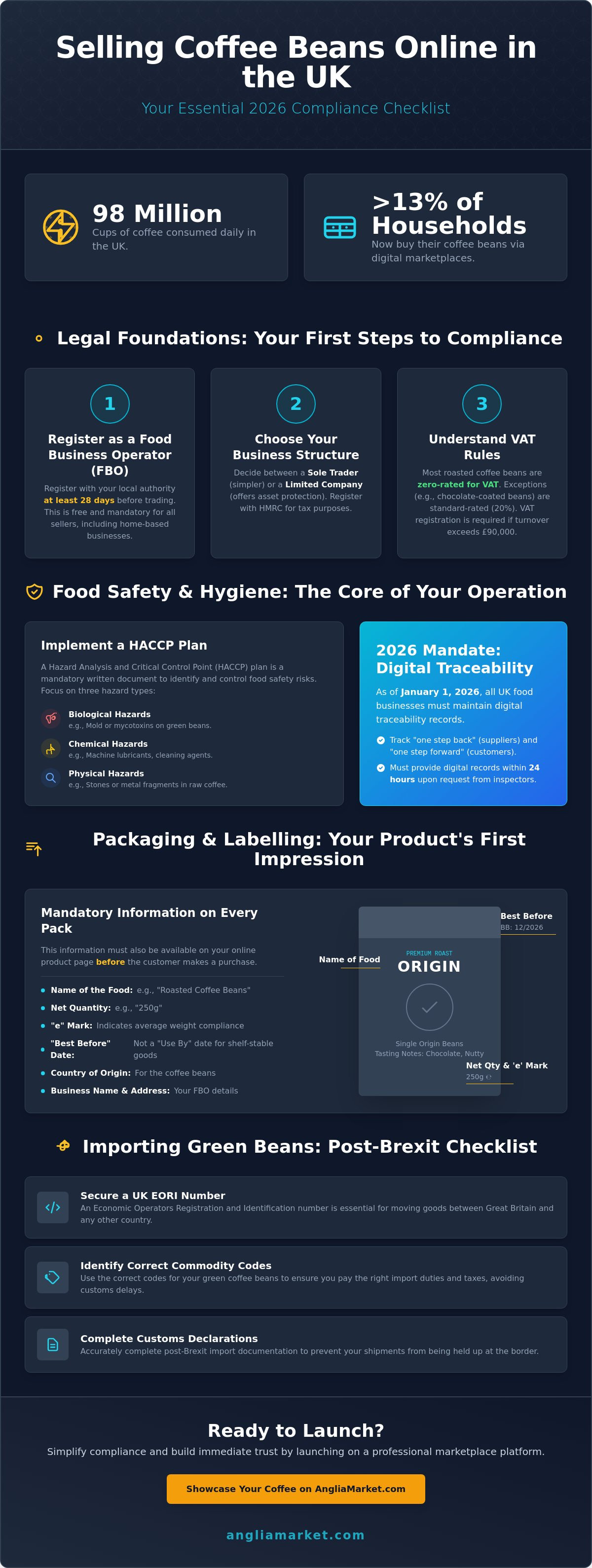
Under UK law, any business involved in the sale, distribution, or preparation of food is classified as a Food Business Operator (FBO). This legal status applies to you the moment you offer products for sale. It doesn't matter if you roast beans in a dedicated commercial unit or package them in your home kitchen; the requirements for selling coffee beans online uk regulations remain consistent. You must register with your local authority at least 28 days before you start trading. This process is free and mandatory. Failing to register can lead to inspections, fines, or even a total stop on your operations.
Distance selling regulations are strict about transparency. When selling online, you must provide mandatory food information on your product pages. This includes the name of the food, the net quantity, and the country of origin. Customers must see this data before they complete their purchase. While roasted beans are shelf-stable food products, brewed coffee sold for immediate consumption follows different hygiene and tax categories. Providing clear, accurate descriptions protects you from refund claims and builds professional credibility with your audience.
Registering as a Food Business Operator
To notify your local Environmental Health Office (EHO), visit the government website to find your specific council. Home-based roasters must comply with the same standards as large-scale facilities. The UK's food safety framework ensures that every seller maintains high standards regardless of their size. After registration, expect an inspection. The EHO officer will review your hygiene practices, storage conditions, and record-keeping. They aim to help you succeed safely. Prepare by having your cleaning schedules and temperature logs ready for review.
HMRC and VAT for Coffee Sellers
Choosing between being a Sole Trader or a Limited Company impacts your taxes and personal liability. Most new sellers start as Sole Traders for simplicity, but a Limited Company offers more protection for your personal assets. VAT rules offer good news for your margins. Most coffee beans are zero-rated for VAT in the UK. This means you don't charge VAT to your customers on standard bags of roasted beans. However, exceptions exist. Chocolate-coated beans or ready-to-drink coffee beverages usually attract the standard 20% rate. Check your specific product mix to ensure you follow selling coffee beans online uk regulations correctly.
Registration with HMRC is a separate but vital step. If you expect your turnover to exceed £90,000, you must register for VAT, even if your products are zero-rated. This allows you to reclaim VAT on business expenses like roasting equipment or packaging. Set up your Self-Assessment or Corporation Tax accounts early in 2026 to avoid late filing penalties. If you are ready to scale, you can sell online through an established marketplace to reach more customers while managing your legal credentials professionally.
Food Safety and Hygiene Standards for Coffee Roasters
Maintaining high food safety standards is about more than avoiding fines. It's about building a brand that customers trust with their morning routine. While coffee beans are considered low-risk compared to dairy or meat, they are still a food product. This means you must follow the same rigorous safety principles as any other food manufacturer. Under selling coffee beans online uk regulations, you're responsible for ensuring your product is safe from the moment green beans arrive at your door until the roasted product reaches the consumer.
As of January 1, 2026, all UK food businesses must maintain digital traceability records. You need to track your inventory "one step back" to your supplier and "one step forward" to your customer. If an inspector requests these records, you must provide them within 24 hours. Using a digital system to log batch numbers and delivery dates makes this process seamless. If you're looking to reach a wider audience while keeping your compliance data organized, you can join a professional marketplace to showcase your products to verified buyers.
Creating Your HACCP Plan
A Hazard Analysis and Critical Control Point (HACCP) plan is a written document that identifies where food safety risks could occur. For coffee roasters, you'll look for three types of hazards. Biological hazards include mold or mycotoxins on green beans. Chemical hazards might involve machine lubricants or cleaning agents. Physical hazards include stones or metal fragments often found in raw coffee shipments. Document your roasting temperatures and cooling times as critical control points. Keeping detailed batch logs ensures you can prove your safety process during an audit.
Hygiene Ratings and Online Transparency
Your local council will issue a Food Hygiene Rating (FHRS) after your inspection. Ratings range from 0 to 5. In a digital marketplace, a high rating is a powerful marketing tool. Many consumers look for this score before buying from a new brand. Displaying your rating clearly on your storefront builds immediate confidence. You should also follow specific Food Standards Agency guidance regarding pest control and storage. Green beans must be kept in a cool, dry environment to prevent spoilage, while roasted beans require airtight storage to maintain quality and prevent contamination.
Personal hygiene is equally important. Anyone roasting or packaging coffee must hold at least a Level 2 Food Safety and Hygiene certification. This training covers essential topics like cross-contamination and effective handwashing. It's a small investment that ensures your team understands selling coffee beans online uk regulations. By staying disciplined with your record-keeping and training, you turn compliance into a competitive advantage that protects your business and your customers.
Packaging and Labelling Requirements in the UK
Your packaging is your primary tool for communication and compliance. Under the Food Information Regulations 2014, your labels must be clear, legible, and easy for the consumer to understand. This isn't just about aesthetics; it's a legal requirement for selling coffee beans online uk regulations. Every bag you ship must contain specific mandatory information that stays visible and permanent until the product is consumed. Accuracy here prevents costly recalls and ensures you pass Trading Standards audits with ease.
Transparency is a core value for modern coffee consumers. You must declare the country of origin on your packaging. If you claim a specific provenance, such as a single estate or farm, you must be able to prove it with purchase records. Before you finalize your designs, review the UK food business registration requirements to ensure your business address is correctly listed as the responsible entity on the label. If you are ready to reach more customers with your professionally labelled products, you can sell online through a trusted marketplace platform.
The Anatomy of a Legal Coffee Label
Precision is everything. Mandatory information, such as the name of the food and the net weight, must meet a minimum font size. Specifically, the lower-case "x" in your chosen font must be at least 1.2mm high. If your packaging is very small, this requirement drops to 0.9mm. You must also include a "best before" date and specific storage instructions, such as "store in a cool, dry place." If you process your beans in a facility that also handles nuts or dairy, you must include a precautionary allergen statement to protect your customers. Claims like "Organic" or "Fairtrade" are only permitted if you hold the relevant valid certificates and your registration numbers are visible on the bag.
Weights and Measures Act Compliance
The UK uses the "Average Quantity" system for most pre-packaged goods. This is often indicated by the "e" mark next to the weight on your bag. It means that while individual bags might vary slightly, the average weight of a batch must not be less than the nominal quantity shown on the label. To use the "e" mark correctly, you must follow the Packer's Rules. These rules ensure that no more than 2.5% of your bags fall below a specific tolerance level, known as T1. Furthermore, no bag can be below the T2 limit, which is double the T1 tolerance.
Your equipment must be fit for the task. All scales used for trade must be Trading Standards approved and regularly calibrated. Keep a dedicated logbook of your weight checks for every batch you roast and package. This documentation is your primary defense if a customer or official challenges your weight claims. By maintaining strict control over your packaging process, you align your business with selling coffee beans online uk regulations and demonstrate a commitment to fair trading practices.
Importing Sourcing: Navigating Post-Brexit Documentation
Importing coffee beans requires precise documentation to clear UK borders. Since the UK left the EU, every shipment from outside the country must undergo a full customs declaration. This is a critical part of selling coffee beans online uk regulations. You cannot simply order beans and wait for them to arrive. You must proactively manage the legal entry of your goods to avoid delays at the port or unexpected charges. Accurate record-keeping is mandatory. As of January 1, 2026, you must keep digital traceability records for every batch imported. These must be available for inspection within 24 hours of a request from authorities.
Customs rules are strict. You'll need to use the Customs Declaration Service (CDS) for all your filings. This system replaced the old CHIEF system and is now the standard for all UK imports. Being prepared prevents your inventory from getting stuck in transit. If you're looking for a reliable way to list your imported products, you can sell online through an established marketplace to reach a ready-made audience of coffee lovers.
EORI and Customs Procedures
Your first step is applying for a UK Economic Operators Registration and Identification (EORI) number. This unique ID starts with "GB" and is required for all businesses moving goods into or out of Great Britain. Applying is simple. It usually takes less than 10 minutes through the government portal. By 2026, your EORI number must be linked to your CDS account to facilitate smooth border crossings. You'll need your Government Gateway ID to complete this setup.
You must also identify the correct Commodity Code for your beans. This ten-digit code determines the rate of duty and VAT you pay. Green (unroasted) coffee and roasted coffee have different codes. While roasted beans are generally zero-rated for VAT, getting the code wrong can lead to overpayment or Trading Standards fines. Many small businesses use a customs broker to handle these filings. However, if you import frequently, learning to self-file through CDS can save you significant administrative costs over time.
Sourcing Sustainably and Legally
Phytosanitary Certificates are another essential document for green coffee importers. Because raw beans are plant products, they must be certified as pest and disease-free by the exporting country's authorities. Roasted beans are processed food and typically don't require these certificates. Always verify this with your supplier before shipping to prevent your cargo from being destroyed at the border. Mistakes here are expensive and can damage your reputation with suppliers.
Ethical sourcing is now a legal consideration as well as a marketing one. You must maintain a Certificate of Origin to prove where your coffee was grown. If you intend to sell your coffee into the EU market, be aware of the July 1, 2026 customs changes. The EU is removing the €150 exemption for customs duties on goods imported from the UK. For those focusing on premium niches, verifying organic certification is vital. Ensure your supplier’s certificates are valid in the UK and clearly documented in your digital records to satisfy selling coffee beans online uk regulations.
If you want to simplify your route to market and focus on roasting rather than web design, become a vendor today and start reaching customers through our established platform.
Scaling Your Coffee Business: Launching on a UK Marketplace
Launching a standalone website requires managing hosting, cybersecurity, and complex payment gateways. For small and medium enterprises (SMEs), using a marketplace is often the most efficient way to handle selling coffee beans online uk regulations without a massive technical overhead. These platforms are built to facilitate commerce while ensuring both buyers and sellers follow current digital trade laws. By joining an established ecosystem, you can focus on roasting and sourcing while the platform provides the infrastructure for secure transactions. It's a practical move that lets you scale quickly without the technical debt of a custom-built site.
Presenting your legal credentials is a major part of building a professional storefront. You should clearly list your Food Hygiene Rating and business registration details in your profile. Many successful roasters leverage vendor support programmes to understand the nuances of digital storefront management. This support helps you navigate the 2026 requirements for digital traceability and distance selling. When you ship your products, your packaging must protect the coffee from moisture and external odors. Using heat-sealed, valved bags ensures that your food safety standards remain intact throughout the delivery process. Proper transit packaging prevents contamination and ensures the customer receives the premium quality they paid for.
The Marketplace Advantage for Coffee Brands
Selling online via a marketplace automatically covers your PCI compliance. This is essential for handling customer credit card data securely. You don't have to worry about the technical burden of maintaining a secure checkout. Instead, you can use built-in analytics to see how your blends perform in the kitchen and dining category. Seeing which regions or demographics buy specific roasts allows you to scale your inventory effectively. Verified customer reviews also serve as a public record of your reliability and product quality. This social proof is vital for new brands looking to build trust in a competitive market.
Final Checklist Before Your First Sale
Before you process your first order, secure product liability insurance. Even with a perfect HACCP plan, insurance is essential to protect your business against claims related to illness or injury. You must also establish a clear refund policy. Under UK law, perishable food items like roasted coffee beans are often exempt from the standard 14-day "right to cancel" distance selling rule, provided the seal is broken or the product is likely to deteriorate quickly. However, you must still offer a refund if the product is faulty or not as described. Clear policies prevent disputes and keep your account in good standing.
Perform one final review of your labels. Check that your "best before" dates and contact details are accurate against current Trading Standards guidelines. Ensuring every detail aligns with selling coffee beans online uk regulations gives you the confidence to list your products and grow your brand. Once your compliance is solid, you're ready to reach the millions of daily coffee drinkers in the UK. Start small, stay compliant, and use marketplace tools to turn your roasting hobby into a professional enterprise.
Launch Your Professional Coffee Brand in 2026
Mastering the legal landscape is the final step before sharing your unique roasts with the world. By registering as a Food Business Operator and implementing digital traceability, you build a foundation of trust and safety. Accurate labelling and a clear understanding of selling coffee beans online uk regulations protect your business from fines while giving customers the transparency they expect. These compliance steps aren't just red tape; they are assets that differentiate your brand from casual hobbyists.
You can simplify your journey by choosing a platform designed for growth. Our marketplace provides a secure transactional platform and dedicated support for UK SMEs, giving you immediate access to thousands of UK-based coffee lovers. We handle the technical infrastructure so you can focus on sourcing the best beans and perfecting your craft. It's time to move from planning to profit with a storefront that supports your ambitions.
Start your online coffee business today on Anglia Market and join a community of independent vendors. The demand for high-quality home brewing is at an all-time high, and your brand could be the next favorite for UK households. Take the leap and start trading with confidence today.
Frequently Asked Questions
Do I need a specific licence to sell coffee beans online from home in the UK?
You don't need a specific "licence" to sell coffee beans, but you must register as a Food Business Operator (FBO) with your local council. This registration is a legal requirement and must be completed at least 28 days before you begin trading. It is free to do and applies even if you are only selling small batches from your home kitchen. Your local authority will then schedule a hygiene inspection for your workspace.
Is coffee zero-rated for VAT in the UK?
Roasted coffee beans and ground coffee are generally zero-rated for VAT in the UK. This helps keep your prices competitive for home brewers. However, specific coffee-related products like chocolate-covered beans or sweetened coffee syrups usually attract the standard 20% VAT rate. Understanding these distinctions is a key part of selling coffee beans online uk regulations. Always verify the VAT status of your specific product range to avoid accounting errors.
What is an EORI number and do I need one to sell coffee?
An EORI number is a unique identification code used by customs to track goods moving into and out of the UK. You need one if you source your green beans directly from international suppliers. It is essential for completing customs declarations through the Customs Declaration Service (CDS). Without this number, your shipments will be held at the border; this can lead to significant delays and potential storage fees from the port authorities.
Can I sell coffee beans without a food hygiene certificate?
Legally, you must be able to demonstrate that you have received adequate food safety training for the tasks you perform. While a certificate isn't a standalone licence, most inspectors require a Level 2 Food Safety and Hygiene certification for anyone roasting or packaging coffee. This training ensures you understand how to prevent contamination and maintain a safe workspace. It's a small investment that builds significant trust with your customers and regulators.
How do I label organic coffee beans legally in the UK?
You can only use the term "organic" if your business is certified by an approved UK organic control body. This requires an annual audit and specific record-keeping to prove the organic integrity of your beans. Your label must include the control body's code and the statement of origin. Using the organic claim without this certification is illegal; it can lead to immediate enforcement action from Trading Standards officers.
What are the distance selling rules for coffee beans?
Distance selling rules require you to provide all mandatory food information to the customer before they complete their purchase. This includes the product name, weight, country of origin, and any allergen warnings. This information must be clearly visible on your product page. Following selling coffee beans online uk regulations ensures that customers can make informed choices. You must also provide a clear refund policy on your website, though perishable food often has specific exemptions once opened.
Do I need to register with the FSA (Food Standards Agency)?
You don't register with the FSA directly. Instead, you register with the Environmental Health department of your local council. They handle the administration and will share your business details with the Food Standards Agency database. The local inspectors are your primary point of contact for hygiene ratings and safety advice. They ensure your business follows the national framework while providing local guidance tailored to your specific setup.
Can I roast coffee beans in my kitchen and sell them on a marketplace?
Yes, you can roast coffee beans at home if your kitchen meets the required hygiene standards. Your local authority will inspect your home to ensure it is clean, well-maintained, and free from pests. You must demonstrate that you can roast and package coffee without risks from domestic activities. Once you have your hygiene rating, listing your products on a marketplace is a fast way to reach thousands of coffee enthusiasts across the UK.

Here to help — ask anything
If you have any questions regarding this disclaimer or any of our policies, please contact Anglia Market through the contact page on our website, by email using the address provided on the site, or by phone at 0333 772 2593