
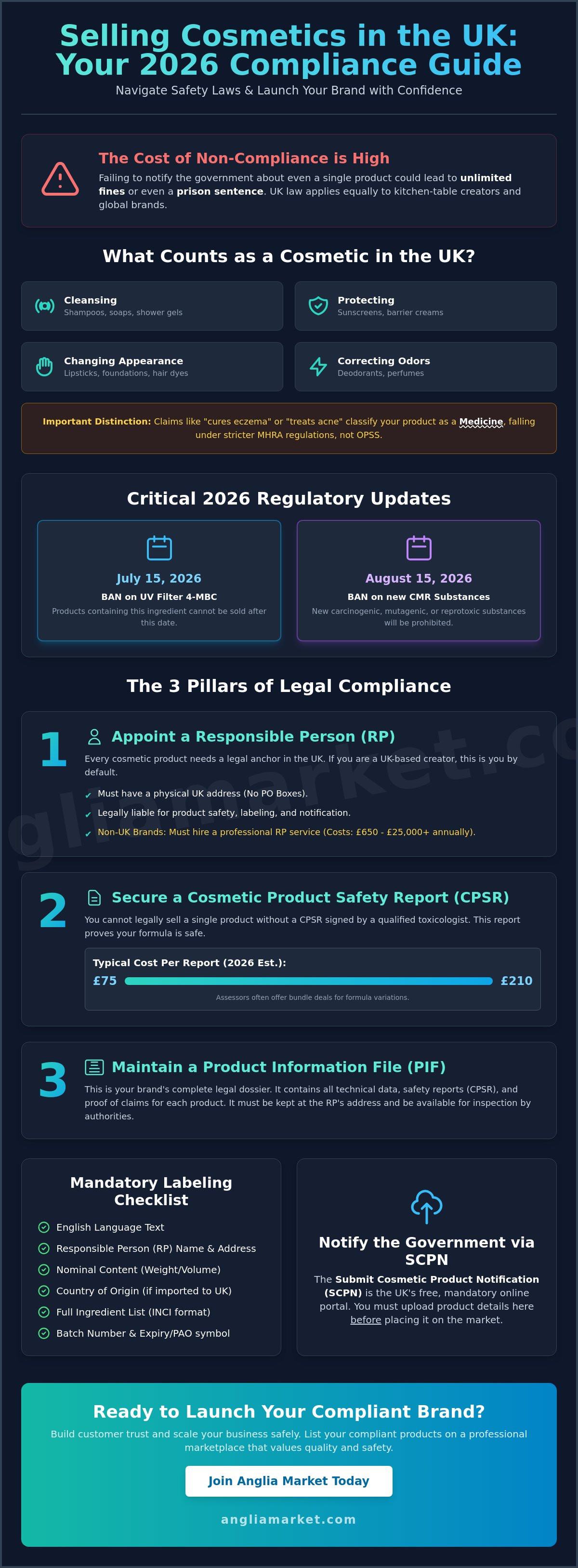
Did you know that failing to notify the government about a single face oil could lead to an unlimited fine or even a prison sentence? It's easy to feel buried under technical acronyms like CPSR, PIF, and SCPN, especially when you're trying to turn a creative passion into a legitimate business. You might worry that your handmade balms don't need the same rigorous testing as global brands, but the law doesn't distinguish between a kitchen table and a factory. Mastering the rules for selling cosmetics and skincare uk safety standards is your first step toward building a brand that customers can truly trust.
We'll help you swap the fear of product recalls for a clear, actionable roadmap. This guide breaks down the critical 2026 updates, including the August 15th ban on new CMR substances and the lowered formaldehyde labeling thresholds. You'll learn exactly what a Cosmetic Product Safety Report costs, how the free SCPN portal works, and why a UK Responsible Person is mandatory. By the end, you'll have the technical knowledge and the confidence to legally launch your brand on a professional marketplace like Anglia Market.
Key Takeaways
- Learn the legal definitions and regulatory framework for selling cosmetics and skincare uk safety standards to ensure your products meet OPSS requirements.
- Identify your mandatory Responsible Person and secure a Cosmetic Product Safety Report (CPSR) from a qualified toxicologist.
- Master UK labeling laws, including English-language requirements and mandatory details like nominal content and country of origin.
- Navigate the Submit Cosmetic Product Notification (SCPN) portal with a step-by-step checklist for successful government notification.
- Build customer trust and scale your brand safely by listing your compliant products on the Anglia Market platform.
Understanding the UK Cosmetic Safety Framework in 2026
The Office for Product Safety and Standards (OPSS) is the national regulator for all cosmetics sold in Great Britain. Their primary mission is to protect consumers from hazardous ingredients and misleading claims. If you're a business owner, compliance is your ticket to the market. The rules aren't just for massive corporations. They apply to every person making small batches of soap in a home kitchen or mixing bespoke facial oils. Mastering the rules for selling cosmetics and skincare uk safety standards ensures your brand remains operational and avoids the risk of heavy fines.
What Counts as a Cosmetic in the UK?
In the UK, a cosmetic is any substance intended to be placed in contact with the external parts of the human body. This includes the skin, hair, nails, lips, and external genital organs. It also covers teeth and the mucous membranes of the oral cavity. The product's main purpose must be to clean, perfume, change appearance, protect, or correct body odors. Common examples include:
- Cleansing: Shampoos, soaps, and shower gels.
- Protecting: Sunscreens and barrier creams.
- Changing Appearance: Lipsticks, foundations, and hair dyes.
- Correcting Odors: Deodorants and perfumes.
Watch your claims carefully. If you market a balm as a "treatment for eczema" or a "cure for acne," the product might be classified as a medicine. Medicines fall under the authority of the MHRA, not the OPSS. It's the intended use and the wording on your packaging that define the category, not just the ingredients.
The Post-Brexit Regulatory Landscape
The UK now operates under its own legal framework known as the UK Cosmetics Regulation (Schedule 34). This legislation is based on the EU's foundational cosmetics regulation, but the two systems have diverged. Complying with EU rules is no longer enough to sell in England, Scotland, or Wales. Under the Windsor Framework, Northern Ireland still follows EU cosmetic rules, meaning sellers often need to manage two different sets of compliance data if they trade across the whole UK.
Significant changes are arriving in 2026. As of August 15, 2026, new substances classified as carcinogenic or toxic for reproduction (CMRs) are banned from the market. Additionally, from July 15, 2026, the UV filter 4-MBC is prohibited. These deadlines are hard stops. To stay ahead, savvy entrepreneurs list their products on a reliable online marketplace platform that values safety and helps small businesses thrive. Understanding these shifts now prevents stock from becoming illegal overnight.
The Three Pillars of Legal Cosmetic Sales
Compliance isn't just a hurdle. It's the foundation of a professional brand. To meet the requirements for selling cosmetics and skincare uk safety standards, you must establish three specific legal safeguards. These pillars ensure that if a customer has a reaction or a regulator asks questions, you have the evidence to prove your products are safe. Skipping these steps can lead to unlimited fines in England and Wales, so getting them right is non-negotiable.
Appointing a Responsible Person (RP)
Every cosmetic product needs a legal anchor. This is the Responsible Person. If you're a UK-based sole trader making your own products, you are the RP by default. Your job is to ensure the product stays compliant with the UK Government's cosmetic safety guidance at all times. Here is what you need to know:
- The RP must have a physical UK address where the legal file is kept.
- PO boxes are not permitted for this role.
- You are legally liable for safety, labelling accuracy, and government notification.
For brands based outside the UK, hiring a professional RP service is mandatory. These services can cost anywhere from £650 to over £25,000 annually, depending on your product range.
Securing Your Cosmetic Product Safety Report (CPSR)
You cannot legally sell a single jar of cream without a CPSR. A qualified toxicologist must sign this document. They analyze your ingredients, stability tests, and microbial data to confirm the formula is safe. The report consists of Part A, which contains the raw safety data, and Part B, which is the toxicologist’s actual assessment. In 2026, a single CPSR typically costs between £75 and £210. Many assessors offer bundle deals if you have multiple variants of the same base formula.
Maintaining the Product Information File (PIF)
The PIF is your brand’s legal dossier. It's a comprehensive file that you must keep for at least 10 years after the very last batch of a product is sold. It isn't just a folder of receipts. It must contain your CPSR, a description of the cosmetic product, and proof that you follow Good Manufacturing Practice (GMP). Digital storage is the best choice for modern SMEs. Keep these files organized and ready. If the authorities request them, you must provide them quickly. Having your paperwork in order makes it much simpler to sell your products online and build a reputation for quality. These three elements work together to shield your business from liability while proving your commitment to customer safety.
Mandatory Labelling Requirements for UK Skincare
Your label is the most visible part of your compliance journey. For anyone selling cosmetics and skincare uk safety standards requires that every piece of information on your packaging is accurate, indelible, and easy to read. In the UK market, all mandatory information must be in English. If you sell a product with a shelf life longer than 30 months, you use the Period After Opening (PAO) symbol, which looks like an open jar. For products that expire sooner, a "Best Before" date is mandatory. This ensures customers know exactly when the product is no longer at its best.
Ingredients must follow the International Nomenclature of Cosmetic Ingredients (INCI). This system uses standardized names for every substance. It ensures that a customer can identify exactly what is inside your formula using a universal language. Consistency here is key. It builds professional credibility and helps customers with sensitivities stay safe.
The 'Never-Miss' Labelling Checklist
Compliance starts with the basics. Your label must feature the name and physical UK address of your Responsible Person. Remember, a PO box is not acceptable. You also need to state the country of origin if the product is made outside the UK. This transparency is a legal requirement that helps the authorities track the supply chain.
Traceability is your best defense against disaster. Every single unit needs a batch number. If a safety issue arises, you can recall a specific batch rather than your entire inventory. Pay close attention to allergens and new 2026 updates. As of July 15, 2026, the threshold for formaldehyde-releasing ingredients has dropped significantly. You must now include the warning "contains formaldehyde" if the concentration is 0.001% or higher. This is a massive change from the previous 0.05% limit. For more detailed industry standards, consult the Cosmetic, Toiletry and Perfumery Association (CTPA).
Handling Small or Unusually Shaped Packaging
Small jars and thin lip balm tubes present a design challenge. If your container is too small to fit the full ingredients list or safety warnings, the law allows for a "hand and book" symbol. This tells the customer that the full information is on an enclosed leaflet or an outer box. However, certain details must always stay on the primary container that touches the product. These include the product name, the batch number, and the PAO or Best Before date.
Design your labels with high contrast. Use clear fonts and avoid placing text over busy patterns. If you're ready to showcase your professionally labelled range, consider listing in our health and beauty category to reach an audience that values quality. Practicality shouldn't come at the expense of legality. A well-designed, compliant label is a sign of a brand that takes its customers seriously.
Notifying the Authorities: The SCPN Process
The Submit Cosmetic Product Notification (SCPN) portal is the final gateway to the market. It is a mandatory, free-of-charge online system managed by the Office for Product Safety and Standards (OPSS). Before you sell a single item, you must notify the government. This step is essential for anyone selling cosmetics and skincare uk safety standards compliant. It allows the authorities to access product details quickly if a safety concern arises. While the portal itself costs nothing to use, the legal consequences of skipping it are severe. In England and Wales, there is no upper limit on fines for failing to notify the OPSS.
Notification is not an approval process. It is a registration. You are telling the government that your product exists and that you have all the necessary safety paperwork ready. This includes the CPSR and PIF discussed in previous sections. You don't need to wait for a "yes" from the portal. Once the notification is submitted, you are legally clear to start trading.
How to Use the SCPN Portal
Setting up your account is straightforward. You can register as an individual or a business. Once inside, you'll need to provide specific details for each product. Have your formulation and labels ready before you start. The portal requires:
- The category and name of the product.
- The name and address of the Responsible Person.
- A full list of ingredients using INCI names.
- The formulation. You can often provide concentration ranges rather than exact percentages.
- A clear photo of the product and its label.
Make sure your photo is high resolution. The authorities use this to verify that your physical packaging matches your digital notification. If you change your formula or update your label, you must update the SCPN entry immediately.
Reporting Undesirable Effects
Your job doesn't end once the product is listed. You have a legal duty to monitor post-market safety. This is called post-market surveillance. If a customer experiences a 'serious undesirable effect', you must report it to the OPSS via the SCPN portal. A serious effect is one that results in temporary or permanent functional impairment, disability, or hospitalization. Professional record-keeping is your best defense. Keep a log of every customer complaint, even minor ones like slight redness. If a pattern emerges, you can act before it becomes a legal crisis. This level of diligence protects your brand's reputation and ensures long-term success.
Ready to reach new customers with your fully notified range? Start selling on our marketplace platform today and join a community of professional vendors who value quality and compliance.
Launching Your Compliant Brand on Anglia Market
Compliance is more than just a legal box to tick. It is your most powerful marketing tool. When you are selling cosmetics and skincare uk safety standards compliance proves to your customers that you care about their well-being. Savvy shoppers on the Anglia Market platform look for quality and transparency. By showcasing your commitment to safety, you distinguish your brand from fly-by-night sellers who ignore the rules. This transparency builds the kind of customer loyalty that leads to repeat purchases and positive reviews. It transforms a one-time buyer into a brand advocate who trusts your formula.
Setting Up Your Storefront for Success
Your product listings are your digital shop window. To succeed in the Health and Beauty category, you must translate technical compliance into buyer confidence. Instead of using jargon like "CPSR Part B," use phrases like "Independently Safety Tested" or "Formulated to UK Standards." If your products are manufactured in Great Britain, highlight "UK-Made" prominently. It signals quality and adherence to strict local regulations. Clear, high-resolution photos of your compliant labels also help. They show customers that you have nothing to hide. You can also leverage Anglia Market promotions to give your compliant new launches an initial boost. A "Safety First" launch campaign can attract health-conscious buyers looking for reliable alternatives to mass-market brands. Use these tools to drive traffic to your store and convert browsers into buyers quickly.
Joining the Community of Independent Sellers
We believe in empowering small and medium-sized businesses. When you start selling online with Anglia Market, you join a supportive network of regional vendors. We provide the platform; you provide the quality. Our loyalty program helps you grow your customer base by rewarding shoppers for choosing independent brands like yours. This creates a cycle of trust and repeat business that is hard to achieve on larger, impersonal sites. You aren't just another SKU in a warehouse. You are a valued partner in a thriving marketplace designed for growth.
The roadmap is clear. You have learned about the SCPN portal, the role of the Responsible Person, and the importance of accurate labelling. Compliance is the foundation. Now it is time to build the house. Take these safety credentials and use them to launch a brand that isn't just legal, but legendary. Your first sale is waiting. Focus on the details, respect the standards, and watch your skincare business thrive in 2026. Transitioning from a maker to a professional vendor is a major milestone. We are here to help you make it a reality.
Scaling Your Skincare Brand Safely in 2026
The path to a successful beauty brand is built on three legal pillars: the Responsible Person, the CPSR, and the PIF. By mastering the requirements for selling cosmetics and skincare uk safety standards, you protect your business from liability and prove your quality to every customer. Once your SCPN notification is complete and your labels meet the 2026 formaldehyde thresholds, you are ready to move from compliance to commerce. These steps are not just hurdles; they are the foundation of a reputable enterprise.
A professional marketplace provides the perfect launchpad for your compliant products. You need a platform that understands the needs of independent vendors while offering a secure transactional environment. This allows you to focus on your formulations while the platform handles the infrastructure. It is the most efficient way to scale without the stress of managing a standalone site from scratch.
Start your journey as a verified skincare vendor on Anglia Market today. Our supportive platform for UK SMEs gives you direct access to thousands of health and beauty shoppers. It is time to turn your safety credentials into sales and grow your brand with confidence. Your future customers are waiting for products they can trust.
Frequently Asked Questions
Do I need a licence to sell handmade cosmetics in the UK?
You don't need a specific trade licence to start, but you must comply with the UK Cosmetics Regulation. This involves having a valid safety report and notifying the government before you trade. While 'licence' is the word many new sellers use, 'compliance' is the actual legal requirement. You are responsible for ensuring every batch meets the same rigorous safety criteria as major retail brands.
Can I sell my skincare products on a marketplace without a CPSR?
No, you cannot legally sell on any professional platform without a Cosmetic Product Safety Report. Marketplaces like Anglia Market require this documentation to protect shoppers and maintain high quality levels. Ensuring your products are selling cosmetics and skincare uk safety standards compliant is a prerequisite for opening a vendor account. It acts as your proof that a qualified toxicologist has verified your formula as safe for use.
How much should I budget for a safety report in 2026?
Expect to pay between £75 and £210 for a single product assessment this year. Many assessors offer bundle deals for variations, such as different scents of the same soap base. This is a one-time cost per formulation unless you change the ingredients. It is a fundamental investment for any brand owner, as it forms the core of your legal Product Information File.
What happens if I sell cosmetics in the UK without following safety standards?
The penalties for non-compliance are severe and can include unlimited fines or even prison time. Trading Standards officers can issue immediate stop-notices, forcing you to remove all stock from sale. You may also be required to fund a full product recall, which can be financially devastating for a small business. Beyond the legal risks, selling unsafe products can permanently destroy your brand's reputation with customers.
Do I need to test my cosmetics on animals for UK safety standards?
Animal testing is strictly prohibited for cosmetic products and ingredients in the UK. You don't need to test on animals to prove safety; in fact, doing so would make your product illegal to sell. Your toxicologist uses existing data and non-animal testing methods to complete your safety report. This cruelty-free approach is a mandatory part of selling cosmetics and skincare uk safety standards in 2026.
Can I be my own 'Responsible Person' for my skincare business?
You can act as your own Responsible Person if you are based in the UK and have a physical business address. This role involves maintaining the Product Information File and ensuring the product remains safe throughout its shelf life. If you manufacture the products yourself, you are the RP by default. You must be reachable at the address listed on your labels for any regulatory enquiries.
What is an INCI list and why is it required on my labels?
An INCI list is a standardized system of ingredient names used internationally. It ensures that consumers can identify potential allergens regardless of where the product was made. For example, using "Aqua" instead of "Water" is part of this global standard. It provides a universal language for safety and transparency, making it easier for customers with sensitive skin to shop with confidence across different brands.
How do I notify the government about a new cosmetic product?
You must use the Submit Cosmetic Product Notification (SCPN) portal before your product goes on the market. This is a free government service where you upload your ingredient list, product category, and a photo of your label. It doesn't provide an 'approval', but it registers your product with the authorities. This step is mandatory for every single SKU you intend to sell in Great Britain.

Here to help — ask anything
If you have any questions regarding this disclaimer or any of our policies, please contact Anglia Market through the contact page on our website, by email using the address provided on the site, or by phone at 0333 772 2593