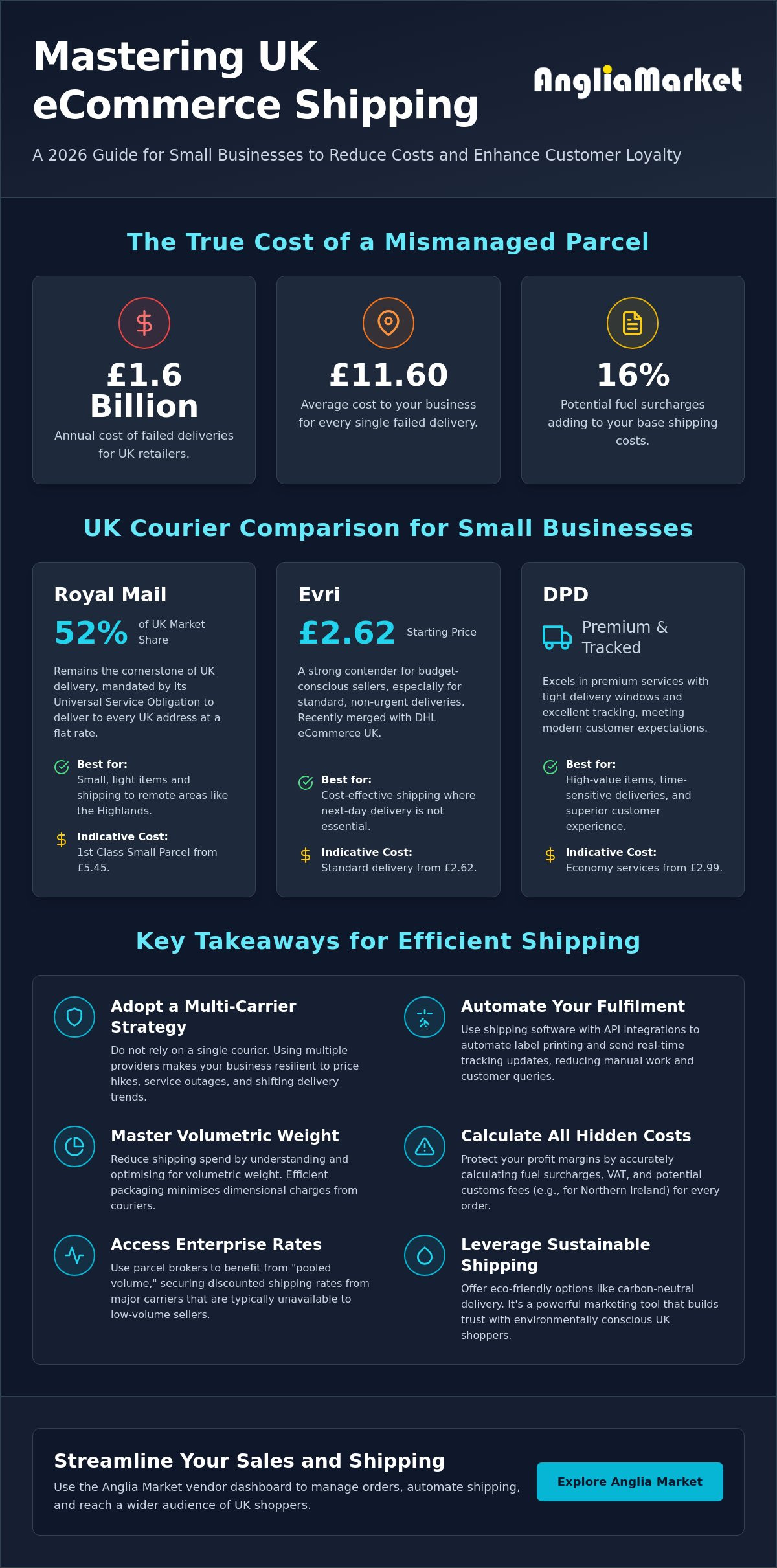
Did you know that failed deliveries cost UK retailers an estimated £1.6 billion annually? With the average cost per failed delivery sitting at £11.60 in 2026, a single logistics hiccup does more than just annoy a customer. It directly drains your profits. You're likely feeling the squeeze as Royal Mail 1st Class Small Parcels hit £5.45 and fuel surcharges climb as high as 16%. Between complex customs paperwork for Northern Ireland and the constant worry that a late courier will lead to a one-star review, managing logistics is a significant challenge for any SME.
This guide offers practical shipping tips for online sellers uk to help you reduce costs and speed up your fulfilment. You'll learn how to choose the right partners for your specific volume and how to automate your label printing to save hours of manual work. We'll break down the latest 2026 courier rates, compare service reliability, and show you how to turn shipping from a cost centre into a competitive advantage for your business.
Key Takeaways
- Adopt a multi-carrier strategy to ensure your UK small business remains resilient against courier capacity changes and shifting delivery trends.
- Discover essential shipping tips for online sellers uk to access enterprise-level rates and automate your label printing with top software solutions.
- Identify and calculate hidden costs like fuel surcharges and VAT to protect your profit margins on every order.
- Reduce your shipping spend by mastering volumetric weight calculations and following a five-step guide to more efficient packaging.
- Leverage the Anglia Market vendor dashboard to streamline your order management and reach a wider audience of UK shoppers.
Navigating the UK Shipping Landscape for Small Businesses
The UK logistics market in 2026 is undergoing significant consolidation. Recent mergers, such as DHL eCommerce UK and Evri, are shifting how small businesses access delivery networks. You need to stay agile to survive. Relying on a single courier leaves you vulnerable to sudden price hikes or service outages. A multi-carrier approach is the only way to ensure resilience amongst changing courier capacities. These shipping tips for online sellers uk will help you navigate these changes while protecting your profit margins.
Delivery speed is a primary driver of customer loyalty. On platforms like Anglia Market, your seller rating is tied directly to your shipping performance. Fast, reliable delivery leads to the positive reviews that help you sell online more effectively. One late parcel can result in a negative review that takes weeks to recover from. Transparency is no longer optional; it is a standard requirement for the modern British shopper.
Royal Mail vs. Private Couriers: Choosing Your Primary Partner
Royal Mail remains a cornerstone of the UK delivery system, holding approximately 52% of the market share. It's often the most cost-effective choice for small, light items like jewellery or stationery. The History of Royal Mail explains its Universal Service Obligation, which ensures they deliver to every UK address at a flat rate. This is a massive benefit if you frequently ship to the Highlands or islands.
Private couriers like DPD, Evri, and DHL offer different strengths. Evri's standard delivery starts from £2.62, making it a strong contender for budget-conscious sellers. DPD excels in premium, tracked services with tight delivery windows. Many modern shoppers now prefer "Click & Collect" points over home delivery. It's often more convenient for those who aren't home during the day. Offering a mix of Royal Mail for small items and private couriers for larger, tracked consignments gives your customers the flexibility they crave.
The Rise of Sustainable Shipping in the UK
Green last-mile delivery is a major priority in 2026. UK shoppers are increasingly selective about the environmental impact of their purchases. Many carriers now offer carbon-neutral options or use electric fleets in major city centres like London, Manchester, and Birmingham. Using these services is more than just an ethical choice; it's a powerful marketing tool.
Displaying eco-friendly shipping badges on your storefront provides a clear advantage. It builds immediate trust with conscious consumers. You can identify green carriers by looking for those with established bicycle courier networks for urban areas. These shipping tips for online sellers uk help you align your brand with modern values while potentially avoiding urban congestion charges that can inflate your costs.
Comparing the Best Small Business Shipping Solutions in the UK
Finding the right balance between cost and efficiency is a constant battle. For many startups, shipping aggregators and parcel brokers are the first port of call. These platforms use "pooled volume" to negotiate enterprise-level rates from major carriers. By combining the orders of thousands of small businesses, they offer prices that individual sellers could never secure alone. This is one of the most effective shipping tips for online sellers uk looking to protect their margins from day one.
Using API integrations is another way to level the playing field. These connections allow your sales channel to talk directly to your shipping provider. It ensures real-time tracking updates are sent to customers automatically. This reduces "where is my order" enquiries and improves your standing on marketplaces. If you are looking to grow, checking out the resources for independent UK vendors can help you understand how platform integrations simplify these daily tasks.
Parcel Brokers: High Volume Rates for Low Volume Sellers
Platforms like Parcel2Go allow for instant price comparisons across the UK. You can see rates from Evri, DPD, and DHL side-by-side without signing a long-term contract. For example, you might find Evri standard delivery from £2.62 or DPD economy from £2.99. This flexibility is great for testing different carriers before committing.
There is a trade-off to consider. When using a broker, you are their customer, not the courier's. If a high-value item goes missing, customer support can be slower than if you had a direct account. As your business scales to hundreds of parcels a week, moving to a direct contract becomes essential. You'll gain better account management and more reliable daily collections.
Multi-Carrier Software: Automating Your Fulfilment
Once you sell across multiple channels, a single shipping dashboard is vital. Software like ShipStation, Veeqo, or Zenstores centralises every order. You don't have to log into several different sites to print labels. These tools automate the tedious parts of the job. They generate the correct labels and handle the complex UK VAT and Customs Duty rules for international or Northern Ireland shipments.
Automation isn't just about saving time. It's about accuracy. One of the best shipping tips for online sellers uk is to use these tools to create a branded tracking page. It provides a professional post-purchase experience. Providing clear returns management through these portals builds long-term loyalty. It shows your customers that you are a reliable, organised business.
Calculating the Real Cost: Surcharges, VAT, and Hidden Fees
Your base shipping rate is rarely the final price you pay. In June 2026, industry data suggests that surcharges and additional fees can account for roughly 33% of the total cost of a package. If you don't account for these in your pricing strategy, your margins will vanish. One of the most critical shipping tips for online sellers uk is to move beyond the "headline" rate and calculate the landed cost of every parcel. This requires a weekly check of carrier updates, as fuel surcharges are currently volatile.
Fuel costs remain a significant burden for UK SMEs. Royal Mail increased its fuel and energy surcharge to 16% in May 2026. Meanwhile, UPS surcharges for the week of 8 June 2026 reached 30% for standard services and a staggering 44.50% for express options. Beyond fuel, keep an eye on handling fees. As of 1 June 2026, FedEx reduced its weight threshold for the Domestic Additional Handling Surcharge from 31kg to 25kg. This change alone could catch out sellers shipping medium-sized electronics or home goods.
Shipping between Great Britain and Northern Ireland also remains complex due to post-Brexit regulatory evolution. For a detailed look at administrative hurdles, this small business's guide to posting post-Brexit provides essential context for navigating customs paperwork. To keep your finances in check, use this monthly audit checklist for your invoices:
- Compare the quoted base rate against the invoiced amount.
- Verify fuel surcharge percentages against the carrier's published weekly rates.
- Check for "Residential Delivery" fees that may have been applied to business addresses.
- Identify any "Address Correction" fees resulting from customer input errors.
UK Geographical Surcharges: The Highlands and Islands Factor
Many private couriers apply heavy surcharges for deliveries to the Scottish Highlands, Isle of Man, and the Channel Islands. These fees can sometimes exceed the value of the item being sent. To maintain a "Free UK Delivery" promise, you must either bake these costs into your average product price or use Royal Mail for these specific postcodes. Because Royal Mail operates under a Universal Service Obligation, they don't apply the same geographical surcharges as private networks, making them the best partner for remote customers.
Understanding VAT on Shipping Charges
VAT rules for delivery can be confusing. If you are VAT-registered (the threshold for the 2026/27 tax year is £90,000), you must generally charge VAT on delivery if the goods themselves are taxable. HMRC distinguishes between "Postage" as a disbursement and "Delivery" as a taxable supply. For most online sellers, shipping is a service you provide to get the goods to the buyer, meaning it's taxable at the same rate as the product. Ensure your checkout clearly displays these taxes to remain compliant and avoid surprises during your quarterly return.
Optimising Packaging to Minimise UK Shipping Costs
Packaging is often where profit margins go to die. Many sellers focus only on the physical weight of a parcel; however, UK carriers in 2026 increasingly prioritise the space a package occupies in their delivery vans. If your box is too big, you're paying to ship air. Mastering your packaging strategy is one of the most effective shipping tips for online sellers uk. For instance, fitting an item into a Royal Mail Large Letter (up to 100g at £3.30) instead of a Small Parcel (£5.45) saves you £2.15 per order immediately. Over a hundred orders, that's £215 back in your pocket.
Custom branded packaging looks professional but carries a higher per-unit cost. For most independent businesses, high-quality recycled boxes paired with a branded sticker or stamp offer the best cost-benefit ratio. You can find essential packing tools and materials in the office supplies category to help streamline your dispatch station. Reducing the physical footprint of your parcels doesn't just save money. It also reduces your carbon footprint, which is a key selling point for 2026 consumers.
The Dimensional Weight Trap: How to Avoid Overpaying
Major UK carriers like DPD and DHL use a volumetric weight formula. This usually involves multiplying the length, width, and height of your parcel in centimetres and dividing by a factor like 5000. If the resulting "volumetric weight" is higher than the actual weight, you are charged the higher price. It's a common trap for sellers of lightweight, bulky items like cushions or plastic toys. Use the "one inch" rule for protective padding. This ensures structural integrity without inflating the box size beyond what is strictly necessary.
Follow these five steps to shrink your shipping spend:
- Measure your product's maximum dimensions and find a box that allows for exactly one inch of padding on all sides.
- Switch from rigid boxes to padded mailer bags for non-fragile items like clothing or soft goods.
- Invest in multi-depth boxes that can be folded down to the exact height of the contents.
- Use a box sizer tool to trim excess cardboard before sealing.
- Audit your current inventory to ensure you aren't using "Medium Parcel" boxes for "Small Parcel" items.
Sustainable Packaging Materials for the Modern UK SME
Sustainable dispatch is no longer a niche preference. UK shoppers in 2026 expect plastic-free deliveries. You can achieve this by switching to biodegradable void fill, such as starch-based "peanuts," and reinforced paper tapes. These materials are often comparable in price to plastic alternatives when bought wholesale. Sourcing your mailers and tape from UK-based wholesalers reduces lead times and supports the local economy. Always include a small insert or a note on the box communicating your commitment to the environment. It builds trust and encourages repeat business without adding significant weight or cost to the consignment.
Selling and Shipping with Anglia Market: A Seamless Solution
Managing logistics doesn't have to be a solo struggle. Success as an independent seller depends on having a platform that understands the specific pressures of the British retail market. Anglia Market provides a high-traffic environment where you can sell online and reach a national audience from your local base. The integrated vendor dashboard centralises your order management; this lets you focus on growth rather than getting bogged down in administrative chaos. You can track every consignment, communicate with buyers, and update order statuses in one place.
High delivery costs are a major barrier to conversion. One of the best shipping tips for online sellers uk is to use Anglia Market promotions to create compelling offers for your customers. You might choose to offer limited-time free shipping or discounted delivery on bulk orders. These tools help you offset the costs for buyers whilst maintaining your own profit margins. By using the platform's promotional features, you can compete with larger retailers without needing their massive logistics budgets.
Empowering Independent UK Vendors
Anglia Market is built for the community. It's the preferred choice for SMEs because it simplifies the complexities of the 2026 logistics landscape. Whether you are shipping handmade crafts or high-end electronics, the platform provides the visibility you need to scale. You can even stock your packing station by sourcing office supplies directly from the marketplace. This keeps your supply chain local and efficient. Having a reliable source for tape, boxes, and labels ensures your dispatch process never grinds to a halt during peak periods.
Taking the Next Step: From Local Hero to National Brand
Scaling your business requires a professional approach to fulfilment. On Anglia Market, you have full control over your shipping rates. You can set specific tiers based on the weight and dimensions discussed in previous sections. This accuracy prevents undercharging for bulky items or overcharging for small parcels. Reliable delivery is the foundation of customer trust. By providing a consistent service, you can leverage the loyalty program to encourage repeat business. Satisfied shoppers are more likely to return when they know their orders will arrive on time and in perfect condition.
Don't let logistics hold your business back. These shipping tips for online sellers uk are most effective when paired with a supportive marketplace environment. Join our growing network of successful UK vendors today. Take advantage of a platform designed to help independent enterprises thrive in a competitive national market.
Master Your UK Delivery Strategy for 2026
Success in the UK's shifting logistics market requires constant vigilance. Auditing your monthly invoices to catch fluctuating fuel surcharges and reducing package dimensions to avoid volumetric weight traps are essential steps. These shipping tips for online sellers uk help you maintain healthy margins whilst providing the fast, reliable service your customers expect. Diversifying your carriers and automating your fulfilment ensures you're prepared for the capacity changes and regulatory updates ahead.
Anglia Market is here to facilitate your growth. We are a comprehensive marketplace trusted by thousands of UK buyers and sellers. Our platform is specifically designed to be supportive of independent UK enterprises, offering a diverse range of product categories to a national audience. Don't let shipping complexities hold your business back from its full potential.
Start selling and reach more UK customers with Anglia Market today. Your journey from a local vendor to a national brand starts with a reliable partner and a smart delivery strategy. We look forward to seeing your business thrive.
Frequently Asked Questions
What is the cheapest way to ship small parcels in the UK?
Evri currently offers the most competitive standard rates for small parcels, with prices starting from £2.62 for a 0 to 1kg package in June 2026. For those who prefer the national postal service, Royal Mail 2nd Class Small Parcels are priced at £4.25 for weights up to 2kg. Choosing the right service depends on whether you prioritise the lowest possible cost or the convenience of Post Office drop-off points.
How do I calculate dimensional weight for UK couriers?
You calculate dimensional weight by multiplying the length, width, and height of your parcel in centimetres and dividing the total by the carrier's divisor, which is typically 5000 for DPD or DHL. If this volumetric figure is higher than the actual physical weight, the courier will charge you based on the space the box occupies. Always measure the widest points of your package to avoid unexpected surcharges on your monthly invoice.
Do I need to charge VAT on shipping for my UK small business?
You must charge VAT on shipping if your business is VAT-registered and the products you are selling are taxable. HMRC rules for the 2026/27 tax year require businesses with a turnover exceeding the £90,000 threshold to register and apply the correct tax rate to delivery charges. If the item you're sending is zero-rated, such as most children's clothes or books, the delivery service usually follows that same tax treatment.
Which UK courier is the most reliable for fragile items?
DPD is widely regarded by independent retailers for its reliable handling and advanced tracking, which reduces the risk of parcels being mishandled in transit. Whilst no carrier can guarantee 100% safety, DPD's specific delivery windows help ensure customers are home to receive delicate consignments. Regardless of the carrier, you should always use double-walled cardboard boxes and at least two inches of internal cushioning for fragile goods.
Can I get discounted shipping rates as a new small business?
New businesses can access enterprise-level discounts by using parcel brokers and shipping aggregators rather than going directly to a courier. These platforms pool the volume of thousands of SMEs to negotiate lower rates that wouldn't be available to a low-volume startup. It's one of the most effective shipping tips for online sellers uk to keep initial overheads low whilst your order volume is still growing.
How does shipping to Northern Ireland work post-Brexit in 2026?
Shipping from Great Britain to Northern Ireland requires adherence to the latest 2026 trade regulations, which include specific customs declarations for certain goods. You'll need to provide accurate descriptions and commodity codes for your items to ensure they pass through the "green lane" without unnecessary inspections. Using automated shipping software can help generate the required digital paperwork and CN22 labels, preventing delivery delays for your Irish customers.
What are the benefits of using a multi-carrier shipping software?
Multi-carrier software centralises orders from all your sales channels into a single dashboard, allowing you to compare live rates and print labels in seconds. These tools help you implement shipping tips for online sellers uk by automatically choosing the best carrier for each specific postcode or parcel weight. This automation reduces manual data entry errors and provides your customers with consistent tracking updates, which significantly improves your seller rating.
How can I offer free shipping without losing money on my margins?
The most sustainable way to offer free shipping is to set a minimum order threshold that covers your average fulfilment costs. This strategy encourages customers to add more items to their basket to qualify for the benefit, increasing your total transaction value. Alternatively, you can incorporate a portion of the shipping cost into your base product price, ensuring that your profit remains protected whilst satisfying the consumer demand for "free" delivery.

Here to help — ask anything
If you have any questions regarding this disclaimer or any of our policies, please contact Anglia Market through the contact page on our website, by email using the address provided on the site, or by phone at 0333 772 2593